- 1. How does one cell become a whole body?
- 2. What does a cell do between divisions?
- 3. Do all cells keep dividing?
- 4. Mitosis begins: prophase and metaphase
- 5. Mitosis ends: anaphase, telophase and cytokinesis
- 6. Why do we need mitosis?
- 7. Meiosis: why eggs and sperm get half
- 8. Prophase I: pairing and swapping
- 9. Two divisions, four cells
- Review
5 of 9·NCERT §10.2.3 · §10.2.4 · §10.2.5·pp. 123–125·5 min
Mitosis ends: anaphase, telophase and cytokinesis
The big ideaThe sister chromatids are pulled to opposite ends, two new nuclei form, and then the cell itself splits in two.
In simple words
Every bundle in the middle line breaks into its two halves at the same moment. The ropes pull one half to each end of the cell. At each end the bundles loosen and get a new wall around them, so now there are two control rooms. Last, the cell squeezes or builds a wall across its middle, and one cell becomes two.
Anaphase: pulling apart
At the start of anaphase, every chromosome on the metaphase plate splits at the same time. Its two chromatids, now called daughter chromosomes, start moving to opposite poles.
As each one moves, its centromere leads, pointing towards the pole, and its arms trail behind, like a rope being dragged by the middle.
Try it: pull a chromatid to its pole and watch which part goes first, then move its centromere.
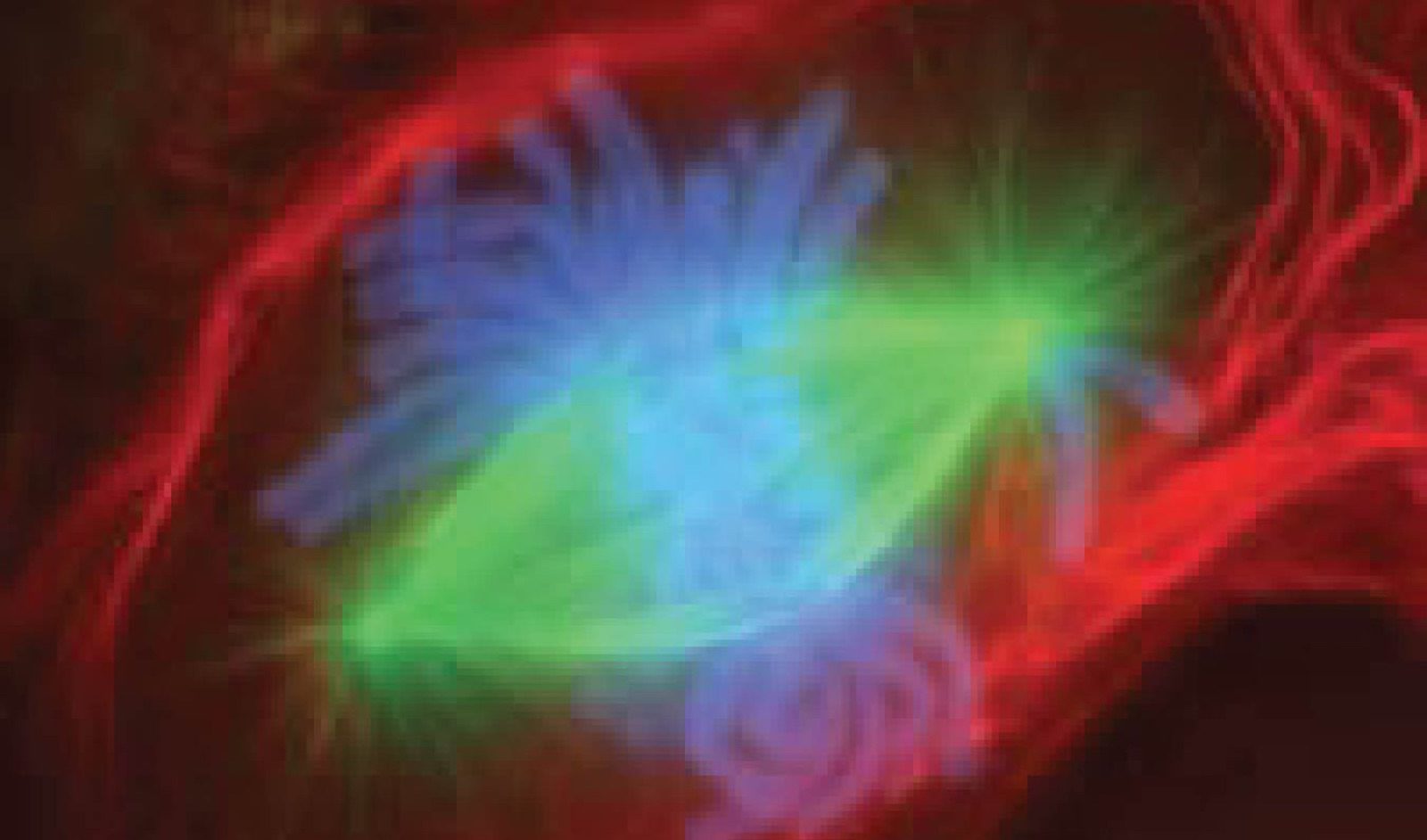 chromosomesspindle
Anaphase in two lines
- Centromeres split and the chromatids separate.
- The chromatids move to opposite poles.
Textbook check · §10.2.3An enzyme cuts the glue between sister chromatids
- The textbook says
- At the onset of anaphase the centromeres split and the chromatids separate.
- What we know now
- The sister chromatids are held together along their length, and most tightly at the centromere, by ring-shaped proteins called cohesin. Anaphase starts when an enzyme, separase, cuts the cohesin rings all at once. Nothing "splits" in the DNA itself: the glue is cut, and the spindle pulls the sisters apart.Source: Uhlmann et al., Cell 2000; Nasmyth review
- In the exam
- "Centromeres split and chromatids separate" is the answer the exam expects.
Telophase: two new nuclei
Telophase is the last stage of karyokinesis. The chromosomes that reached each pole decondense (loosen up again) and can no longer be seen one by one. Each set gathers at its pole as a mass of chromatin.
Telophase in three lines
- Chromosomes cluster at the poles and lose their identity as separate threads.
- A nuclear envelope forms around each cluster: two daughter nuclei.
- The nucleolus, Golgi complex and ER form again.
Textbook check · §10.2.4Chromosomes keep their own territories
- The textbook says
- In telophase the chromosomes decondense and lose their individuality.
- What we know now
- They become invisible under the light microscope, but they keep their identity. In the interphase nucleus each chromosome stays a separate thread and occupies its own region, a chromosome territory, a few micrometres across. They were never dissolved into one shapeless mass.Source: Cremer & Cremer, Cold Spring Harbor Perspectives in Biology 2010
- In the exam
- Write that chromosomes "lose their identity as discrete elements" in telophase, as in the textbook.
Cytokinesis: splitting the cell
Karyokinesis gives two nuclei. Cytokinesis, the division of the cytoplasm, gives two cells and finishes the division.
- In an animal cell, a furrow (a groove) appears in the plasma membrane. It deepens until it meets in the centre, pinching the cell in two.
- A plant cell has a cell wall that hardly stretches, so it cannot pinch. Instead a new wall starts in the centre and grows outwards until it meets the side walls. It begins as a simple early layer, the cell plate, which becomes the middle lamella between the walls of the two new cells.
Try all three: pinch an animal cell, build a plate across a plant cell, or skip the split altogether.
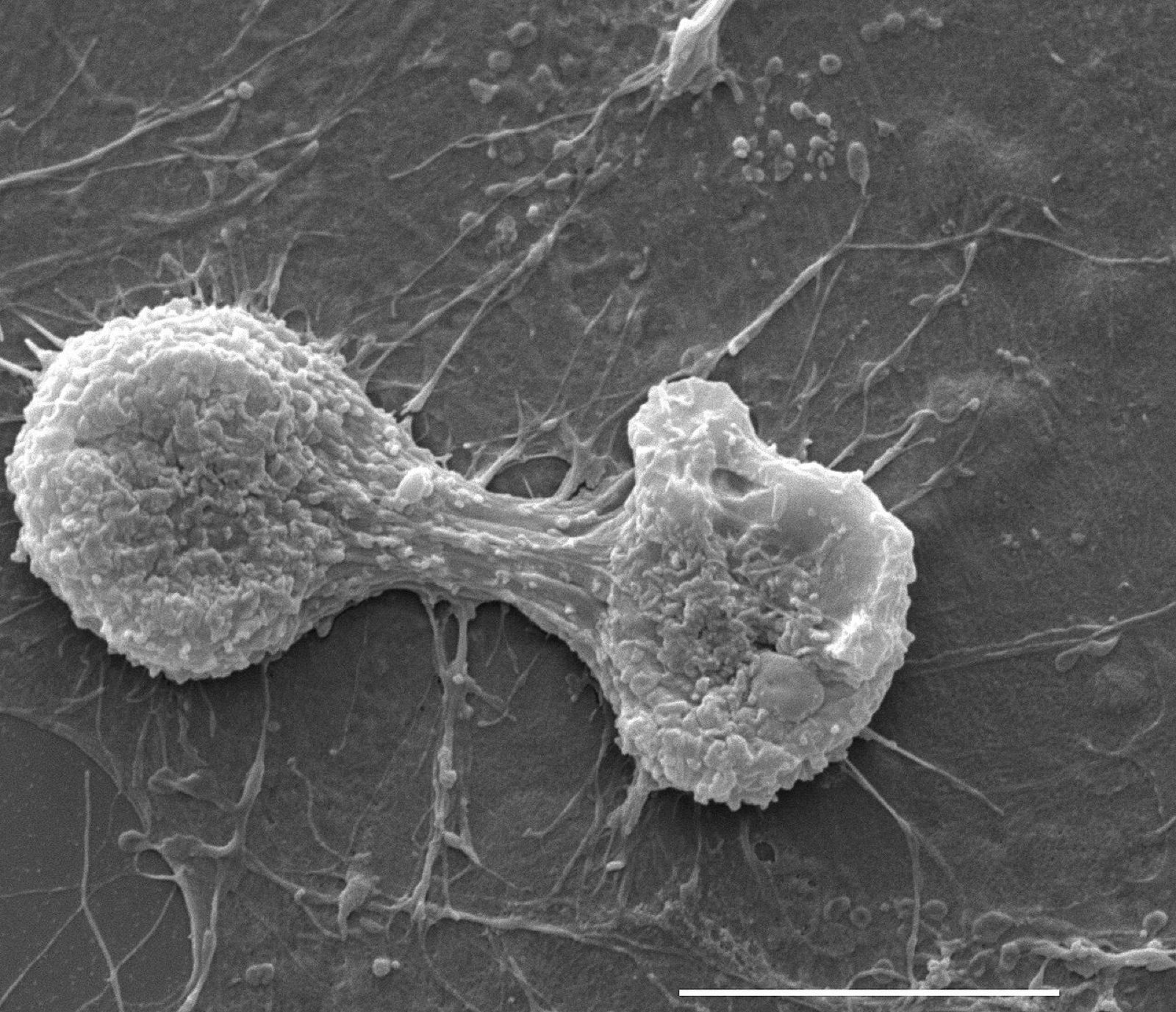 daughter celldaughter cellcleavage furrow
As the cytoplasm divides, organelles such as mitochondria and plastids are shared between the two daughters.
Sometimes karyokinesis is not followed by cytokinesis. The nucleus divides again and again inside one cell, giving a multinucleate (many-nuclei) mass called a syncytium. The liquid endosperm of coconut, the coconut water in a tender coconut, is one: thousands of free nuclei in one shared cytoplasm.
- Daughter chromosomes
- Sister chromatids once they have separated in anaphase.
- Decondense
- Chromosomes loosening back into chromatin.
- Furrow
- The groove that pinches an animal cell in two.
- Cell plate
- The first layer of the new wall in a dividing plant cell; becomes the middle lamella.
- Syncytium
- One cell with many nuclei, formed when cytokinesis does not follow karyokinesis.
Words to know
Why can't a plant cell divide by a furrow, like an animal cell?
- It has no plasma membrane
- Its cell wall cannot stretch to be pinched in
- Plant cells never split their cytoplasm
Coconut water is full of free nuclei in one cytoplasm. What step was skipped?
- Karyokinesis
- Cytokinesis
- DNA replication
During anaphase, which part of a moving chromosome points towards the pole?
- The centromere
- The ends of the arms
- It moves sideways, arms first
Picture and video credits
Show 2 picture and video credits
- fluorescent-mitosis-lung-cell.jpg: OpenStax, CC BY 4.0
- fibroblast-cytokinesis-sem.jpg: Reneferretti1, CC BY 4.0

