- 1. How does one cell become a whole body?
- 2. What does a cell do between divisions?
- 3. Do all cells keep dividing?
- 4. Mitosis begins: prophase and metaphase
- 5. Mitosis ends: anaphase, telophase and cytokinesis
- 6. Why do we need mitosis?
- 7. Meiosis: why eggs and sperm get half
- 8. Prophase I: pairing and swapping
- 9. Two divisions, four cells
- Review
9 of 9·NCERT §10.4.1 · §10.4.2 · §10.5·pp. 126–128·5 min
Two divisions, four cells
The big ideaMeiosis I separates the partner chromosomes, meiosis II separates the sister chromatids, and the result is four haploid cells, all different.
In simple words
After swapping bits, the partners line up in pairs across the middle and get pulled apart: one partner to each end. Now each new cell has half as many threads. Then each of those cells splits once more, this time just like an ordinary split, pulling each thread's two copies apart. One cell has become four, each with half the threads and its own mix.
The rest of meiosis I
- Metaphase I: the bivalents line up on the equatorial plate. Microtubules from opposite poles attach to the pair of homologous chromosomes, one homologue to each pole.
- Anaphase I: the two homologues of each pair part and go to opposite poles; each still has its sister chromatids joined at the centromere. This is the reduction: each pole gets half as many chromosomes.
- Telophase I: a nuclear membrane and a nucleolus form again, then the cytoplasm divides. The two cells formed are called a dyad of cells. The chromosomes loosen a little, but never as fully as in an interphase nucleus.
The short pause between the two divisions is interkinesis. It is usually short-lived, and there is no DNA replication in it. Prophase II follows, much simpler than prophase I.
At metaphase I, each bivalent lines up on its own, without any link to the others. So which pole gets the mother's or the father's copy of each chromosome is decided pair by pair, like tossing a coin for each pair.
Don't mix these up
- Anaphase I: homologues separate; sister chromatids stay joined. The chromosome number halves here.
- Anaphase II (and mitotic anaphase): centromeres split; sister chromatids separate. The number does not change.
Compare them yourself: pull the chromosomes apart in each kind of anaphase and count what reaches each pole.
Meiosis II: like a mitosis
Meiosis II begins right after cytokinesis, most often while the chromosomes are still partly coiled. It looks very much like an ordinary mitosis.
- Prophase II: the chromosomes tighten up again, and by the end of the stage the nuclear membrane has gone.
- Metaphase II: the chromosomes line up at the equator. Microtubules from opposite poles attach to the kinetochores of the sister chromatids.
- Anaphase II: the centromere of every chromosome splits at the same time, freeing the sister chromatids. They move to opposite poles as the microtubules attached to their kinetochores shorten.
- Telophase II: a nuclear envelope forms again around each group of chromosomes. Then the cytoplasm divides, giving a tetrad of cells: four haploid daughter cells.
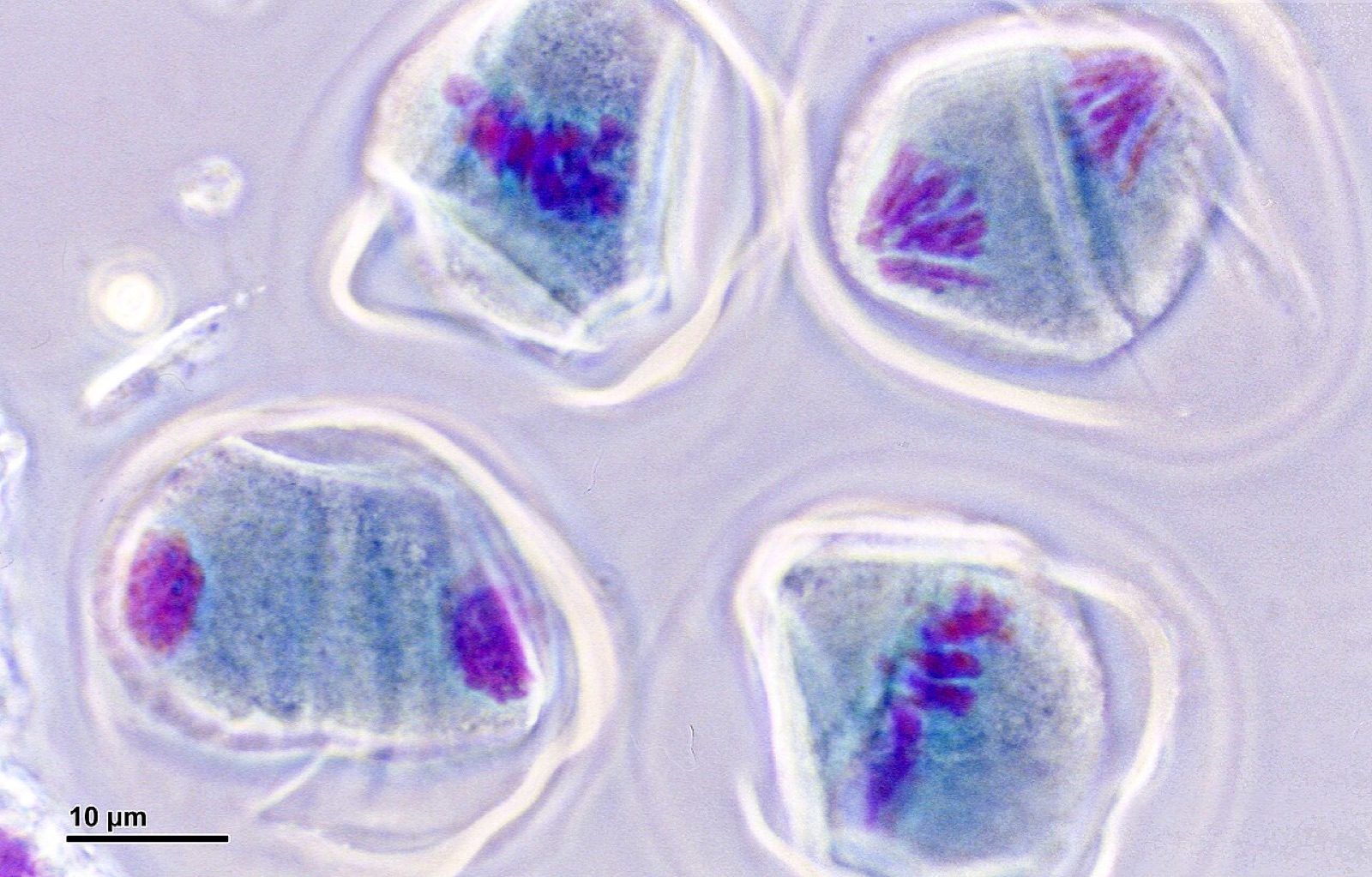 metaphase Ianaphase Itelophase I
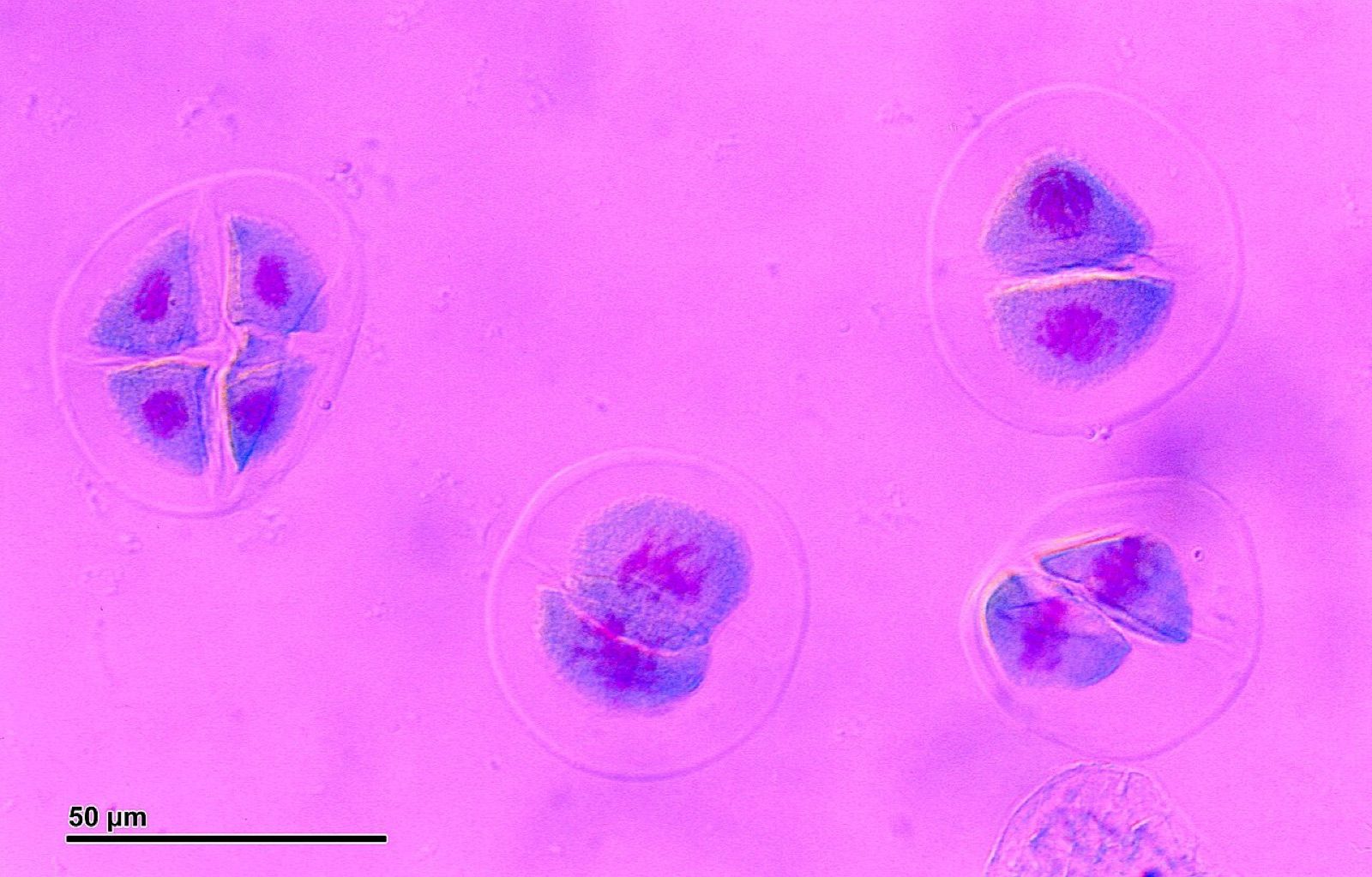 tetrad of four cellsdyad
| Mitosis | Meiosis | |
|---|---|---|
| Divisions | One | Two (meiosis I and II) |
| DNA replication | Once, before division | Once, before meiosis I only |
| Homologues pair? | No | Yes, in prophase I (synapsis) |
| Crossing over | No | Yes, in pachytene |
| What separates at anaphase | Sister chromatids | Homologues (I), then sister chromatids (II) |
| Daughter cells | Two, diploid, identical | Four, haploid, all different |
| Where | Body cells, meristems | Cells that make gametes or spores |
Sort them: which events belong to meiosis I, which to meiosis II, and which to both?
Why meiosis matters
Meiosis is how a species keeps its chromosome number the same from one generation to the next, even though, oddly, the process itself cuts the number in half. Halving in meiosis and doubling in fertilisation cancel out.
It also increases genetic variation in a population, generation after generation, in two ways: crossing over mixes genes between homologues, and the bivalents line up independently at metaphase I. Variation is the raw material of evolution.
Guess first
Which has more chromosomes in each body cell: you, or a potato?
- You, by a long way
- The potato
- The same
- Dyad
- The pair of cells left when meiosis I is done.
- Interkinesis
- The short pause between meiosis I and II, with no DNA copying.
- Tetrad of cells
- The four haploid cells left when meiosis II is done.
- Genetic variation
- Differences between individuals, the raw material of evolution.
Words to know
A cell with 2n = 8 goes through meiosis I. How many chromosomes does each daughter cell have?
- 8
- 4, each still made of two chromatids
- 2
Which stage of meiosis involves the splitting of the centromere?
- Anaphase I
- Anaphase II
- Metaphase II
Interkinesis differs from interphase because
- no DNA is copied in it
- it is much longer
- the chromosomes fully decondense
Picture and video credits
Show 2 picture and video credits
- meiosis-pollen-mother-cells.jpg: Doc. RNDr. Josef Reischig, CSc., CC BY-SA 3.0
- meiosis-tetrads.jpg: Doc. RNDr. Josef Reischig, CSc., CC BY-SA 3.0

