- 1. How does one cell become a whole body?
- 2. What does a cell do between divisions?
- 3. Do all cells keep dividing?
- 4. Mitosis begins: prophase and metaphase
- 5. Mitosis ends: anaphase, telophase and cytokinesis
- 6. Why do we need mitosis?
- 7. Meiosis: why eggs and sperm get half
- 8. Prophase I: pairing and swapping
- 9. Two divisions, four cells
- Review
1 of 9·NCERT §10.1·pp. 120–121·3 min
How does one cell become a whole body?
The big ideaEvery body is built by one cell growing and splitting in two, again and again.
In simple words
You started as one tiny ball. It got a bit bigger, then broke into two balls. Each of those got bigger and broke into two again. Do that enough times and you get a whole person. Before each break, the ball has to copy its book of instructions, so that both new balls get a full copy.
A banyan tree, a blue whale and you all began as a single cell. Getting from one cell to trillions needs just two things, done over and over: the cell grows, then it divides into two daughter cells, the new cells made when a parent cell splits.
Each daughter can grow and divide in its turn, so the number doubles: 2, 4, 8, 16, 32. Only about 45 doublings turn one cell into more than 35 trillion. The cells formed from one parent and all its descendants make a new cell population.
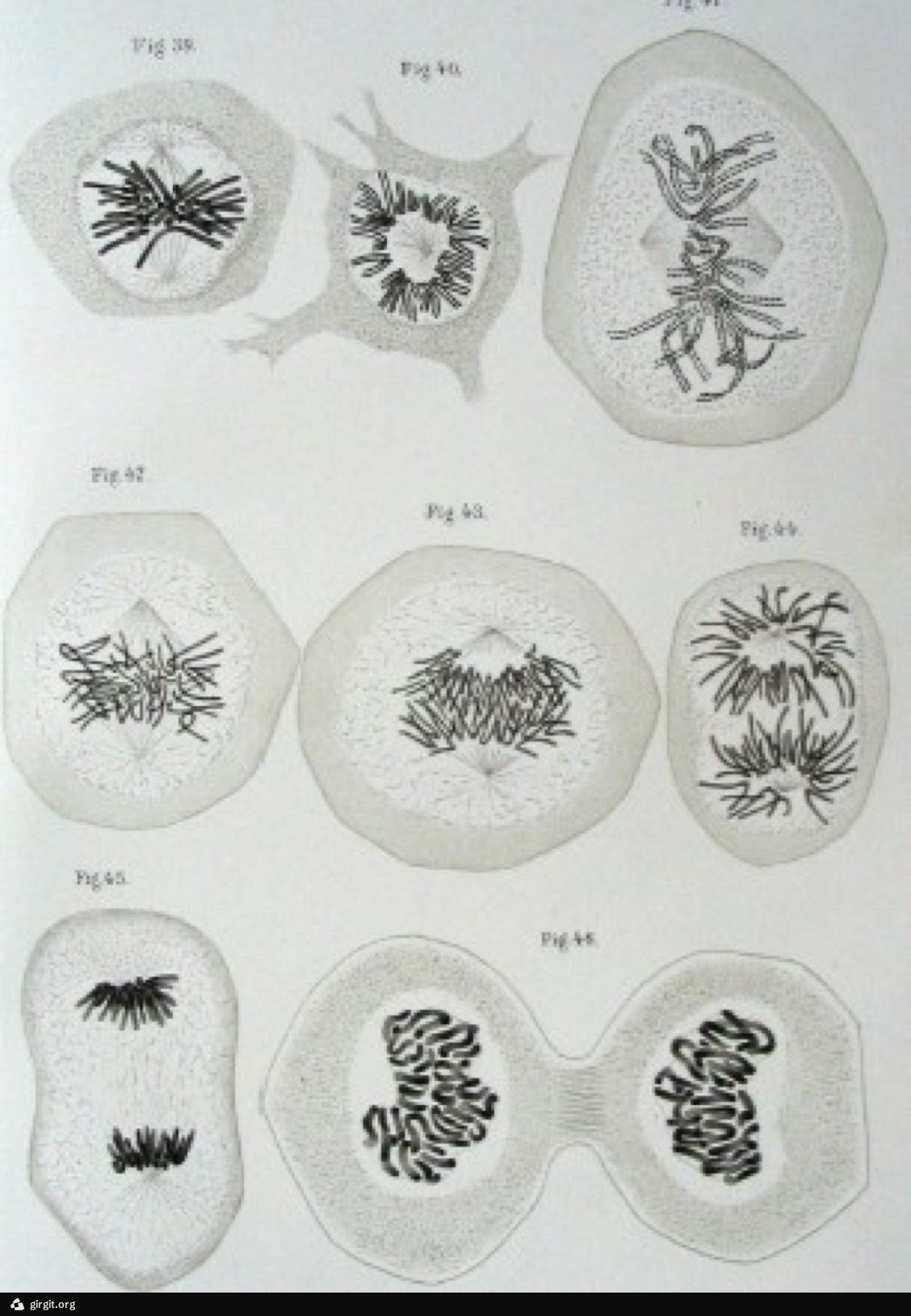
Try it: count the doublings it takes to build you.
The cell cycle
The hard part is not the doubling. It is the copying. Before a cell splits it must copy all its DNA exactly once, and then hand one complete copy to each daughter. If something slips, a daughter ends up with a chromosome too many or too few.
So three things happen when a cell divides: its DNA is copied (DNA replication), the cell grows, and the cell splits (cell division). They must happen in the right order and in step, so that every daughter gets a whole, undamaged set of genes.
The cell cycle is that full round of events: the cell copies its genome (all its DNA), makes the rest of its parts, and finally divides into two daughter cells.
Two parts of the cycle behave very differently:
- Growth, meaning more cytoplasm, goes on all the time, through almost the whole cycle.
- DNA synthesis happens in one stage only.
After copying, the chromosomes are shared out between the two new nuclei by a careful series of steps. All of it is under genetic control: the cell's own genes decide when each step happens.
Remember
- Cell cycle: copy the DNA, make the other parts, divide into two.
- Growth is continuous; DNA copying happens in one stage only.
- The whole cycle is under genetic control.
- Daughter cells
- The two cells formed when one cell divides.
- Genome
- All the DNA of a cell, its full set of instructions.
- DNA replication
- Making an exact copy of the DNA.
- Cell cycle
- The round of copying, growing and dividing, from one division to the next.
Words to know
Which statement about the cell cycle is true?
- The cell grows only in one stage
- The cell grows all the time, but copies its DNA in one stage only
- DNA is copied throughout the cycle
Why must DNA copying and division happen in a fixed order?
- So the cell divides faster
- So each daughter cell gets one whole, undamaged set of genes
- So each daughter gets half the DNA of the parent's starting set
Picture and video credits