ReviewClassification of Elements and Periodicity in Properties25 min
Everything, once more
The table runs back through its history in one scroll: from the reactivity map to a heap of elements, Mendeleev's columns, the long form, the blocks, and the trend landscapes.
From a heap of elements to the trend landscapes: twelve points, 60 cards, then the questions.
ReviewThe chapter in one line
Order by atomic number, and everything repeats.
Electron arrangements repeat, so size, grip on electrons, valence and reactivity rise and fall across periods and down groups.
Full text
The chapter in one lineArrange the elements by atomic number and their electron arrangements repeat, so their size, grip on electrons, valence and reactivity rise and fall in a pattern across periods and down groups.
1 of 6The early tries · atomic weight
Threes, a spiral, then eights.
Each worked in patches only.
- Dobereiner's triads
- 1829
- Li · Na · K
- 7 · 23 · 39
- De Chancourtois's cylinder
- 1862
- Newlands' octaves, up to Ca
- 1865
2 of 6Mendeleev and Lothar Meyer · 1869
Properties repeat with atomic weight. Leave gaps.
Iodine after tellurium, by properties.
- Eka-aluminium = gallium
- 1875
- Eka-boron = scandium
- 1879
- Eka-silicon = germanium
- 1886
- Davy Medal, both
- 1882
3 of 6Moseley · 1913
Properties are periodic in atomic number.
√ν against Z: a straight line.
- Periods · groups
- 7 · 18
- Period lengths
- 2, 8, 8, 18, 18, 32, 32
- Temporary names
- nil, un, bi … + ium
- Elements in a period
- 2 × orbitals filled
4 of 6Blocks and kinds
The last electron names the block.
s and p: the representative elements.
- s · p
- ns¹⁻² · ns²np¹⁻⁶
- d
- (n−1)d¹⁻¹⁰ns⁰⁻²
- Metals
- over 78%
- Metalloids
- Si Ge As Sb Te
5 of 6Trends · landscapes
Across: smaller, tighter, greedier. Down: the reverse.
Dips at B and O; Cl beats F.
- Caesium's radius
- 262 pm
- Helium's ΔᵢH
- 2372 kJ mol⁻¹
- ΔegH: Cl, F
- −349, −328
- Fluorine, Pauling
- 4.0
6 of 6Valence and reactivity
Wild at both ends, calm in the middle.
Basic oxides left, acidic right.
- Diagonal pairs
- Li–Mg, Be–Al
- Period 2 covalency
- at most 4
- Amphoteric
- Al₂O₃
- Neutral
- CO, NO, N₂O
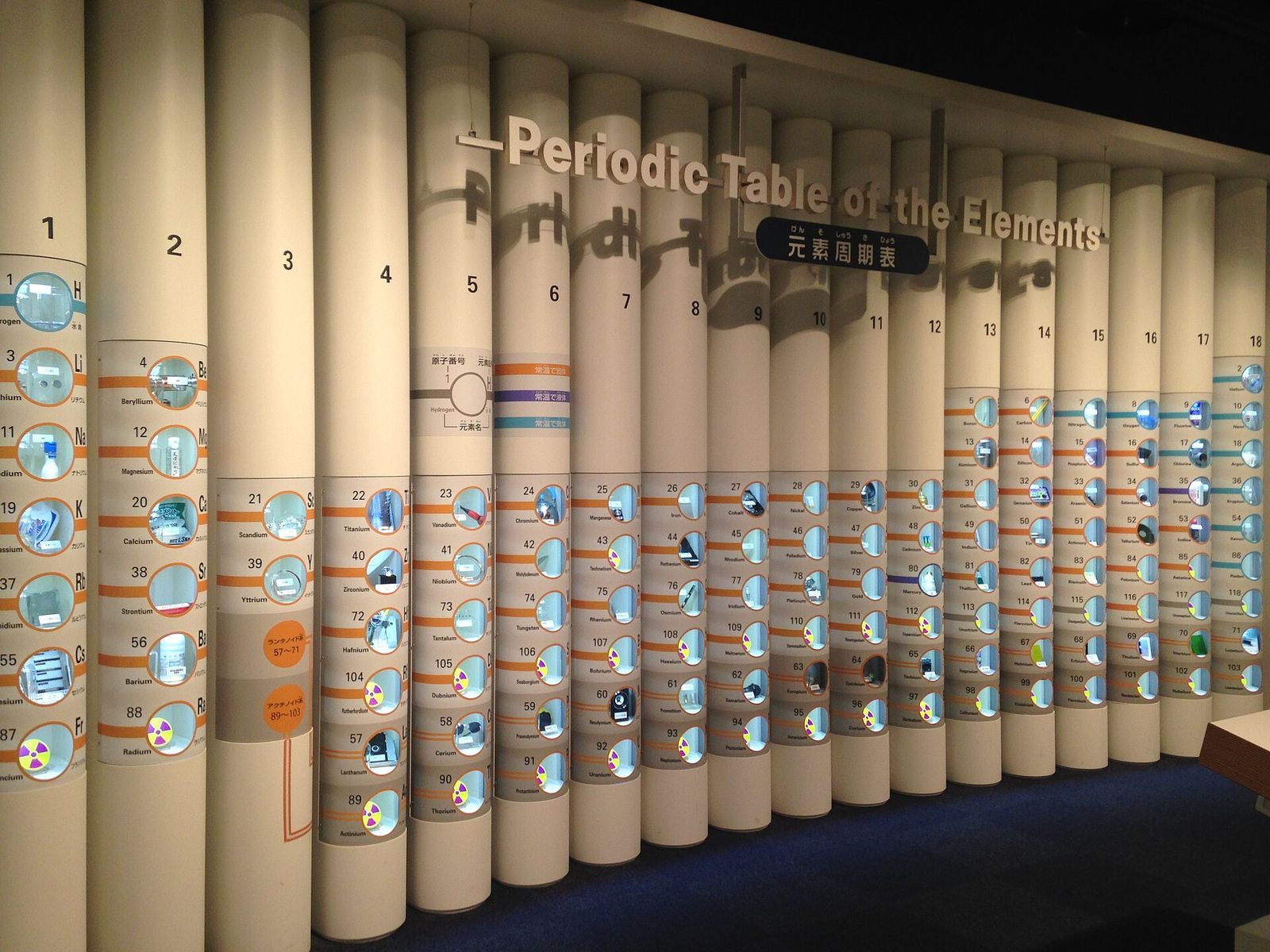
The chapter's 3D periodic table runs back through the chapter as you scroll: the heap of 63 elements known in 1865, Dobereiner's triads, Newlands' octaves, Mendeleev's table with its gaps filled, the long form ordered by atomic number, the four blocks, metals and non-metals, the landscapes of atomic radius, ionisation enthalpy, electron gain enthalpy and electronegativity, valence and reactivity, each with the numbers to remember.
Summary 1–2By atomic weight
Four tries, one winner
- 1829Dobereiner's triadsThe middle weight is the average of the outer two.
- 1862De Chancourtois's cylinderAlike elements one above another.
- 1865Newlands' octavesEvery eighth alike; works only up to calcium.
- 1869Mendeleev (and Lothar Meyer)Periodic law by weight; iodine after tellurium; gaps for eka-aluminium (gallium) and eka-silicon (germanium).
Full text
Summary
Read the summary · 12 points
- Early attempts used atomic weights: Dobereiner's triads (1829), de Chancourtois's cylinder (1862) and Newlands' law of octaves (1865), which worked only up to calcium.
- In 1869 Mendeleev and Lothar Meyer independently found that properties repeat with atomic weight. Mendeleev published the periodic law, put similar elements in the same group even against weight order (iodine after tellurium), and left gaps, correctly predicting eka-aluminium (gallium) and eka-silicon (germanium).
- Moseley (1913) showed that \( \sqrt{\nu} \) of X-rays plotted against atomic number is a straight line. The modern periodic law: properties are periodic functions of atomic number.
- The long form has 7 periods (2, 8, 8, 18, 18, 32, 32 elements) and 18 groups numbered by IUPAC. The period number is the outermost shell n. Lanthanoids and actinoids sit in a separate panel below.
- New elements get a temporary IUPAC name from the digits of Z (nil, un, bi, tri, quad, pent, hex, sept, oct, enn + ium) and a three-letter symbol until an official name is agreed.
- The number of elements in a period is twice the number of orbitals filled in it. Elements in a group share the same outer configuration, such as ns1 for the alkali metals.
- There are four blocks: s (groups 1–2, ns1–2), p (groups 13–18, ns2np1–6), d (groups 3–12, (n−1)d1–10ns0–2) and f (lanthanoids Ce–Lu and actinoids Th–Lr). The s- and p-blocks are the representative elements. Helium goes with the noble gases; hydrogen is placed on its own.
- Metals (over 78% of elements) are on the left, non-metals at the top right, and metalloids such as Si, Ge, As, Sb and Te along the diagonal border. Metallic character increases down a group and decreases across a period.
- Atomic radius decreases across a period and increases down a group. Cations are smaller and anions larger than their atoms; among isoelectronic species, more protons means a smaller size.
- Ionization enthalpy increases across a period and decreases down a group, with dips at B (below Be) and O (below N). Electron gain enthalpy becomes more negative across a period and less negative down a group, with Cl more negative than F. Electronegativity (Pauling, F = 4.0) rises across and falls down.
- Valence of main group elements equals the outer electrons or eight minus them. Period 2 elements are anomalous: small size, high charge/radius ratio, maximum covalency 4, strong pπ–pπ bonding, and diagonal relationships (Li–Mg, Be–Al).
- Reactivity is highest at the two ends of a period and lowest in the centre. Oxides on the left are basic, on the right acidic, and in the centre amphoteric (Al2O3) or neutral (CO, NO, N2O).
Summary 3–5Moseley · the long form · names
Number, not weight
Seven periods (2, 8, 8, 18, 18, 32, 32), 18 IUPAC groups; period number = outermost shell n; lanthanoids and actinoids below. New elements: nil, un, bi, tri, quad, pent, hex, sept, oct, enn + ium, three-letter symbol.
Practice 1Z = 34
Which period and group?
1
An element has Z = 34. In which period and group is it?
- Period 3, group 16
- Period 4, group 16
- Period 4, group 6
- Period 4, group 14
Summary 6–8Periods, groups, blocks, kinds
The shape is the electrons
Elements in a period = 2 × orbitals filled. A group shares its outer configuration (ns¹ for alkali metals).
s
Groups 1–2
- Outer
- ns¹⁻²
p
Groups 13–18
- Outer
- ns²np¹⁻⁶
d
Groups 3–12
- Outer
- (n−1)d¹⁻¹⁰ns⁰⁻²
f
Below the table
- Series
- Ce–Lu, Th–Lr
Helium goes with the noble gases; hydrogen sits on its own. Metals (over 78%) left, non-metals top right, metalloids (Si, Ge, As, Sb, Te) on the diagonal. Metallic character rises down a group, falls across.
Practice 2Ten electrons each
Which order of size?
2
Which is the correct order of size?
- \(\ce{Al^3+} > \ce{Mg^2+} > \ce{Na+}\)
- \(\ce{Na+} > \ce{Mg^2+} > \ce{Al^3+}\)
- \(\ce{Mg^2+} > \ce{Na+} > \ce{Al^3+}\)
Summary 9–10Four trends, two directions
Across, then down
Property
Across →
Down ↓
Atomic radiuscations smaller, anions larger
decreasesincreasesIonization enthalpydips at B and O
increasesdecreasesElectron gain enthalpyCl more negative than F
more negativeless negativeElectronegativityPauling, F = 4.0
risesfallsIsoelectronic species: more protons, smaller size.
Practice 3738, 1451, 7733 …
Where is the big jump?
3
The successive ionization enthalpies of an element are 738, 1451, 7733 and 10540 kJ mol⁻¹. Which group is it most likely in?
- Group 1
- Group 2
- Group 13
Practice 4Electron gain
The most negative?
4
Which element has the most negative electron gain enthalpy?
- F
- Cl
- O
- Ne
Summary 11–12Valence and reactivity
Odd tops, wild ends
Valence · period 2
Outer electrons, or eight minus them
Period 2 is anomalous: small size, high charge/radius ratio, maximum covalency 4, strong pπ–pπ bonds, diagonal pairs Li–Mg, Be–Al.
Reactivity · oxides
Highest at both ends, lowest in the centre
Oxides basic on the left, acidic on the right, amphoteric (Al₂O₃) or neutral (CO, NO, N₂O) in the centre.
Practice 5Lithium and magnesium
What is it called?
5
Lithium resembles magnesium more than sodium in many ways. This is called
- the inert pair effect
- the diagonal relationship
- the lanthanoid contraction
Remember it all60 cards
Say it, then tap
Every name, date, number, trend and exception, with the hooks. Missed cards come back.
Common questionsEight, answered
Still wondering?
What was wrong with Mendeleev's table?
It was ordered by atomic weight, so some pairs came out in the wrong order (tellurium and iodine, argon and potassium) and had to be swapped by hand. It also had no proper place for isotopes, which have different masses but the same chemistry. Ordering by atomic number fixes all of these.
Why are the lanthanoids and actinoids placed below the table?
They belong to periods 6 and 7, but each series has 14 elements with very similar properties. Squeezing them into the main grid would make the table 32 columns wide. Putting them in a separate panel keeps the table compact and keeps similar elements together.
Where does hydrogen really belong?
Nowhere perfectly. Like the alkali metals it has one s electron and forms H+; like the halogens it is one electron short of a noble gas arrangement and can form H−. So it is usually shown on its own at the top of the table.
Why is the first ionization enthalpy of oxygen lower than nitrogen's?
Nitrogen's three 2p electrons sit in separate orbitals. In oxygen, the fourth 2p electron has to share an orbital with another, and the repulsion between the pair makes it easier to remove. The order across period 2 is Li < B < Be < C < O < N < F < Ne.
Fluorine is the most electronegative element, so why does chlorine have the more negative electron gain enthalpy?
Fluorine is so small that an electron added to its n = 2 shell is strongly repelled by the electrons already there, so less energy is released (−328 against −349 kJ mol−1 for chlorine). Electronegativity is a different property: it is about pulling shared electrons in a bond, where fluorine's small size helps.
What is the difference between electron gain enthalpy and electron affinity?
They describe the same process with opposite signs. Electron gain enthalpy is negative when energy is released; electron affinity is taken as positive in that case. Electron affinity is defined at absolute zero, so the two also differ by a small temperature term.
How do I tell whether an element is main group just from its configuration?
Look at where the last electron went. If it is in an s orbital of the outer shell (ns1 or ns2 after a noble gas core) or a p orbital (np), it is main group. If the last electron entered an inner (n−1)d or (n−2)f orbital, it is a transition or inner transition element. [Ar]3d104s1 is copper, a d-block element.
What makes an oxide amphoteric?
Its element sits between the strongly metallic and strongly non-metallic ends, so the oxide can act as a base towards acids and as an acid towards bases. Al2O3 dissolves in both HCl and NaOH.
NEETEvery past question, one card at a time
The real thing
Chapter puzzle578, 1817, 2745, 11,577
One element, the whole chapter
Chapter puzzle
An element X in period 3 has successive ionisation enthalpies of 578, 1817, 2745 and 11,577 kJ mol−1.
- Which group is X in? Name it, give its block and write its electronic configuration.
- Its first ionisation enthalpy is lower than magnesium's (738 kJ mol−1), even though X has one more proton. Why?
- Is an atom of X bigger or smaller than a magnesium atom? Is its ion X3+ bigger or smaller than Mg2+?
- Write the formula of its oxide. Is it acidic, basic or amphoteric? Show it with two equations.
- Which period 2 element does X resemble diagonally, and what do their oxides or hydroxides have in common?
- In 1869 Mendeleev left a gap directly below X. What did he call the missing element, what formula would you predict for its oxide, and what density did he predict?
Hint
Answer
1. The jump from 2745 to 11,577 kJ mol−1 (about four times) comes after the third electron, so X has three valence electrons: group 13. In period 3 that is aluminium, Z = 13, configuration [Ne]3s23p1. Its last electron is in a p orbital, so it is a p-block element.
2. Aluminium's first electron leaves from 3p; magnesium's leaves from 3s. A 3p electron penetrates less towards the nucleus and is partly shielded by the 3s pair under it, so it is held less tightly even with one more proton. It is the same reason boron is below beryllium.
3. Smaller: across period 3 the nuclear charge rises while the outer shell stays n = 3, so Al (143 pm) is smaller than Mg (160 pm). Al3+ (50 pm) is also smaller than Mg2+ (65 pm): both have the same 10 electrons, and 13 protons pull them in harder than 12.
4. Valence 3 against oxygen's 2 gives \( \ce{Al2O3} \). It sits at the turn of the row, between the basic oxides of Na and Mg and the acidic ones of Si to Cl, so it is amphoteric: \( \ce{Al2O3 + 6HCl -> 2AlCl3 + 3H2O} \) (as a base) and \( \ce{Al2O3 + 2NaOH + 3H2O -> 2Na[Al(OH)4]} \) (as an acid).
5. Beryllium: one row up and one group to the left (the Be–Al diagonal). Be2+ and Al3+ pack their charge into similarly small spaces, and both form amphoteric oxides and hydroxides, dissolving in acids and in alkalis.
6. Eka-aluminium, one place below aluminium. Same group, same valence, so its oxide should be \( \ce{Ea2O3} \), and gallium's oxide is indeed \( \ce{Ga2O3} \). Mendeleev predicted a density of about 5.9 g cm−3. When Lecoq de Boisbaudran found gallium in 1875 he first measured 4.7; after purifying his sample he got 5.9.