Act 11NCERT §3.7.2 · pp. 92–945 min
Valence, and the odd ones at the top
The landscape becomes valence: the s and p groups rise 1, 2, 3, 4 and fall back 3, 2, 1, 0 across the table, and the second period, lithium to fluorine, glows as the row that behaves differently.
Across the s and p groups: 1, 2, 3, 4, then back down 3, 2, 1, 0.
From the textbookpp. 92–94
NCERT Chemistry Part I, Class 11 · Reprint 2026-27
11.0The big idea · Valence, the combining capacity
Count the outer electrons
The most characteristic property of an element. For representative elements it is usually (not always) the number of outer electrons, or eight minus that number.
52,
61,
70,
8
Full text
The big ideaThe valence of a main group element follows from its outer electrons, either equal to their number or eight minus it, and the first element of each group is an odd one out because it is so small.
In simple words
Each building block has a number of hands it can hold with others. You can read that number from where it sits on the chart. And the first member of every family, the one at the very top, is the tiny youngest child: it does things a little differently from its bigger brothers and sisters, and often behaves more like the cousin sitting one step down and to the right.
| Group | Hydrides | Oxides |
|---|---|---|
| 1 | LiH, NaH, KH | \(\ce{Li2O}\), \(\ce{Na2O}\), \(\ce{K2O}\) |
| 2 | \(\ce{CaH2}\) | MgO, CaO, SrO, BaO |
| 13 | \(\ce{B2H6}\), \(\ce{AlH3}\) | \(\ce{B2O3}\), \(\ce{Al2O3}\), \(\ce{Ga2O3}\), \(\ce{In2O3}\) |
| 14 | \(\ce{CH4}\), \(\ce{SiH4}\), \(\ce{GeH4}\), \(\ce{SnH4}\) | \(\ce{CO2}\), \(\ce{SiO2}\), \(\ce{GeO2}\), \(\ce{SnO2}\), \(\ce{PbO2}\) |
| 15 | \(\ce{NH3}\), \(\ce{PH3}\), \(\ce{AsH3}\), \(\ce{SbH3}\) | \(\ce{N2O3}\), \(\ce{N2O5}\); \(\ce{P4O6}\), \(\ce{P4O10}\); \(\ce{As2O3}\), \(\ce{As2O5}\); \(\ce{Sb2O3}\), \(\ce{Sb2O5}\); \(\ce{Bi2O3}\) |
| 16 | \(\ce{H2O}\), \(\ce{H2S}\), \(\ce{H2Se}\), \(\ce{H2Te}\) | \(\ce{SO3}\), \(\ce{SeO3}\), \(\ce{TeO3}\) |
| 17 | HF, HCl, HBr, HI | \(\ce{Cl2O7}\) |
11.1Hydrides and oxides
Same group, same formula
Down group 15 every hydride is XH₃ (valence 3) and the highest oxides are X₂O₅ (valence 5). Exactly what Mendeleev noticed.
Try itSodium to chlorine
Up the hill, down again
Drag across period 3. Many elements, especially transition elements and actinoids, show variable valence.
Full text
Periodicity of valence
Valence is the combining capacity of an element, and it is its most characteristic property. For representative elements it is usually (not always) equal to the number of outer electrons, or eight minus that number.
| Group | 1 | 2 | 13 | 14 | 15 | 16 | 17 | 18 |
|---|---|---|---|---|---|---|---|---|
| Valence electrons | 1 | 2 | 3 | 4 | 5 | 6 | 7 | 8 |
| Valence | 1 | 2 | 3 | 4 | 3, 5 | 2, 6 | 1, 7 | 0, 8 |
You can see the pattern in the formulas of hydrides and oxides:
| Group | Hydrides | Oxides |
|---|---|---|
| 1 | LiH, NaH, KH | \(\ce{Li2O}\), \(\ce{Na2O}\), \(\ce{K2O}\) |
| 2 | \(\ce{CaH2}\) | MgO, CaO, SrO, BaO |
| 13 | \(\ce{B2H6}\), \(\ce{AlH3}\) | \(\ce{B2O3}\), \(\ce{Al2O3}\), \(\ce{Ga2O3}\), \(\ce{In2O3}\) |
| 14 | \(\ce{CH4}\), \(\ce{SiH4}\), \(\ce{GeH4}\), \(\ce{SnH4}\) | \(\ce{CO2}\), \(\ce{SiO2}\), \(\ce{GeO2}\), \(\ce{SnO2}\), \(\ce{PbO2}\) |
| 15 | \(\ce{NH3}\), \(\ce{PH3}\), \(\ce{AsH3}\), \(\ce{SbH3}\) | \(\ce{N2O3}\), \(\ce{N2O5}\); \(\ce{P4O6}\), \(\ce{P4O10}\); \(\ce{As2O3}\), \(\ce{As2O5}\); \(\ce{Sb2O3}\), \(\ce{Sb2O5}\); \(\ce{Bi2O3}\) |
| 16 | \(\ce{H2O}\), \(\ce{H2S}\), \(\ce{H2Se}\), \(\ce{H2Te}\) | \(\ce{SO3}\), \(\ce{SeO3}\), \(\ce{TeO3}\) |
| 17 | HF, HCl, HBr, HI | \(\ce{Cl2O7}\) |
Look down group 15: every hydride is \(\ce{XH3}\) (valence 3), and the highest oxides are \(\ce{X2O5}\) (valence 5). Same group, same formula type, exactly what Mendeleev noticed.
Many elements show variable valence, especially the transition elements and actinoids.
11.2Oxidation state: the charge an atom is given
Oxygen can be +2 or −2
Often used for valence today. Electronegativity decides who gets the electrons: F > O > Na.
In OF₂
Each fluorine (2s²2p⁵) shares one electron with oxygen; fluorine is more electronegative.
In Na₂O
Oxygen takes one electron from each sodium (3s¹).
Same element, opposite signs: the oxidation state depends on the partner.
Full text
Oxidation state
Today the word oxidation state is often used for valence. It is the charge an atom is given in a compound, deciding who gets the electrons by electronegativity. Compare oxygen in two compounds (electronegativity order F > O > Na):
- In \(\ce{OF2}\), each fluorine (2s22p5) shares one electron with oxygen. Fluorine is the more electronegative, so each F is −1, and oxygen is +2.
- In \(\ce{Na2O}\), oxygen is the more electronegative. It takes one electron from each sodium (3s1), so oxygen is −2 and each sodium +1.
Same element, opposite signs: the oxidation state depends on the partner.
Worked example: predicting formulas
Predict the formulas of compounds of (a) germanium and chlorine, (b) calcium and phosphorus.
- (a) Ge is in group 14: valence 4. Cl is a halogen: valence 1. Four Cl per Ge: \(\ce{GeCl4}\).
- (b) Ca is in group 2: valence 2. P is in group 15: valence 8 − 5 = 3. Cross the valences: 3 Ca (total 6) balance 2 P (total 6): \(\ce{Ca3P2}\).
Answer
11.3Cross the valences
Predict a formula
Worked example: predicting formulas
Predict the formulas of compounds of (a) germanium and chlorine, (b) calcium and phosphorus.
- (a) Ge is in group 14: valence 4. Cl is a halogen: valence 1. Four Cl per Ge: \(\ce{GeCl4}\).
- (b) Ca is in group 2: valence 2. P is in group 15: valence 8 − 5 = 3. Cross the valences: 3 Ca (total 6) balance 2 P (total 6): \(\ce{Ca3P2}\).
Guess firstBoron and sulphur
B₂S₃ or BS?
Boron is in group 13, sulphur in group 16.
Answer
Try itLet the hands decide
Pair any two elements
Guess first, then see the formula.
CheckGroups 16 and 13
X and Y make…
Element X is in group 16 and element Y in group 13. The likely formula of their compound is
- \(\ce{Y2X}\)
- \(\ce{Y2X3}\)
- \(\ce{Y3X2}\)
11.4Anomalous second period · the diagonal relationship
One step down, one right
Lithium, beryllium, and boron to fluorine behave differently from the heavier members below them.
Each resembles the second element of the next group: lithium is like magnesium, beryllium like aluminium.
11.5Drawn to scale, in pm
Li⁺ and Mg²⁺: almost one size
Outer ring: metallic radius. Filled disc: the ion. Same size is part of why the diagonal pairs behave alike.
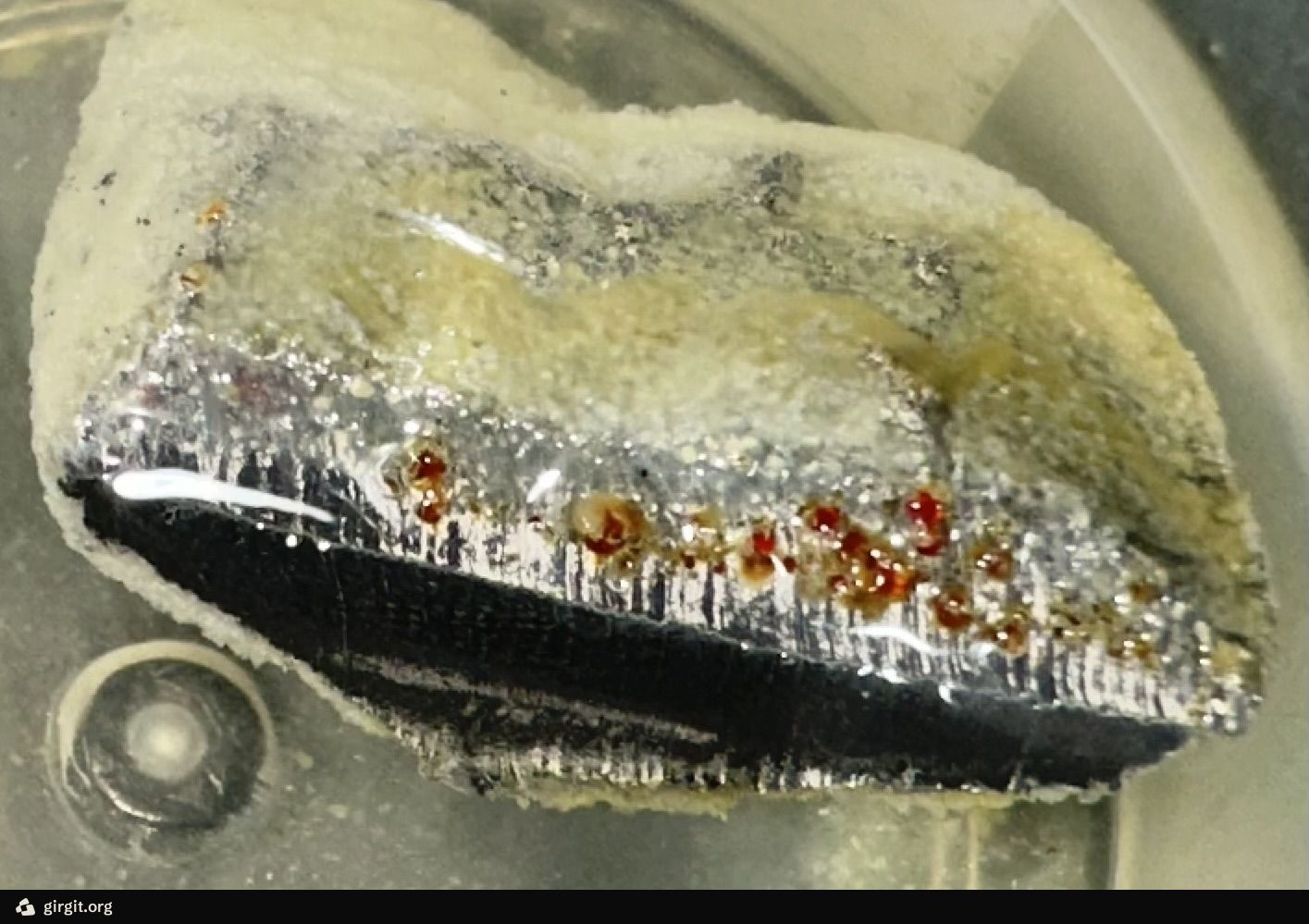 Li₃N crystalslithium metal
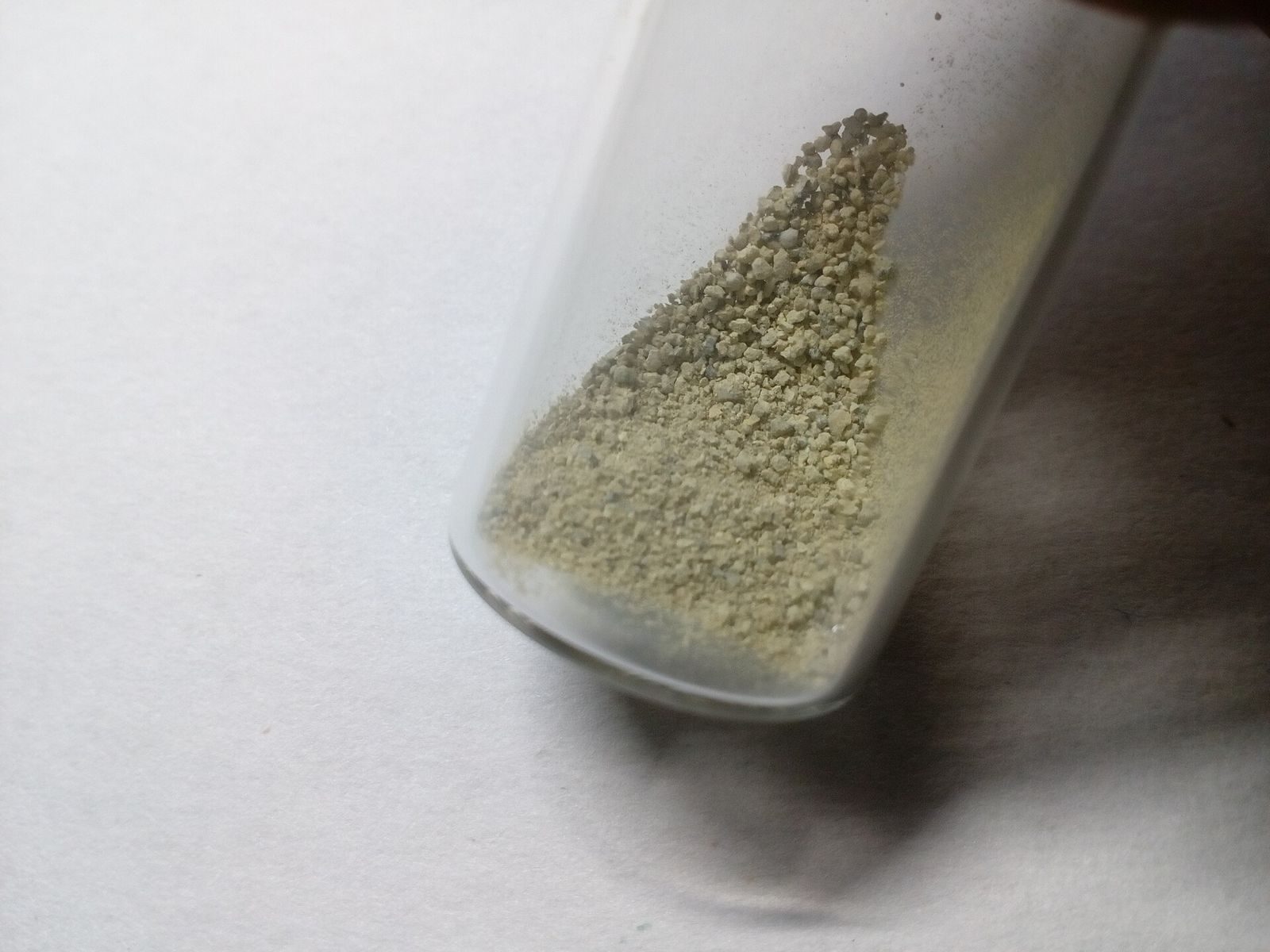 Mg₃N₂
11.6One clear test
Only lithium eats air's nitrogen
Lithium is the only alkali metal that combines with nitrogen from the air. Magnesium does the same when it burns. Sodium and potassium do not.
11.7Why the first member is different
Small, and only four rooms
- Small, high charge/radius ratio, high electronegativity.
- Four valence orbitals (2s, three 2p) against nine (3s, 3p, 3d): maximum covalency 4.
- Easy pπ–pπ multiple bonds: C=C, C≡C, N=N, N≡N; C=O, C=N, C≡N, N=O.
A rickshaw and a bus: four seats, or six.
Full text
Anomalous properties of second period elements
The first element of groups 1 and 2 (lithium, beryllium) and of groups 13 to 17 (boron to fluorine) behaves differently from the heavier members below it. Lithium and beryllium form compounds that are noticeably covalent, whereas sodium, potassium, magnesium, calcium and the rest form mainly ionic ones.
In fact lithium behaves a lot like magnesium, and beryllium like aluminium: each resembles the second element of the next group, one step down and one step right. This is the diagonal relationship.
| Element | Li | Mg | Be | Al |
|---|---|---|---|---|
| Metallic radius / pm | 152 | 160 | 111 | 143 |
| Ionic radius / pm | 76 (Li+) | 72 (Mg2+) | 31 (Be2+) | 53.5 (Al3+) |
Li+ and Mg2+ are almost the same size, which is part of why they behave alike. One clear test: lithium is the only alkali metal that combines with the nitrogen of the air, and magnesium does the same when it burns. Sodium and potassium do not.
Why is the first member different?
- Small size, a large charge/radius ratio (a lot of charge packed into a tiny ion) and high electronegativity.
- Only four valence orbitals (one 2s and three 2p) are available for bonding. The second member has nine (3s, 3p and 3d). So the maximum covalency of the first member is 4: boron forms only \(\ce{[BF4]-}\), while aluminium can expand its valence shell and form \(\ce{[AlF6]^3-}\).
- The first member of each p-block group forms pπ–pπ multiple bonds much more readily, both with itself (C=C, C≡C, N=N, N≡N) and with other period 2 elements (C=O, C=N, C≡N, N=O).
The plainest example sits in one group. Nitrogen is a gas of N≡N molecules; phosphorus, just below it, makes no P≡P at all under ordinary conditions and instead joins four atoms by single bonds into P4:
Textbook check · §3.7.2Do period 3 atoms really use their 3d orbitals?
- The textbook says
- The second member of a group has nine valence orbitals (3s, 3p and 3d), so it can expand its valence shell, as aluminium does in [AlF6]3−.
- What we know now
- The limit of four for period 2 is real: n = 2 has no d orbitals. But careful calculations since 1990 show that 3d orbitals take almost no part in the bonding of molecules such as PCl5, SF6 or [AlF6]3−. What lets period 3 atoms hold five or six neighbours is mainly their bigger size (room around them) and bonds in which one electron pair is spread over three atoms.Source: Hypervalent molecule (Wikipedia), citing E. Magnusson, J. Am. Chem. Soc. 1990
- In the exam
- Write the textbook's reason: period 2 elements have no d orbitals, so their maximum covalency is 4, while period 3 elements can use d orbitals to expand.
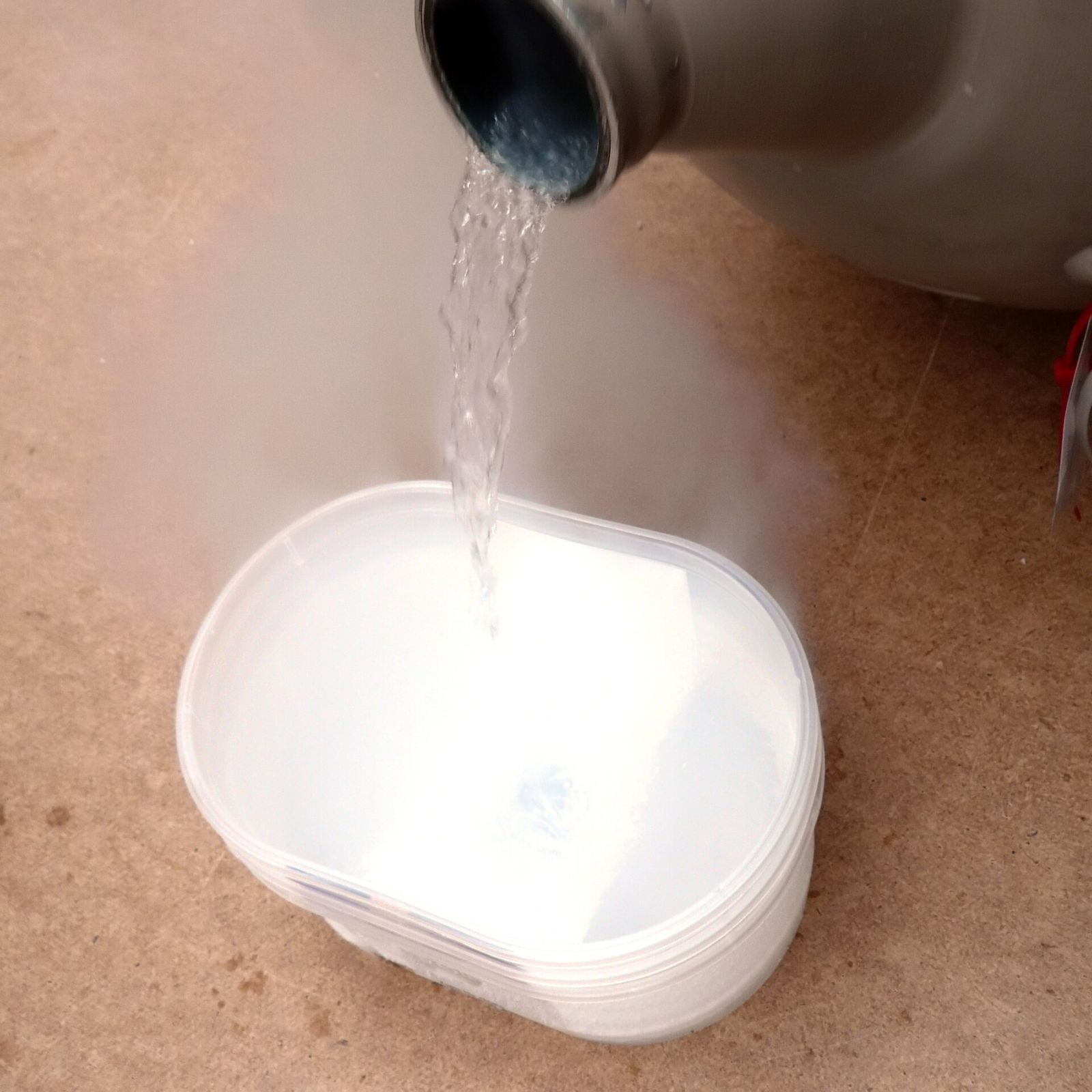 liquid N₂
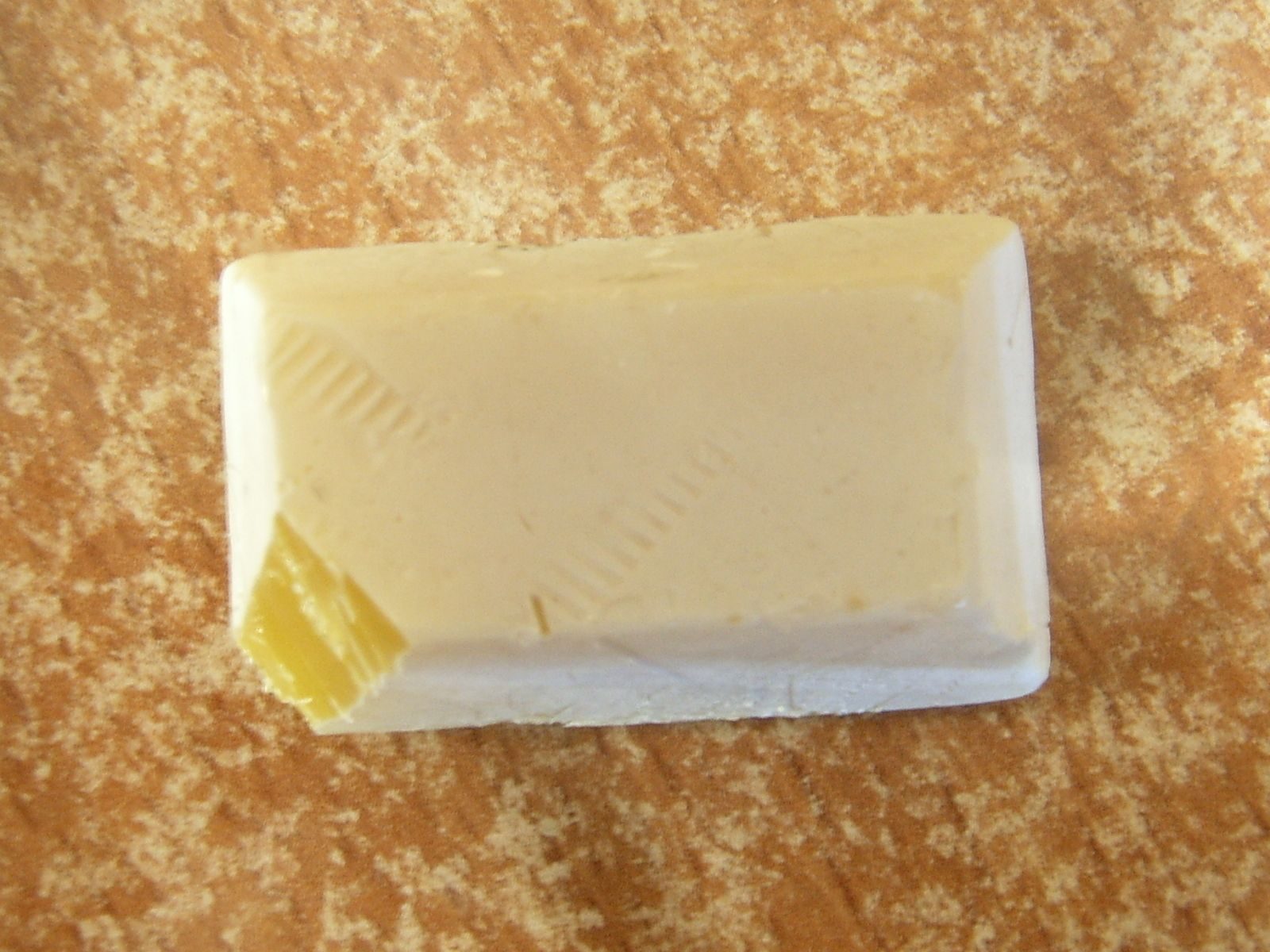 P₄ (white phosphorus)
11.8The plainest example, in one group
N≡N, but P₄
Nitrogen is a gas of N≡N molecules. Phosphorus, just below, makes no P≡P under ordinary conditions: it joins four atoms by single bonds into P₄.
Textbook check§3.7.2
Do period 3 atoms use 3d?
The textbook says
Nine valence orbitals, 3d included, let aluminium expand to [AlF₆]³⁻
What we know now
The limit of four is real; the 3d reason is not
Calculations since 1990 (E. Magnusson, J. Am. Chem. Soc.) show 3d takes almost no part in PCl₅, SF₆ or [AlF₆]³⁻: size and three-atom bonds do it. In the exam, write the textbook's reason.
11.9Covalency: the number of bonds
+3, yet four bonds
So boron is +3, but it forms four B–F bonds: covalency 4. The two need not match.
Worked example
In \(\ce{[BF4]-}\), what are the oxidation state and the covalency of boron?
- Each F is −1; the ion's charge is −1. So B + 4(−1) = −1, giving B = +3.
- Boron forms four B–F bonds: covalency 4.
- They are different: +3 and 4.
Full text
Oxidation state is not covalency
Covalency is the number of bonds an atom forms; oxidation state is the charge it is assigned. They need not match.
Worked example
In \(\ce{[BF4]-}\), what are the oxidation state and the covalency of boron?
- Each F is −1; the ion's charge is −1. So B + 4(−1) = −1, giving B = +3.
- Boron forms four B–F bonds: covalency 4.
- They are different: +3 and 4.
Answer
Don't mix these up
- Diagonal pairs: Li–Mg, Be–Al (and B–Si). Not Li–Be.
- Maximum covalency of period 2 elements is 4, because they have no d orbitals in the valence shell.
- Oxygen is −2 in \(\ce{Na2O}\) but +2 in \(\ce{OF2}\): only fluorine is more electronegative than oxygen.
Guess firstSulphur hexafluoride
Same or different in SF₆?
Answer
CheckFour rooms
Why no [BF₆]³⁻?
Why can aluminium form \(\ce{[AlF6]^3-}\) while boron cannot form \(\ce{[BF6]^3-}\)?
- Boron is less electronegative
- Boron has only four valence orbitals, so its maximum covalency is 4
- Aluminium has more valence electrons
11.10Don't mix these up
A bishop, not a rook
Myth
Li–Be is a diagonal pair
Fact
Li–Mg, Be–Al, B–Si
One step down, one step right.
Don't mix these up
- Diagonal pairs: Li–Mg, Be–Al (and B–Si). Not Li–Be.
- Maximum covalency of period 2 elements is 4, because they have no d orbitals in the valence shell.
- Oxygen is −2 in \(\ce{Na2O}\) but +2 in \(\ce{OF2}\): only fluorine is more electronegative than oxygen.
NEETAsked in the exam
The real thing
KeepJust remember
Lists the exam asks for
Tap a card for its hook.
WordsTo know
Six words
- Valence
- Combining capacity: outer electrons, or eight minus them.
- Oxidation state
- The charge an atom is assigned in a compound, by electronegativity.
- Covalency
- The number of covalent bonds an atom forms.
- Diagonal relationship
- Likeness between a period 2 element and the period 3 element one group to the right.
- Charge/radius ratio
- How much charge sits on how small an ion; high for Li⁺ and Be²⁺.
- pπ–pπ bond
- A multiple bond made by side-on overlap of p orbitals, common for C, N and O.
Rootsl can only go up to n − 1
4orbitals
in n = 2: one 2s, three 2p, and no 2d.
- Nitrogen: at most four pairs; NH₄⁺ is as far as it goes. No NCl₅.
- Phosphorus makes PCl₅: big enough for five chlorines.
- Same rule makes period 2 exactly eight long.
Full text
The roots: the first p orbital is special
- Why does phosphorus make PCl5 while nitrogen can never make NCl5?Because nitrogen's outer shell, n = 2, holds only four orbitals (2s and three 2p), so it can share at most four electron pairs. NH4+ is as far as it goes. Phosphorus is also big enough to fit five chlorine atoms round it; nitrogen is not.
- Why only four orbitals in n = 2?Because l can only go up to n − 1. For n = 2 that allows l = 0 (one s) and l = 1 (three p), and nothing else: there is no 2d. This is the same rule that makes the second period exactly eight elements long.
- Why are period 2 atoms so small, even compared with period 3?Their 2p orbital is the first p orbital of all. Later p orbitals (3p, 4p) must keep out of the way of the p electrons already inside them, so they have extra ripples (radial nodes) and reach further out. 2p has nothing to avoid, so it stays close to the nucleus, about as close as 2s. Chemists call such first-of-their-kind orbitals (1s, 2p, 3d, 4f) kainosymmetric, from the Greek for "new".
- Why do small atoms make strong double and triple bonds?A π bond is made by two p orbitals overlapping side by side, above and below the line between the atoms. Small atoms sit close together (N≡N is 110 pm long), so their p lobes overlap well. In P2 the atoms are 189 pm apart and the side-on overlap is poor, so its triple bond (490 kJ mol−1) is only about half as strong as nitrogen's (946 kJ mol−1).
- Why are lithium and beryllium compounds partly covalent?Li+ and Be2+ are tiny ions with their charge packed into a small space. Such an ion pulls the electron cloud of a neighbouring anion towards itself, back into the gap between them: half-way to sharing. The more packed the charge, the more covalent the bond.
- The bedrockThe rule l ≤ n − 1 from Chapter 2, Coulomb's law (more charge, closer, pulls harder), and the fact that a bond is only as strong as the overlap of the orbitals that make it.
The diagonal relationship comes from the same packed-charge idea. Moving one step right adds charge and shrinks the atom, so charge density goes up; moving one step down adds a shell, so it goes down. One step down and one step right roughly cancel. Be2+ (+2 in 31 pm) and Al3+ (+3 in 50 pm) end up with nearly the same pull on their neighbours, and both form amphoteric hydroxides and covalent chlorides. Be honest about the limits, though: chemists say the reasons for the diagonal relationship are not fully understood. It works best for Be–Al; for Li–Mg the match depends on which table of ionic radii you use. It is a useful pattern, not a law.
RootsKainosymmetric: Greek for "new"
The first p orbital stays close
3p and 4p must avoid the p electrons inside them, so they carry radial nodes and reach further out. 2p has nothing to avoid: it stays about as close as 2s.
Rootsπ bonds need side-on overlap
Close atoms, strong π bonds
N≡N
Nitrogen
- Bond length
- 110 pm
- Triple bond
- 946 kJ mol⁻¹
P≡P
P₂ gas
- Bond length
- 189 pm
- Triple bond
- 490 kJ mol⁻¹, about half
Li⁺ and Be²⁺ are tiny, packed charges: they pull a neighbour's electron cloud into the gap, half-way to sharing. Coulomb's law: more charge, closer, pulls harder.
RootsThe diagonal, explained (mostly)
Down and right cancel
Right: more charge, smaller atom. Down: a new shell. Be²⁺ and Al³⁺ pull alike: amphoteric hydroxides, covalent chlorides. Reasons not fully understood; best for Be–Al, weaker for Li–Mg. A pattern, not a law.
Story1798 to 1884, Paris to Uppsala
The element that looked like aluminium
- 1700sEmerald and berylAnalysed as aluminium silicates. René Just Haüy saw the two had exactly the same crystal shape.
- 1798Louis-Nicolas VauquelinExtra alkali left a different earth behind. Some salts tasted sweet: glucina, glucinium, a name used until 1949. (Toxic: never taste it.)
- 1870sBe₂O₃ and weight 14?Then it fits nowhere. Mendeleev: divalent, about 9.4, above magnesium. Papers on "glucinum" in the Royal Society's journals.
- 1884Lars Nilson and Otto PetterssonTwo Swedish chemists weigh beryllium chloride gas: BeCl₂. Divalent. Mendeleev was right.
Full text
The story
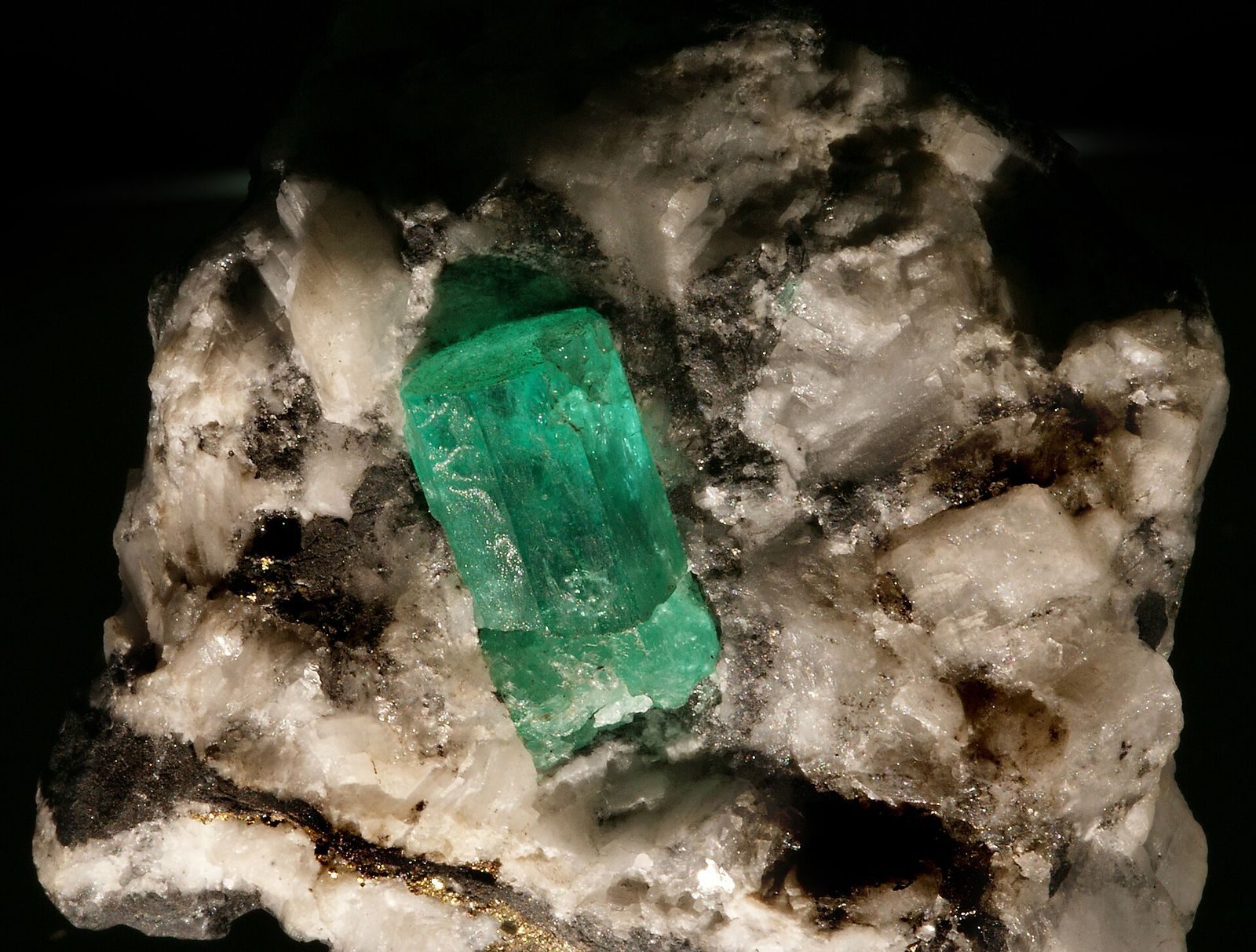 emerald (beryl)
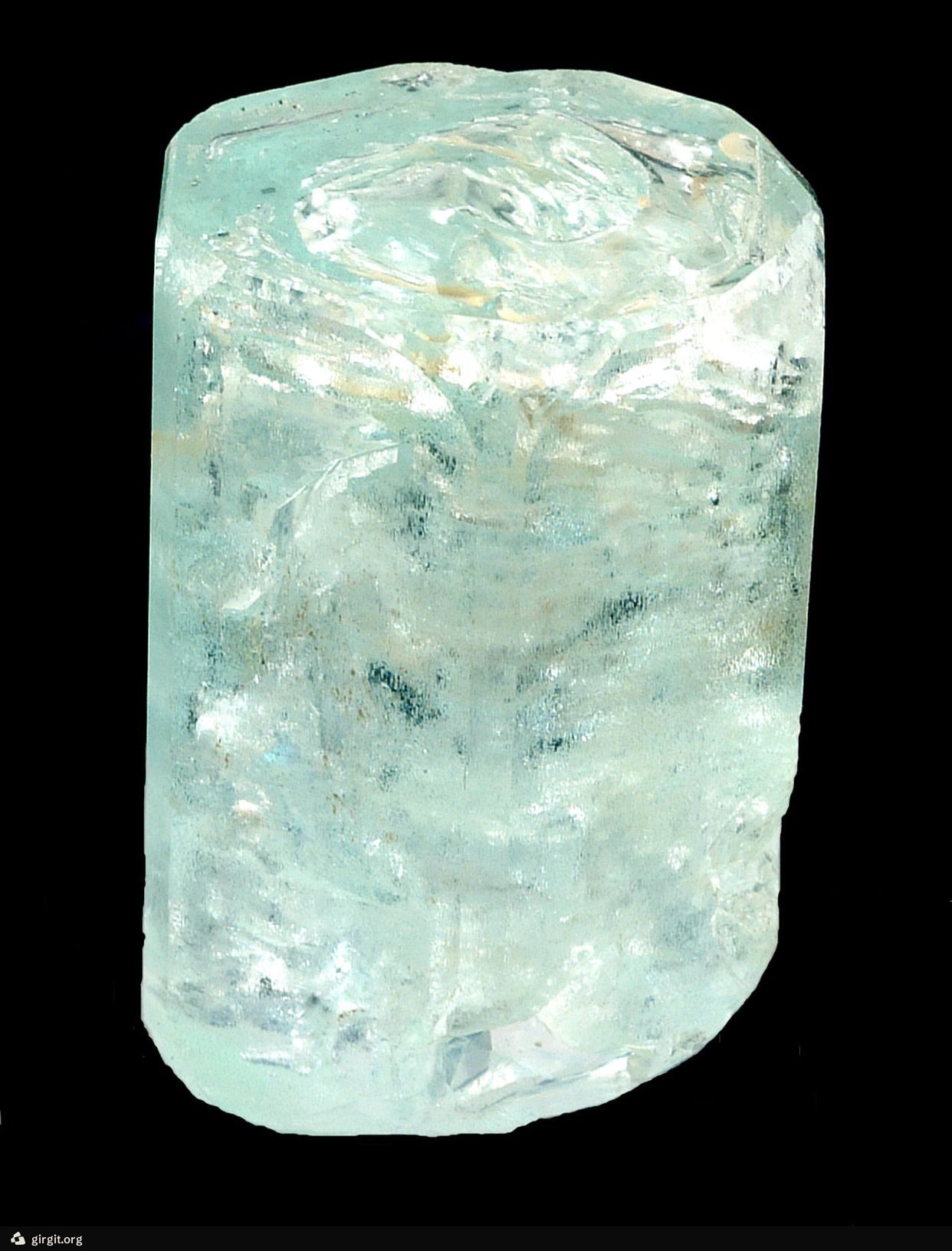 aquamarine (beryl)
StoryOne mineral, two colours
Emerald and aquamarine are beryl
The stones that hid beryllium behind aluminium for decades: fooled by its diagonal neighbour.
See itCharge ÷ radius², Pauling's radii
Follow the three arrows
Pick lithium, beryllium or boron: down, right, diagonal. Then press Every ion on one line.
Solve itFour problems
Your turn
Solve it: why N2 but P4?
Take four nitrogen atoms. They could pair up as two N≡N molecules, or join into a tetrahedron of six N–N single bonds (like P4). Do the same for four phosphorus atoms. Which choice gives out more energy in each case? Use N≡N 946, N–N 159, P–P 213 kJ mol−1 (NCERT's bond table) and P≡P 490 kJ mol−1 (measured in P2 gas).
Hint
Answer
Solve it: predict
Carbon dioxide is a gas of separate O=C=O molecules. Silicon dioxide, just below it, is sand and quartz, which melt above 1,600 °C. Explain the difference from this page's ideas.
Answer
Solve it: which can exist?
Which of these can exist: NCl5, PCl5, NF3, [BF6]3−, [AlF6]3−, [SiF6]2−, [CF6]2−?
Answer
Solve it: think harder
Lithium carbonate gives off CO2 when strongly heated (like magnesium carbonate); sodium carbonate does not. Use packed charge to explain why.
Answer
ConnectAnd still confused?
Where this goes next
Connect it
- Quantum numbers, Chapter 2. l ≤ n − 1 is why there is no 2d and why period 2 has eight elements: quantum numbers. Radial nodes, which make 3p bigger than 2p, are on shapes and energies of orbitals.
- Atomic radius, this chapter. Period 2 atoms are small because of the pull-minus-shield story on how big is an atom?
- Chemical bonding, Chapter 4. The octet limit, σ and π overlap, and N2's bond order of three: the octet rule and its exceptions, valence bond theory and bond order. Packed charge making bonds covalent is Fajans' idea, in polarity.
- Oxidation numbers, Chapter 7. The rules for assigning oxidation states, including oxygen's +2 in OF2: oxidation number rules.
- Daily life. The strength of N≡N is why the 78% of air that is nitrogen is useless to most living things until bacteria or a fertiliser plant break it apart, and why the ammonia plants that feed India's urea factories run hot and at high pressure. Glass beakers in Indian labs are borosilicate glass, boron and silicon oxides melted together: a B–Si diagonal pair sharing one network.
Oxygen is in period 2, yet it makes O=O and also SO2-like compounds?
Oxygen's own compounds stay within four pairs: O2, H2O, O3, H3O+. It is sulphur, the period 3 member below it, that makes SF6 and H2SO4 with six bonds. Oxygen's other oddity is its strong double bond, which is exactly the pπ–pπ point: O=O and C=O are common, S=S is rare.
If Li is "like Mg", should Li be in group 2?
No. Groups are set by the outer electrons, and lithium has one (2s1), like sodium; it forms Li+, never Li2+. The diagonal relationship is a likeness in some behaviour (nitrides, carbonates, covalent character), caused by similar packed charge. Its family is still group 1.
The table above says Li+ is 76 pm, but the widget uses 60 pm. Which is right?
Both. Ionic radii are not measured directly; a crystal gives only the distance between neighbouring ions, which must then be split (see the deep dive on atomic radius). Pauling's set (Li+ 60 pm, the one used for Na+ 95 pm in this chapter) and Shannon's later set (Li+ 76 pm) split the distances differently. Compare ions only within one set.
Sources
- Diagonal relationship (Wikipedia): Li–Mg, Be–Al, B–Si evidence; reasons not fully understood; charge density
- Kainosymmetry (Wikipedia) and M. Kaupp, "The role of radial nodes of atomic orbitals for chemical bonding and the periodic table", J. Comput. Chem. 28, 320 (2007)
- Nitrogen (Wikipedia): N≡N 109.76 pm, 945 kJ mol−1; nitrogen's differences from phosphorus and Diphosphorus (Wikipedia): P≡P 490 kJ mol−1, 189 pm; why phosphorus prefers P4
- NCERT Chemistry Part I, Class 11, Thermodynamics, Table 6.3(a): mean bond enthalpies N–N 159, P–P 213, N≡N 946 kJ mol−1
- Hypervalent molecule (Wikipedia): Magnusson 1990 on d orbitals
- Beryllium (Wikipedia): early analyses of emerald and beryl, Haüy, Vauquelin 1798, glucine, the name until 1949
- G. Lente, "Where Mendeleev was wrong: predicted elements that have never been found", ChemTexts 5, 17 (2019): beryllium's mass 14 and Mendeleev's 9.4
- L.F. Nilson and O. Pettersson, "Ueber die Dampfdichte des Chlorberylliums", Berichte 17 (1884); T.S. Humpidge, "On the atomic weight of glucinum (beryllium)", Phil. Trans. R. Soc. (1883)
- Lithium nitride (Wikipedia): the only stable alkali-metal nitride
- Silicon dioxide (Wikipedia): tetrahedral network
- WebElements: Pauling ionic radii (Li+ 60, Be2+ 31, B3+ 20, Na+ 95, Mg2+ 65, Al3+ 50, Si4+ 41 pm)