Complex Numbers and Quadratic Equations
- 1. Why do we need a new kind of number?
- 2. What is a complex number?
- 3. Adding and subtracting complex numbers
- 4. Multiplying complex numbers
- 5. Dividing one complex number by another
- 6. Why the powers of i go round in a circle
- 7. Square roots of negative numbers
- 8. Do the old algebra identities still work?
- 9. Modulus and conjugate
- 10. Complex numbers as points: the Argand plane
- Review
5 of 10·NCERT §4.3.4·4 min
Dividing one complex number by another
The big ideaDividing by a complex number means multiplying by its inverse; in practice, multiply top and bottom by the bottom number with the sign of its \( i \) part flipped, and the \( i \) disappears from the bottom.
In simple words
A fraction with \( i \) on the bottom is messy, like a sum with a messy number underneath. There is a trick. Find the bottom number's twin, the same number with the sign in the middle turned round. Times the top and the bottom by that twin. The bottom turns into a plain number, and then the sharing out is easy.
The definition
For complex numbers \( z_1 \) and \( z_2 \) with \( z_2 \ne 0 \), the quotient \( \dfrac{z_1}{z_2} \) is defined as
\[ \frac{z_1}{z_2} = z_1 \cdot \frac{1}{z_2} \]That is, divide by \( z_2 \) by multiplying with its multiplicative inverse (from the last concept). This is exactly how division works for real numbers too: \( 6 \div 3 = 6 \times \tfrac{1}{3} \).
Worked example: using the inverse
Find \( \dfrac{7 + i}{1 + 2i} \).
- Inverse of \( 1 + 2i \): \( a^2 + b^2 = 1 + 4 = 5 \), so \( \dfrac{1}{1 + 2i} = \dfrac{1}{5} - \dfrac{2}{5}i = \dfrac{1 - 2i}{5} \).
- Multiply: \( (7 + i) \cdot \dfrac{1 - 2i}{5} = \dfrac{7 - 14i + i - 2i^2}{5} = \dfrac{9 - 13i}{5} \).
- Answer: \( \dfrac{9}{5} - \dfrac{13}{5}i \).
The everyday method
Look at step 1 again: the inverse of \( c + id \) is \( \dfrac{c - id}{c^2 + d^2} \). So dividing is the same as multiplying top and bottom by \( c - id \):
\[ \frac{a + ib}{c + id} = \frac{(a + ib)(c - id)}{(c + id)(c - id)} = \frac{(a + ib)(c - id)}{c^2 + d^2} \]The bottom becomes the real number \( c^2 + d^2 \), because \( (c + id)(c - id) = c^2 - i^2 d^2 = c^2 + d^2 \). The number \( c - id \) is called the conjugate of \( c + id \); concept 9 is about it.
Try it: change the numbers and watch every step redo itself.
Worked example: the everyday method
- \( \dfrac{3 + i}{2 - i} = \dfrac{(3 + i)(2 + i)}{(2 - i)(2 + i)} = \dfrac{6 + 3i + 2i + i^2}{4 + 1} = \dfrac{5 + 5i}{5} = 1 + i \).
Check: \( (2 - i)(1 + i) = 2 + 2i - i - i^2 = 3 + i \). Correct. - \( \dfrac{1}{i} = \dfrac{1 \cdot (-i)}{i \cdot (-i)} = \dfrac{-i}{-i^2} = \dfrac{-i}{1} = -i \). Remember this: \( \tfrac{1}{i} = -i \).
- \( \dfrac{4 - 2i}{i} = (4 - 2i)(-i) = -4i + 2i^2 = -2 - 4i \).
- \( \dfrac{5}{3 - 4i} = \dfrac{5(3 + 4i)}{9 + 16} = \dfrac{15 + 20i}{25} = \dfrac{3}{5} + \dfrac{4}{5}i \).
Don't mix these up
- Multiply both top and bottom by the conjugate of the bottom. Multiplying only the bottom changes the value.
- \( \dfrac{a + ib}{c + id} \) is not \( \dfrac{a}{c} + i\dfrac{b}{d} \). Try \( \tfrac{3 + i}{2 - i} \): that shortcut gives \( 1.5 - i \), but the true answer is \( 1 + i \).
- The bottom after the trick is \( c^2 + d^2 \), with a plus, even when \( d \) is negative.
- Division by \( 0 + 0i \) is not defined.
Remember
- \( \dfrac{z_1}{z_2} = z_1 \cdot \dfrac{1}{z_2} \), for \( z_2 \ne 0 \).
- \( \dfrac{a + ib}{c + id} = \dfrac{(a + ib)(c - id)}{c^2 + d^2} \).
- \( \dfrac{1}{i} = -i \).
Try it. Write in the form \( a + ib \): (a) \( \dfrac{2 + 3i}{1 + i} \) (b) \( \dfrac{10}{1 - 3i} \) (c) \( \dfrac{1 + i}{1 - i} \).
Answer
Just remember
Division has a reason (multiply by the inverse), but three small facts are worth having on the tip of your tongue. Each one rebuilds in a line.
- \( \dfrac{1}{i} = -i \)
- "Flip it over and it flips sign." Rebuild: \( i \times (-i) = -i^2 = 1 \). Picture: \( i \) points straight up; its reciprocal is its mirror image, straight down.
- Multiply top and bottom by the conjugate of the bottom
- "Clear the bottom with the bottom's twin." The top's twin does nothing useful.
- The new bottom is \( c^2 + d^2 \), always with a plus
- "Twins multiply to a sum of squares": \( (c + id)(c - id) = c^2 - i^2 d^2 = c^2 + d^2 \), whatever the sign of \( d \).
- Quotient
- The result of a division, \( \tfrac{z_1}{z_2} \).
- Inverse \( \tfrac{1}{z} \)
- The number that multiplies \( z \) to give 1.
- Conjugate (first look)
- \( c - id \) for \( c + id \): same number, sign of the \( i \) part flipped.
- Standard form
- The answer written as \( a + ib \) with \( a \), \( b \) real.
Words to know
To simplify \( \dfrac{4 + i}{3 - 2i} \), you multiply top and bottom by ...
- \( 4 - i \)
- \( 3 + 2i \)
- \( 3 - 2i \)
What is \( \dfrac{1}{i} \)?
- \( i \)
- \( -i \)
- \( -1 \)
What is \( \dfrac{2i}{1 + i} \)?
- \( 1 + i \)
- \( 2 \)
- \( -1 + i \)
Deep dive · optional
Dividing is turning back, and why it almost never works
What dividing does on the plane, why every non-zero complex number can be divided by, and how a famous mathematician spent ten years failing to do the same in three dimensions. None of this is in the exam; it shows why the complex numbers are special.
The roots: undoing a turn and a stretch
- What does \( \tfrac{z}{w} \) do on the plane?It undoes multiplying by \( w \). Multiplying by \( w \) turns by \( w \)'s angle and stretches by \( |w| \) (see the deep dive on multiplying). So dividing by \( w \) turns back by that angle and shrinks by \( |w| \): lengths divide, angles subtract.
- Then what is \( \tfrac{1}{z} \)?Start at 1 (angle 0, length 1) and undo \( z \): the angle becomes \( -\theta \) and the length \( \tfrac{1}{|z|} \). Angle \( -\theta \) is exactly the mirror image \( \bar{z} \); so \( \tfrac{1}{z} \) is \( \bar{z} \), resized. That is the formula \( \tfrac{1}{z} = \tfrac{\bar{z}}{|z|^2} \): \( \bar{z} \) has length \( |z| \), and dividing by \( |z|^2 \) leaves length \( \tfrac{1}{|z|} \).
- Why can every non-zero \( z \) be divided by?Because \( z\bar{z} = a^2 + b^2 \) is a positive real number whenever \( z \ne 0 \). Every complex number has a partner that turns it into an ordinary positive number, and ordinary numbers we already know how to divide by. This is the whole trick of the "everyday method".
- Is that true of other number systems?Almost never. In a system with three parts, \( a + bi + cj \), no multiplication with these good habits exists at all. Ferdinand Frobenius proved in 1877 that if you want multiplication to keep the associative law and division always to work, the only possible sizes are 1 part (the real numbers), 2 parts (the complex numbers) and 4 parts (quaternions, which give up the commutative law).
- And underneath?The rule \( i^2 = -1 \) makes \( a^2 + b^2 \), a sum of squares, appear when you multiply a number by its twin. A sum of real squares is zero only when every part is zero. That single fact is what lets you divide.
The story: "Well, Papa, can you multiply triplets?"
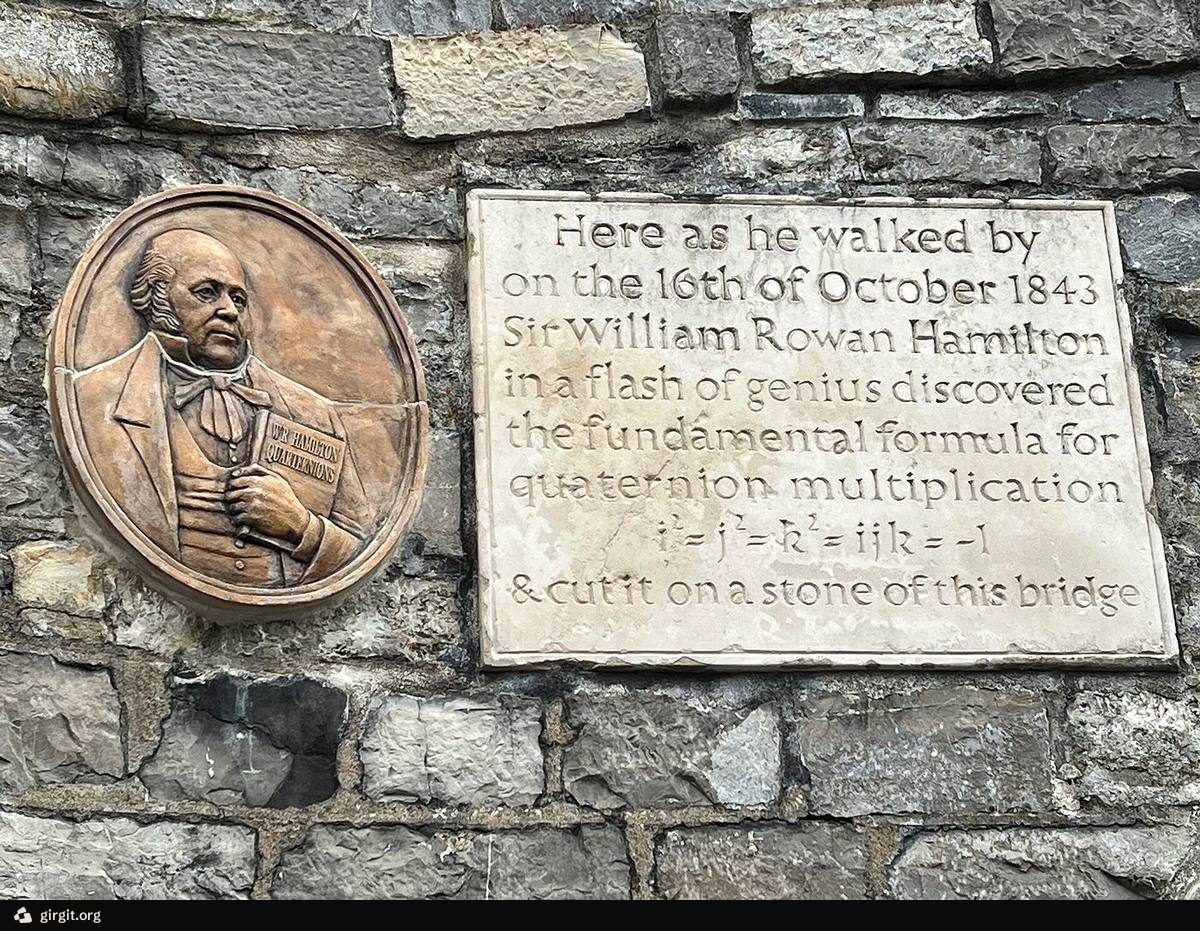 Hamilton, holding "Quaternions"three square roots of −1
Hamilton had not been unlucky. Frobenius's theorem of 1877 shows that triplets with all the good habits cannot exist: Hamilton was looking for something impossible. Our two-part complex numbers sit in a rare sweet spot: you can add, subtract, multiply, divide, swap the order, and it all still works.
See it: one over z
Drag \( z \) around. Its mirror image \( \bar{z} \) appears dashed, and \( \tfrac{1}{z} \) sits on the same ray as \( \bar{z} \) at length \( \tfrac{1}{|z|} \). Move \( z \) inside the dashed unit circle and \( \tfrac{1}{z} \) jumps outside; put \( z \) on the circle and \( \tfrac{1}{z} = \bar{z} \) exactly. Then switch on "A whole line of z's": every point of a vertical line is flipped at once, and the reciprocals land on a circle through 0.
Now \( \tfrac{z}{w} = z \times \tfrac{1}{w} \) is easy to picture: mirror and resize \( w \), then multiply, which turns and stretches. The algebra of the everyday method and this picture always give the same point.
Solve it
Predict, then check
Without dividing, find the length of \( \dfrac{3 + 4i}{1 + 2i} \) and say roughly which way it points. Then divide to check.
Hint
Answer
Proof step
Show that if \( |z| = 1 \) then \( \tfrac{1}{z} = \bar{z} \). Use it to find \( \tfrac{1}{i} \) and \( \dfrac{1}{\tfrac{3}{5} + \tfrac{4}{5}i} \) in one line each.
Answer
\( |z| = 0.5 \). What is \( \left|\tfrac{1}{z}\right| \), and is \( \tfrac{1}{z} \) inside or outside the unit circle?
- 0.5, inside
- 2, outside
- 2, inside
Connect it
Connect it
- Concept 9: conjugate. \( \tfrac{1}{z} = \tfrac{\bar{z}}{|z|^2} \) comes from \( z\bar{z} = |z|^2 \): modulus and conjugate.
- Concept 2: Hamilton's pairs. The first half of Hamilton's story: what is a complex number.
- Matrices, Class 12. Matrices are another system where order matters, as in Hamilton's \( ij = -ji \), and where not every non-zero thing can be divided by: multiplication surprises and invertible matrices.
- Physics: AC circuits. Engineers divide a voltage by a current, both written as complex numbers, to get a circuit's impedance; its length and angle tell how much it resists and how far it shifts the current: the series LCR circuit.
Still confused?
Why can't we divide by \( 0 + 0i \)?
For the same reason as with real numbers: \( \tfrac{z}{0} \) would be a number that gives \( z \) when multiplied by 0, but anything times 0 is 0. On the plane, 0 has no direction to undo and no length to divide by.
Is \( \tfrac{z}{w} \) the same as \( z\bar{w} \)?
Only when \( |w| = 1 \). In general \( \tfrac{z}{w} = \tfrac{z\bar{w}}{|w|^2} \): \( z\bar{w} \) turns the right way but has the wrong length, so you still divide by the real number \( |w|^2 \).
Sources
- William Rowan Hamilton (couples 1833; triplets; "Well, Papa, can you multiply triplets?"; 16 October 1843), MacTutor History of Mathematics, St Andrews.
- William Rowan Hamilton (4 November 1833 paper; Royal Astronomer of Ireland at Dunsink; Broom Bridge, carved with a penknife; the Hamilton Walk since 1989) and History of quaternions (plaque text), Wikipedia.
- Frobenius theorem (1877): the only finite-dimensional associative real division algebras are R, C and the quaternions, Wikipedia.
- Broombridge Hamilton plaque, photo Brendan Ward, CC0, Wikimedia Commons.

Picture and video credits