Complex Numbers and Quadratic Equations
- 1. Why do we need a new kind of number?
- 2. What is a complex number?
- 3. Adding and subtracting complex numbers
- 4. Multiplying complex numbers
- 5. Dividing one complex number by another
- 6. Why the powers of i go round in a circle
- 7. Square roots of negative numbers
- 8. Do the old algebra identities still work?
- 9. Modulus and conjugate
- 10. Complex numbers as points: the Argand plane
- Review
1 of 10·NCERT §4.1 · §4.2·4 min
Why do we need a new kind of number?
The big ideaNo real number squares to give \( -1 \), so we invent a new number \( i \) whose square is \( -1 \), and with it every quadratic equation gets an answer.
In simple words
Pick any number and times it by itself. If it was more than nothing, you get more than nothing. If it was less than nothing, you still get more than nothing, because two minus signs make a plus. So no number on the usual line, timed by itself, can ever give minus one. People were stuck on this for a thousand years. In the end they said: fine, let us make up a new number that does it, give it a name, and see if it behaves. It does.
Where real numbers get stuck
Try to solve \( x^2 + 1 = 0 \). It says \( x^2 = -1 \). But the square of every real number is non-negative (zero or positive): \( 3^2 = 9 \), \( (-3)^2 = 9 \), \( 0^2 = 0 \). So no real \( x \) works. The equation has no real solution.
The same thing happens with many quadratic equations. In Class 10 you met the general quadratic \( ax^2 + bx + c = 0 \) (with \( a \ne 0 \)) and its discriminant, the number
\[ D = b^2 - 4ac \]which sits under the square root in the formula \( x = \dfrac{-b \pm \sqrt{D}}{2a} \). When \( D \lt 0 \), you would need the square root of a negative number, and the real numbers have none. For example, \( x^2 + x + 1 = 0 \) has \( D = 1 - 4 = -3 \): stuck.
Try it: lift the curve with c until it no longer touches the axis, and watch D.
So the real numbers are not enough. This chapter builds a bigger family of numbers, containing all the real numbers, in which every such equation has answers.
The number \( i \)
We give the square root of \( -1 \) a symbol, the letter \( i \) (for "imaginary"):
\[ i = \sqrt{-1}, \qquad \text{so} \qquad i^2 = -1 \]That one rule, \( i^2 = -1 \), is all you need. It means \( i \) is a solution of \( x^2 + 1 = 0 \). Everything else in this chapter comes from treating \( i \) like an ordinary letter in algebra and replacing \( i^2 \) by \( -1 \) whenever it appears.
The name "imaginary" is only history. Today \( i \) is as real a tool as \( -5 \) or \( \sqrt{2} \): engineers use it daily for alternating current, and physicists for waves.
Who thought of it?
- The Greeks already knew that a negative number has no square root among the numbers they used.
- The Indian mathematician Mahavira (about 850 CE) was the first to state the difficulty clearly, in his book Ganitasara Sangraha: a negative quantity is not a square, so it has no square root.
- Bhaskara said the same in his Bijaganita (1150).
- Cardan (Gerolamo Cardano, 1545) tried to find two numbers with sum 10 and product 40. He got \( 5 + \sqrt{-15} \) and \( 5 - \sqrt{-15} \), checked that they work, and then called the result "as subtle as it is useless".
- Albert Girard (about 1625) accepted such roots, seeing that with them a polynomial equation has as many roots as its degree.
- Euler was the first to use the symbol \( i \) for \( \sqrt{-1} \), in a paper of 1777.
- W. R. Hamilton (1833) treated a complex number as an ordered pair of real numbers, which gave it a clean definition with nothing "imaginary" about it. You will see that pair picture in the last concept.
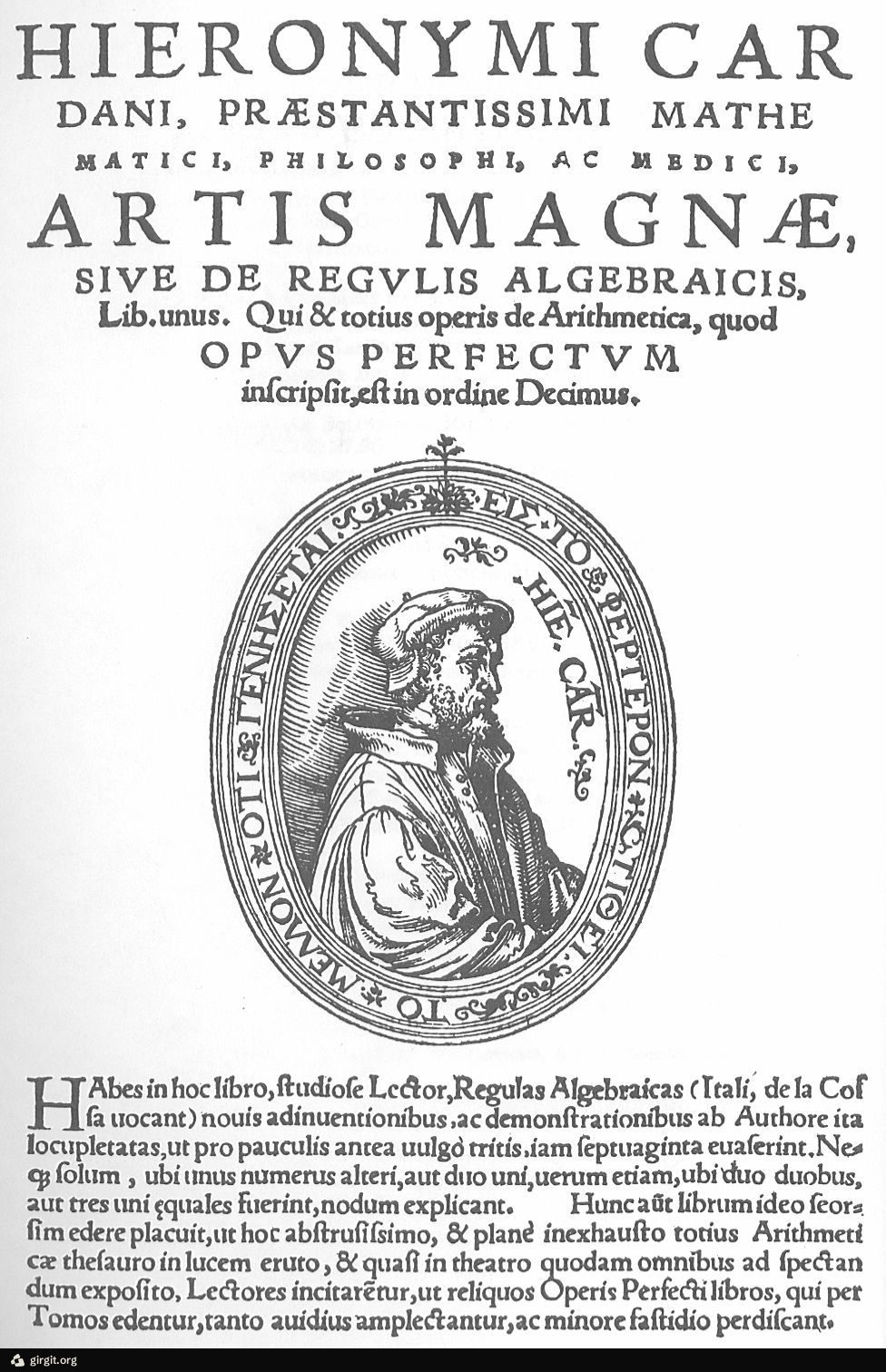 Artis Magnae: of the Great ArtCardano himself'de la Cosa': the art of the thing
Worked example
Check that \( i \) and \( -i \) both solve \( x^2 + 1 = 0 \).
- Put \( x = i \): \( i^2 + 1 = -1 + 1 = 0 \). It works.
- Put \( x = -i \): \( (-i)^2 = (-1)^2 \, i^2 = 1 \times (-1) = -1 \), so \( (-i)^2 + 1 = 0 \). It works too.
- So the equation that had no real solution has two solutions once \( i \) is allowed, just as a quadratic should.
Remember
- The square of a real number is never negative, so \( x^2 = -1 \) has no real solution.
- \( i = \sqrt{-1} \) and \( i^2 = -1 \).
- A quadratic with \( D = b^2 - 4ac \lt 0 \) has no real roots; \( i \) lets us write its roots.
Try it. (a) Find the discriminant of \( 2x^2 - 3x + 4 = 0 \). Does it have real roots? (b) Simplify \( i^2 + 3 \) and \( (2i)^2 \).
Answer
Just remember
Two things here are choices or history, not reasons: the letter, and who did what when. Hooks below; the deep dive at the end tells the stories behind them.
- The letter \( i \), for "imaginary"
- Euler chose it in 1777, the year Gauss was born. Engineers write \( j \) instead, because their \( i \) is already the electric current. Same number, different letter.
- Mahavira (850) and Bhaskara (1150): "a negative number has no square root"
- Two Indian teachers, 300 years apart, saying the same true thing about real numbers. Mahāvīra means "great hero": even the great hero found no root for a minus. Add 300 years and Bhaskara says it again.
- Cardano, 1545: sum 10, product 40, answer \( 5 \pm \sqrt{-15} \)
- The year hides the number: 15-45 and \( \sqrt{-15} \). Rebuild: two numbers with sum 10 and product 40 solve \( t^2 - 10t + 40 = 0 \), so \( t = 5 \pm \sqrt{25 - 40} \).
- Hamilton, 1833: a complex number is an ordered pair \( (a, b) \)
- A ham sandwich always has two slices. The pair picture is the Argand plane of the last concept.
- Real number
- Any number on the ordinary number line, like \( -2 \), \( 0 \), \( \tfrac{3}{4} \), \( \sqrt{5} \), \( \pi \).
- Non-negative
- Zero or positive.
- Discriminant
- \( D = b^2 - 4ac \) for \( ax^2 + bx + c = 0 \); its sign decides whether the roots are real.
- \( i \)
- The number \( \sqrt{-1} \), with \( i^2 = -1 \).
- Imaginary
- An old name for numbers involving \( i \); they are perfectly well defined.
Words to know
Why does \( x^2 + 9 = 0 \) have no real solution?
- Because 9 has no square root
- Because it needs a real number whose square is negative
- Because quadratic equations never have real solutions
What is \( (-i)^2 \)?
- \( 1 \)
- \( -1 \)
- \( -i \)
Cardan's numbers had sum 10 and product 40. Which quadratic do they solve?
- \( t^2 - 10t + 40 = 0 \)
- \( t^2 + 10t + 40 = 0 \)
- \( t^2 - 40t + 10 = 0 \)
Deep dive · optional
Why did anyone believe in \( \sqrt{-1} \)?
Quadratics did not force anyone to accept \( i \): people simply said "no solution" and moved on. A cubic did. This goes into the equation that made square roots of negatives impossible to ignore, and the quarrel around it. The exam does not ask it; it is here so \( i \) never feels like a trick.
The roots: a real answer that needed an unreal road
- Why was "no solution" good enough for quadratics?Because when \( D \lt 0 \) the parabola really does miss the axis. A question like "two numbers with sum 10 and product 40" simply has no real answer, so writing \( \sqrt{-15} \) felt like inventing an answer to an impossible question.
- So what changed?The cubic \( x^3 = 15x + 4 \). It plainly has a real solution: \( 4^3 = 64 \) and \( 15 \times 4 + 4 = 64 \). Yet the cubic formula of the 1500s, applied to it, produces \( \sqrt{-121} \) on the way.
- What is the formula?For \( x^3 = px + q \) it says \( x = u + v \), where \( u^3 \) and \( v^3 \) are \( \tfrac{q}{2} \pm \sqrt{\left(\tfrac{q}{2}\right)^2 - \left(\tfrac{p}{3}\right)^3} \). It comes from the identity \( (u + v)^3 = 3uv(u + v) + u^3 + v^3 \): choose \( 3uv = p \) and \( u^3 + v^3 = q \). For \( p = 15 \), \( q = 4 \) the number under the root is \( 4 - 125 = -121 \).
- Is that just bad luck with this one equation?No. It happens exactly when the cubic has three different real roots: then \( \left(\tfrac{q}{2}\right)^2 \lt \left(\tfrac{p}{3}\right)^3 \) every time. Pierre Wantzel proved in 1843 that in this case no formula built from real roots can avoid it. The case got the name casus irreducibilis, "the case that cannot be reduced".
- So how does a road through \( \sqrt{-121} \) reach the real answer 4?Rafael Bombelli (1572) took the rule \( \sqrt{-1}\cdot\sqrt{-1} = -1 \) seriously and simply calculated. With \( i \) for \( \sqrt{-1} \): \( (2 + i)^3 = 2 + 11i = 2 + \sqrt{-121} \), so one cube root is \( 2 + i \); likewise \( 2 - i \) for the other. Their sum is \( (2 + i) + (2 - i) = 4 \). The imaginary parts cancel and the true root falls out.
- And underneath?Consistency. If a set of rules never contradicts itself and always gives answers that check out in the original equation, it has earned the right to be used. That is the only test any number system has ever had to pass, negative numbers included.
So \( i \) was not accepted because someone wanted answers to \( x^2 + 1 = 0 \). It was accepted because it was the only way through to real answers that everyone could check with ordinary arithmetic. Check Bombelli's step yourself with the identity for \( (a + b)^3 \) from concept 8: \( (2 + i)^3 = 8 + 12i + 6i^2 + i^3 = 8 + 12i - 6 - i = 2 + 11i \).
The story: a secret, an oath and a book
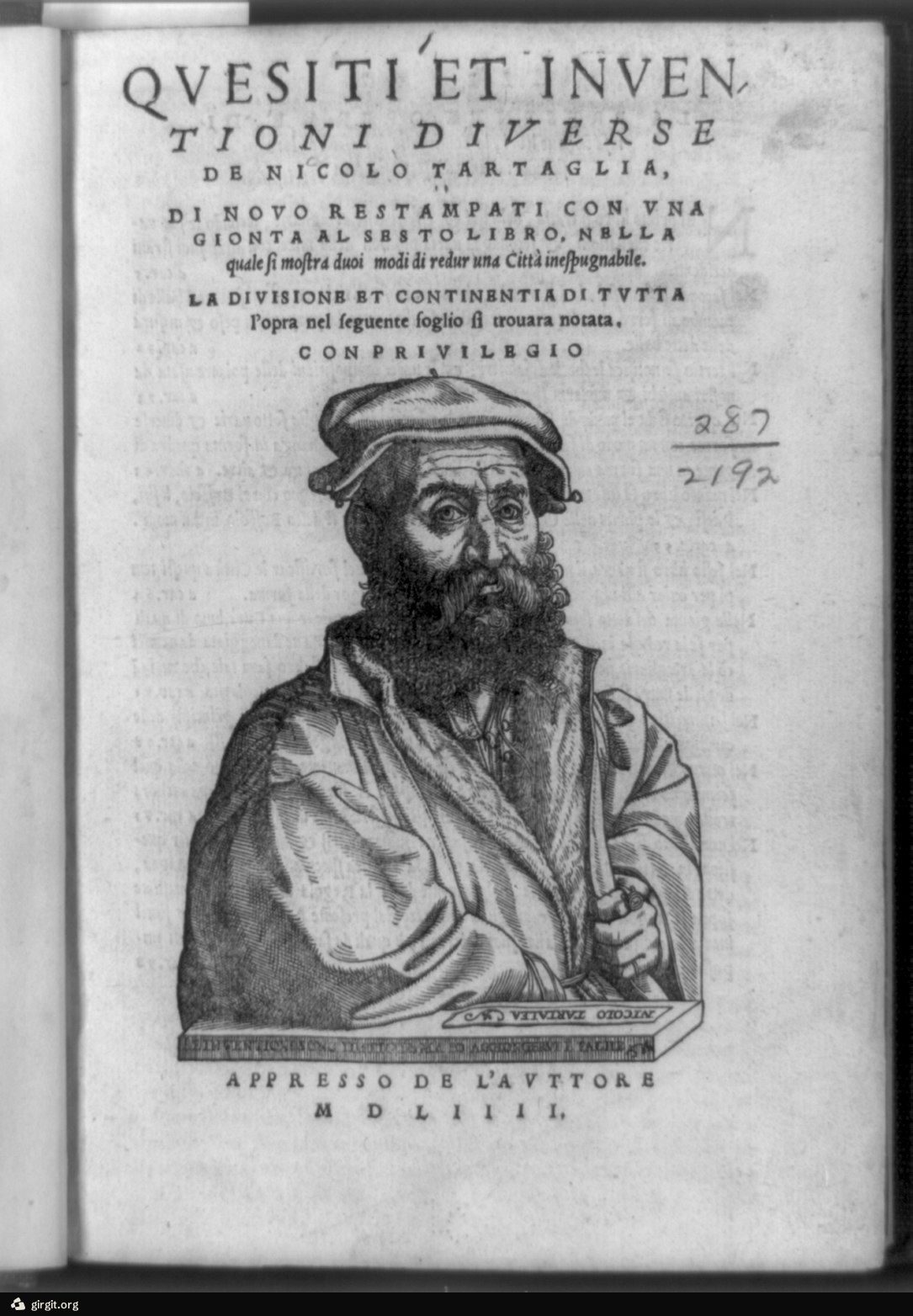 Questions and inventions, by Nicolo Tartagliathe beard hid his sabre scarsMDLIIII = 1554
See it: three real roots, one negative square root
Below, a cubic \( x^3 = px + q \) is drawn as the curve \( y = x^3 \) and the line \( y = px + q \); every crossing is a real root. Drag the line. Watch the number under Cardano's square root in the sentence: it turns red (negative) exactly when the line crosses the curve three times. The lower picture is Bombelli's way through: the three cube roots \( u \) of a complex number, each with its mirror image \( \bar{u} \), and each pair adding up to one of the real roots.
Open "Every p and q": the red wedge is every cubic with three real roots, and it is exactly where the formula needs \( \sqrt{\text{negative}} \). It is not a corner case. Any cubic whose graph wiggles across the axis three times lands in it.
Solve it
Solve it
Bombelli's trick works for other cubics too. Use the formula on \( x^3 = 6x + 4 \), then find all three roots.
Hint
Answer
Predict, then check
Without drawing anything, can \( x^3 = px + q \) with \( p \lt 0 \) ever lead to a negative number under Cardano's root?
Answer
Cardano's two numbers were \( 5 + \sqrt{-15} \) and \( 5 - \sqrt{-15} \). What is their product?
- \( 10 \)
- \( 25 - 15i \)
- \( 40 \)
Connect it
Connect it
- Concept 3: adding. Bombelli's rules for "plus of minus" and "minus of minus" are the first rules ever written for adding and multiplying complex numbers: his story.
- Concept 8: identities. Bombelli's check \( (2 + i)^3 = 2 + 11i \) is the cube identity at work: identities.
- Trigonometry, Ch 3. Viète later solved the same "three real roots" cubics with no \( i \) at all, using \( \cos 3\theta = 4\cos^3\theta - 3\cos\theta \): double and triple angles.
- Concept 7: quadratics. With \( i \) allowed, every quadratic has two roots, and with real coefficients they come in mirror pairs: square roots of negatives.
- Physics: alternating current. Engineers in India's 230 V, 50 Hz grid draw voltages and currents as spinning arrows, which are complex numbers in disguise: phasors.
Still confused?
If all three roots are real, why can't we just avoid \( i \)?
You can find the roots by other means (guessing, graphs, trigonometry), but not with a formula made only of real square and cube roots. Wantzel proved this in 1843. The detour through \( i \) is forced on any formula of that kind, which is why the 1500s could not dodge it.
Did Cardano invent complex numbers?
He was the first to print a calculation with them (1545), but he did not trust it. Bombelli (1572) was the first to give rules for computing with them and to use them to get real answers. The symbol \( i \) came from Euler in 1777, and the picture of them as points, which finally made people comfortable, from Wessel, Argand and Gauss between 1797 and 1831.
Sources
- Quadratic, cubic and quartic equations (del Ferro c. 1515, Fior, the 1535 contest, x³ = 15x + 4 and the letter of 4 August 1539), MacTutor History of Mathematics, St Andrews.
- Niccolò Tartaglia (Brescia 1512, the oath and poem of March 1539, the 1548 contest), MacTutor.
- Girolamo Cardan ("Dismissing mental tortures… so subtle that it is useless"), MacTutor; Ars Magna (1545; chapter 37; credit to del Ferro, Tartaglia and Ferrari), Wikipedia.
- H. K. Strick, Rafael Bombelli (cube root of 2 + √−121 = 2 + √−1), St Andrews; Rafael Bombelli, MacTutor.
- Casus irreducibilis (three real roots force square roots of negatives; Wantzel 1843), Wikipedia.
- 5 May 1777: Euler first uses i for √−1, MacTutor; Gauss (born 30 April 1777), MacTutor.
- Mahāvīra (Gaṇita-sāra-saṅgraha, 850) and William Rowan Hamilton (couples, 1833), Wikipedia.
Picture and video credits