Complex Numbers and Quadratic Equations
- 1. Why do we need a new kind of number?
- 2. What is a complex number?
- 3. Adding and subtracting complex numbers
- 4. Multiplying complex numbers
- 5. Dividing one complex number by another
- 6. Why the powers of i go round in a circle
- 7. Square roots of negative numbers
- 8. Do the old algebra identities still work?
- 9. Modulus and conjugate
- 10. Complex numbers as points: the Argand plane
- Review
6 of 10·NCERT §4.3.5·4 min
Why the powers of i go round in a circle
The big ideaThe powers of \( i \) repeat every four steps, \( i, -1, -i, 1 \), so to find \( i^n \) you only need the remainder when \( n \) is divided by 4.
In simple words
Stand facing the front of the class and turn a quarter turn to your left. Again. Again. Again. After four turns you face the front once more, and the same four directions come back forever. Multiplying by \( i \) is like one of those turns. So to know where a hundred turns leave you, just count how many are left over after taking away fours.
The first few powers
Start from \( i^2 = -1 \) and keep multiplying by \( i \):
| Power | Working | Value |
|---|---|---|
| \( i^1 \) | \( i \) | |
| \( i^2 \) | definition | \( -1 \) |
| \( i^3 \) | \( i^2 \cdot i = (-1)i \) | \( -i \) |
| \( i^4 \) | \( (i^2)^2 = (-1)^2 \) | \( 1 \) |
| \( i^5 \) | \( i^4 \cdot i \) | \( i \) |
| \( i^6 \) | \( (i^2)^3 = (-1)^3 \) | \( -1 \) |
Because \( i^4 = 1 \), every block of four powers brings you back to 1, and the pattern \( i, -1, -i, 1 \) repeats.
There is a picture behind the table. On the plane of concept 10, multiplying by \( i \) turns any arrow a quarter turn anticlockwise. Watch an arrow from 0 to 1 being multiplied by \( i \) eight times:
Try it: push n as high as you like and watch where it lands.
The general rule
For any integer \( k \):
\[ i^{4k} = 1, \qquad i^{4k+1} = i, \qquad i^{4k+2} = -1, \qquad i^{4k+3} = -i \]Method: divide the power \( n \) by 4. If the remainder is 0, 1, 2 or 3, then \( i^n \) is \( 1, i, -1 \) or \( -i \).
Negative powers
Negative powers use \( i^{-n} = \dfrac{1}{i^n} \):
- \( i^{-1} = \dfrac{1}{i} = \dfrac{i}{i^2} = -i \)
- \( i^{-2} = \dfrac{1}{i^2} = \dfrac{1}{-1} = -1 \)
- \( i^{-3} = \dfrac{1}{i^3} = \dfrac{1}{-i} = \dfrac{i}{-i^2} = i \)
- \( i^{-4} = \dfrac{1}{i^4} = 1 \)
The same rule still works because \( k \) may be negative: write the power as \( 4k + r \) with \( r \) = 0, 1, 2 or 3. For example \( -7 = 4(-2) + 1 \), so \( i^{-7} = i \). Another way: multiply by a convenient \( i^{4m} = 1 \), as in \( i^{-7} = i^{-7} \cdot i^8 = i^1 = i \).
Worked example
- \( i^{103} \): \( 103 = 4 \times 25 + 3 \), remainder 3, so \( i^{103} = -i \).
- \( i^{2026} \): \( 2026 = 4 \times 506 + 2 \), remainder 2, so \( i^{2026} = -1 \).
- \( i^{-50} \): \( -50 = 4(-13) + 2 \), so \( i^{-50} = -1 \). Check: \( i^{50} = i^{48} \cdot i^2 = -1 \), and \( \tfrac{1}{-1} = -1 \).
- \( i^{13} + i^{14} = i + (-1) = -1 + i \).
- Any four powers in a row add to 0: \( i^n + i^{n+1} + i^{n+2} + i^{n+3} = i^n(1 + i - 1 - i) = 0 \).
Don't mix these up
- Use the remainder on division by 4, not by 2. \( i^6 = -1 \) but \( i^8 = 1 \), although both powers are even.
- For negative powers the remainder must be 0, 1, 2 or 3: \( -7 = 4(-2) + 1 \), not \( 4(-1) - 3 \).
- \( i^{-1} = -i \), not \( i \). It is easy to forget the minus sign.
Remember
- \( i^1 = i, \; i^2 = -1, \; i^3 = -i, \; i^4 = 1 \), then repeat.
- \( i^{4k+r} = i^r \) for every integer \( k \).
- \( i + i^2 + i^3 + i^4 = 0 \).
Try it. Find (a) \( i^{57} \) (b) \( i^{-30} \) (c) \( i^{10} + i^{11} + i^{12} \) (d) \( \left(i^{17} + \dfrac{1}{i^{17}}\right) \).
Answer
Just remember
The cycle has a reason (four quarter turns make a full turn), but you want the four values instantly. Hook, then the 5-second rebuild.
- \( i^1, i^2, i^3, i^4 = i, -1, -i, 1 \)
- "i, minus one, minus i, one": say it like a cricket over being counted, and it starts again. Rebuild: start at 1 and turn left a quarter at a time: up (\( i \)), left (\( -1 \)), down (\( -i \)), right (\( 1 \)).
- Divide the power by 4, keep the remainder 0, 1, 2 or 3
- "Four walls of a room": every four turns you face the same wall. For negative powers, still pick the remainder 0 to 3: \( -7 = 4(-2) + 1 \).
- \( i^{-1} = -i \)
- One turn backwards (clockwise) from 1 points down, at \( -i \).
- Power \( i^n \)
- \( i \) multiplied by itself \( n \) times.
- Cycle of four
- The repeating values \( i, -1, -i, 1 \).
- Remainder
- What is left of \( n \) after taking out a multiple of 4: 0, 1, 2 or 3.
- \( i^{-n} \)
- \( \tfrac{1}{i^n} \).
Words to know
What is \( i^{39} \)?
- \( i \)
- \( -i \)
- \( -1 \)
What is \( i^{-3} \)?
- \( -i \)
- \( i \)
- \( -1 \)
What is \( 1 + i + i^2 + i^3 + \dots + i^{100} \)?
- \( 0 \)
- \( 1 \)
- \( 1 + i \)
Deep dive · optional
Why is \( i \) a quarter turn?
The cycle \( i, -1, -i, 1 \) is not a coincidence of algebra. It is forced by one idea: multiplying by \( -1 \) is a half turn. This goes into why, who gave \( i \) its name, and what the powers of any other number do. Not for the exam; it is the picture that makes the cycle obvious.
The roots: half of a half turn
- What does multiplying by \( -1 \) do?On the number line it flips everything through 0: \( 3 \to -3 \), \( -2 \to 2 \). Picture the line as a stick pinned at 0: multiplying by \( -1 \) swings it round half a turn, \( 180^\circ \).
- What must multiplying by \( i \) do, then?Since \( i \times i = -1 \), doing "\( \times i \)" twice must give that half turn. Which move, done twice, makes a half turn? A quarter turn, \( 90^\circ \).
- Why can't that move stay on the number line?A move along the line that keeps 0 fixed can only stretch the line or flip it. Do a stretch twice and you get a stretch; do a flip twice and you get no flip at all. Nothing on the line, done twice, gives a flip. So \( \times i \) has to swing the line off itself: the numbers need a second direction, and the plane is forced on us.
- Then why do the powers repeat every four?Each factor of \( i \) adds another quarter turn. Four quarter turns make \( 360^\circ \), a full turn, and you face the way you started: \( i^4 = 1 \). The four values \( 1, i, -1, -i \) are just the four directions right, up, left, down.
- And underneath?A half turn is a flip, and half of a half turn is a quarter turn. That is all \( i^2 = -1 \) says.
The same picture handles big and negative powers. \( i^{n} \) is \( n \) quarter turns, so only \( n \) modulo 4 matters; \( i^{-1} \) is one quarter turn clockwise, which is \( -i \). And \( -i \) is the other square root of \( -1 \): a quarter turn clockwise, done twice, is also a half turn.
The story: a letter chosen by a blind man
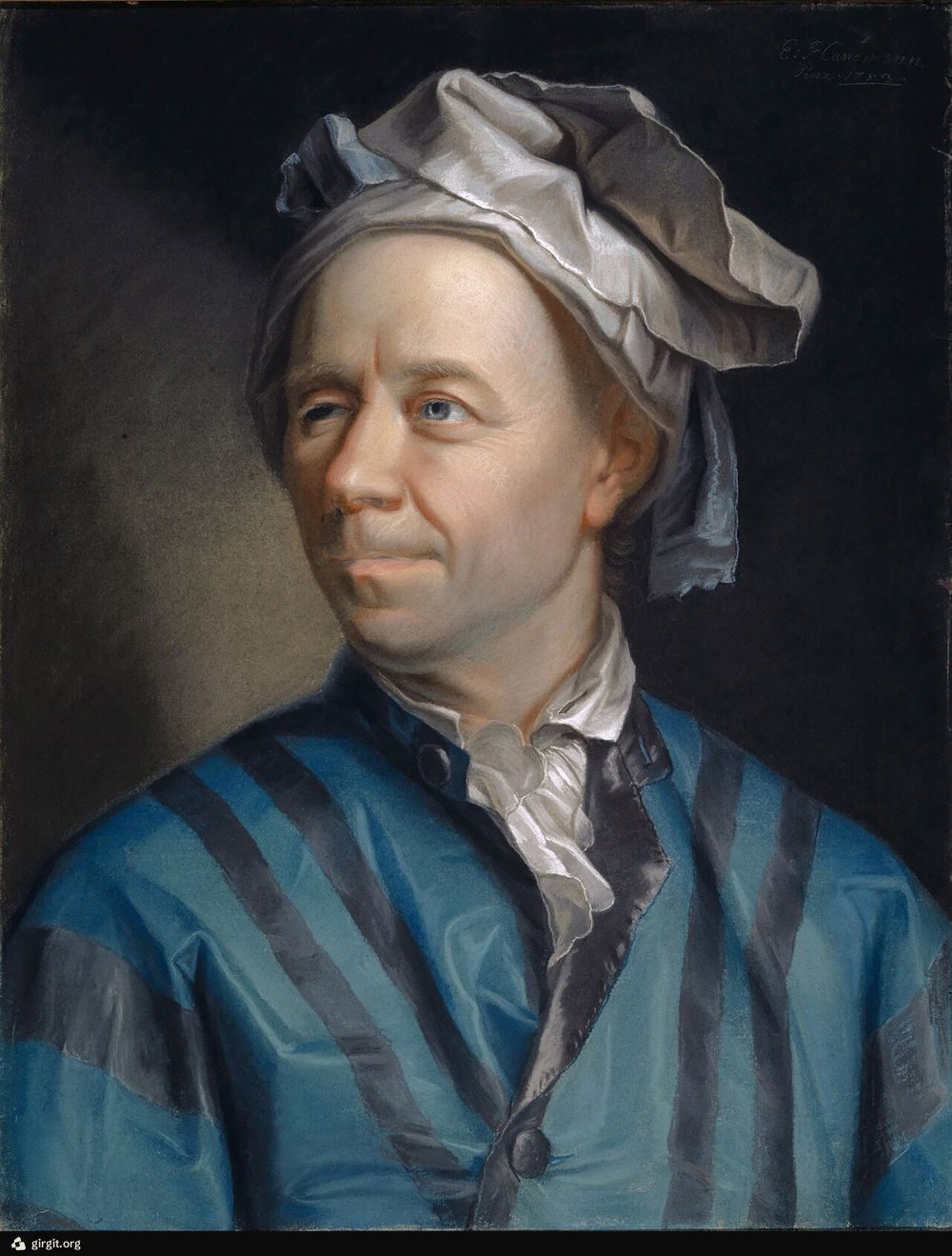 the failing right eye
See it: the powers of any number
Powers of \( i \) go round a square of four points. What about the powers of another number? Each power is the last one turned by \( z \)'s angle and stretched by \( |z| \), so the points \( 1, z, z^2, z^3, \dots \) trace a spiral. Drag \( z \) and watch the whole history at once. Then press "Put z = i" to see the familiar cycle of four as the one special case.
Three kinds of behaviour, decided only by \( |z| \): inside the circle the powers shrink to 0, outside they run away, and on the circle they go round for ever. They come back exactly to 1 only when some whole number of steps adds up to whole turns, which is why \( i \) (four steps) and \( -1 \) (two steps) are so tidy.
Solve it
Solve it
Use turns, not remainders, to find \( i^{2026} \). Then find \( (-i)^{2026} \) the same way.
Hint
Answer
Think it through
Which complex numbers \( z \) satisfy \( z^4 = 1 \)? Use the picture: what length and what angle must \( z \) have?
Answer
\( |z| = 1.1 \). What happens to \( |z^{20}| \)?
- it is \( 3 \)
- it is about \( 6.7 \)
- it stays \( 1.1 \)
Connect it
Connect it
- Concept 4: multiplying. Why \( \times i \) sends \( (a, b) \) to \( (-b, a) \), and why every multiplication turns and stretches: multiplying.
- Trigonometry, Ch 3. The four values sit at the quadrantal angles \( 0, \tfrac{\pi}{2}, \pi, \tfrac{3\pi}{2} \): sine and cosine on the unit circle.
- Sequences, Ch 8. \( 1, i, i^2, i^3, \dots \) is a geometric progression with ratio \( i \); its sum formula explains why any four in a row add to 0: sum of a G.P.
- Concept 7: the square root trap. The reason Euler wanted a letter at all: square roots of negative numbers.
- Physics: AC. A phasor is an arrow that turns steadily; in India's 50 Hz mains it makes 50 full turns, 200 quarter turns, every second: phasors.
Still confused?
Why anticlockwise and not clockwise?
Because we put \( i \) above the real axis. That is a convention, the same one that makes angles anticlockwise in trigonometry. If \( i \) were drawn below, multiplying by \( i \) would turn clockwise and everything else would be a mirror image. The algebra (\( i^2 = -1 \)) cannot tell the two pictures apart.
Is \( i^{1/2} \) one of \( i, -1, -i, 1 \)?
No. Half a quarter turn is \( 45^\circ \), so a square root of \( i \) is \( \tfrac{1 + i}{\sqrt{2}} \): check that \( \left(\tfrac{1 + i}{\sqrt{2}}\right)^2 = \tfrac{2i}{2} = i \). The cycle of four is only for whole-number powers, which is all the syllabus asks.
Sources
- 5 May 1777: Euler first uses the symbol i for √−1 (De formulis differentialibus angularibus), MacTutor History of Mathematics, St Andrews.
- Leonhard Euler (blindness, the fire and cataract operation of 1771, the 1753 portrait), MacTutor.
- Euler Archive, E671 (written 1777, published 1794), University of the Pacific.
- Complex number: history (the √a√b confusion that "bedeviled" Euler and led to the symbol i), Wikipedia.
- Jean-Robert Argand (1806: i as a rotation of 90 degrees), Wikipedia.
Picture and video credits