Chemical Bonding and Molecular Structure
- 1. Why do atoms join at all?
- 2. How do you draw a Lewis structure?
- 3. What holds salt together?
- 4. How long, how strong? Bond parameters
- 5. When one drawing is not enough: resonance
- 6. Why does water have a plus end? Polarity of bonds
- 7. Why is water bent but CO₂ straight? VSEPR theory
- 8. What happens when two atoms bond? Valence bond theory
- 9. How does carbon make four equal bonds? Hybridisation
- 10. Electrons that belong to the whole molecule: MO theory
- 11. Why does oxygen stick to a magnet? Bond order
- 12. What makes water so sticky? Hydrogen bonding
- Review
7 of 12·NCERT §4.4·pp. 112–117·7 min
Why is water bent but CO₂ straight? VSEPR theory
The big ideaElectron pairs around a central atom push each other as far apart as they can, and lone pairs push hardest, so counting the pairs tells you the shape of the molecule.
In simple words
Tie a few balloons together at their necks and they spread out on their own: two point opposite ways, three make a flat star, four make a three-legged stand with one pointing up. The pairs of tiny charged bits around a middle piece do the same, because they push each other away. A pair that is not holding anything is fatter and pushes harder, so it squeezes the others closer together.
Lewis structures tell us which atoms are bonded, not the shape. The Valence Shell Electron Pair Repulsion (VSEPR) theory gives a simple way to predict shapes. It was proposed by Sidgwick and Powell in 1940 and improved by Nyholm and Gillespie in 1957.
The rules
- The shape depends on the number of electron pairs, bonding or not, in the valence shell of the central atom.
- These pairs repel one another, because electron clouds are negatively charged.
- They settle where repulsion is least, that is, as far apart as possible, as if spread over the surface of a sphere.
- A multiple bond counts as one pair (a "super pair").
- If a molecule has resonance structures, any one of them can be used.
Nyholm and Gillespie added the key difference between pair types. A bond pair (bp) is shared between two nuclei, so it is held in a narrow region. A lone pair (lp) belongs only to the central atom and spreads out more, taking up more room. So repulsion falls in the order
\[ \text{lp–lp} > \text{lp–bp} > \text{bp–bp} \]Lone pairs therefore squeeze the bonds closer and shrink the bond angles below their ideal values.
How to use it
- Find the central atom's valence electrons. Add one for each atom bonded by a single bond to it (H or a halogen); adjust for charge (+1 per negative charge, −1 per positive). Halve to get the number of electron pairs. (Atoms joined by a double bond, such as O in \(\ce{SO2}\), add nothing.)
- Bond pairs = number of atoms attached. Lone pairs = total pairs − bond pairs.
- The total gives the arrangement of pairs; the atoms alone give the shape.
Example, \(\ce{NH3}\): (5 + 3) ÷ 2 = 4 pairs; 3 bond pairs, 1 lone pair.
Central atom with no lone pairs (ABn)
Here the shape is simply the arrangement of the pairs.
| Pairs | Shape | Angles | Examples |
|---|---|---|---|
| 2 (AB2) | Linear | 180° | \(\ce{BeCl2}\), \(\ce{HgCl2}\) |
| 3 (AB3) | Trigonal planar | 120° | \(\ce{BF3}\) |
| 4 (AB4) | Tetrahedral | 109.5° | \(\ce{CH4}\), \(\ce{NH4+}\) |
| 5 (AB5) | Trigonal bipyramidal | 120° and 90° | \(\ce{PCl5}\) |
| 6 (AB6) | Octahedral | 90° | \(\ce{SF6}\) |
- Linear: the three atoms lie on one straight line, like a bead on a stick with one bead each side.
- Trigonal planar: the central atom sits in the middle of a flat equilateral triangle, the three outer atoms at its corners, all in one plane.
- Tetrahedral: the outer atoms sit at the four corners of a tetrahedron, a pyramid with four triangular faces. Stand it on three legs and the fourth bond points straight up.
- Trigonal bipyramidal: three equatorial atoms form a flat triangle round the middle (120° apart), and two axial atoms sit straight above and below (90° to the triangle, 180° to each other). Two triangular pyramids glued base to base.
- Octahedral: six atoms, one on each end of three lines at right angles (up, down, left, right, front, back). Every neighbouring pair is at 90°. Two square pyramids glued base to base.
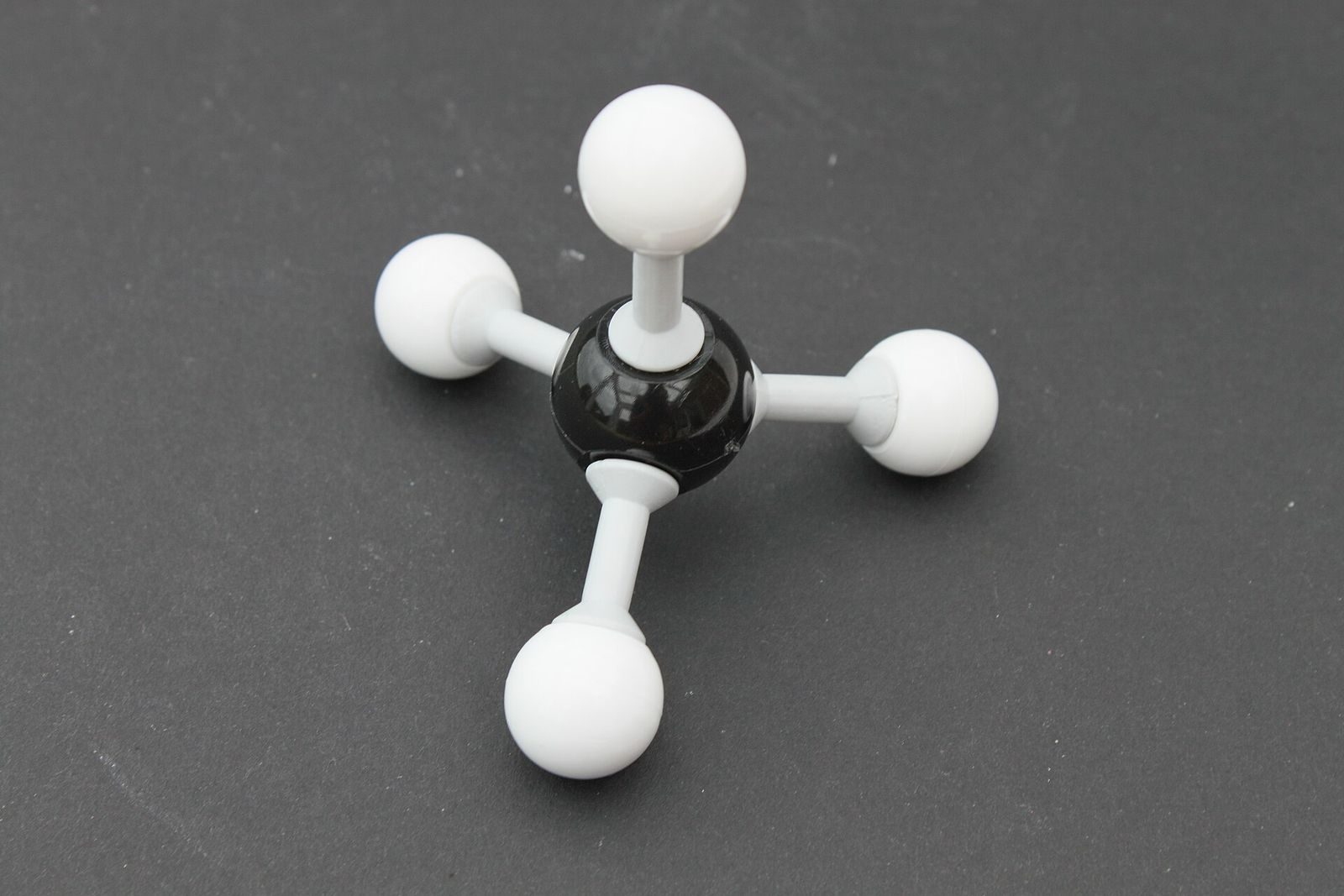 C: 4 bond pairsany H–C–H: 109.5°
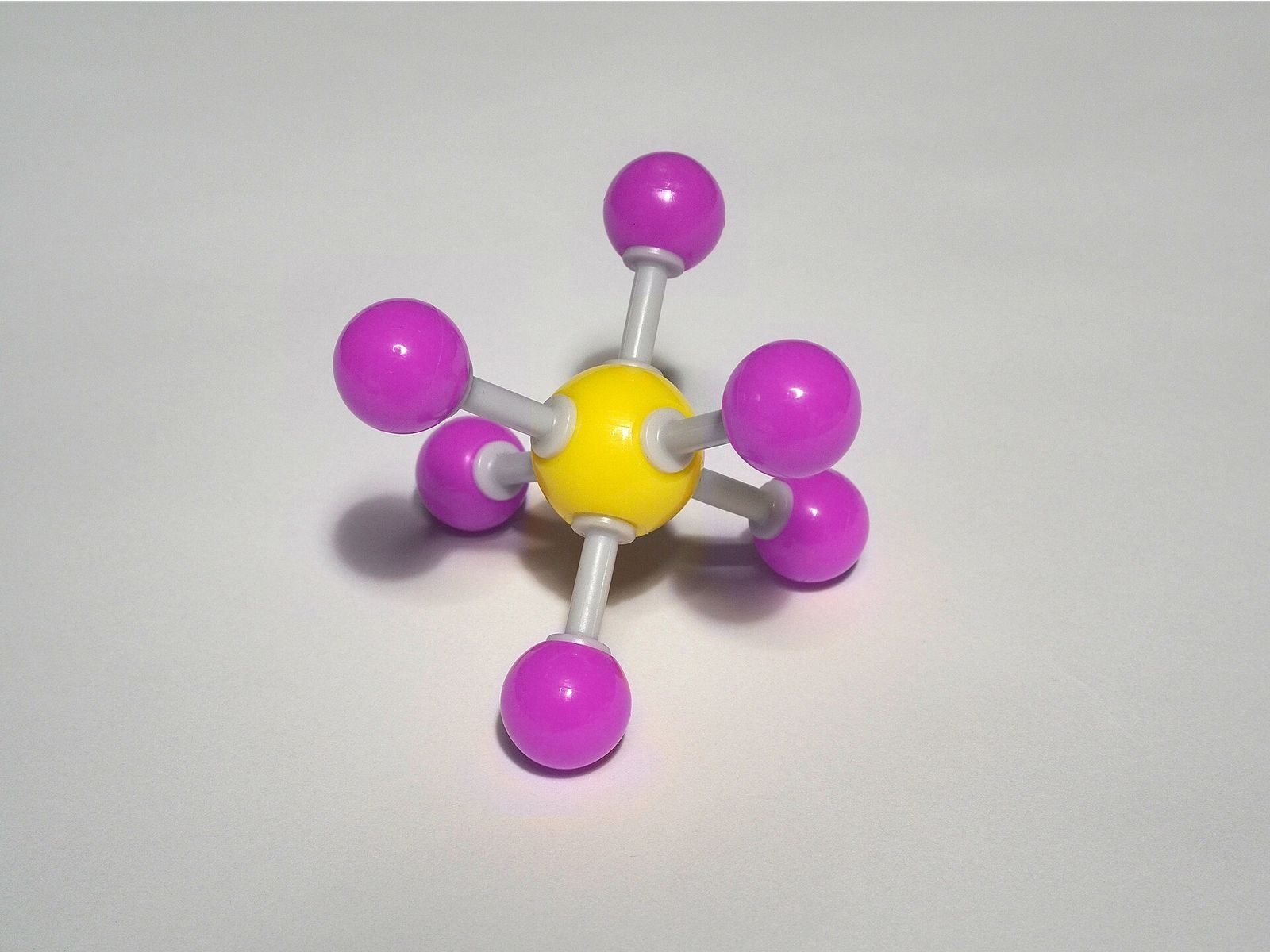 S: 6 bond pairsF–S–F 90°
 tetrapods: 4 arms, tetrahedral
Try it: add electron pairs one at a time, then swap bond pairs for lone pairs.
Central atom with lone pairs (ABnEm)
E stands for a lone pair. The pairs still take the arrangement above, but the shape names only where the atoms are, and lone pairs bend the angles.
| Type | bp | lp | Pairs arranged | Shape | Example |
|---|---|---|---|---|---|
| AB2E | 2 | 1 | trigonal planar | Bent | \(\ce{SO2}\), \(\ce{O3}\) |
| AB3E | 3 | 1 | tetrahedral | Trigonal pyramidal | \(\ce{NH3}\) |
| AB2E2 | 2 | 2 | tetrahedral | Bent | \(\ce{H2O}\) |
| AB4E | 4 | 1 | trigonal bipyramidal | See-saw | \(\ce{SF4}\) |
| AB3E2 | 3 | 2 | trigonal bipyramidal | T-shaped | \(\ce{ClF3}\) |
| AB5E | 5 | 1 | octahedral | Square pyramidal | \(\ce{BrF5}\) |
| AB4E2 | 4 | 2 | octahedral | Square planar | \(\ce{XeF4}\) |
- Bent (AB2E): a flat V. It would be a triangle, but one corner is a lone pair; its extra push closes the angle a little below 120° (119.5° in \(\ce{SO2}\)).
- Trigonal pyramidal (AB3E): a short pyramid with N at the top and the three H atoms as the base; the lone pair points up from the top. The lone pair squeezes H–N–H from 109.5° to 107°.
- Bent (AB2E2): a V shape, like an open book seen from the end. Two lone pairs squeeze harder, so H–O–H closes from 109.5° to 104.5°.
- See-saw (AB4E): the lone pair takes an equatorial place. There it has only two neighbours at 90°; in an axial place it would have three. What is left looks like a see-saw: two axial S–F bonds form the plank (nearly 180°), and two equatorial ones the support. Also called a distorted tetrahedron or folded square.
- T-shaped (AB3E2): both lone pairs take equatorial places, again to have the fewest 90° clashes. The three F atoms form a T: two axial, one equatorial, with F–Cl–F angles a little under 90°.
- Square pyramidal (AB5E): an octahedron with one corner taken by a lone pair: four atoms make a square base and the fifth sits on top. The Br atom lies slightly below the plane of the square.
- Square planar (AB4E2): the two lone pairs go opposite each other (above and below), as far apart as possible. The four F atoms lie in a flat square round Xe, at 90°.
Try it: slide SF₄'s lone pair between axial and equatorial places.
Worked example: \(\ce{XeF4}\)
- Pairs: (8 + 4) ÷ 2 = 6. Bond pairs 4, lone pairs 2.
- Six pairs take an octahedral arrangement.
- The two lone pairs sit opposite each other (180° apart, to avoid a 90° lp–lp clash). The four F atoms are in a flat square: square planar.
Try it. Predict the shape of \(\ce{ClF3}\).
Answer
Try it: count the pairs for four molecules straight from their formulas.
Not in the current textbook, but NEET has asked it: with 5 pairs and 3 lone pairs (AB2E3), all three lone pairs take the equatorial triangle and the two atoms sit axial, at 180°: a linear molecule. \(\ce{XeF2}\) ((8 + 2) ÷ 2 = 5 pairs) and the ions \(\ce{I3-}\) and \(\ce{IBr2-}\) are linear this way. With three lone pairs, \(\ce{XeF2}\) has more lp–lp repulsion than \(\ce{SF4}\), \(\ce{ClF3}\) or \(\ce{IF5}\).
Don't mix these up
- Arrangement of electron pairs counts lone pairs; shape describes only the atoms. \(\ce{NH3}\): tetrahedral arrangement, pyramidal shape.
- In a trigonal bipyramid, lone pairs always go equatorial. In an octahedron, two lone pairs go opposite each other.
- Angles: \(\ce{CH4}\) 109.5° > \(\ce{NH3}\) 107° > \(\ce{H2O}\) 104.5°. More lone pairs, smaller angle.
VSEPR predicts the shapes of a great many molecules correctly, especially p-block compounds, even when two possible structures differ only slightly in energy. Yet why electron-pair repulsion should work so well is still not fully clear and is debated.
Just remember
The shapes follow from the rule, but in the exam you need the names and angles instantly. Count the pairs, then use these hooks:
- 2, 3, 4, 5, 6 pairs: linear 180°, trigonal planar 120°, tetrahedral 109.5°, trigonal bipyramidal 120° and 90°, octahedral 90°
- Think stick, star, stand, spinning top, six-way crossing. The angle shrinks as the crowd grows: 360 ÷ 2, 360 ÷ 3, then the odd one, 109.5, which you get only in 3D (a tetrapod).
- One lone pair on four: 107° (NH3); two: 104.5° (H2O)
- Start at 109.5 and take off about 2.5° for each lone pair: 109.5, 107, 104.5, a countdown in steps of two and a half. Methane, ammonia, water: C, N, O in order across the period.
- Five pairs: lone pairs go equatorial (SF4 see-saw, ClF3 T-shape, XeF2 linear)
- The equator is the roomy middle seat: only two neighbours at 90° instead of three. Fill the equator with lone pairs one by one: see-saw, then T, then a straight line.
- Six pairs: one lone pair gives square pyramidal (BrF5); two go opposite, square planar (XeF4)
- Two lone pairs on an octahedron sit back to back, like two people who have just had a fight: as far apart as the room allows.
- Repulsion order: lp–lp > lp–bp > bp–bp
- Lone is loud: a pair with no partner atom spreads out and shoves hardest; two lone pairs together shove hardest of all.
- VSEPR theory
- Shapes come from electron pairs around the central atom repelling each other.
- Bond pair (bp)
- An electron pair shared between two atoms.
- Lone pair (lp)
- An unshared pair on the central atom; it takes more room and repels more.
- Equatorial position
- One of the three positions round the middle of a trigonal bipyramid.
- Axial position
- One of the two positions above and below the equatorial plane.
- Square planar
- Four atoms in a flat square round the central atom, as in XeF4.
Words to know
What is the shape of \(\ce{SF4}\)?
- Tetrahedral
- See-saw
- Square planar
Why is the H–O–H angle in water (104.5°) smaller than the H–N–H angle in ammonia (107°)?
- Water has fewer electron pairs
- Water has two lone pairs, which repel the bonds more
- O–H bonds are shorter than N–H bonds
Which species has all its bond angles equal to 120°?
- \(\ce{NH3}\)
- \(\ce{BF3}\)
- \(\ce{PCl5}\)
Deep dive · optional
Why is water bent, and how do we know the angle is 104.5°?
What really pushes electron pairs apart, how a handful of chemists in three countries turned that into a rule, and where the rule stops working. Not needed for the exam; it is here so "bent" is something you can see, not something you memorise.
The roots: four pairs, one sphere
- Why is water bent and not straight like CO2?Because oxygen has four electron pairs in its outer shell, not two. Two of them hold the hydrogen atoms; the other two are lone pairs. Carbon in CO2 has only two groups (two double bonds), and two groups are farthest apart on opposite sides: a straight line.
- Why do four pairs make a tetrahedron?Think of the pairs as four points that must sit on a ball round the oxygen and stay as far from each other as possible. A flat cross keeps neighbours 90° apart; lifting two arms up and two down, into a tetrahedron, opens every angle to 109.5°. There is no better arrangement of four points on a sphere.
- Then why 104.5° and not 109.5°?A lone pair is held by one nucleus only, so it sits closer to the oxygen and spreads wider, like a fat balloon among thin ones. Two fat balloons shove the two thin ones (the O–H bonds) together by about 5°.
- Why do electron pairs push each other at all?Partly because electrons are negative and repel. But Ronald Gillespie, who did most to develop the theory, stressed a stronger reason: the Pauli exclusion principle. Two electrons with the same spin cannot be in the same place, so each pair keeps its own region of space, and different pairs stay out of each other's way.
- The bedrockCoulomb's law (like charges repel) and the Pauli principle (from quantum numbers: no two electrons share all four). Add the geometry of points on a sphere, and the shapes follow.
So VSEPR is really a counting rule plus a geometry fact. Count the pairs (bond pairs and lone pairs alike), place them on a sphere as far apart as they will go, then look only at where the atoms are. The lone pairs are invisible in the final shape, but they set it: that is why ammonia is a pyramid and water a V, though both have four pairs arranged as a tetrahedron.
The story
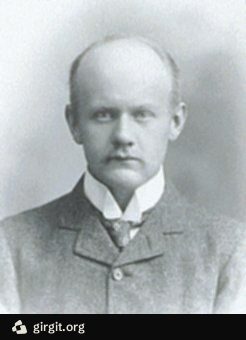
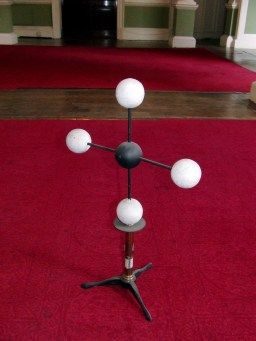 all 4 H in one flat cross
How the angle is measured. Nobody measures 104.5° with a protractor. A water molecule spinning and flexing in a gas absorbs microwave and infrared light at exact frequencies, and those frequencies depend on the masses of the atoms, the bond lengths and the angle between them. Solving the equations of a bending, rotating molecule backwards from the measured lines gives the gas-phase H–O–H angle as 104.48°.
See it
Here is VSEPR as a machine. The pairs start scattered on a sphere and slide to where the pushes balance; nothing else is built in. Guess first, then change the number of pairs, the number of lone pairs, and how hard a lone pair pushes. "Every push strength" asks one question of the whole family: can one number explain both ammonia and water?
The model is a toy (it treats each pair as a point and picks a simple law for the push), yet with a lone pair about 1.3 times as pushy as a bond pair it lands within a degree of ammonia's 107° and water's 104.5° at once. What it cannot do is reach hydrogen sulphide's 92°: no amount of lone-pair pushing squeezes the water shape that far. Something else is happening in H2S, and the hybridisation deep dive explains what.
Solve it
Solve it: how van 't Hoff could tell
Replace two of methane's hydrogens with chlorine to get dichloromethane, CH2Cl2. Chemists only ever find one compound with this formula. If methane were a flat square, how many would there be? What does that prove?
Hint
Answer
Solve it: half a pair
Three nitrogen–oxygen species have measured O–N–O angles of 180°, 134° and 115°: NO2+, NO2 and NO2−. Match each angle to its species and explain the order.
Hint
Answer
Solve it: where would the lone pairs go?
XeF4 has six pairs, two of them lone. Count the 90° lone pair–lone pair contacts if the two lone pairs sit next to each other (cis) and if they sit opposite (trans). Which does VSEPR choose?
Answer
Connect it
Connect it
- Bent means polar, Chapter 4. A straight CO2 cancels its two bond dipoles; a bent water molecule cannot, so it has a dipole moment of 1.85 D: Polarity and dipole moment.
- Where the pairs live, Chapter 4. The four pairs on oxygen sit in four sp3 hybrid orbitals, and the 92° of H2S is the clue that sulphur hardly hybridises at all: Hybridisation.
- Why pairs, Chapter 2. Electrons pair up because each orbital holds two with opposite spins; the four quantum numbers and the Pauli principle are on Quantum numbers, and the orbital shapes on Shapes and energies of orbitals.
- Why nitrogen stops at four pairs, Chapter 3. Second-period atoms have only one s and three p orbitals in the outer shell, so at most four pairs: no NF5, though PF5 exists. See Valence and the second period.
- Ice and snowflakes. Each water molecule's two hydrogens and two lone pairs point to the corners of a tetrahedron, so in ice every molecule holds four neighbours in an open, cage-like network. That openness is why ice floats: Hydrogen bonding.
Still confused?
If lone pairs are invisible in the shape, how do we know they are there?
By what they do. Ammonia's angle (107°) and water's (104.5°) are smaller than methane's (109.5°) exactly in step with the number of lone pairs; ammonia uses its lone pair to grab an H+ and become NH4+, which is a perfect tetrahedron again; and the lone pairs are why water and ammonia are polar. A rule that counts lone pairs predicts all of this; a rule that ignores them predicts none of it.
Why does a double bond count as one pair?
Both pairs of a double bond lie between the same two atoms, so they point in the same direction from the central atom. For the question "which directions are taken?", they are one group. They are fatter than a single bond, though, which is why the angles next to a double bond open up a little.
Is VSEPR always right?
No, it is a model. Molecular Li2O is linear, not bent like water, because its bonds are almost purely ionic and the two Li+ ions repel each other. Gaseous CaF2, SrF2 and BaF2 are bent (about 145°, 120° and 108°) where VSEPR says straight. And the heavier hydrides H2S and PH3 have angles near 90°. For the p-block molecules in your syllabus, though, it works remarkably well.
Sources
- VSEPR theory, Wikipedia: Tsuchida 1939, Sidgwick and Powell 1940, Gillespie and Nyholm 1957; the balloon demonstration; the NO2+/NO2/NO2− angles; exceptions (Li2O, CaF2, SrF2, BaF2); Gillespie on the Pauli principle
- N.V. Sidgwick and H.M. Powell, "Bakerian Lecture. Stereochemical types and valency groups", Proc. R. Soc. A 176, 153 (1940)
- R.J. Gillespie and R.S. Nyholm, "Inorganic stereochemistry", Q. Rev. Chem. Soc. 11, 339 (1957)
- R.J. Gillespie, "Fifty years of the VSEPR model", Coord. Chem. Rev. 252, 1315 (2008)
- Ryutaro Tsuchida, Nevil Sidgwick, Ronald Gillespie and Ronald Nyholm, Wikipedia: dates, places and careers
- Properties of water, Wikipedia: gas-phase angle 104.48° (Hoy and Bunker, J. Mol. Spectrosc. 74, 1, 1979)
- Hydrogen chalcogenide, Wikipedia: H2O 104.45°, H2S 92.1°; Phosphine: 93.5°; Ammonia: 106.7° (CRC)
- Ball-and-stick model, Wikipedia: Hofmann's 1865 models and his flat methane; Jacobus Henricus van 't Hoff, Wikipedia: the 1874 tetrahedral carbon, Kolbe's attack and the 1901 Nobel Prize
- Tetrapod (structure), Wikipedia: tetrahedral concrete blocks, invented in Grenoble in 1950
Picture and video credits
Show 4 picture and video credits
- methane-model-kit-tetrahedral.jpg: Bin im Garten, CC BY-SA 3.0
- sf6-school-model-octahedral.jpg: Ljeto, CC BY-SA 4.0
- marine-drive-tetrapods-mumbai.jpg: Kelisi, CC BY-SA 3.0
- hofmann-square-methane-model.jpg: Henry Rzepa, CC BY-SA 4.0


