Structure of AtomFull experience
- 1. What is an atom made of?
- 2. Why did a few alpha particles bounce back?
- 3. Atomic number, mass number, isotopes and isobars
- 4. Why should Rutherford's atom collapse? And what is light?
- 5. Light comes in packets
- 6. Why does each element glow in its own colours?
- 7. Bohr's model of the hydrogen atom
- 8. How Bohr explained the hydrogen spectrum, and where he failed
- 9. Is an electron a particle or a wave?
- 10. Orbitals and quantum numbers
- 11. What does an orbital look like, and which is lowest?
- 12. How do electrons fill an atom?
- Review
10 of 12·NCERT §2.6 · §2.6.1·pp. 53–57·7 min
Orbitals and quantum numbers
The big ideaIn the quantum mechanical model each electron has a wave function ψ, its orbital, labelled by three quantum numbers (n, l, ml), plus a fourth (ms) for its spin.
In simple words
We cannot say where an electron is, only where it is likely to be. A new kind of maths gives, for each allowed energy, a map of those likely places. Each map is called an orbital. Four numbers work like a full postal address: which floor (how big and how far out), which kind of room (its shape), which way the room faces, and which way the electron itself is turned.
Quantum mechanics
Classical mechanics, the physics of Newton's laws, works for big objects like a falling stone or a planet. It fails for electrons, atoms and molecules, because it ignores their dual behaviour and the uncertainty principle. Quantum mechanics is the science of how tiny objects move when they act as both waves and particles. Applied to big objects, it gives the same answers as classical mechanics.
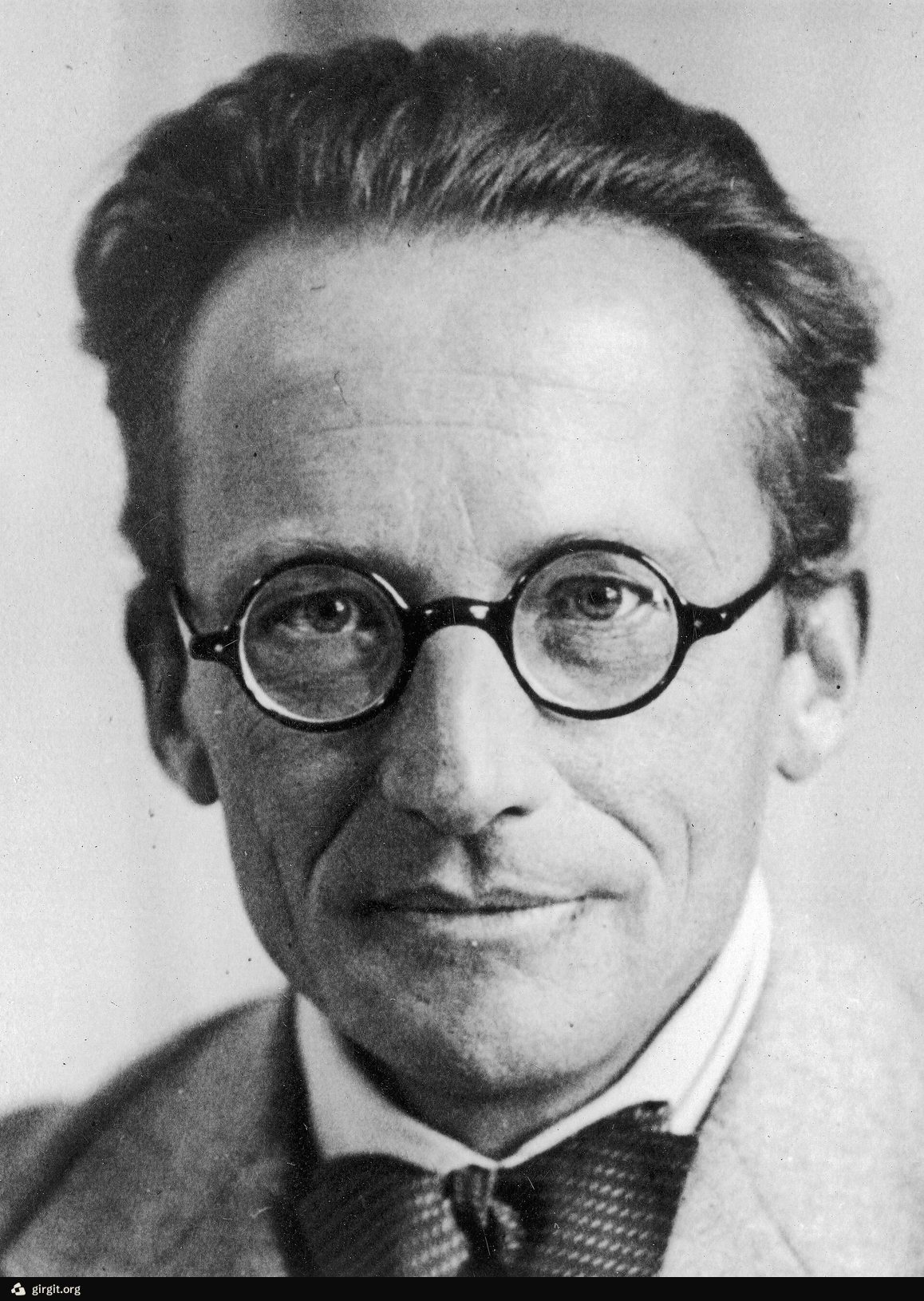
Werner Heisenberg and Erwin Schrödinger each built it, separately, in 1926. We use Schrödinger's form, which treats the electron as a wave. For an atom or molecule with a constant total energy, his equation reads
\[ \hat{H}\psi = E\psi \]\( \hat{H} \) is the Hamiltonian, a mathematical operator that Schrödinger built from the system's total energy: the kinetic energy of all electrons and nuclei, the attraction between electrons and nuclei, and the repulsion among electrons and among nuclei. Solving it gives the allowed energies \( E \) and the wave functions \( \psi \) (psi). The solution needs higher maths; you will meet it in later classes.
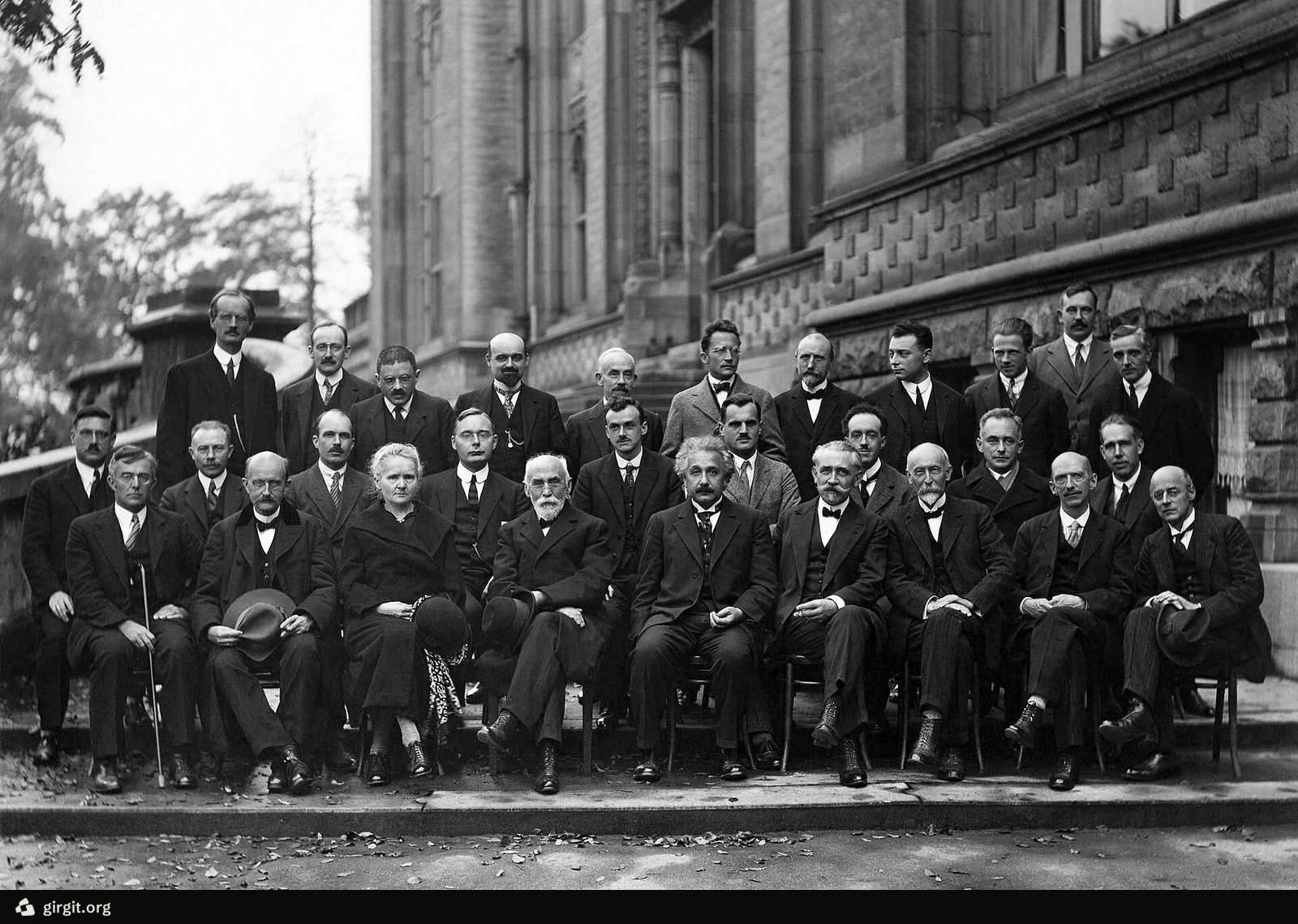 PlanckMarie CurieEinsteinde BroglieBohrSchrödingerHeisenberg
What the equation says
For hydrogen, the solution gives the allowed energy levels and a wave function for each. Three quantum numbers, \( n \), \( l \) and \( m_l \), come out naturally from the maths; Bohr had to assume his. The wave function holds all the information about the electron, yet by itself \( \psi \) has no physical meaning. The wave function of a single electron in an atom is called an atomic orbital. The results explain every feature of hydrogen's spectrum, including some Bohr could not.
For atoms with many electrons the equation cannot be solved exactly, but computer approximations show their orbitals are much like hydrogen's, a little contracted by the larger nuclear charge. One key difference: in hydrogen an orbital's energy depends only on \( n \); in multi-electron atoms it depends on n and l.
Features of the quantum mechanical model
- Electron energy in atoms is quantised: only certain values are allowed.
- These levels arise from the wave nature of electrons, as allowed solutions of Schrödinger's equation.
- Exact position and velocity cannot both be known, so we speak only of the probability of finding the electron.
- An atomic orbital is a wave function ψ. An electron in a given orbital has a fixed energy, and no orbital takes more than two electrons. Electrons fill orbitals in order of rising energy.
- The probability of finding the electron at a point is proportional to \( |\psi|^2 \) there, the probability density. It is always positive, and it shows where the electron is most likely to be.
Don't mix these up
- An orbit (Bohr) is a fixed circular path; it can never be shown to exist, because of the uncertainty principle. An orbital is a wave function ψ described by n, l and ml.
- \( \psi \) has no physical meaning; \( |\psi|^2 \) does. \( |\psi|^2 \) is probability per unit volume; multiply it by a small volume to get the probability of finding the electron in that volume, and add up such pieces for a bigger region.
Principal quantum number, n
\( n = 1, 2, 3 \ldots \) It fixes the size and, largely, the energy of the orbital (in hydrogen-like species, the energy entirely). It also names the shell: n = 1, 2, 3, 4 are the K, L, M, N shells. A shell with quantum number n has \( n^2 \) orbitals. Larger n means a bigger orbital, farther from the nucleus, and higher energy, since pulling the electron away from the nucleus costs energy.
Azimuthal quantum number, l
\( l \), which is also called the subsidiary quantum number or orbital angular momentum quantum number, sets the orbital's 3-D shape. For any n it takes n values: \( l = 0, 1, 2 \ldots (n-1) \). Each value is a sub-shell (sub-level), so shell n has n sub-shells.
| l | 0 | 1 | 2 | 3 | 4 | 5 |
|---|---|---|---|---|---|---|
| Sub-shell | s | p | d | f | g | h |
| Orbitals (2l + 1) | 1 | 3 | 5 | 7 | 9 | 11 |
So n = 1 has only 1s; n = 2 has 2s and 2p; n = 3 has 3s, 3p, 3d; n = 4 has 4s, 4p, 4d, 4f.
Try it: climb from the K shell to the N shell and count the orbitals.
Magnetic quantum number, ml
\( m_l \) gives the orientation of the orbital in space, relative to a set of axes. For each l it has \( 2l + 1 \) values, \( m_l = -l, \ldots, 0, \ldots, +l \). For l = 1, ml = −1, 0, +1: three p orbitals. For l = 2, ml = −2 to +2: five d orbitals. So ml comes from l, and l comes from n; every orbital has its own set (n, l, ml). For example n = 2, l = 1, ml = 0 is one of the 2p orbitals.
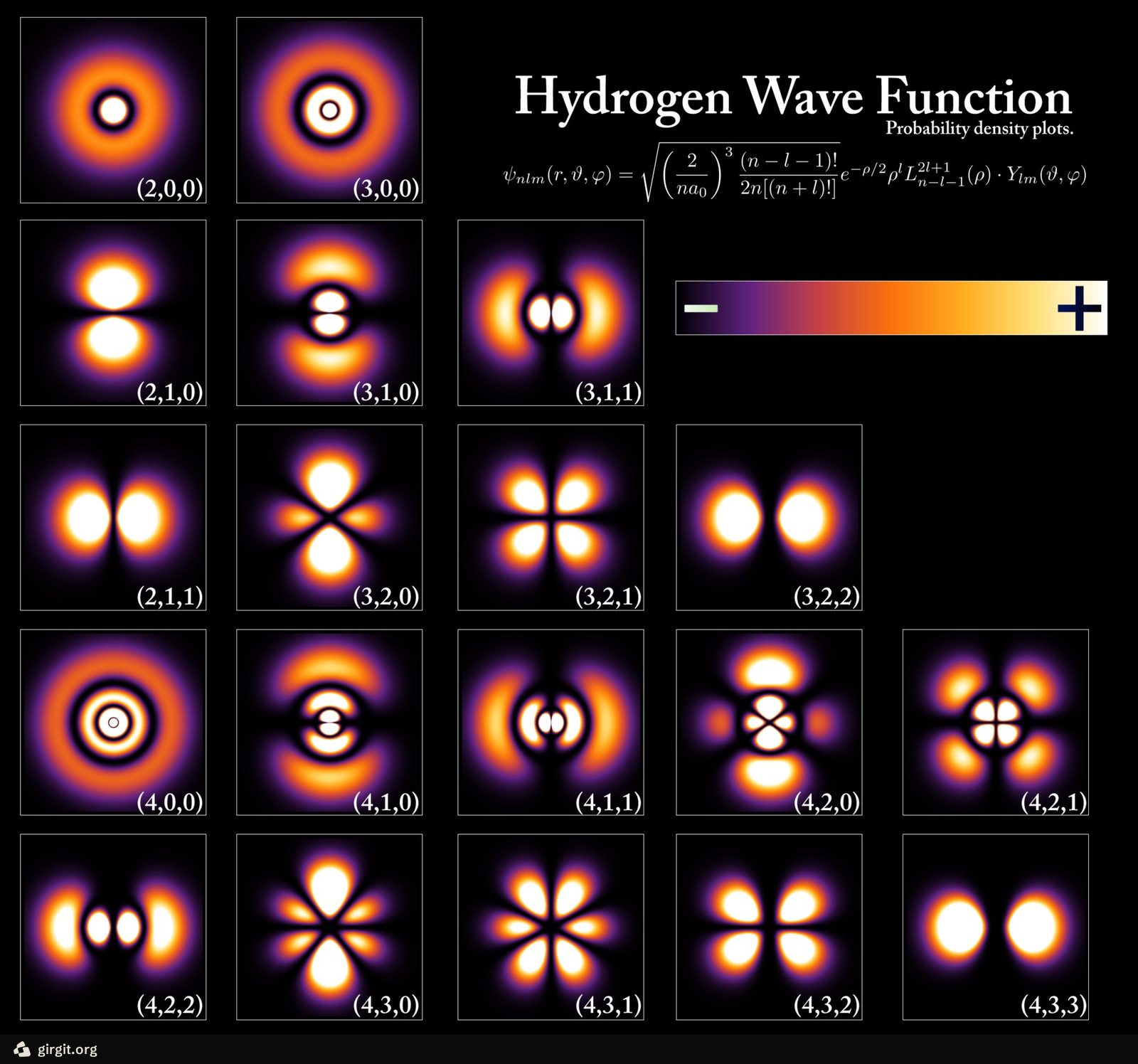 2s2p3d4f
Try it: one p orbital, pointed three ways, one for each m_l.
And the five d orbitals, for m_l = −2 to +2.
Spin quantum number, ms
Three numbers could not explain why some lines in the spectra of multi-electron atoms come as doublets or triplets: there must be a few more energy levels. George Uhlenbeck and Samuel Goudsmit (1925) suggested a fourth quantum number, the electron spin quantum number, \( m_s \). The electron carries its own built-in spin angular momentum, often pictured as the electron spinning on its axis like the earth. It can point only two ways relative to a chosen axis: \( m_s = +\tfrac12 \) (spin up, ↑) or \( -\tfrac12 \) (spin down, ↓). Two electrons with different ms have opposite spins. One orbital holds at most two electrons, and they must have opposite spins.
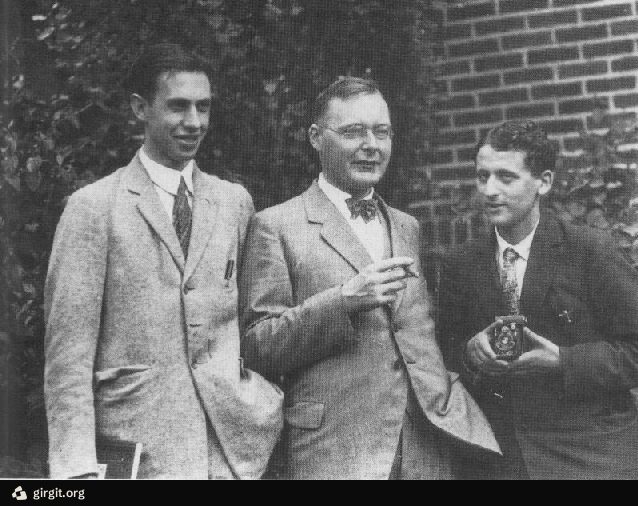 UhlenbeckKramersGoudsmit
Worked example 1: counting in a shell
How many orbitals and electrons can the n = 4 shell hold?
- l = 0, 1, 2, 3: the 4s, 4p, 4d and 4f sub-shells.
- Orbitals: 1 + 3 + 5 + 7 = 16, which is \( n^2 = 16 \).
- Electrons: two per orbital, 32, which is \( 2n^2 \).
Worked example 2: is this set allowed?
- n = 2, l = 2: not allowed. l can only go up to n − 1 = 1.
- n = 3, l = 1, ml = −2: not allowed. For l = 1, ml is only −1, 0 or +1.
- n = 4, l = 3, ml = −2, ms = +½: allowed. It is an electron in a 4f orbital.
Try it. Name the sub-shell with n = 5, l = 2, and say how many orbitals it has.
Answer
Not in the current textbook, but NEET has asked it: the size of an electron's orbital angular momentum is \( \sqrt{l(l+1)}\,\dfrac{h}{2\pi} \). For an s electron, l = 0, so it is zero.
Just remember
The counting rules follow from the ranges of the numbers (see above). The letters and names are history, so they need hooks.
- l = 0, 1, 2, 3 are called s, p, d, f
- The letters are the first letters of four series of lines in the spectra of sodium and other alkali metals: sharp, principal, diffuse, fundamental. Say the words once and the letters stick. After f the letters simply run on alphabetically: g, h.
- Shells n = 1, 2, 3, 4 are K, L, M, N
- Four letters in a row from K. "King, Ladder, Mango, Nut": the king is closest to the centre.
- Orbitals in a sub-shell: 2l + 1, so 1, 3, 5, 7 for s, p, d, f
- The odd numbers in order: one ball, then three dumbbells, then five, then seven.
- Orbitals in shell n: n²; electrons: 2n² (2, 8, 18, 32)
- Add the odd numbers: 1 = 1, 1 + 3 = 4, 1 + 3 + 5 = 9. Two electrons per orbital doubles it.
- ms = +½ or −½, never 0
- Two people per flat, "up" and "down". Up is +½ only by convention.
- Wave function, ψ
- The mathematical function that describes an electron; no direct meaning.
- Atomic orbital
- The wave function of one electron in an atom.
- Probability density, |ψ|²
- Probability of finding the electron per unit volume.
- Shell / sub-shell
- All orbitals with the same n / the same n and l.
- Azimuthal quantum number, l
- Fixes the shape: s, p, d, f.
- Magnetic quantum number, ml
- Fixes the orientation of an orbital.
- Spin quantum number, ms
- +½ or −½: the two spin states.
Words to know
How many orbitals are there in the n = 3 shell?
- 3
- 9
- 18
Which set of quantum numbers is not possible?
- n = 3, l = 2, ml = +2
- n = 1, l = 1, ml = 0
- n = 2, l = 0, ml = 0
- n = 4, l = 1, ml = −1
What does |ψ|2 at a point tell us?
- The exact path of the electron
- How likely the electron is to be found there, per unit volume
- The energy of the electron at that point
Deep dive · optional
Why exactly these four numbers?
Where n, l and ml come from, why there are only so many of each, and how a bad cigar helped reveal the fourth. Not needed for the exam; it turns four rules into one idea.
The roots: a wave trapped in three directions
- Why does an orbital need exactly three numbers?Because the electron in an atom behaves as a wave trapped in three-dimensional space, and a trapped wave needs one counting number for each direction it can vary in. A guitar string (one direction) needs one number: how many loops. A drum skin (two directions) needs two: how many rings and how many straight lines of stillness. An atom (three directions) needs three.
- Why must they be whole numbers?A trapped wave must join up smoothly with itself. It can have one node or two, never one and a half. Counting nodes is counting in whole numbers, and every allowed pattern has a fixed energy.
- Why can l never reach n?An orbital has n − 1 nodes in all. Of these, l are flat (planes or cones through the nucleus) and the rest, n − l − 1, are spheres. You cannot have a negative number of spheres, so l can be at most n − 1.
- Why are there exactly 2l + 1 values of ml?A pattern with l flat nodes can be turned to point many ways, but only 2l + 1 of them are independent: every other direction is a mixture of those. For l = 1 this is the familiar fact that any arrow in space is made of three parts, along x, y and z. So three p orbitals cover every direction a dumbbell could point.
- And why a fourth number?Schrödinger's equation does not give it at all. It was forced on chemists by experiments: sodium's yellow light is really two lines (589.0 and 589.6 nm), and a beam of silver atoms splits in two in a magnet. The electron carries its own built-in magnet that can point only two ways. In 1928 Paul Dirac wrote an equation that also obeys relativity, and spin came out of it naturally.
- The bedrockA wave held in a space can only take shapes with a whole number of nodes. You have seen this on a string fixed at both ends; an atom is the same idea in three directions.
This is why Bohr had to assume his n but Schrödinger did not: once the electron is treated as a wave, the numbers are simply the node counts of the patterns that fit. It also explains the counting rules on this page without memorising them. A shell n has n choices of l; each l has 2l + 1 orientations; add them up, 1 + 3 + 5 + … , and you get n² orbitals. Two spin directions per orbital give 2n² electrons.
The story
See it
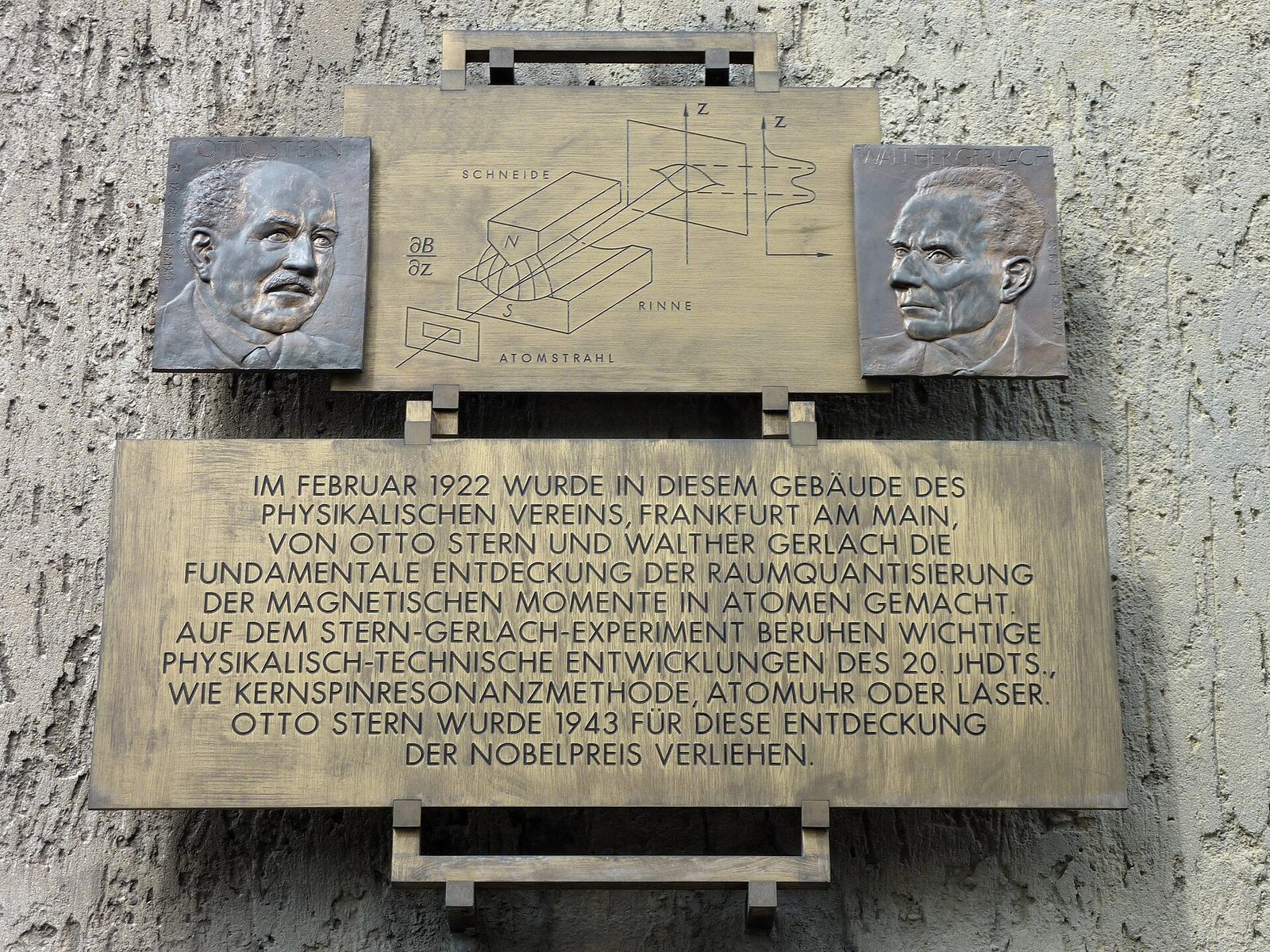 atom beamshaped magnetbeam split in two
Run Stern and Gerlach's experiment yourself. Fire silver atoms through the magnet and watch the plate fill. Then switch to an ordinary magnet, and to atoms whose magnet comes from an orbital with l = 1 or l = 2, and count the lines.
The pattern is the whole point of ml: an orbital magnet with quantum number l can sit only 2l + 1 ways in a field, so it makes 2l + 1 lines. Spin makes two, which would need "l = ½". That is why spin is a separate, fourth quantum number with values ±½.
Solve it
Solve it
How many electrons in one atom can have both n = 3 and ml = −1?
Hint
Answer
Solve it: what would happen if…
Suppose the electron's spin could point three ways, ms = −1, 0, +1, instead of two. How many electrons would the first and second shells hold? Which element would then be the first noble gas?
Answer
Solve it: numbers
In the Stern–Gerlach magnet the field changes by 10 T per cm (1000 T m−1). A silver atom (mass \( 1.79 \times 10^{-25} \) kg) carries a magnet of one Bohr magneton, \( 9.27 \times 10^{-24} \) J T−1, and crosses 3.5 cm of magnet at 550 m s−1. How far apart are the two lines?
Answer
Spot the error
A student writes the full address of an electron as n = 2, l = 1, ml = 0, ms = 0. What is wrong?
Answer
Connect it
Connect it
- Shapes and nodes, next page. The node counts n − l − 1 and l are the same idea seen from the other side. See What does an orbital look like?
- Pauli's rule and filling, page 12. Four numbers per electron, no two electrons alike: that is the Pauli exclusion principle. See How do electrons fill an atom?
- The periodic table, Chapter 3. The s, p, d and f blocks are 2, 6, 10 and 14 columns wide: 2 × (2l + 1). See The s, p, d and f blocks.
- Magnets from spin, Class 12. Unpaired electron spins are why iron, cobalt and many d-block ions are drawn into a magnetic field. See Magnetism and colour.
- In hospital. MRI scanners work with the spins of hydrogen nuclei in your body's water, flipped by magnets and radio waves. The Frankfurt plaque names nuclear spin resonance, atomic clocks and lasers as children of the Stern–Gerlach experiment.
- S.N. Bose. Particles whose spin is a whole number are called bosons, after Satyendra Nath Bose of Kolkata; electrons, with spin ½, are not, which is why only two fit in an orbital. Bose's story is told on Light comes in packets.
Still confused?
Is the electron really spinning like a top?
No. Spin is a built-in property, like charge, and it behaves like angular momentum, but nothing is turning. If the electron were a tiny ball spinning fast enough to make its measured magnet, its surface would have to move faster than light. The spinning top is a picture that helps you remember "two directions"; the exam uses the picture, and that is fine.
Is ml = +1 the px orbital?
Not exactly. The maths gives the ml = ±1 orbitals as rings round the z-axis. Chemists add and subtract that pair to make px and py, which are easier to draw and to use for bonds. Only ml = 0 is the same as pz. The next page shows both sets side by side.
If ψ has no meaning, why do we bother with it?
Because it is the thing that obeys the equation. Squaring it gives the probability density, which you can test against experiment. It is like a bank balance's history: the individual entries can be positive or negative, but what you care about is computed from them.
Sources
- Suslov, "Schrödinger's Wave Mechanics: Remarkable Dates and Place One Hundred Years Ago", arXiv:2601.05337 (2026)
- IMUS, University of Seville, "Bringing some order: Schrödinger's wave mechanics" (letter to Wien, 27 Dec 1925; paper received 27 Jan 1926)
- blue News, "The foundation for smartphones was laid in Arosa 100 years ago" (the 2026 plaque)
- The Nobel Prize in Physics 1933 (Schrödinger and Dirac)
- B. Friedrich and D. Herschbach, "Stern and Gerlach: How a Bad Cigar Helped Reorient Atomic Physics", Physics Today 56(12), 53 (2003)
- Instituut-Lorentz, Leiden University, "The discovery of electron spin"
- Solvay Conference (1927 attendees and Nobel laureates)
- Atomic orbital (origin of the letters s, p, d, f)
- NIST Atomic Spectra Database handbook: strong lines of sodium (589.0 and 589.6 nm)
- Encyclopaedia Britannica, "Boson"
Picture and video credits
Show 1 picture and video credits
- stern-gerlach-plaque-frankfurt.jpg: Frank Behnsen, CC BY-SA 3.0
