Chemical Bonding and Molecular Structure
- 1. Why do atoms join at all?
- 2. How do you draw a Lewis structure?
- 3. What holds salt together?
- 4. How long, how strong? Bond parameters
- 5. When one drawing is not enough: resonance
- 6. Why does water have a plus end? Polarity of bonds
- 7. Why is water bent but CO₂ straight? VSEPR theory
- 8. What happens when two atoms bond? Valence bond theory
- 9. How does carbon make four equal bonds? Hybridisation
- 10. Electrons that belong to the whole molecule: MO theory
- 11. Why does oxygen stick to a magnet? Bond order
- 12. What makes water so sticky? Hydrogen bonding
- Review
3 of 12·NCERT §4.2 · §4.2.1·pp. 106–107·5 min
What holds salt together?
The big ideaMaking ions from atoms usually costs energy, but packing the ions into a crystal releases far more, and that lattice energy is what really makes an ionic compound stable.
In simple words
Pulling a bit away from one piece costs work. The other piece gets a little back when it takes the bit, but not enough to pay. So why does it happen? Because once one piece is plus and the other is minus, huge numbers of them stack into a neat solid block, every plus held by the minuses around it. Settling into that block gives out much more than all the work it cost.
What an ionic bond needs
From Kössel's picture, forming an ionic compound depends on two things:
- how easily the neutral atoms turn into positive and negative ions, and
- how the ions are arranged in the solid, the crystal lattice.
Making a positive ion means removing electrons; making a negative ion means adding them. You met both energies in the last chapter:
- Ionisation enthalpy: \( \ce{M(g) -> M+(g) + e-} \)
- Electron gain enthalpy, \( \Delta_{eg}H \): \( \ce{X(g) + e- -> X^-(g)} \)
- Lattice formation: \( \ce{M+(g) + X^-(g) -> MX(s)} \)
Ionisation always takes in energy (it is endothermic). Electron gain can give out energy or take it in. Electron affinity is simply the negative of the energy change on gaining an electron.
Who forms ionic bonds?
- Elements with low ionisation enthalpy (metals) with elements of large negative electron gain enthalpy (non-metals).
- So most ionic compounds have a metal cation and a non-metal anion.
- The odd one out: the ammonium ion, \(\ce{NH4+}\), is built only from non-metals, yet it is the cation of many ionic salts such as \(\ce{NH4Cl}\).
Ions in a crystal
An ionic solid is not made of separate "NaCl molecules". It is an endless, orderly three-dimensional stack of cations and anions, held by the coulombic (electrostatic) attraction between opposite charges. The pattern of the stack depends on the sizes of the ions and how they pack. In rock salt, NaCl, each \(\ce{Na+}\) has six \(\ce{Cl-}\) ions around it, and each \(\ce{Cl-}\) has six \(\ce{Na+}\).
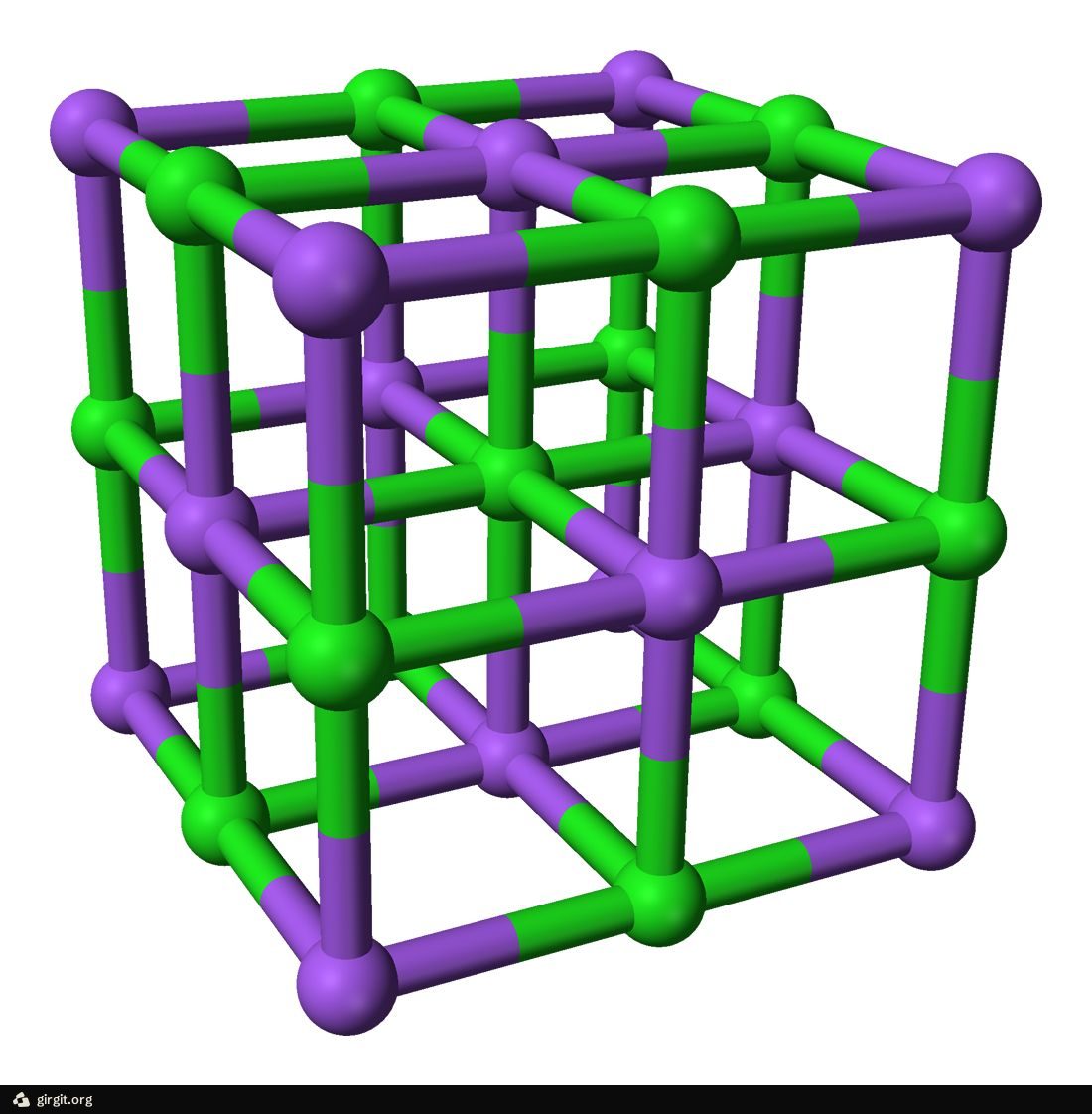 Na⁺Cl⁻
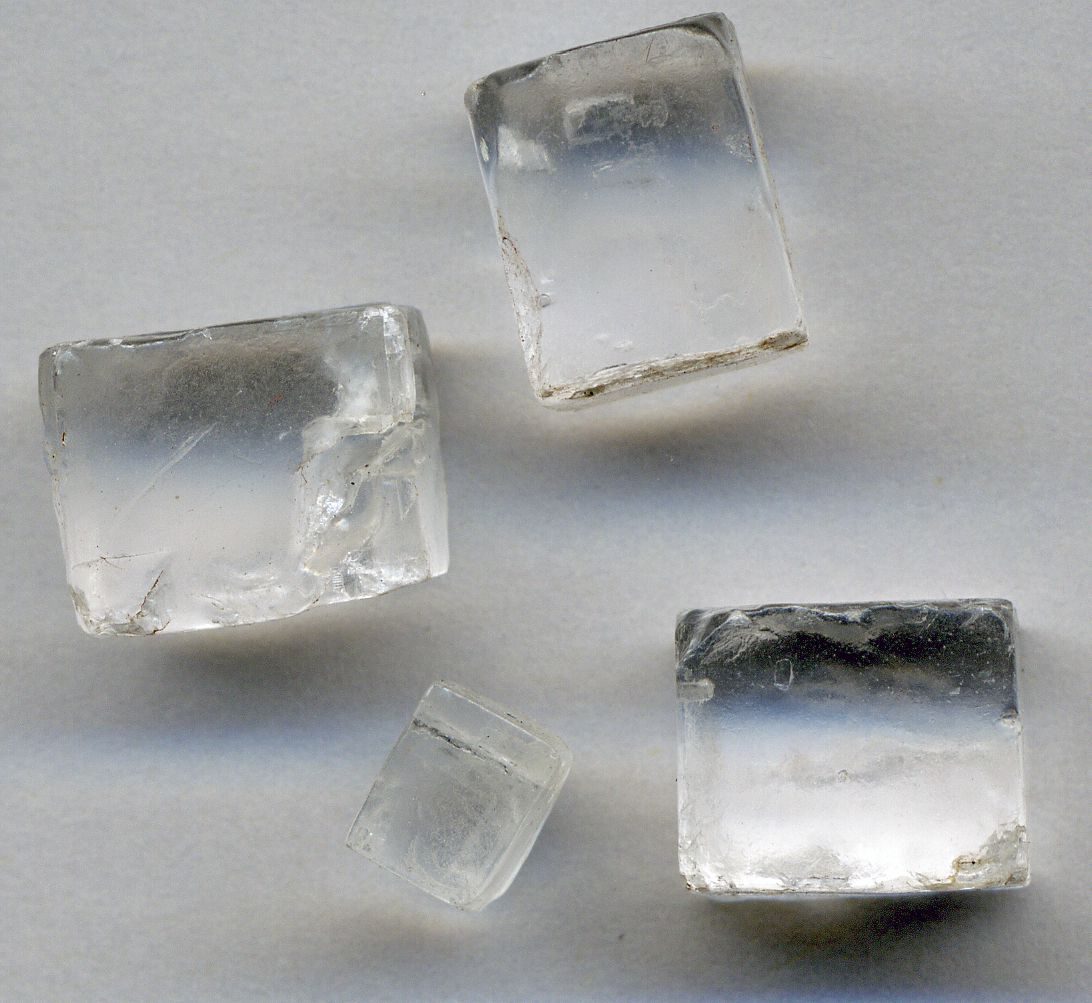 right-angled faces
Try it: guess first, then climb the energy staircase from atoms to salt.
Where the energy comes from
Look at the numbers for sodium chloride, starting from gaseous atoms:
Worked example: is making NaCl worth it?
- \(\ce{Na(g) -> Na+(g) + e-}\): ionisation enthalpy +495.8 kJ mol−1 (energy taken in).
- \(\ce{Cl(g) + e- -> Cl^-(g)}\): electron gain enthalpy −348.7 kJ mol−1 (energy given out).
- So far: 495.8 − 348.7 = +147.1 kJ mol−1. Making the two gas ions costs energy. On its own, that would never happen.
- \(\ce{Na+(g) + Cl^-(g) -> NaCl(s)}\): enthalpy of lattice formation −788 kJ mol−1.
- Overall for these steps: 147.1 − 788 = −640.9 kJ mol−1. Much more energy is released than was spent.
So reaching an octet is not, by itself, the reason ionic compounds form. The gas-phase ions with their octets are actually higher in energy than the atoms. The real payoff is the lattice. The enthalpy of lattice formation is the best simple measure of how stable an ionic compound is.
Lattice enthalpy
The lattice enthalpy of an ionic solid is the energy needed to completely separate one mole of the solid into its ions in the gas phase, far apart from each other. Sodium chloride's value is 788 kJ mol−1:
\[ \ce{NaCl(s) -> Na+(g) + Cl^-(g)} \] \[ \Delta H = +788\ \mathrm{kJ\,mol^{-1}} \]It is the same quantity as the lattice formation energy above, with the sign reversed: breaking up the crystal costs exactly what building it releases.
Inside the crystal every ion feels attraction from the oppositely charged ions and repulsion from the ions of the same charge, in all three directions. Because of this, lattice enthalpy cannot be worked out from simple attraction and repulsion between two ions; the geometry of the crystal must be taken into account too.
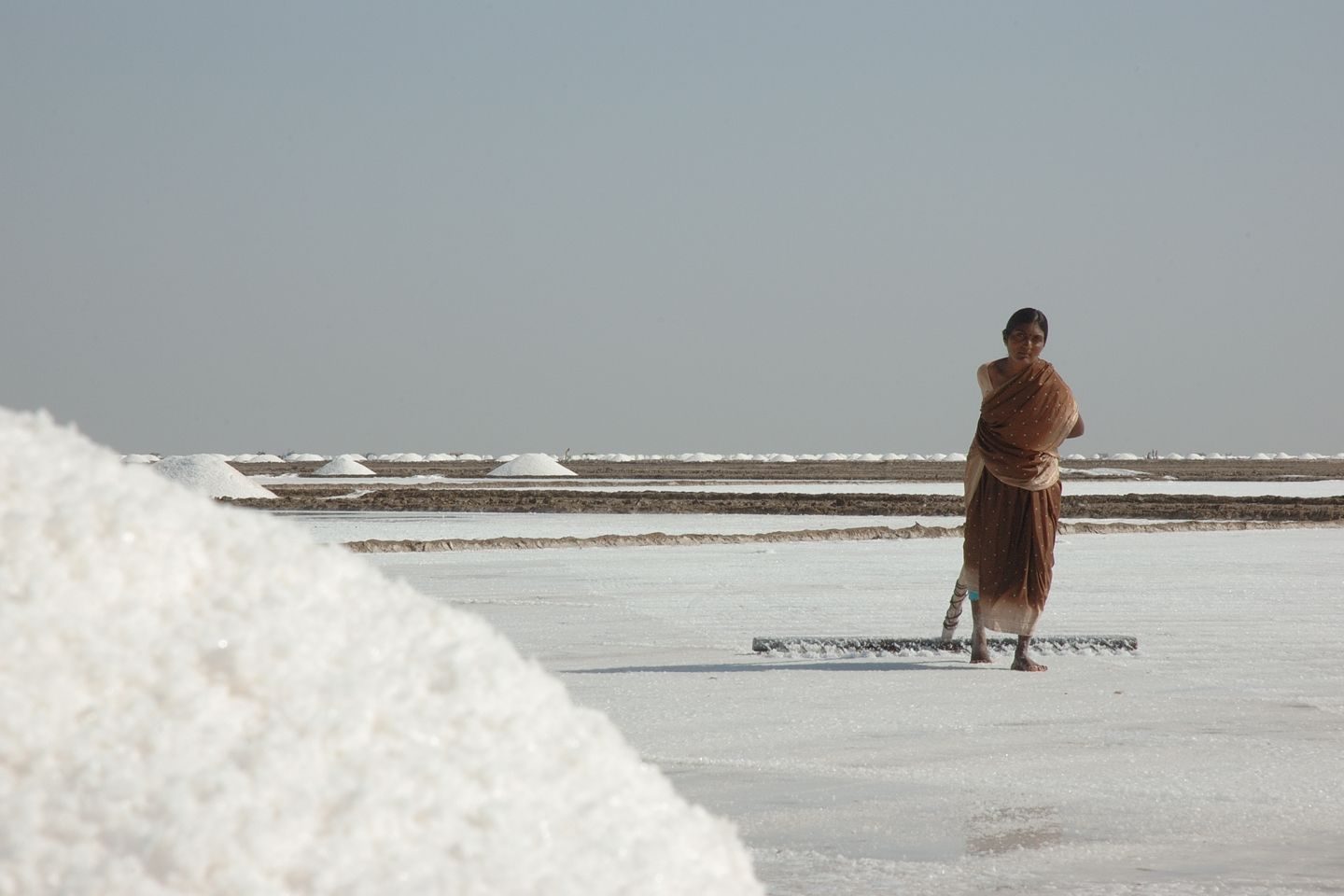 salt (NaCl)drying brine
As a rule of thumb, smaller ions and higher charges hold each other more tightly, so they give larger lattice enthalpies. Magnesium oxide (\(\ce{Mg^2+}\), \(\ce{O^2-}\)) has a lattice enthalpy of about 3800 kJ mol−1, nearly five times that of NaCl, and melts at about 2850 °C against 801 °C for salt.
Don't mix these up
- Lattice enthalpy is energy needed to break the crystal (positive, 788 kJ mol−1). Enthalpy of lattice formation is energy released when it forms (−788 kJ mol−1).
- Electron gain enthalpy is negative when energy is released; electron affinity is that same quantity with the sign flipped.
Just remember
The reasons are above; these numbers and conventions are simply to be known for the exam. Hooks:
- NaCl account: ionise Na +495.8, Cl gains −348.7, ions cost +147.1; lattice −788; overall −640.9 kJ mol−1
- The bus ticket and the salary: a ₹147 ticket (making the ions) to a ₹788 job (the crystal). Remember 788 and 147; the rest follows by adding.
- Lattice enthalpy = energy to break the crystal into gas ions: +788 kJ mol−1 for NaCl; forming it is −788
- Todna costs, jodna pays. Breaking always has the plus sign.
- Rock salt: each Na+ has 6 Cl− neighbours and each Cl− has 6 Na+
- A six-seater dining table: every guest sits with six of the other family, never next to their own.
- MgO lattice about 3800 kJ mol−1, melts about 2850 °C; NaCl 788 and 801 °C
- Double both charges and the pull goes ×4; smaller ions add a bit more, so "about five salts' worth".
- NH4+: the cation made only of non-metals
- The odd one out in the "metal plus non-metal" rule: ammonium is a non-metal in a metal's chair, as in NH4Cl (naushadar, the sal ammoniac of the tinsmith).
- Ionic (electrovalent) bond
- The attraction between cations and anions in a compound.
- Crystal lattice
- The regular 3-D arrangement of ions in an ionic solid.
- Ionisation enthalpy
- Energy needed to remove an electron from a gaseous atom; always positive.
- Electron gain enthalpy
- Enthalpy change when a gaseous atom gains an electron; can be either sign.
- Electron affinity
- The negative of the energy change on gaining an electron.
- Lattice enthalpy
- Energy needed to separate one mole of an ionic solid into gaseous ions.
Words to know
For NaCl, forming \(\ce{Na+(g)}\) and \(\ce{Cl^-(g)}\) from the gaseous atoms costs +147.1 kJ mol−1. Why does NaCl form anyway?
- Because both ions reach an octet
- Because forming the crystal lattice releases much more energy
- Because ionisation of sodium releases energy
The lattice enthalpy of NaCl is 788 kJ mol−1. This is the energy needed to
- melt one mole of NaCl
- turn one mole of solid NaCl into far-apart \(\ce{Na+}\) and \(\ce{Cl-}\) gas ions
- turn one mole of NaCl into sodium and chlorine atoms
Which compound is ionic even though it contains no metal?
- \(\ce{CCl4}\)
- \(\ce{NH4Cl}\)
- HCl
Deep dive · optional
Why NaCl and MgCl2, but never NaCl2 or MgCl?
The octet rule says sodium makes Na+ and magnesium makes Mg2+. Here is the energy account that decides it, and why a crystal pays back so much more than one pair of ions could. The exam asks only for the NaCl numbers; this is the reason behind them.
The roots: costs that jump, a payback that grows
- Why does sodium stop at Na+?Its first electron is a lone 3s electron, held loosely: 495.8 kJ mol−1. The second would have to come out of the full neon core underneath, much closer to the nucleus: 4562 kJ mol−1, more than nine times as much. No crystal can pay that back.
- Then why does magnesium go on to Mg2+, when its second electron costs twice the first?Because the payback grows faster than the cost. The pull between ions goes as the product of their charges divided by their distance. Mg2+ carries twice the charge of Na+ and is smaller (72 pm against 102 pm), and MgCl2 has three ions to pack, not two. The lattice pays back about 2500 kJ mol−1, against about 750 for a crystal of Mg+ ions. The extra 1451 kJ mol−1 is well spent.
- Why not Mg3+?Same wall as sodium: the third electron would come from the neon core, 7733 kJ mol−1. The cheap electrons are exactly the valence electrons, which is why the octet rule's prediction comes out right.
- Why is the lattice payback so big?In a crystal each ion is not paired with one partner. A Na+ ion has 6 chloride neighbours at 282 pm, then 12 sodium ions a little farther (repelling), then 8 chlorides, and so on outwards. Added up, the attractions win: the whole crystal is worth 1.748 times the energy of a single Na+–Cl− pair at the same distance. That number is the Madelung constant of rock salt.
- The bedrockCoulomb's law (attraction grows with charge and falls with distance) and the successive ionisation enthalpies you met in the Periodicity chapter, with their big jump at each new shell.
So "metals lose their valence electrons" is not a rule the atoms follow; it is what the energy account produces. Each extra electron removed costs more, and each extra charge on the ion lets the crystal pay back more. The formula that forms is the one where cost and payback leave the biggest profit. Shapes follow too: the cubes of rock salt in the picture above are what the 6-around-6 stacking of ions looks like when it grows large enough to hold.
The story
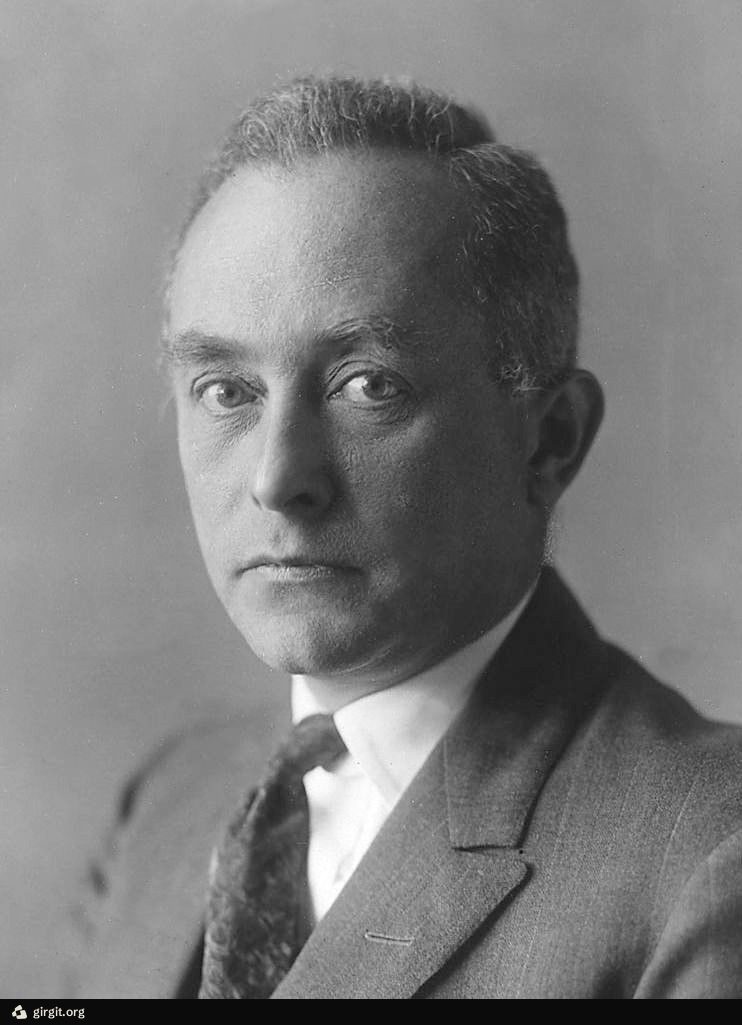
See it
The whole account for sodium and magnesium chlorides with one, two or three chlorines. Guess first; then change the metal and the number of chlorines in the sentence, and open the graph to see every case together.
Solve it
Solve it: predict MgO
The page says MgO has a lattice enthalpy near 3800 kJ mol−1. Predict it yourself from NaCl's 788, using only charges and distances: Na–Cl is 283 pm, and Mg–O is 72 + 140 = 212 pm. Both crystals have the rock-salt arrangement.
Hint
Answer
Solve it: the compound that eats itself
The widget estimates ΔfH of MgCl at about −90 kJ mol−1: negative, so it should form. Measured ΔfH of MgCl2 is −641 kJ mol−1. Show that MgCl would still never be seen.
Answer
Solve it: a teaspoon of salt
A teaspoon holds about 6 g of salt (NaCl, 58.5 g mol−1). How much energy would it take to pull all its ions apart into a gas? Compare it with heating a cup of water (250 g) from 25 °C to boiling (4.18 J g−1 °C−1).
Answer
Solve it: spot the error
"Sodium chloride forms because chlorine's electron gain enthalpy pays for sodium's ionisation enthalpy." What is wrong?
Answer
Connect it
Connect it
- The costs, Periodicity. The jump in successive ionisation enthalpies at each new shell, electron gain enthalpy of chlorine, and the ionic radii that set the distance.
- Why the core is so expensive, Structure of Atom. The neon core under sodium's 3s electron: electronic configuration.
- Kössel's idea, measured. The giving and taking of the first page, and how real ionic bonds gain some covalent character in Fajans' rules.
- Hess's law, Thermodynamics. The Born–Haber cycle is Hess's law at work: Hess's law and lattice and solution enthalpy.
- Salt in India. Most of India's inland salt comes from the Rann of Kutch, where the sun drives the water off brine and the ions settle back into their cubes.
Still confused?
Is there an "NaCl molecule" inside the crystal?
No. Every Na+ is held equally by six Cl− neighbours; none of them is "its" partner. The formula NaCl only says the ions come in a 1 : 1 ratio. That is why a salt crystal is one giant structure with no separate molecules, and why it takes so much heat to melt.
If lattice enthalpy is so huge, how does salt dissolve in water?
Water molecules are polar. Their negative oxygen ends crowd round each Na+ and their positive hydrogen ends round each Cl−, and that attraction pays back nearly all of the lattice enthalpy. The small difference is made up by the disorder gained when the ions spread through the water, which you meet in Thermodynamics.
Is lattice enthalpy ever measured directly?
No. It is worked out from the Born–Haber cycle, using quantities that can be measured (sublimation, ionisation, bond and electron gain enthalpies, and the enthalpy of formation), or calculated from the charges and the crystal geometry. The two ways agree closely for salts like NaCl, which is the evidence that their bonding really is ionic.
Sources
- Born–Haber cycle (Wikipedia): Born and Haber 1919, Fajans independently
- Kapustinskii equation (Wikipedia): the 1956 formula and its constants
- Lattice energy (Wikipedia): NaCl and BaO values
- Madelung constant (Wikipedia): 1.748 for rock salt
- Molar ionisation energies of the elements (Wikipedia, CRC data)
- R.D. Shannon, revised effective ionic radii, Acta Cryst. A32, 751 (1976), via Ionic radius (Wikipedia)
- Max Born (Wikipedia)
- Fritz Haber (Wikipedia): Nobel Prize 1918, chlorine at Ypres
- Little Rann of Kutch (Wikipedia): salt panning
Picture and video credits
Show 2 picture and video credits
- halite-cubes.jpg: James St. John, CC BY 2.0
- salt-worker-rann-of-kutch.jpg: Vinod Panicker, CC BY-SA 2.5

