- 1. How do we measure an angle?
- 2. What is a radian?
- 3. Changing degrees into radians and back
- 4. Sine and cosine for any angle
- 5. Tan, cot, sec and cosec
- 6. Which functions are positive where?
- 7. Domain and range of the six functions
- 8. What the graphs look like, and why they repeat
- 9. Sine and cosine of a sum or difference
- 10. Angles like π − x, and tan of a sum
- 11. Double and triple angles
- 12. Turning sums into products and back
- Review
4 of 12·NCERT §3.3·5 min
Sine and cosine for any angle
The big ideaWalk a distance \( x \) anticlockwise round the unit circle from \( (1, 0) \); the point you reach is \( (\cos x, \sin x) \), and this defines sine and cosine for every real number.
In simple words
Picture a round track with its centre at the middle of graph paper and a radius of 1. Start at the right-hand edge and walk round, against the clock. Wherever you stop, ask two questions: how far to the right of the centre am I, and how far above it? The first answer is the cosine. The second is the sine. Walk backwards and you get the answers for minus numbers.
The definition
Draw a unit circle with its centre at the origin O. Let A be the point \( (1, 0) \). Go along the circle from A, anticlockwise, an arc of length \( x \), and call the point you reach \( P(a, b) \). Then \( \angle AOP = x \) radian, and we define
\[ \cos x = a, \qquad \sin x = b \]In words: cosine is the \( x \)-coordinate and sine is the \( y \)-coordinate of the point on the unit circle. For negative \( x \), go clockwise instead.
This matches what you learnt in Class 10. If \( P \) is in the first quadrant, drop a perpendicular PM to the \( x \)-axis. Triangle OMP is right-angled with hypotenuse \( OP = 1 \), adjacent side \( OM = a \) and opposite side \( MP = b \). So \( \cos x = \tfrac{a}{1} \) and \( \sin x = \tfrac{b}{1} \), exactly the old ratios. The new definition simply keeps working after the triangle runs out.
Try it: walk P round the circle, past the first quadrant and all the way back, and watch the two coordinates.
The most used identity
Since \( P(a, b) \) is on a circle of radius 1, its distance from O is 1. By Pythagoras, \( OM^2 + MP^2 = OP^2 \), so \( a^2 + b^2 = 1 \). Hence, for every real \( x \),
\[ \cos^2 x + \sin^2 x = 1 \](\( \cos^2 x \) means \( (\cos x)^2 \).) This holds for every angle, not only acute ones, because every point of the unit circle obeys \( a^2 + b^2 = 1 \).
Quadrantal angles
Angles that are integer multiples of \( \tfrac{\pi}{2} \) put P exactly on an axis. These are called quadrantal angles. A quarter turn takes you from A\( (1, 0) \) to B\( (0, 1) \), a half turn to C\( (-1, 0) \), three quarters to D\( (0, -1) \), and a full turn back to A.
| Angle | Point P | cos | sin |
|---|---|---|---|
| \( 0 \) | \( (1, 0) \) | \( 1 \) | \( 0 \) |
| \( \tfrac{\pi}{2} \) | \( (0, 1) \) | \( 0 \) | \( 1 \) |
| \( \pi \) | \( (-1, 0) \) | \( -1 \) | \( 0 \) |
| \( \tfrac{3\pi}{2} \) | \( (0, -1) \) | \( 0 \) | \( -1 \) |
| \( 2\pi \) | \( (1, 0) \) | \( 1 \) | \( 0 \) |
Going round again changes nothing
After one full turn, \( 2\pi \), you are back at the same point P. After any whole number of turns, forwards or backwards, the same. So for every integer \( n \):
\[ \sin(2n\pi + x) = \sin x, \qquad \cos(2n\pi + x) = \cos x, \qquad n \in \mathbf{Z} \]Where sine and cosine are zero
- \( \sin x = 0 \) when P is on the \( x \)-axis: at \( x = 0, \pm\pi, \pm 2\pi, \pm 3\pi, \dots \) So \( \sin x = 0 \) exactly when \( x = n\pi \), \( n \) any integer.
- \( \cos x = 0 \) when P is on the \( y \)-axis: at \( x = \pm\tfrac{\pi}{2}, \pm\tfrac{3\pi}{2}, \pm\tfrac{5\pi}{2}, \dots \), the odd multiples of \( \tfrac{\pi}{2} \). So \( \cos x = 0 \) exactly when \( x = (2n + 1)\tfrac{\pi}{2} \), \( n \) any integer.
Worked example
- \( \sin \tfrac{5\pi}{2} = \sin\left(2\pi + \tfrac{\pi}{2}\right) = \sin \tfrac{\pi}{2} = 1 \).
- \( \cos(-3\pi) = \cos(-4\pi + \pi) = \cos \pi = -1 \). (Here \( n = -2 \).)
- \( \cos 7\pi \): \( 7\pi = 6\pi + \pi \), so \( \cos 7\pi = \cos \pi = -1 \).
- If \( \cos x = 0.6 \), what can \( \sin x \) be? \( \sin^2 x = 1 - 0.36 = 0.64 \), so \( \sin x = 0.8 \) or \( -0.8 \). Without knowing the quadrant, both are possible.
Remember
- On the unit circle, \( P = (\cos x, \sin x) \).
- \( \cos^2 x + \sin^2 x = 1 \) for every real \( x \).
- \( \sin x = 0 \iff x = n\pi \); \( \cos x = 0 \iff x = (2n+1)\tfrac{\pi}{2} \).
Try it. (a) Find \( \sin \tfrac{7\pi}{2} \) and \( \cos(-2\pi) \). (b) Is \( \sin x = 0 \) at \( x = 15\pi \)? Is \( \cos x = 0 \) at \( x = 15\pi \)? (c) If \( \sin x = \tfrac{5}{13} \), find the two possible values of \( \cos x \).
Answer
Just remember
Two conventions with no deeper reason: someone had to pick an order and a way of writing it. Hooks below; the unit circle rebuilds both.
- The point is \( (\cos x, \sin x) \), cos first
- Alphabet order twice over: c before s, and x before y. So cos goes with \( x \) (across) and sin with \( y \) (up). Rebuild: at \( x = 0 \) you stand at \( (1, 0) \), and \( \cos 0 = 1 \), \( \sin 0 = 0 \), so the first number must be cos.
- \( \cos^2 x \) means \( (\cos x)^2 \)
- The little 2 sits on the function's name but squares the answer, not the angle. It is not \( \cos(x^2) \). (Only \( \cos^{-1} x \), in Class 12, breaks this pattern.)
- Unit circle
- Circle of radius 1 with centre at the origin.
- \( \cos x \)
- The \( x \)-coordinate of the point reached after an arc \( x \).
- \( \sin x \)
- The \( y \)-coordinate of that point.
- Quadrantal angle
- An integer multiple of \( \tfrac{\pi}{2} \); the point lies on an axis.
- \( n \in \mathbf{Z} \)
- \( n \) is any integer: \( \dots, -2, -1, 0, 1, 2, \dots \)
Words to know
The point on the unit circle for angle \( x \) is \( (-0.6, 0.8) \). What is \( \sin x \)?
- \( -0.6 \)
- \( 0.8 \)
- \( -\tfrac{4}{3} \)
For which values of \( x \) is \( \cos x = 0 \)?
- \( x = n\pi \)
- \( x = (2n + 1)\tfrac{\pi}{2} \)
- \( x = 2n\pi \)
Which statement is true for every real \( x \)?
- \( \sin x + \cos x = 1 \)
- \( \sin^2 x + \cos^2 x = 1 \)
- \( \sin x = \cos x \)
Deep dive · optional
Why is the sine half of a bowstring?
Where the definition comes from, why it is a coordinate, and how an Indian word for a bowstring became the English word "sine". The exam does not ask this; it is here so the definition never feels arbitrary again.
The roots: why a coordinate, why radius 1
- Why is \( \sin x \) the \( y \)-coordinate of P?Because for an acute angle that is exactly the Class 10 ratio: opposite ÷ hypotenuse, with the hypotenuse OP equal to 1. The new definition agrees with the old one wherever the old one works.
- Why does it have to be a circle of radius 1?It does not have to be. On a circle of radius \( r \) the point is \( (r\cos x, r\sin x) \); dividing by \( r \) gives the same two numbers. Radius 1 just means there is nothing to divide by: the coordinates are the values.
- Why does \( \cos^2 x + \sin^2 x = 1 \) then hold for every angle?Because every point of the circle is at distance 1 from O, in every quadrant. The definition was chosen so that this, the most useful fact about the triangle, survives after the triangle is gone.
- Why is this "half a chord"?Reflect P in the \( x \)-axis to get P′, at angle \( -x \). The chord PP′ is cut in half by the axis at M, so \( MP = \sin x \) is half the chord of the arc \( 2x \). Old astronomers measured chords of circles; the half-chord is the piece that sits in a right triangle.
- And underneath?Pythagoras: a circle is just the set of points at one fixed distance from the centre, and distance is worked out with \( a^2 + b^2 \).
So "sine" is not a new invention of this chapter. Greek astronomers, from Hipparchus in the second century BCE, made tables of chords: the straight line across a circle for a given arc. Indian astronomers noticed that only half of that chord is needed, because the half-chord, the radius and a piece of the diameter make a right triangle. That half-chord is our sine. The chord itself is still useful: for an arc \( 2x \) on a unit circle,
\[ \text{chord}(2x) = 2\sin x . \]The story: a bowstring that became a fold
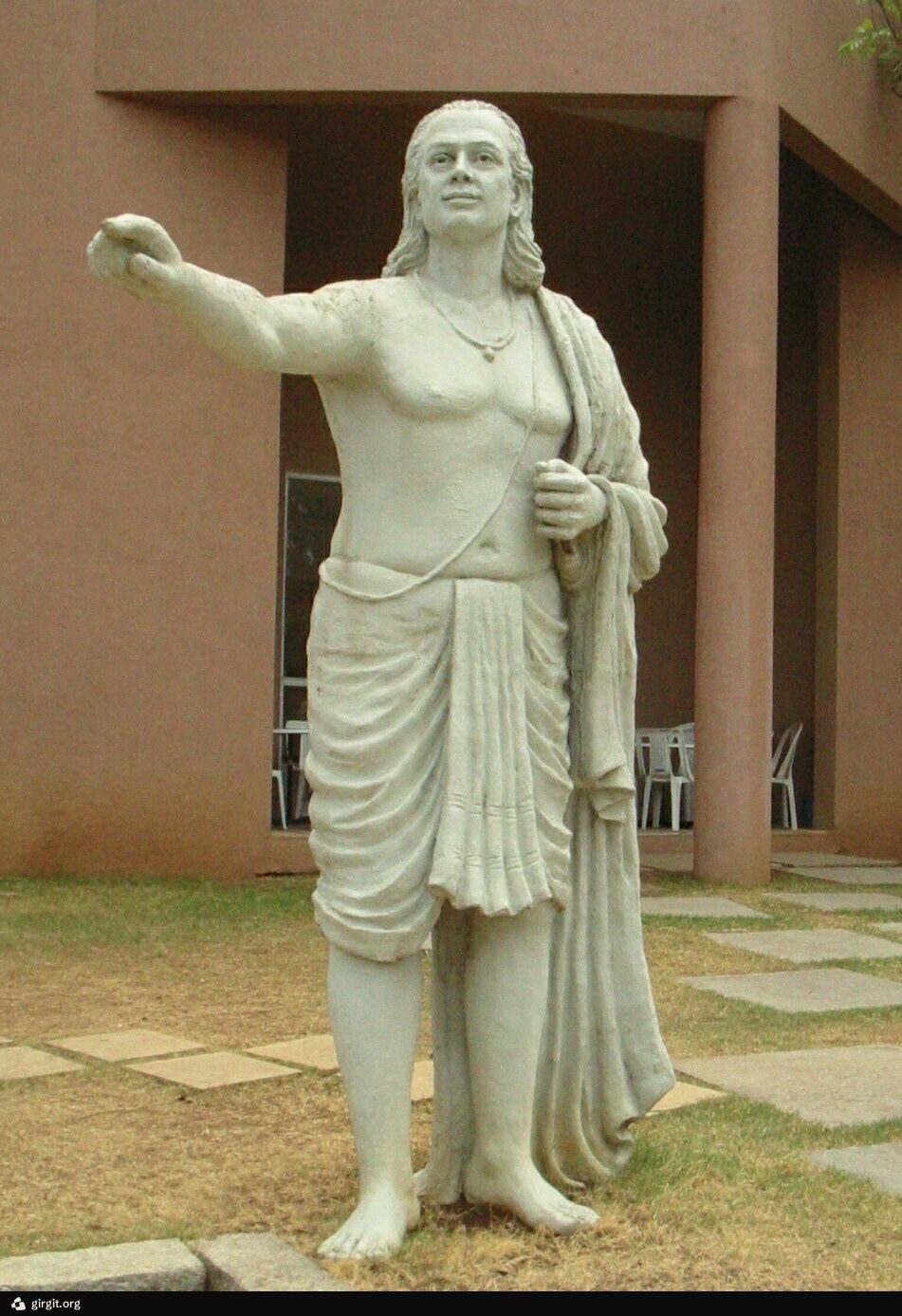
Why the odd radius 3438? A full circle has \( 360 \times 60 = 21600 \) minutes of arc. If the radius is measured in the same "minutes" as the arc, it must be \( \tfrac{21600}{2\pi} \approx 3437.7 \), so 3438. Aryabhata was measuring the radius and the arc with one ruler, which is exactly the idea behind the radian on page 2. That is why his first jump, 225, equals the first arc, 225 minutes: for a small angle the half-chord and the arc are almost the same length.
See it: the table, all at once
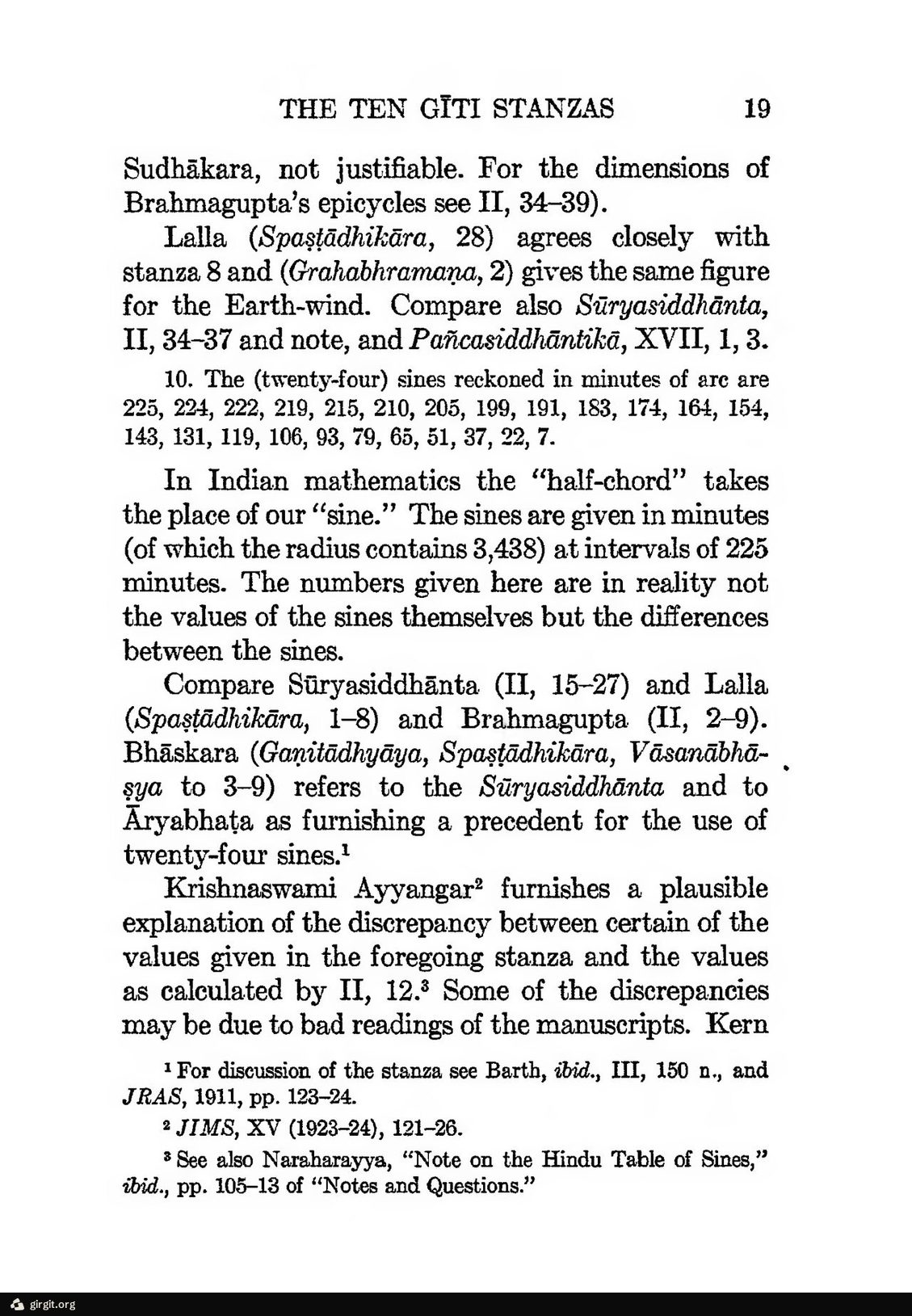 the 24 jumpsradius 3438
Drag P below and the bow, the string and the half-string move together. Then look at the bottom chart: all 24 of Aryabhata's jumps as bars, their running total as dots, and the true sine curve under the dots. Tap a bar to see how close a 1,500-year-old table comes.
Why do the jumps shrink? Near 0° the point P on the circle moves almost straight up, so its height grows fast. Near 90° it moves almost sideways, so its height hardly changes. The size of each jump follows the cosine, and the cosine falls from 1 to 0. (This is the first glimpse of a Class 12 fact: the rate of change of \( \sin x \) is \( \cos x \).)
Solve it
Solve it
Aryabhata's first sine is 225 on a circle of radius 3438, for an arc of 225 minutes. Turn this into today's numbers and say what it tells you about \( \sin x \) for a small angle.
Hint
Answer
Spot the error
A student writes: "P = (3, 4) is on the terminal side of angle \( x \), and sine is the \( y \)-coordinate, so \( \sin x = 4 \)." What went wrong, and what is \( \sin x \)?
Answer
Solve it (JEE style)
A and B are the points of the unit circle for angles \( a \) and \( b \). Show that the chord AB has length \( 2\left|\sin \tfrac{a - b}{2}\right| \). Then find the side of a regular 12-sided polygon drawn inside a circle of radius 10 cm.
Hint
Answer
Connect it
Connect it
- Radians, page 2. Aryabhata's 3438 is a radius measured in arc-minutes: the same "measure the arc with the radius" idea as the radian.
- The sum formula, page 9. The proof of \( \cos(x + y) \) on page 9 compares two chords of the unit circle: chords again.
- Physics: SHM and circular motion. The shadow of a point going round a circle moves in simple harmonic motion, \( x = A\cos\omega t \): Oscillations.
- Limits, Ch 12. "The half-chord is almost the arc" becomes \( \lim_{x \to 0} \tfrac{\sin x}{x} = 1 \): sin x over x.
- The circle, Ch 10. Every point of \( x^2 + y^2 = r^2 \) can be written \( (r\cos\theta, r\sin\theta) \): the circle.
Still confused?
In Class 10 sine was a ratio. Now it is a coordinate. Which is it?
Both, and they agree. A ratio does not depend on the size of the triangle, so you may pick the triangle whose hypotenuse is 1. Then "opposite ÷ hypotenuse" is just "opposite", which is the \( y \)-coordinate of P. The coordinate version is the ratio version with the division already done, and it keeps working past 90°.
Is \( x \) an angle or a length here?
On the unit circle it is both at once. The arc walked from A has length \( x \), and the angle it makes at O is \( x \) radians, because on a circle of radius 1 arc length = angle in radians. That is why the definition can say "walk a distance \( x \)".
Why did old tables use a radius like 3438 or 60 instead of 1?
Before decimals were common, a fraction like 0.0654 was awkward to write. A big radius turned every sine into a whole number of units (225 instead of 0.0654). Radius 1 became the standard with Euler's book of 1748; see the story on page 6.
Sources
- Sine and cosine: etymology (jya, jiba, jayb, sinus; Gerard of Cremona, Robert of Chester), Wikipedia.
- Aryabhata's sine table (24 differences, radius 3438, interval 225′, the verse and its letter-numbers), Wikipedia.
- W. E. Clark, The Aryabhatiya of Aryabhata (University of Chicago Press, 1930), Dasagitika stanza 10, p. 19.
- Aryabhata (age 23 at 3,600 years of the Kali Yuga, 499 CE; ardha-jya), Wikipedia; and Aryabhata, MacTutor History of Mathematics, St Andrews.
- History of trigonometry (Hipparchus's chord table; jya and koti-jya), Wikipedia.
Picture and video credits