- 1. How do we measure an angle?
- 2. What is a radian?
- 3. Changing degrees into radians and back
- 4. Sine and cosine for any angle
- 5. Tan, cot, sec and cosec
- 6. Which functions are positive where?
- 7. Domain and range of the six functions
- 8. What the graphs look like, and why they repeat
- 9. Sine and cosine of a sum or difference
- 10. Angles like π − x, and tan of a sum
- 11. Double and triple angles
- 12. Turning sums into products and back
- Review
11 of 12·NCERT §3.4·6 min
Double and triple angles
The big ideaPut \( y = x \) in the sum formulas and you get the double-angle formulas; add one more \( x \) and you get the triple-angle formulas.
In simple words
If you know a recipe for two angles put together, try putting an angle together with itself. That gives a recipe for twice the angle. Do it once more and you have a recipe for three times the angle. Run the recipe for twice the angle backwards and it tells you about half an angle too.
Try it first: test some likely-looking formulas against the real curves.
\( \cos 2x \): one formula, four faces
In \( \cos(x + y) = \cos x \cos y - \sin x \sin y \), put \( y = x \):
\[ \cos 2x = \cos^2 x - \sin^2 x \]Now use \( \sin^2 x + \cos^2 x = 1 \) to rewrite it.
- Replace \( \sin^2 x \) by \( 1 - \cos^2 x \): \( \cos 2x = 2\cos^2 x - 1 \).
- Replace \( \cos^2 x \) by \( 1 - \sin^2 x \): \( \cos 2x = 1 - 2\sin^2 x \).
- Write \( \cos 2x = \dfrac{\cos^2 x - \sin^2 x}{\cos^2 x + \sin^2 x} \) (the bottom is 1) and divide top and bottom by \( \cos^2 x \): \[ \cos 2x = \frac{1 - \tan^2 x}{1 + \tan^2 x}, \qquad x \ne n\pi + \tfrac{\pi}{2} \]
So in all: \( \cos 2x = \cos^2 x - \sin^2 x = 2\cos^2 x - 1 = 1 - 2\sin^2 x = \dfrac{1 - \tan^2 x}{1 + \tan^2 x} \). Pick whichever face matches what you are given.
\( \sin 2x \) and \( \tan 2x \)
Put \( y = x \) in \( \sin(x + y) \): \( \sin 2x = \sin x \cos x + \cos x \sin x \), so
\[ \sin 2x = 2\sin x \cos x = \frac{2\tan x}{1 + \tan^2 x}, \qquad x \ne n\pi + \tfrac{\pi}{2} \](For the second form, write \( \sin 2x = \dfrac{2\sin x \cos x}{\cos^2 x + \sin^2 x} \) and divide top and bottom by \( \cos^2 x \).)
Put \( y = x \) in \( \tan(x + y) \):
\[ \tan 2x = \frac{2\tan x}{1 - \tan^2 x}, \qquad 2x \ne n\pi + \tfrac{\pi}{2} \]Triple angles
Write \( 3x = 2x + x \) and use the double-angle formulas.
- \( \sin 3x = \sin 2x \cos x + \cos 2x \sin x = 2\sin x \cos^2 x + (1 - 2\sin^2 x)\sin x \). Put \( \cos^2 x = 1 - \sin^2 x \): \( 2\sin x - 2\sin^3 x + \sin x - 2\sin^3 x \). \[ \sin 3x = 3\sin x - 4\sin^3 x \]
- \( \cos 3x = \cos 2x \cos x - \sin 2x \sin x = (2\cos^2 x - 1)\cos x - 2\sin^2 x \cos x \). Put \( \sin^2 x = 1 - \cos^2 x \): \( 2\cos^3 x - \cos x - 2\cos x + 2\cos^3 x \). \[ \cos 3x = 4\cos^3 x - 3\cos x \]
- \( \tan 3x = \dfrac{\tan 2x + \tan x}{1 - \tan 2x \tan x} \). Substitute \( \tan 2x = \tfrac{2\tan x}{1 - \tan^2 x} \) and multiply top and bottom by \( 1 - \tan^2 x \): \[ \tan 3x = \frac{3\tan x - \tan^3 x}{1 - 3\tan^2 x}, \qquad 3x \ne n\pi + \tfrac{\pi}{2} \]
A quick memory check: \( \sin 3x \) starts with a "3 sin" and \( \cos 3x \) starts with a "4 cos cubed". Test at \( x = \tfrac{\pi}{6} \): \( 3 \cdot \tfrac{1}{2} - 4 \cdot \tfrac{1}{8} = 1 = \sin \tfrac{\pi}{2} \).
Running \( \cos 2x \) backwards: half angles
Rearranging two faces of \( \cos 2x \) gives the forms used most in problems:
\[ 1 + \cos 2x = 2\cos^2 x, \qquad 1 - \cos 2x = 2\sin^2 x \]Write \( \tfrac{x}{2} \) in place of \( x \) and they become \( 2\cos^2 \tfrac{x}{2} = 1 + \cos x \) and \( 2\sin^2 \tfrac{x}{2} = 1 - \cos x \): the half-angle values from \( \cos x \).
Worked example
\( \sin x = \tfrac{3}{5} \), \( x \) in the second quadrant. Find \( \sin 2x \), \( \cos 2x \), \( \tan 2x \).
- Cosine is negative in II: \( \cos x = -\tfrac{4}{5} \), so \( \tan x = -\tfrac{3}{4} \).
- \( \sin 2x = 2 \cdot \tfrac{3}{5} \cdot \left(-\tfrac{4}{5}\right) = -\tfrac{24}{25} \).
- \( \cos 2x = 1 - 2\sin^2 x = 1 - \tfrac{18}{25} = \tfrac{7}{25} \).
- \( \tan 2x = \tfrac{\sin 2x}{\cos 2x} = -\tfrac{24}{7} \). Check with the tan formula: \( \dfrac{2(-3/4)}{1 - 9/16} = \dfrac{-3/2}{7/16} = -\tfrac{24}{7} \).
Worked example
- An exact value. \( 2\cos^2 \tfrac{\pi}{8} = 1 + \cos \tfrac{\pi}{4} = 1 + \tfrac{\sqrt{2}}{2} \), so \( \cos^2 \tfrac{\pi}{8} = \tfrac{2 + \sqrt{2}}{4} \). \( \tfrac{\pi}{8} \) is in the first quadrant, so \( \cos \tfrac{\pi}{8} = \tfrac{\sqrt{2 + \sqrt{2}}}{2} \).
- Half angles. \( \cos x = -\tfrac{7}{25} \) with \( \pi \lt x \lt \tfrac{3\pi}{2} \). Then \( \tfrac{\pi}{2} \lt \tfrac{x}{2} \lt \tfrac{3\pi}{4} \), the second quadrant: \( \sin \tfrac{x}{2} \gt 0 \), \( \cos \tfrac{x}{2} \lt 0 \). \( 2\sin^2 \tfrac{x}{2} = 1 + \tfrac{7}{25} = \tfrac{32}{25} \), so \( \sin \tfrac{x}{2} = \tfrac{4}{5} \). \( 2\cos^2 \tfrac{x}{2} = 1 - \tfrac{7}{25} = \tfrac{18}{25} \), so \( \cos \tfrac{x}{2} = -\tfrac{3}{5} \). Hence \( \tan \tfrac{x}{2} = -\tfrac{4}{3} \).
Don't mix these up
- \( \sin 2x \ne 2\sin x \). At \( x = \tfrac{\pi}{2} \): \( \sin \pi = 0 \), but \( 2\sin \tfrac{\pi}{2} = 2 \).
- \( \cos 2x = 2\cos^2 x - 1 \) (cos form) but \( 1 - 2\sin^2 x \) (sin form). The 1 moves.
- \( \sin 3x = 3\sin x - 4\sin^3 x \), while \( \cos 3x = 4\cos^3 x - 3\cos x \): the order is reversed.
Try it. (a) If \( \tan x = \tfrac{1}{2} \), find \( \tan 2x \) and \( \cos 2x \). (b) Show that \( \dfrac{1 - \cos 2x}{\sin 2x} = \tan x \). (c) Find \( \cos 3x \) when \( \cos x = \tfrac{1}{3} \).
Answer
Just remember
All of these come from the sum formula in a few lines, so the hooks are only for speed. Better than any hook: test your memory at an angle you know, usually \( x = 0 \) or \( x = 90^\circ \).
- \( \sin 3x = 3\sin x - 4\sin^3 x \), \( \cos 3x = 4\cos^3 x - 3\cos x \)
- "Sine says teen–chaar, cos says chaar–teen": 3 then 4 for sine, 4 then 3 for cos. Check: at \( x = 0 \), \( \cos 0 = 1 \) needs \( 4 - 3 \); at \( x = 90^\circ \), \( \sin 270^\circ = -1 \) needs \( 3 - 4 \).
- \( \cos 2x = 2\cos^2 x - 1 = 1 - 2\sin^2 x \)
- "The 1 goes where it keeps the answer 1 at x = 0": \( 2\cdot 1 - 1 = 1 \) and \( 1 - 2 \cdot 0 = 1 \). Write it the other way and \( x = 0 \) gives \( -1 \): wrong.
- \( \tan 2x = \dfrac{2\tan x}{1 - \tan^2 x} \)
- It is \( \tan(x + y) \) with \( y = x \), so it keeps the minus at the bottom ("cos is contrary"). Check: at \( x = 45^\circ \) the bottom is 0 and \( \tan 90^\circ \) is indeed not defined.
- \( 1 - \cos x = 2\sin^2\tfrac{x}{2} \), \( 1 + \cos x = 2\cos^2\tfrac{x}{2} \)
- "Minus goes with sin": for a tiny x, \( 1 - \cos x \) is tiny, and so is \( \sin^2 \) of a tiny angle.
- Double-angle formula
- A formula for \( \sin 2x \), \( \cos 2x \) or \( \tan 2x \) in terms of \( x \).
- Triple-angle formula
- A formula for \( \sin 3x \), \( \cos 3x \) or \( \tan 3x \) in terms of \( x \).
- \( 1 - \cos 2x = 2\sin^2 x \)
- Turns "one minus cos" into a square.
- Half angle
- \( \tfrac{x}{2} \); its sine and cosine come from \( \cos x \).
Words to know
Which of these is not equal to \( \cos 2x \)?
- \( 2\cos^2 x - 1 \)
- \( 2\sin^2 x - 1 \)
- \( \dfrac{1 - \tan^2 x}{1 + \tan^2 x} \)
What is \( 2\sin 15^\circ \cos 15^\circ \)?
- \( \tfrac{1}{2} \)
- \( \sin 15^\circ \)
- \( \tfrac{\sqrt{3}}{2} \)
If \( \sin x = \tfrac{1}{2} \), what is \( \sin 3x \)?
- \( \tfrac{3}{2} \)
- 1
- 0
Deep dive · optional
Halving is easy, thirding is impossible
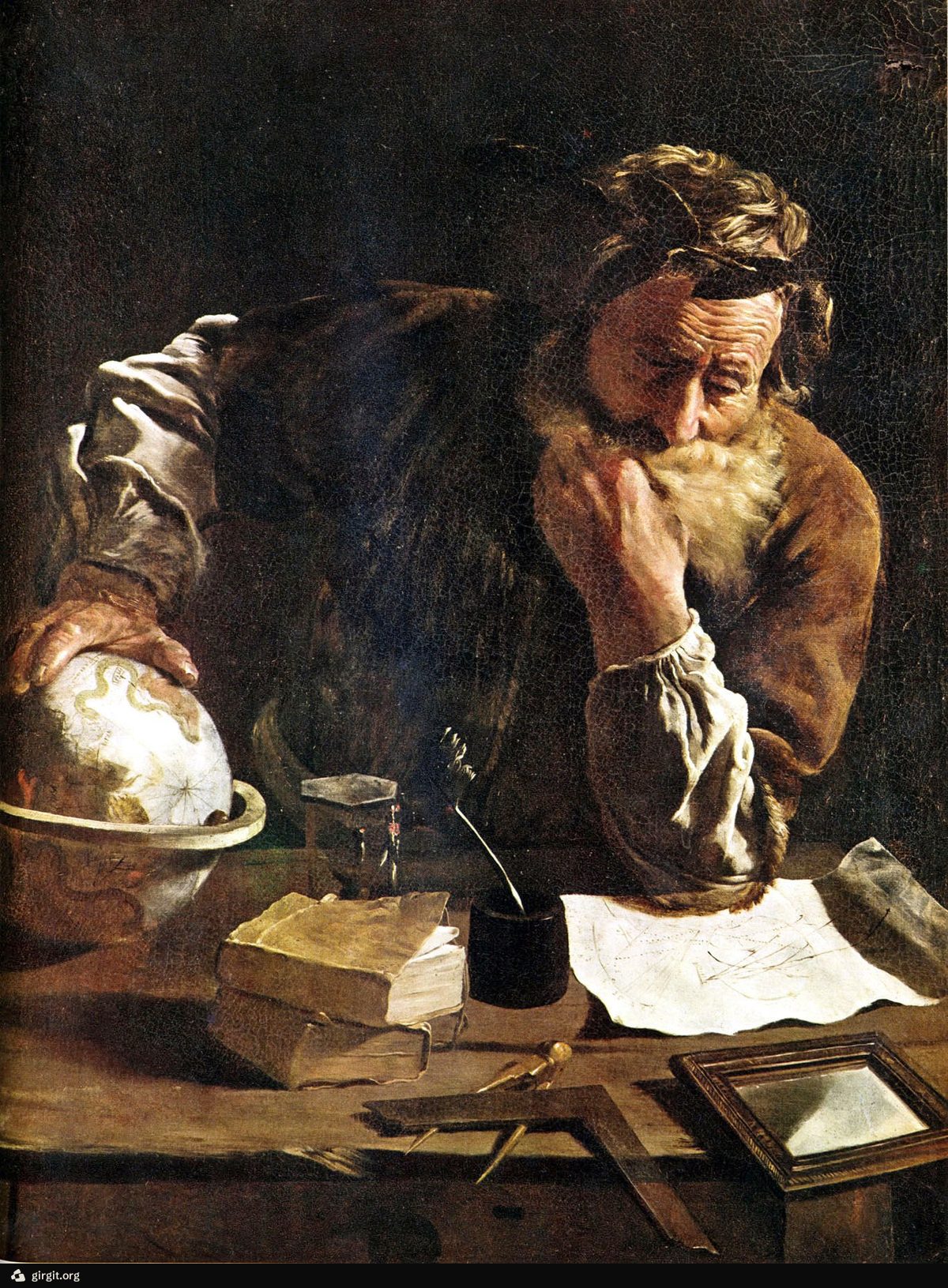
What the double-angle formulas really give you: a way to halve an angle with one square root, which Archimedes used to trap π, and a cubic for the triple angle, which is why no one can trisect 60° with ruler and compass. Beyond the exam, but it shows what these formulas are for.
The roots: one triangle, counted twice
First a second picture proof of \( \sin 2x = 2\sin x \cos x \), by area. Take a thin isosceles triangle with two sides of length 1 and the angle 2x between them. Count its area two ways.
Now the chain that makes these formulas more than tricks.
- Why is there a formula for 2x at all?Because \( 2x = x + x \), and the sum formula works for any two angles, equal ones included.
- Why can cos 2x and cos 3x be written using cos x alone?Because every \( \sin^2 x \) can be traded for \( 1 - \cos^2 x \) (Pythagoras on the unit circle). So \( \cos 2x = 2c^2 - 1 \) and \( \cos 3x = 4c^3 - 3c \), where \( c = \cos x \): a square and a cube.
- Why does that make halving easy?To halve, run \( \cos 2x = 2c^2 - 1 \) backwards: \( c = \sqrt{(1 + \cos 2x)/2} \). One square root. With a ruler and compass you can draw a square root (it is a half-chord in a semicircle), so halving an angle is easy: it is the bisection with arcs you learnt in school.
- Why does that make thirding hard?To third, run \( \cos 3x = 4c^3 - 3c \) backwards: you must solve a cubic. For \( 3x = 60^\circ \) it is \( 8c^3 - 6c - 1 = 0 \), and this cubic has no rational root, so its roots cannot be reached by square roots alone.
- And why do square roots matter?A ruler draws lines and a compass draws circles. Where lines and circles cross, you only ever solve equations of degree 1 or 2, so every length you can construct is built from \( +, -, \times, \div \) and square roots. That is the bedrock: a cubic that refuses square roots is out of reach.
So the two formulas in this page are two halves of one story: \( \cos 2x \) is a quadratic in \( \cos x \), and quadratics are friendly; \( \cos 3x \) is a cubic, and that one cubic settled a 2000-year-old puzzle.
The story: π squeezed, a cubic solved, a puzzle closed
See it
 compassesgeometry drawings
Double the sides and watch the two polygons pinch the circle. The numbers are not looked up: each row is made from the one before by \( \cos\tfrac{\theta}{2} = \sqrt{\tfrac{1 + \cos\theta}{2}} \), starting from a hexagon.
Solve it
Solve it · a classic product
Show that \( \cos 20^\circ \cos 40^\circ \cos 80^\circ = \tfrac{1}{8} \).
Hint
Answer
Solve it · why 60° won't split in three
Show that \( c = \cos 20^\circ \) satisfies \( 8c^3 - 6c - 1 = 0 \), and check that no fraction \( \tfrac{p}{q} \) is a root.
Hint
Answer
Solve it · predict, then check
Aryabhata's value was 3.1416. Guess how many sides the two polygons need before both bounds round to 3.1416, then find it with the widget.
Answer
Connect it
Connect it
- Limits, Ch 12. Archimedes' squeeze \( \sin\theta \lt \theta \lt \tan\theta \) is the same one that proves \( \tfrac{\sin x}{x} \to 1 \): see the sandwich theorem.
- Integrals, Class 12. \( \cos^2 x = \tfrac{1 + \cos 2x}{2} \) is how you integrate a square of a cosine: integrals using trig identities.
- Projectiles, Physics Ch 3. The range of a throw is \( \tfrac{u^2\sin 2\theta}{g} \): the \( 2\sin\theta\cos\theta \) is the across speed times the time in the air, and it is largest at 45° because \( \sin 2\theta \le 1 \). See height, range and time of flight.
- Sum formulas, this chapter. Everything here is the sum formula with y = x, once or twice.
Still confused?
sin 2x = 2 sin x cos x has a 2 in it. Why does it never go above 1?
Because \( \sin x \) and \( \cos x \) are never both large: \( 2\sin x\cos x \le \sin^2 x + \cos^2 x = 1 \), since \( (\sin x - \cos x)^2 \ge 0 \). Equality is at 45°, where both are \( \tfrac{1}{\sqrt{2}} \).
Which face of cos 2x should I use?
The one that matches what you have. Given only sin x, use \( 1 - 2\sin^2 x \); only cos x, use \( 2\cos^2 x - 1 \); only tan x, use \( \tfrac{1 - \tan^2 x}{1 + \tan^2 x} \). Going backwards to a half angle, use the forms with the 1 (\( 1 \pm \cos \)), because they turn into a single square.
Sources
- Measurement of a Circle, Wikipedia (96-gons; \( 3\tfrac{10}{71} \lt \pi \lt 3\tfrac{1}{7} \)).
- Archimedes' Algorithm, Wolfram MathWorld (perimeters \( 2n\sin\tfrac{\pi}{n} \), \( 2n\tan\tfrac{\pi}{n} \), doubling from the hexagon).
- Aryabhata, Wikipedia (circumference 62832 for diameter 20000).
- Cubic equation, Wikipedia (Viète, trigonometric solution for three real roots).
- Angle trisection, Wikipedia (Wantzel 1837; \( 8x^3 - 6x - 1 = 0 \) for \( \cos 20^\circ \)).
- Domenico Fetti, Archimedes (1620), Wikimedia Commons.

Picture and video credits