Act 08NCERT §2.4 · pp. 17–214 min
Stopping distance and reaction time
A bus at 20 m/s: for 0.5 s while the driver reacts it does not slow at all and covers 10 m; then it brakes at 5 m/s² and stops 40 m later. Its ghosts are evenly spaced, then crowd together; under them the velocity-time graph is flat, then a falling line.
Half a second to react, at full speed. Then the brakes: the ghosts crowd together.
From the textbookpp. 17–21
NCERT Physics Part I, Class 11 · Rationalised 2023-24
8.0The big idea
Twice the speed. Four times the road.
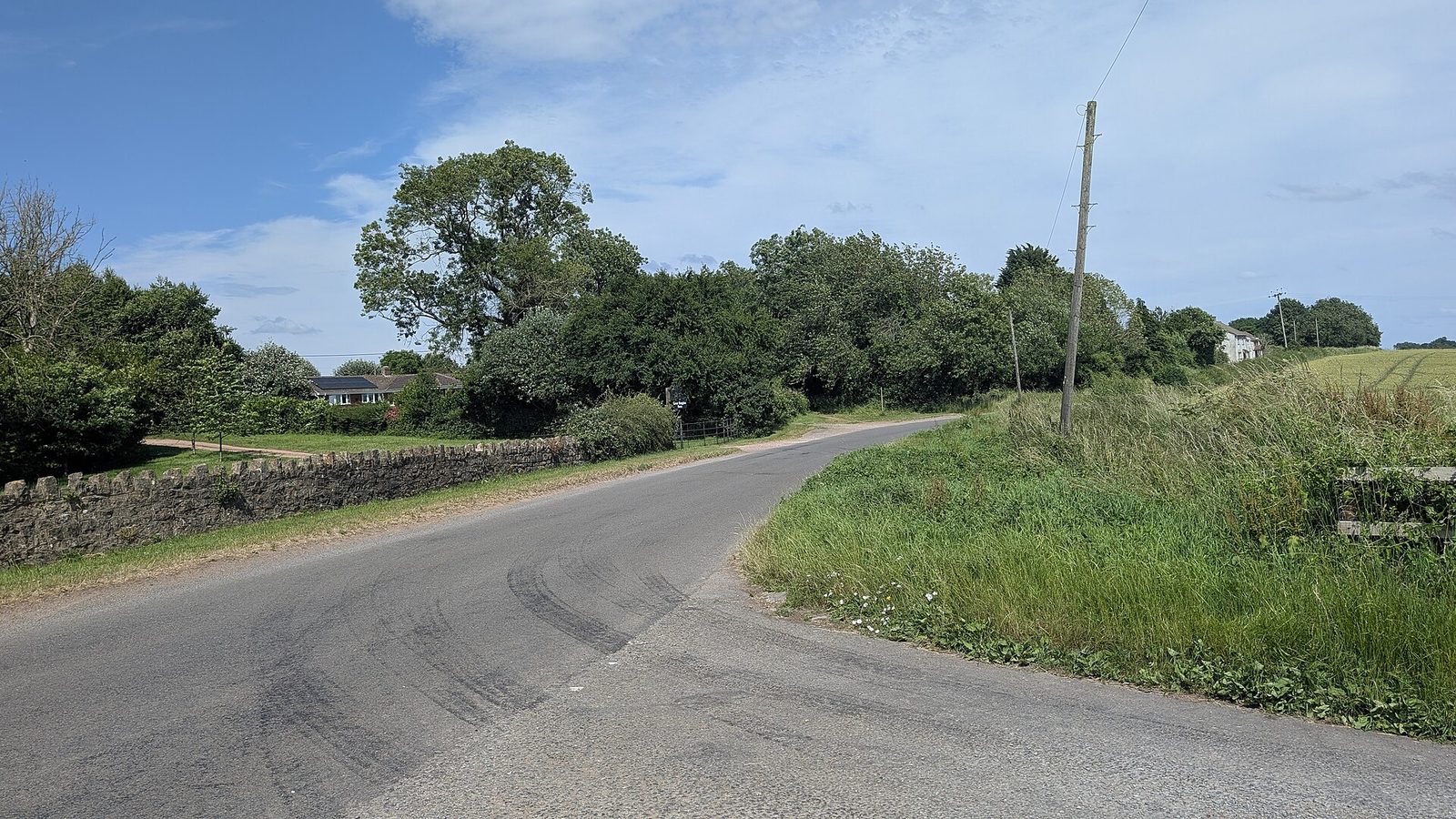
Skid marks are the braking distance written on the road. And before the brakes do anything, the driver must see and move a foot, at full speed.
Full text
The big ideaBraking distance grows with the square of the speed, and a driver's reaction time adds extra distance before the brakes even start.
In simple words
A car going twice as fast does not need twice the road to stop. It needs four times the road. And before the brakes do anything, the driver has to see the danger and move a foot, and all that while the car keeps rolling at full speed.
8.1Stopping distance
Speed squared, over twice the braking
Final velocity zero, time not needed: \( 0 = v_0^2 - 2a\,d_s \).
The stopping distance is proportional to the square of the starting speed.
Full text
Stopping distance
When brakes are applied, the distance a vehicle covers before it comes to rest is its stopping distance \( d_s \). It depends on the starting velocity \( v_0 \) and on how hard the brakes can slow the vehicle, its deceleration. Let the acceleration be \( -a \), where \( a \) is the (positive) size of the deceleration.
The final velocity is zero, and we don't care about the time, so use \( v^2 = v_0^2 + 2(-a)d_s \):
\[ 0 = v_0^2 - 2a\,d_s \quad\Longrightarrow\quad d_s = \frac{v_0^2}{2a} \]The stopping distance is proportional to the square of the initial velocity. Double the speed and, with the same brakes, the stopping distance becomes four times as long. Triple it, and it becomes nine times.
Worked example
A bus can brake at 5 m s−2. Find its braking distance at 36 km/h and at 72 km/h.
- 36 km/h = 10 m s−1: \( d_s = \dfrac{10^2}{2 \times 5} = \) 10 m.
- 72 km/h = 20 m s−1: \( d_s = \dfrac{20^2}{2 \times 5} = \) 40 m.
Twice the speed, four times the distance. This is why speed limits near schools and hospitals are kept low: a small cut in speed gives a big cut in stopping distance.
8.2Brakes at 5 m/s²
Why the square
A bus brakes at 5 m/s². From 10 m/s it stops in 2 s and 10 m: a small triangle on its v-t graph. From 20 m/s it takes 4 s and 40 m: a triangle twice as wide and twice as tall, which holds exactly four of the small ones. Then, at 20 m/s, the driver first reacts for 0.5 s without slowing: a flat strip worth 10 m, then the 40 m triangle: 50 m in all. On the road the ghosts are evenly spaced while reacting and crowd together while braking.
From 10 m/s: 2 s and 10 m. The triangle is the distance.
Twice as long to stop, twice as fast on average: four triangles, 40 m.
0.5 s to react, no slowing: 10 m more before the brakes even begin.
Worked example
A bus can brake at 5 m s−2. Find its braking distance at 36 km/h and at 72 km/h.
- 36 km/h = 10 m s−1: \( d_s = \dfrac{10^2}{2 \times 5} = \) 10 m.
- 72 km/h = 20 m s−1: \( d_s = \dfrac{20^2}{2 \times 5} = \) 40 m.
Twice the speed, four times the distance. This is why speed limits near schools and hospitals are kept low: a small cut in speed gives a big cut in stopping distance.
8.3Worked example
A bus braking at 5 m/s²
36 km/h
10m
72 km/h
40m
That is why speed limits near schools and hospitals are low: a small cut in speed, a big cut in stopping distance.
Try itAt the school crossing
Set the speed, let it brake
Brakes at 6 m/s² from the marker. 10 m/s stops in 8.3 m; 20 m/s needs 33.3 m, well past the crossing.
8.4Proportional to the square
×4
the braking distance, when the speed doubles. Triple the speed: ×9.
Like running into a corridor and stopping: twice as fast in, twice as long to stop, at twice the average speed. Four times the floor.
CheckHalf the speed
24 m at 60 km/h
With the same brakes, a car going at 60 km/h needs 24 m to stop. How much does it need at 30 km/h?
- 12 m
- 6 m
- 24 m
8.5Reaction time
Full speed, before the brakes
Notice, decide, act: the reaction time, usually a few tenths of a second. Meanwhile the vehicle does not slow at all.
Full text
Reaction time
When something needs an urgent response, we never respond at once. The reaction time is how long it takes someone to notice, decide and act. A driver sees a child step onto the road; the time until the foot actually presses the brake is the reaction time. It depends on the person and on how complicated the situation is, and is usually a few tenths of a second.
During the reaction time the vehicle does not slow down at all. So the full distance needed to stop is
\[ \text{total} = \underbrace{v_0\,t_r}_{\text{while reacting}} + \underbrace{\frac{v_0^2}{2a}}_{\text{while braking}} \]Worked example
The bus above is going at 20 m s−1 and its driver has a reaction time of 0.5 s. How far does it travel from the moment the driver sees danger?
- While reacting: \( 20 \times 0.5 = 10 \) m.
- While braking: 40 m (from above).
- Total: 50 m. A quarter of it is covered before the brakes even begin.
Worked example
The bus above is going at 20 m s−1 and its driver has a reaction time of 0.5 s. How far does it travel from the moment the driver sees danger?
- While reacting: \( 20 \times 0.5 = 10 \) m.
- While braking: 40 m (from above).
- Total: 50 m. A quarter of it is covered before the brakes even begin.
8.6The same bus, a real driver
A quarter gone before braking
50m
20 m/s and 0.5 s: 10 m reacting, then 40 m braking.
Try itGuess, then change both
Speed against reaction
8.7Measure your own
A ruler is a stopwatch
A 30 cm ruler and a friend. Without warning they let go; you catch it. It fell freely from rest: \( d = \tfrac12 g t_r^2 \).
\( t_r = \sqrt{\dfrac{2d}{g}} \)
Full text
Measure your own reaction time
You need a 30 cm ruler and a friend. Hold your thumb and first finger open at the bottom of the ruler, which your friend holds hanging straight down. Without warning, your friend lets go, and you catch it as fast as you can. Read how far it fell, \( d \).
The ruler falls freely from rest, so \( d = \tfrac12 g t_r^2 \), which gives
\[ t_r = \sqrt{\frac{2d}{g}} \]Worked example
The ruler falls 18.0 cm before you catch it. Find your reaction time (\( g = 9.8 \) m s−2).
- \( d = 0.180 \) m.
- \( t_r = \sqrt{\dfrac{2 \times 0.180}{9.8}} = \sqrt{0.0367} \approx \) 0.19 s.
Try it
A bullet entering a wooden plank loses half its speed after going 3 cm in. If the plank slows it at a constant rate, how much further will it go before it stops?
Answer
Remember
- \( d_s = v_0^2/2a \): double speed, four times the braking distance.
- Reaction time: no slowing at all, distance \( v_0 t_r \).
- Ruler test: \( t_r = \sqrt{2d/g} \).
Try itOn the screen
Catch the falling ruler
Worked example
The ruler falls 18.0 cm before you catch it. Find your reaction time (\( g = 9.8 \) m s−2).
- \( d = 0.180 \) m.
- \( t_r = \sqrt{\dfrac{2 \times 0.180}{9.8}} = \sqrt{0.0367} \approx \) 0.19 s.
8.8Worked example
Caught after 18.0 cm
0.19s
About a blink, when you are waiting for it. A surprised driver is far slower.
CheckFour times as far
Your friend's ruler
Your friend's ruler falls 4 times as far as yours before being caught. Their reaction time is
- 4 times yours
- 2 times yours
- half of yours
8.9Your turn
A bullet in a plank
It loses half its speed in the first 3 cm. Slowed at a constant rate, how much further does it go?
Answer
8.10Don't mix these up
Two distances, two rules
Myth
Double the speed, double the stopping distance
Fact
Braking ×4. Only the reacting part doubles.
Remember
- \( d_s = v_0^2/2a \): double speed, four times the braking distance.
- Reaction time: no slowing at all, distance \( v_0 t_r \).
- Ruler test: \( t_r = \sqrt{2d/g} \).
KeepJust remember
Two handy numbers
They have reasons, but keep them at your fingertips. Tap a card for its hook.
WordsTo know
Four words
- Stopping distance
- How far a vehicle goes after braking begins until it stops.
- Deceleration
- The rate of slowing down; acceleration opposite to the motion.
- Reaction time
- The time to notice, decide and act.
- Proportional to the square
- Doubling one thing makes the other four times as big.
NEETAsked in the exam
The real thing
- ×2time to stop: at 5 m/s², 10 m/s is gone in 2 s; 20 m/s needs 4 s
- ×2average speed: it falls evenly to zero, so half the start
- =×4the triangle: height v₀, base v₀/a, area v₀²/2a
RootsTwice as long, twice as fast
2 × 2 = 4
- The limit is grip between tyre and road, hardly changed by speed.
- Wet or sandy road: less grip, every distance grows.
- Reacting distance v₀t_r only doubles: it wins at low speed.
Full text
The roots: twice as long, twice as fast
- Why does twice the speed need four times the braking road?Because it takes twice as long to stop, and during that time it is going twice as fast on average. 2 × 2 = 4.
- Why twice as long?The brakes take away the same speed every second. At 5 m s−2, 10 m s−1 is gone in 2 s; 20 m s−1 needs 4 s.
- Why twice the average speed?The speed falls evenly to zero, so the average is half the starting speed (the mean speed rule from the equations page). Double the start, double the average.
- Why do the brakes slow it by the same amount per second at any speed?The limit is the grip between tyre and road, and that grip hardly depends on speed. On a wet or sandy road the grip is less, so the deceleration is smaller and every stopping distance grows.
- And the bedrock?The area of the braking triangle on the v-t graph: height \( v_0 \), base \( v_0/a \), area \( v_0^2/2a \).
The reaction part behaves differently. While you react, nothing slows the car, so the distance is just \( v_0 t_r \): it only doubles when the speed doubles. At low speeds the reaction part can be bigger than the braking part; at high speeds the braking part, growing as the square, takes over.
Why is there any delay at all? Your eye must catch the danger, your brain must notice and decide, and a signal must travel down nerves to your leg muscles, which must then move your foot. The ruler test measures the simplest case, when you are already waiting for the drop: about 0.2 s. A driver who is surprised is far slower. Road-safety researchers find about 0.7 s when a driver expects to brake, about 1.25 s for an unexpected but ordinary event, and about 1.5 s for a real surprise.
That gives the reason following distance is counted in seconds. If the car ahead brakes as hard as you can, both cars lose speed at the same rate; the only distance you lose is the road you cover at full speed while reacting, \( v\,t_r \). A gap of g seconds is \( v\,g \) metres, so you are safe whenever g is more than your reaction time, at any speed. That is why driving guides give the gap in seconds and add a margin. But if the car ahead stops dead, crashing into something, you need your whole stopping distance, and that grows with the square of the speed.
Why delay?Eye, brain, nerve, foot
1.5s
a driver's reaction to a real surprise
Waiting for it
About 0.2 s: the ruler test.
Drivers
About 0.7 s expected, 1.25 s unexpected but ordinary.
Follow at a distanceCounted in seconds
A gap in seconds, safe at any speed
Both cars brake alike: you lose only v t_r. A gap of g seconds is v g metres: safe if g beats your reaction time. If it stops dead, you need your whole stopping distance.
See itUK Highway Code, dry road
Thinking adds steps, braking quadruples
Thinking time just under 0.7 s. Thinking goes up in equal steps of 3 m; braking from 20 to 40 mph goes 6 m to 24 m.
thinking braking
RainLess grip
Leave a bigger gap.
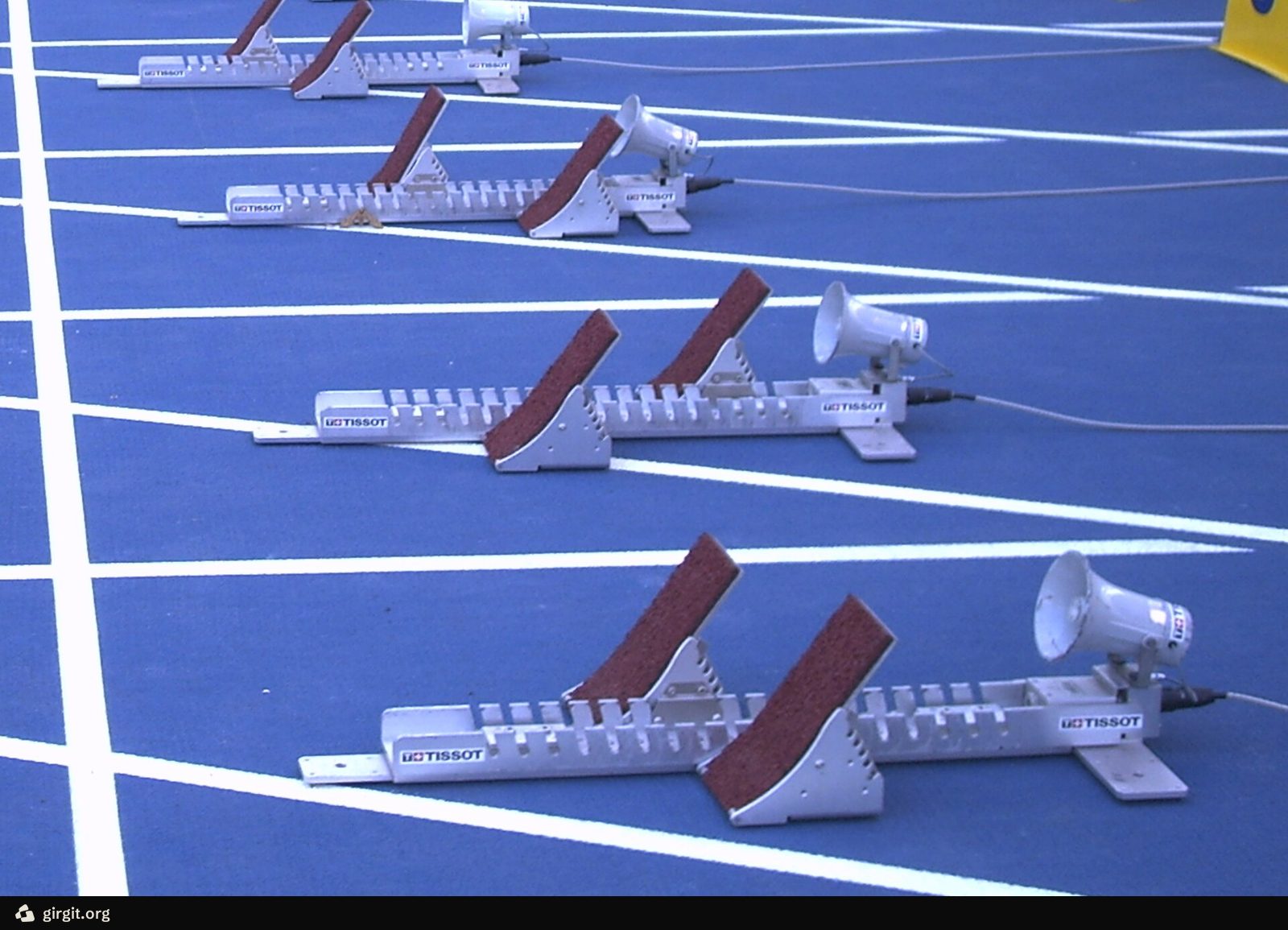 foot plate that senses the pushloudspeaker
28 August 2011Daegu, South Korea · World Championships
< 0.1s
a reaction this fast "is deemed a false start"
- Usain Bolt moved early: out, under a 2010 rule. Yohan Blake won.
- The limit: from the 1990s, partly tests on Finnish athletes.
- 2022: the American Devon Allen, out at 0.099 s. Bolt's 9.58 s record: 0.146 s.
1884London · International Health Exhibition
9,000
people and more, aged 5 to 80, timed for threepence
Francis Galton's "Anthropometric Laboratory": height, strength, eyesight and reaction time, one of the first big measurements of how fast people react.
Solve itThree problems
Your turn
Solve it
From the table: at 20 mph (8.9 m s−1) the braking distance is 6 m. Use \( d \propto v^2 \) to predict it at 40 mph and at 70 mph. Then use the 20 mph thinking distance to find the thinking time the table assumes.
Answer
Solve it
The false-start limit is 0.1 s. How far does a ruler fall in 0.1 s? What does that tell you about a friend who always catches the ruler within 3 cm?
Answer
Solve it
You drive at 90 km/h two seconds behind a car. Your reaction time is 1.0 s and both cars can brake at 7 m s−2. (a) The car ahead brakes hard. Do you hit it? (b) It hits a stalled lorry and stops dead. Do you hit it?
Answer
ConnectAnd still confused?
Where this goes next
Connect it
- Friction, Chapter 4. What sets the deceleration: the grip of the tyres, static and kinetic friction.
- Energy, Chapter 5. The same \( v^2 \) appears in kinetic energy, ½mv²: the brakes must remove four times the energy at twice the speed. Kinetic energy.
- Biology: the nerve impulse. Part of every reaction time is a signal travelling along nerves: how a nerve impulse travels.
- Free fall, this chapter. The ruler test is free fall used as a stopwatch: free fall.
If both cars brake equally, why do I need any gap at all?
Because of your reaction time. For that fraction of a second the car ahead is already slowing and you are not, so you close in by \( v\,t_r \). The gap must cover that, plus a margin for slower brakes, worn tyres or a wet road.
Does a heavier vehicle need a longer braking distance?
Not because of the weight alone: a heavier vehicle presses harder on the road, and gets more grip in the same proportion. Real lorries do need longer distances, because their brakes and tyres can't use all that grip, and their brakes heat up. The formula \( v_0^2/2a \) still holds; the a is smaller.
Sources
- UK Highway Code, rule 126: the two-second gap, doubled on wet roads.
- The AA, stopping distances: the Highway Code's typical stopping distances and thinking time.
- Marc Green, "How long does it take to stop?", summarising Green (2000), Transportation Human Factors 2(3): driver reaction times.
- World Athletics, 100 metres: the 0.1 s false-start rule; arXiv 2506.11460: its origin in the 1990s.
- World Athletics, "The disqualification of Usain Bolt" (Daegu 2011).
- Karl Pearson, The Life, Letters and Labours of Francis Galton: the 1884 Anthropometric Laboratory.