Act 09NCERT §2.55 min
Relative velocity
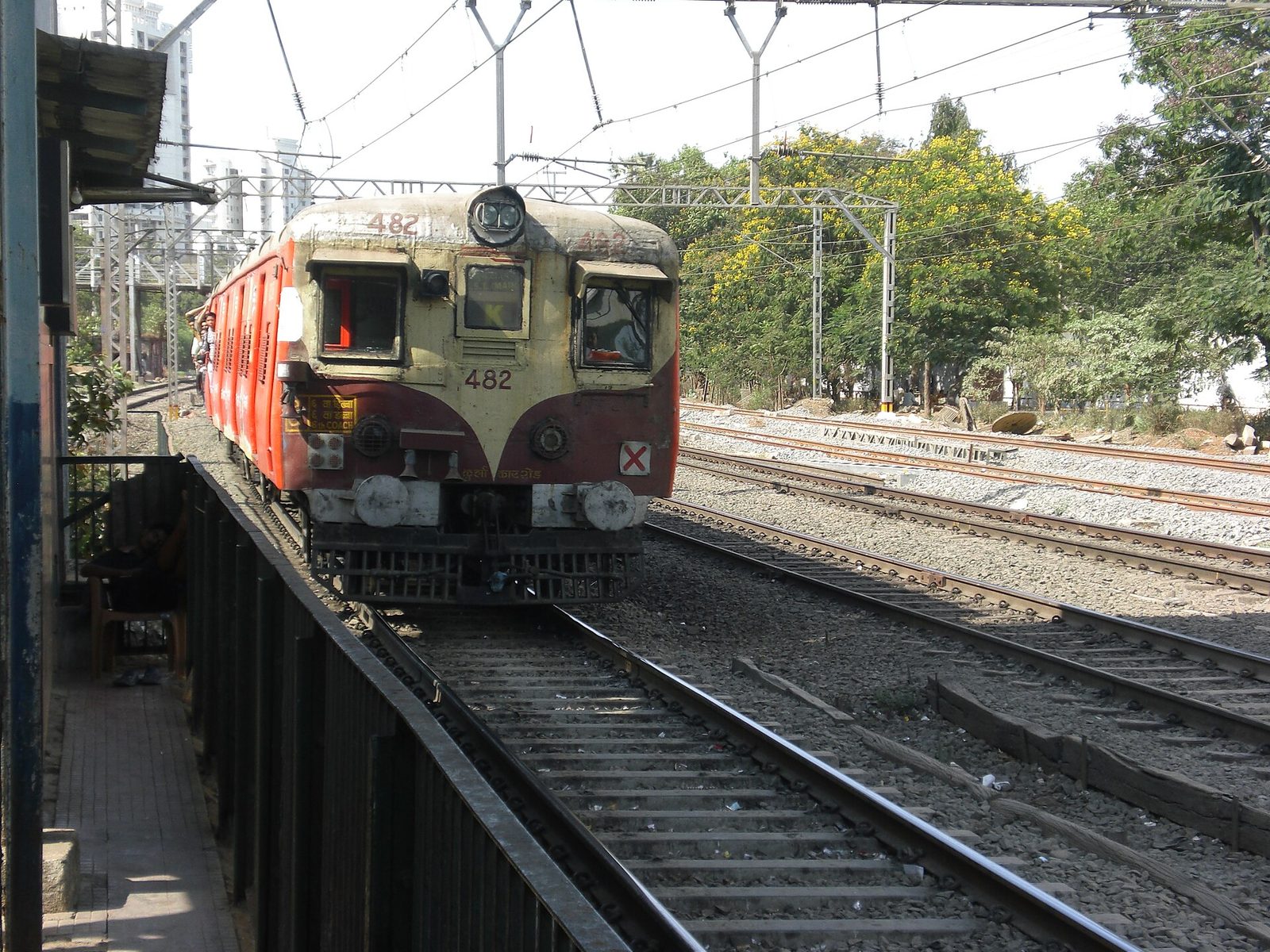
Two trains on parallel tracks: one at 30 m/s from the start, the other at 20 m/s from 200 m ahead. Their position-time lines close in at 10 m/s and cross at 20 s and 600 m, where one draws level with the other.
B starts 200 m behind A and gains 10 m every second.
From the textbook
NCERT Physics Part I, Class 11, Chapter 2 (2023-24 rationalised)
- 2.5
9.0The big idea
How fast depends on who is watching.
Motion is relative. Asleep in a train, you are at rest compared with the train, and moving at 100 km/h compared with the platform.
Full text
The big ideaThe velocity of B as seen from A is B's velocity minus A's velocity: \( v_{BA} = v_B - v_A \).
In simple words
Sit in a train and look at a train next to you going the same way at the same speed. It seems to stand still. If it goes the other way, it rushes past. How fast something seems to move depends on how fast you are moving yourself.
9.1Velocity as seen by someone else
Subtract the watcher's velocity
- Two objects on one line, constant velocities, both measured from the ground.
- Turn it round: \( v_{AB} = v_A - v_B = -v_{BA} \).
- Same size, opposite sign.
Full text
Velocity as seen by someone else
So far every position was measured from a fixed origin on the ground. But motion is relative: the same object can be still for one observer and moving for another. A passenger asleep in a moving train is at rest compared with the train, and moving at 100 km/h compared with the platform.
Let two objects A and B move along the same line with constant velocities \( v_A \) and \( v_B \), both measured from the ground. The relative velocity of B with respect to A is
\[ v_{BA} = v_B - v_A \]Read \( v_{BA} \) as "velocity of B as seen from A". Turning it round, A as seen from B is \( v_{AB} = v_A - v_B = -v_{BA} \): the same size, opposite sign.
- Same direction: the speeds subtract. Two buses at 50 and 60 km/h seem to creep apart at only 10 km/h.
- Opposite directions: the speeds add. Two buses at 50 and 60 km/h heading at each other close the gap at 110 km/h.
9.2Two buses, 50 and 60 km/h
Same way subtract, head-on add
Same direction
10km/h
They creep apart: the speeds subtract.
Opposite directions
110km/h
They close the gap: the speeds add.
Try itRide train A
Set train B's speed
A runs north at 15 m/s. Set B to +15 m/s: it looks parked while the masts fly by. Send it south at 25 m/s: it rushes past at 40 m/s.
9.3Change the watcher
Ride along and the graph tilts
Two trains on parallel tracks with a ghost every 2 seconds. Train A runs at 20 m/s from 200 m ahead; train B at 30 m/s from the start. Seen from the platform, their position-time lines close in and cross at 20 s and 600 m. Then positions are measured from train A: A's line tilts flat, B's line tilts to a slope of 10 m/s, the masts stream backwards at 20 m/s, and the crossing stays at 20 s.
B at 30 m/s; A at 20 m/s, 200 m ahead.
The lines cross at 20 s, 600 m: B draws level.
Take 20 m/s off every velocity. Every line tilts.
A is flat. B creeps up at 10 m/s. Same crossing, same moment.
9.4What the x-t graphs show
The gap between the lines
The vertical gap \( x_B - x_A \) is B's position as seen from A. It changes at \( v_B - v_A \).
Parallel
Equal velocities: each sees the other at rest, \( v_{BA} = 0 \).
Spreading apart
The gap grows: B is pulling away.
Crossing
Same position at the crossing: one meets or overtakes the other.
Full text
What the x-t graphs show
Draw both objects on the same x-t graph. Each is a straight line, with slope equal to its velocity. The vertical gap between the lines, \( x_B - x_A \), is the position of B as seen from A, and it changes at the rate \( v_B - v_A \).
- Parallel lines (\( v_A = v_B \)): the gap never changes. Each sees the other at rest; \( v_{BA} = 0 \).
- Lines that spread apart: the gap grows; B is pulling away.
- Lines that cross: at the crossing, both have the same position. That is when one overtakes or meets the other.
Worked example
A Rajdhani Express 300 m long runs at 30 m s−1 on a track beside a goods train 400 m long going the same way at 20 m s−1. How long does the Rajdhani take to overtake it completely? How long would they take to pass each other if the goods train were going the other way?
- "Completely" means from the Rajdhani's engine reaching the goods train's tail until its own last coach passes the goods engine. Relative to the goods train, the Rajdhani must cover both lengths: 300 + 400 = 700 m.
- Same direction: \( v_{RG} = 30 - 20 = 10 \) m s−1. Time = 700 ÷ 10 = 70 s.
- Opposite directions: \( v_{RG} = 30 - (-20) = 50 \) m s−1. Time = 700 ÷ 50 = 14 s.
See it with two trains on a hillside.
Before the next example, a guess.
Worked example
Walking up a stopped moving walkway takes Ravi 60 s. Standing still on it when it runs takes 40 s. How long if he walks on it while it runs?
- Let the walkway's length be \( L \). Ravi's walking speed is \( L/60 \); the belt's speed is \( L/40 \).
- Walking on the running belt, the speeds add: \( \dfrac{L}{60} + \dfrac{L}{40} = \dfrac{5L}{120} = \dfrac{L}{24} \).
- Time = \( L \div (L/24) = \) 24 s. In general, \( t = \dfrac{t_1 t_2}{t_1 + t_2} \).
Notice the answer is shorter than both 40 s and 60 s, which makes sense: two pushes together beat either alone.
CheckParallel lines
What does the passenger see?
Two trains on parallel tracks have straight x-t lines that are parallel. What does a passenger in one see of the other?
- It seems to stand still
- It is about to collide
- It seems to pull steadily away
Try itCatch the speeding car
Widest gap when speeds match
A car passes at 15 m/s; a police jeep starts from rest at 1.5 m/s². The gap peaks at 75 m at 10 s; the jeep catches it at 20 s.
Worked example
A Rajdhani Express 300 m long runs at 30 m s−1 on a track beside a goods train 400 m long going the same way at 20 m s−1. How long does the Rajdhani take to overtake it completely? How long would they take to pass each other if the goods train were going the other way?
- "Completely" means from the Rajdhani's engine reaching the goods train's tail until its own last coach passes the goods engine. Relative to the goods train, the Rajdhani must cover both lengths: 300 + 400 = 700 m.
- Same direction: \( v_{RG} = 30 - 20 = 10 \) m s−1. Time = 700 ÷ 10 = 70 s.
- Opposite directions: \( v_{RG} = 30 - (-20) = 50 \) m s−1. Time = 700 ÷ 50 = 14 s.
9.5Rajdhani and goods train
To pass, cover both lengths
700m
300 m + 400 m, at the relative speed
Overtaking · 10 m/s
70s
Head-on · 50 m/s
14s
See itA hillside, two tracks
Head-on, then overtaking
A 200 m express and a 300 m goods train: 500 m to clear. At 30 m/s head-on, 16.7 s. At 10 m/s overtaking, 50 s.
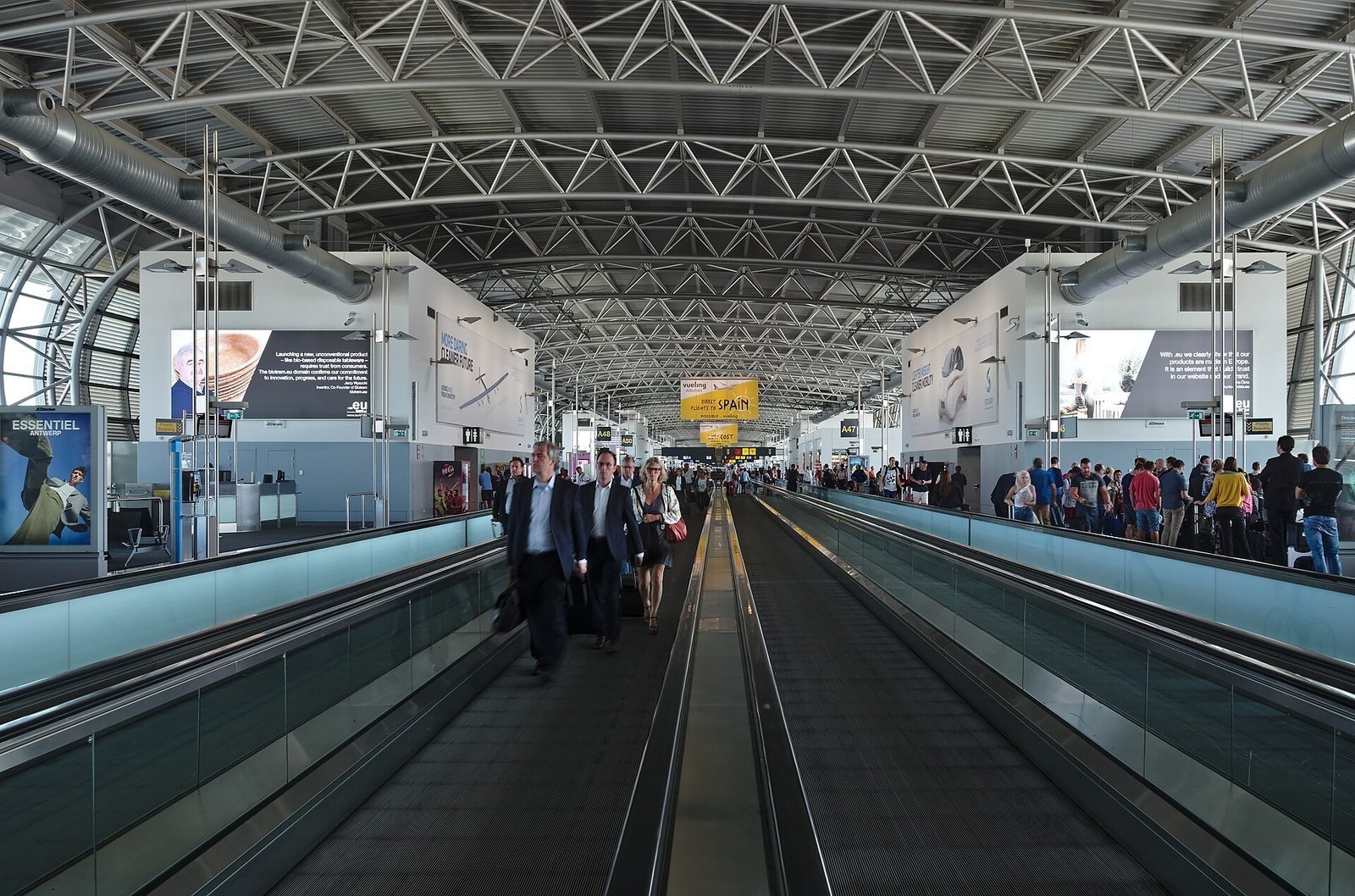 walking on the moving beltmoving walkway
9.6Think of it like
Walking on a moving walkway
- To someone beside it: your walking speed plus the belt's.
- To someone riding the belt: only your walking speed.
Guess firstWalk on the belt
Faster than either alone?
9.7Ravi on the walkway
Two pushes beat either alone
Worked example
Walking up a stopped moving walkway takes Ravi 60 s. Standing still on it when it runs takes 40 s. How long if he walks on it while it runs?
- Let the walkway's length be \( L \). Ravi's walking speed is \( L/60 \); the belt's speed is \( L/40 \).
- Walking on the running belt, the speeds add: \( \dfrac{L}{60} + \dfrac{L}{40} = \dfrac{5L}{120} = \dfrac{L}{24} \).
- Time = \( L \div (L/24) = \) 24 s. In general, \( t = \dfrac{t_1 t_2}{t_1 + t_2} \).
Notice the answer is shorter than both 40 s and 60 s, which makes sense: two pushes together beat either alone.
9.8A neat case: two falling bodies
5m/s
steady, for as long as both fall
Drop one stone; throw another down at 5 m/s. Both gain g every second, so their relative acceleration is zero. Seen from the first, the second moves away at a steady 5 m/s.
Full text
A neat case: two falling bodies
Drop one stone from a bridge and, at the same moment, throw another straight down at 5 m s−1. Both have the same acceleration \( g \) downward, so their relative acceleration is zero. Seen from the first stone, the second just moves away at a steady 5 m s−1. Relative velocity between two freely falling objects never changes.
Try it
A scooter rides at 40 km/h. A bus going the same way at 60 km/h overtakes it. (a) What is the bus's velocity relative to the rider? (b) The rider's relative to the bus? (c) What if the bus were coming the other way?
Answer
Remember
- \( v_{BA} = v_B - v_A \), and \( v_{AB} = -v_{BA} \).
- Same direction: subtract speeds. Opposite: add them.
- Parallel x-t lines: zero relative velocity; crossing lines: they meet.
- Overtaking or crossing a train: relative distance = sum of the lengths.
9.9Your turn
A bus overtakes a scooter
Scooter 40 km/h, bus 60 km/h, same way. The bus as seen by the rider? The rider as seen from the bus? A bus coming the other way?
Answer
9.10Don't mix these up
Get the letters backwards, every sign flips
Myth
\( v_{BA} \) is A's velocity seen by B
Fact
"B from A": B on stage, A in the audience. Subtract the audience.
Remember
- \( v_{BA} = v_B - v_A \), and \( v_{AB} = -v_{BA} \).
- Same direction: subtract speeds. Opposite: add them.
- Parallel x-t lines: zero relative velocity; crossing lines: they meet.
- Overtaking or crossing a train: relative distance = sum of the lengths.
CheckEast and west
B relative to A
Car A goes east at 15 m/s and car B goes west at 10 m/s. What is the velocity of B relative to A? (East positive.)
- −5 m/s
- −25 m/s
- +25 m/s
KeepJust remember
One convention, one hook
The order of the letters is an agreement. Tap the card for its hook.
WordsTo know
Four words
- Relative velocity
- The velocity of one object as seen from another.
- vBA
- Velocity of B relative to A, equal to vB − vA.
- Observer
- The person or object from whose point of view motion is measured.
- Relative acceleration
- The difference of two accelerations; zero for two freely falling bodies.
NEETAsked in the exam
The real thing
RootsA moving origin
The watcher is a moving zero
- Same for every steady watcher: differences of velocities, and all accelerations.
- So a smooth train can't be felt. Only a jolt gives it away.
- On an x-t graph, a new watcher tilts every line; its own goes flat. Crossings stay crossings.
Full text
The roots: a moving origin
- Why do velocities just subtract when the watcher changes?Because the watcher is a moving origin. B's position measured from A is \( x_B - x_A \), and its rate of change is \( v_B - v_A \).
- Why does a moving origin change velocities but a fixed one doesn't?Shifting the origin by a fixed amount changes every position by the same constant, which drops out of every rate (page 1's deep dive). A moving origin shifts positions by an amount that grows steadily, \( v_A t \), so every velocity drops by \( v_A \).
- What stays the same for every steadily moving watcher?Differences of velocities (how fast B gains on C) and all accelerations. Subtracting the same constant \( v_A \) from every velocity can't change how fast any velocity changes.
- So why can't you feel a train moving smoothly?Everything you can check inside it, a dropped coin, a cup of tea, a ball tossed to a friend, depends on accelerations and on positions relative to the carriage. None of those change when the whole carriage moves steadily. Only a jolt, a change of velocity, gives it away.
- And the bedrock?Subtraction, once more, plus experiment: no test done inside a steadily moving room has ever shown which way, or whether, it moves.
On an x-t graph, changing the watcher tilts every line by the same amount: each slope drops by the watcher's velocity, and the watcher's own line becomes flat. Points where two lines cross stay crossings, at the same time. Two trains that meet, meet for everybody; only the speeds people report differ.
Your eyes judge motion the same way, by comparing. Sitting in a stopped train, you may feel your own train start when it is really the train on the next track that moves. Psychologists call the feeling of self-motion produced by a moving scene "vection"; Ernst Mach studied it in 1875 with a large rotating striped drum.
The rule \( v_{BA} = v_B - v_A \) has one limit. Close to the speed of light, c, velocities stop adding and subtracting simply. In 1905 Einstein showed that two velocities v and w combine to \( (v + w)/(1 + vw/c^2) \), never more than c. For trains the correction \( vw/c^2 \) is about one part in a hundred million million, so on earth the simple rule is as good as exact.
1875Ernst Mach's striped drum
Is my train moving, or theirs?
Your eyes judge motion by comparing. A moving scene can make you feel you move: "vection". Mach studied it with a large rotating striped drum.
LimitEinstein, 1905
Near light speed, velocities don't just add
For trains the correction \( vw/c^2 \) is about one part in a hundred million million. On earth, the simple rule is as good as exact.
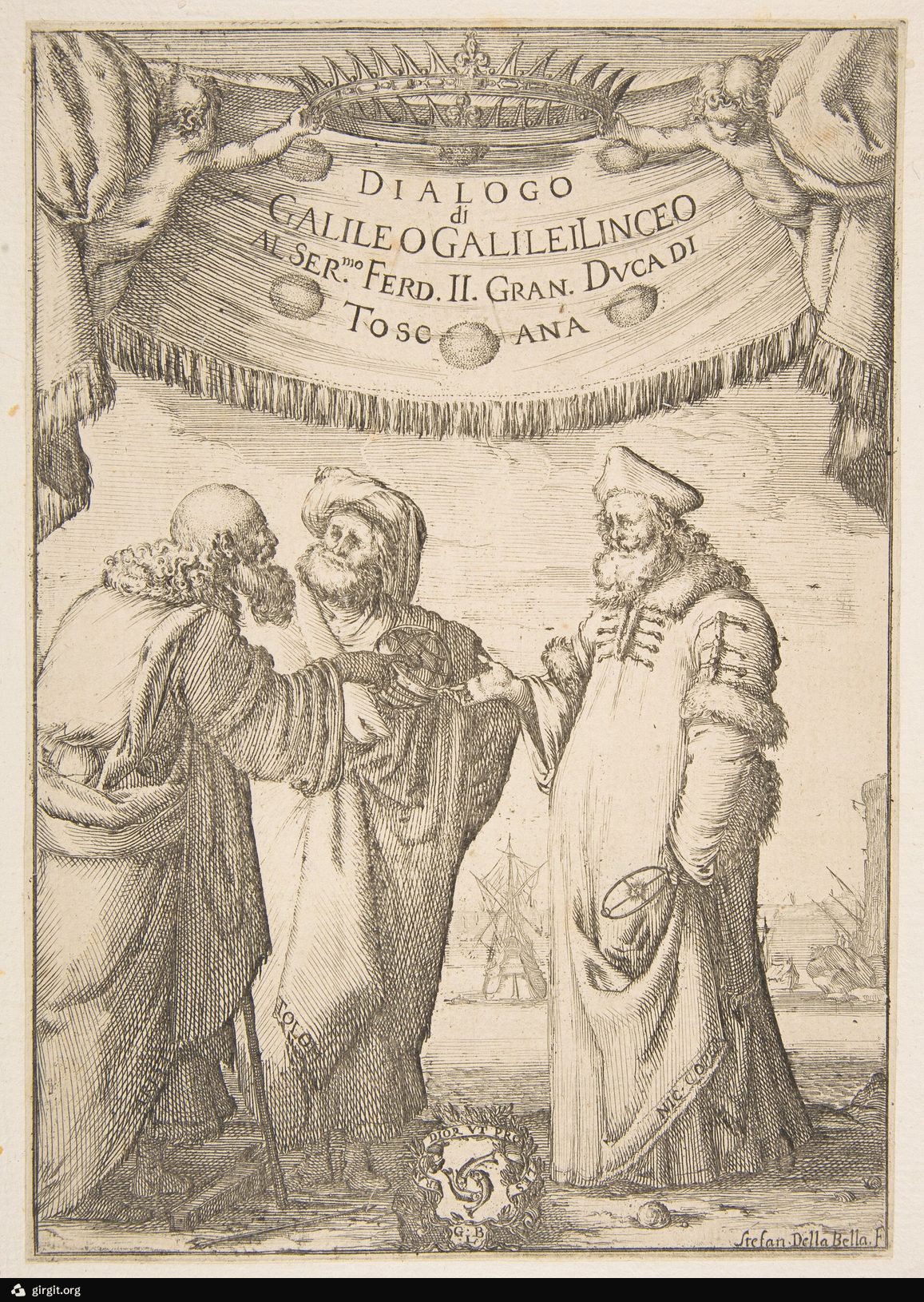 AristotlePtolemyCopernicusships in the harbour
1632Florence · the Dialogue
whether the ship was moving or standing still
- Salviati's cabin: flies, butterflies, a bowl of fish, a bottle dripping into a vessel.
- Ship still, then steady: nothing changes. Drops fall straight; fish swim either way.
- Why: the ship's motion is shared by everything in it, air included.
Full text
The story
See itRide along
Watch the graph tilt
Change who is watching: every velocity changes by the same amount.
Solve itThree problems
Your turn
Solve it
You sit at the window of a train running at 130 km/h. A goods train on the next track runs at 50 km/h. Suppose each goods wagon is 15 m long. How many wagons pass your window each second if the goods train goes (a) the same way, (b) the other way?
Answer
Solve it
In a train moving steadily at 25 m s−1, you drop a coin from a height of 1.25 m. Where does it land, and where does a person on the platform see it land? (g = 10 m s−2.)
Answer
Solve it
Use Einstein's rule to find how wrong the simple rule is for two trains approaching each other at 30 m s−1 each. (c = 3 × 10⁸ m s−1.)
Answer
ConnectAnd still confused?
Where this goes next
Connect it
- Laws of motion, Chapter 4. Galileo's ship leads straight to the law of inertia: steady motion needs no cause. Inertia and the first law.
- Vectors, Chapter 3. In a plane, relative velocity is vector subtraction, \( \vec v_B - \vec v_A \): adding (and subtracting) vectors.
- Collisions, Chapter 5. How fast two bodies approach and separate, relative velocity again, decides how bouncy a collision is: collisions in one dimension.
- Page 1's deep dive. Moving the origin by a fixed amount changed nothing that mattered; moving it steadily changes velocities but not accelerations: where is zero?
Which velocity is the "real" one, then?
None of them, and all of them. A velocity is always measured from something. "Relative to the ground" is the everyday default, so that is what a question means when it doesn't say.
Why does a train going round a curve or braking give itself away, when a steady one doesn't?
Because those are changes of velocity, accelerations, and accelerations are the same for every steadily moving watcher. Your tea sloshes because the carriage accelerates and the tea doesn't, at first.
Sources
- Galileo, Dialogue Concerning the Two Chief World Systems (1632), Second Day, the ship passage (Drake's translation, excerpt).
- Einstein, "On the Electrodynamics of Moving Bodies" (1905), §5, the composition of velocities.
- "Measuring vection", Behavior Research Methods (2024): the train illusion and Mach's 1875 drum.