Motion in a Straight LineFull experience
- 1. What does it mean to move?
- 2. How fast, on average?
- 3. How fast right now?
- 4. What is acceleration?
- 5. Reading velocity-time graphs
- 6. The three equations of motion
- 7. Why does a ball fall faster and faster?
- 8. Stopping distance and reaction time
- 9. Relative velocity
- Review
7 of 9·NCERT §2.4·pp. 17–21·6 min
Why does a ball fall faster and faster?
The big ideaNear the earth, with air resistance ignored, everything falls with the same constant downward acceleration g, about 9.8 m s−2.
In simple words
Let go of a stone and the earth pulls it down. Each second it falls, it goes about 10 metres per second faster than the second before. A big stone and a small stone do this the same way, if the air does not get in the way. Throw it up, and the same pull slows it, stops it at the top, and brings it back.
What free fall means
An object released near the earth's surface speeds up downward because of gravity. The size of this acceleration due to gravity is written \( g \). If we ignore air resistance, the object is in free fall.
As long as the height of the fall is small compared with the earth's radius (about 6400 km), \( g \) stays constant at 9.8 m s−2. So free fall is just uniformly accelerated motion, and the three kinematic equations apply. Exam questions often round \( g \) to 10 m s−2; use whatever the question says.
Free fall does not depend on mass. A cricket ball and a coconut dropped together from the same height land together, unless air resistance is large (a feather, a sheet of paper).
Choosing signs
Take the vertical axis \( y \) with up as positive. Gravity always pulls down, so
\[ a = -g = -9.8\ \text{m s}^{-2} \]whether the object is going up, coming down, or sitting for an instant at the top. For an object dropped from rest at \( y = 0 \) (\( v_0 = 0 \)):
\[ \begin{gathered} v = -gt \\ y = -\tfrac12 g t^2 \\ v^2 = -2gy \end{gathered} \]The minus signs just say it is moving and ending up below where it started. With \( g = 9.8 \): \( v = -9.8\,t \), \( y = -4.9\,t^2 \), \( v^2 = -19.6\,y \).
The graphs: the a-t graph is a flat line at −g; the v-t graph is a straight line through the origin sloping down; the y-t graph is a parabola curving downward.
Try it: turn the axis round and throw again.
At the top
Here is where intuition misleads most people. A ball thrown straight up stops for an instant at its highest point. Is its acceleration zero there? No. Its velocity is zero, but gravity has not switched off: the acceleration is still \( g \), downward. If the acceleration really became zero at the top, the ball would just hang there.
Try it: scrub through a throw from a roof.
Worked example
From a terrace 20 m above the ground, a ball is thrown straight up at 15 m s−1. Take \( g = 10 \) m s−2. (a) How high above the ground does it rise? (b) When does it hit the ground, and how fast?
Put the origin on the ground, up positive: \( y_0 = 20 \) m, \( v_0 = +15 \) m s−1, \( a = -10 \) m s−2.
- (a) At the top \( v = 0 \): \( 0 = 15^2 + 2(-10)(y - 20) \), so \( y - 20 = 11.25 \) m. Highest point: 31.25 m above the ground.
- (b) Use \( y = y_0 + v_0 t + \tfrac12 a t^2 \) with \( y = 0 \): \( 0 = 20 + 15t - 5t^2 \), that is \( t^2 - 3t - 4 = 0 \), so \( (t - 4)(t + 1) = 0 \).
- Time cannot be negative, so t = 4 s.
- Velocity then: \( v = 15 - 10 \times 4 = -25 \) m s−1, so it lands at 25 m s−1 going down.
Another way. Split the trip. Going up: \( 0 = 15 - 10t_1 \), so \( t_1 = 1.5 \) s. Falling from rest from 31.25 m: \( 31.25 = 5t_2^2 \), so \( t_2 = 2.5 \) s. Total 4 s. Same answer, but the first method is quicker: because the acceleration never changes, one equation covers the whole flight and you need not care where it turned round.
Two handy results for a throw up at speed \( u \) that comes back to the same level: the greatest height is \( u^2/2g \); the time up equals the time down, \( u/g \) each; and it returns with the same speed \( u \), now pointing down.
Before Galileo's rule, a guess: then mark the fall in equal intervals.
Galileo's law of odd numbers
Galileo Galilei (1564 to 1642) was the first to study free fall with careful measurements. He found that a body falling from rest covers distances in successive equal time intervals in the ratio of the odd numbers 1 : 3 : 5 : 7 : …
Here is why. Split the time into equal intervals \( \tau \). The distance fallen by the end of each interval is \( \tfrac12 g t^2 \), so in units of \( \tfrac12 g\tau^2 \):
| Time | Total fallen (units of ½gτ²) | Fallen in that interval |
|---|---|---|
| τ | 1 | 1 |
| 2τ | 4 | 3 |
| 3τ | 9 | 5 |
| 4τ | 16 | 7 |
| 5τ | 25 | 9 |
The totals are square numbers; the gaps between square numbers are the odd numbers. With \( g = 10 \) m s−2 and \( \tau = 1 \) s, a stone falls 5 m in the first second, 15 m in the next, 25 m in the third.
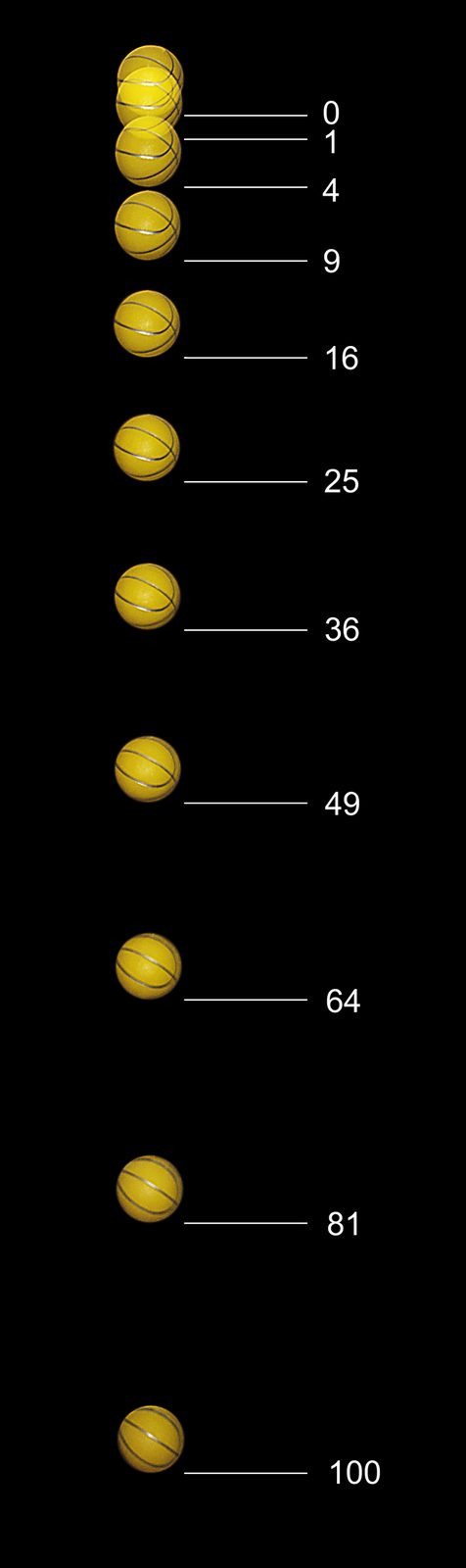
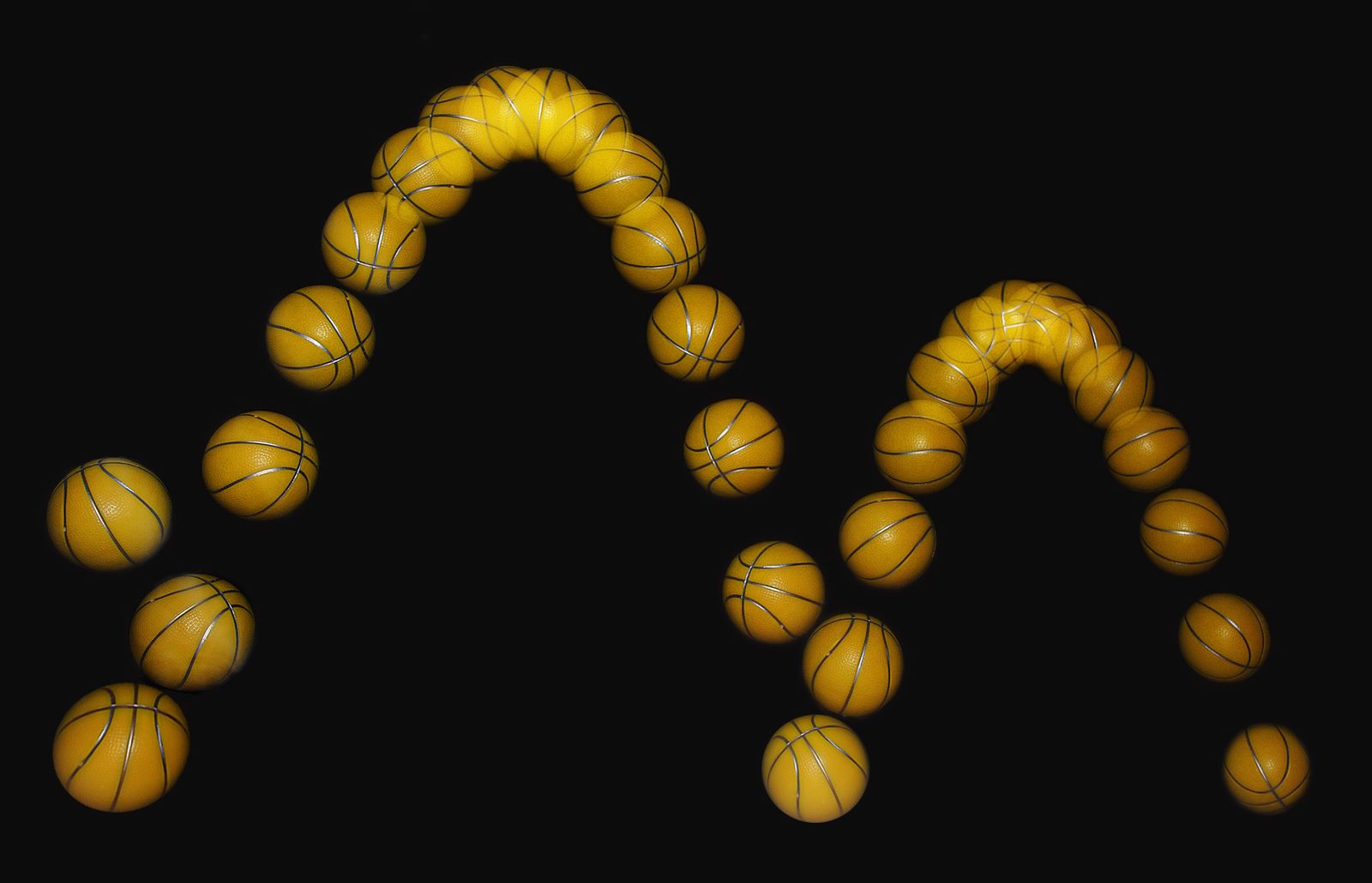 top: slow, bunchedlow: fast, spread out
Try it
A coconut falls from rest from the top of a 20 m tree. How long does it take to reach the ground, and how fast is it going? (\( g = 10 \) m s−2.)
Answer
Remember
- Free fall: \( a = -g \) (up positive), \( g = 9.8 \) m s−2, same for all masses if air is ignored.
- At the top: \( v = 0 \) but \( a = g \) downward.
- Thrown up at \( u \): \( H = u^2/2g \), time up = time down = \( u/g \).
- From rest, equal intervals: distances 1 : 3 : 5 : 7.
Just remember
A measured number and a chosen sign. Nothing to derive; use the hooks.
- \( g = 9.8 \) m s−2 near the earth's surface (exams often say 10)
- "Nearly ten": each second of falling adds about 10 m s−1, about 35 km/h. On the Moon it is 1.62 m s−2, about a sixth.
- Usual choice: up is positive, so \( a = -g \)
- Thumbs up is plus. Choose once at the start of a problem and never switch midway.
- Free fall
- Motion under gravity alone, with air resistance ignored.
- Acceleration due to gravity, g
- The downward acceleration of a freely falling body, 9.8 m s⁻² near the earth.
- Air resistance
- The push of the air against a moving object.
- Galileo's law of odd numbers
- From rest, distances in equal successive intervals go 1 : 3 : 5 : 7.
Words to know
A ball is thrown straight up. At its highest point, which is true?
- v = 0 and a = 0
- v = 0 and a = g downward
- v = 0 and a = g upward
A stone dropped from rest falls 5 m in the first second. How far does it fall during the third second?
- 45 m
- 25 m
- 15 m
Two balls are thrown from the same cliff top at the same speed, one straight up and one straight down. Ignoring air, which hits the ground faster?
- The one thrown up
- The one thrown down
- They land with the same speed
Deep dive · optional
Why does everything fall together?
For two thousand years, educated people believed heavy things fall faster. Why they were wrong, what the air really does, how Galileo actually measured falling (not from a tower), and a hammer and a feather on the Moon. The exam doesn't need this; it makes the page stick.
The roots: the same mass, twice
- Why doesn't a heavy stone fall faster than a light one?The earth does pull harder on the heavy stone. But the heavy stone is also harder to get moving, by exactly the same factor. The two cancel.
- Why exactly the same factor?Because the pull of gravity is proportional to an object's mass, and so is its reluctance to speed up (its inertia). The same mass appears twice and divides out. Experiments have checked this to extraordinary precision, and Einstein later built his theory of gravity on it.
- Then why does a feather drift down slowly?Air pushes back on anything moving through it. That push depends on the object's size, shape and speed, not its mass. For a light, fluffy feather, a small push is already a big share of its weight.
- Why does a falling object stop speeding up?The air's push grows with speed, roughly as the square of the speed. At some speed it equals the weight, and then the acceleration is zero: the object falls at a steady terminal velocity.
- And the bedrock?Take the air away. On the Moon, a hammer and a feather land together.
So "free fall" in this chapter is a model: it is exact in a vacuum and very good for compact, heavy objects falling short distances, like a stone, a coconut or a cricket ball. It fails for feathers, paper and parachutes, and over long falls for everything. A skydiver in ordinary air soon stops speeding up. High in the stratosphere the air is so thin that its push is tiny, and a falling person gets far closer to true free fall, for a while.
The story
See it
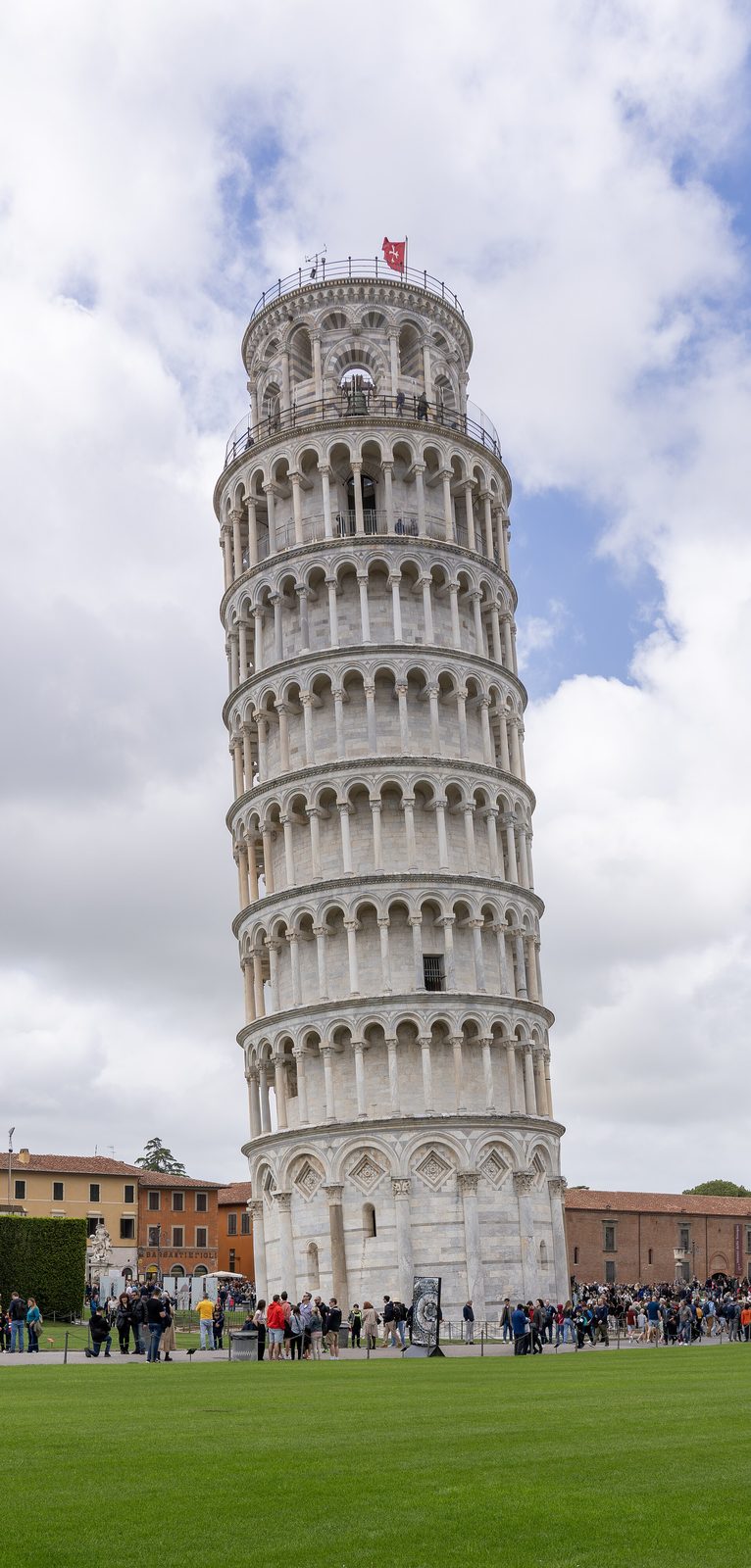
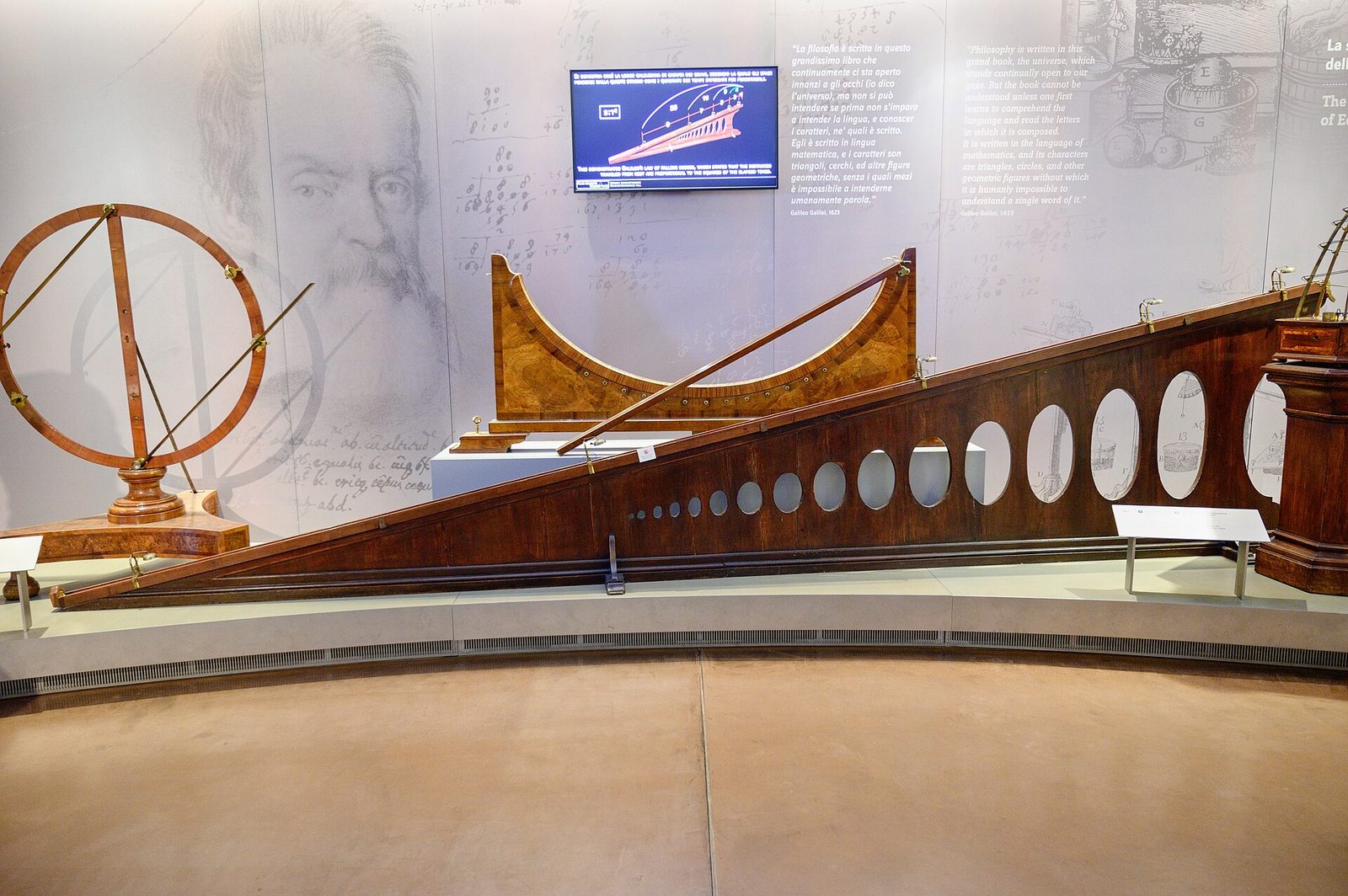 groove, about 5.4 m longraised end
Galileo's own numbers survive in his notebook. Guess first, then roll the ball and lay his marks beside the odd numbers.
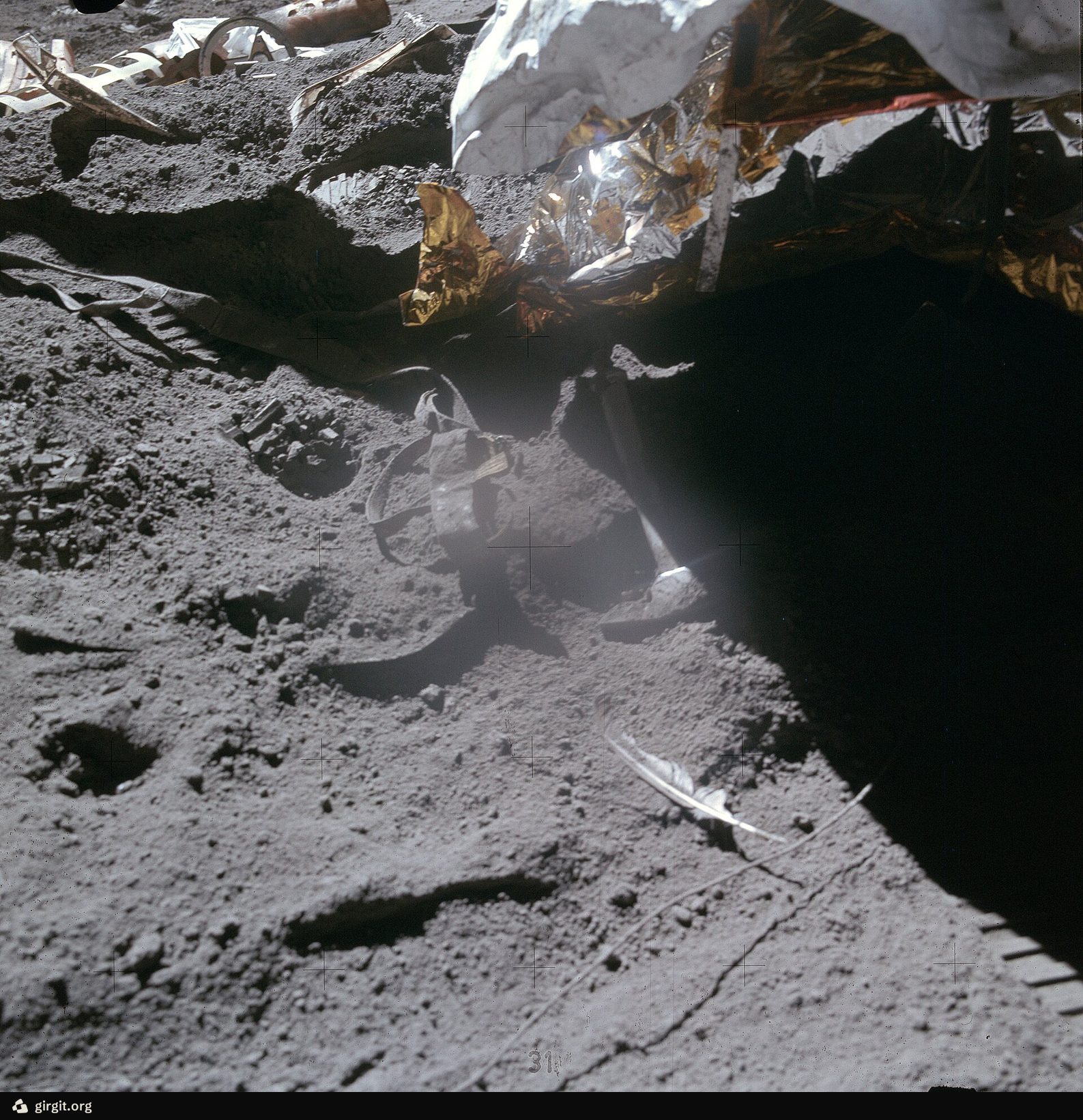 falcon featherhammer
At the other extreme, air is everything. In 1960 Joseph Kittinger jumped from a balloon at 31,300 m (102,800 ft) and reached about 990 km/h (614 mph) in the thin air before the thicker air lower down slowed him. In 2012 Felix Baumgartner, jumping from 38,969 m, reached 1,357.6 km/h, faster than sound.
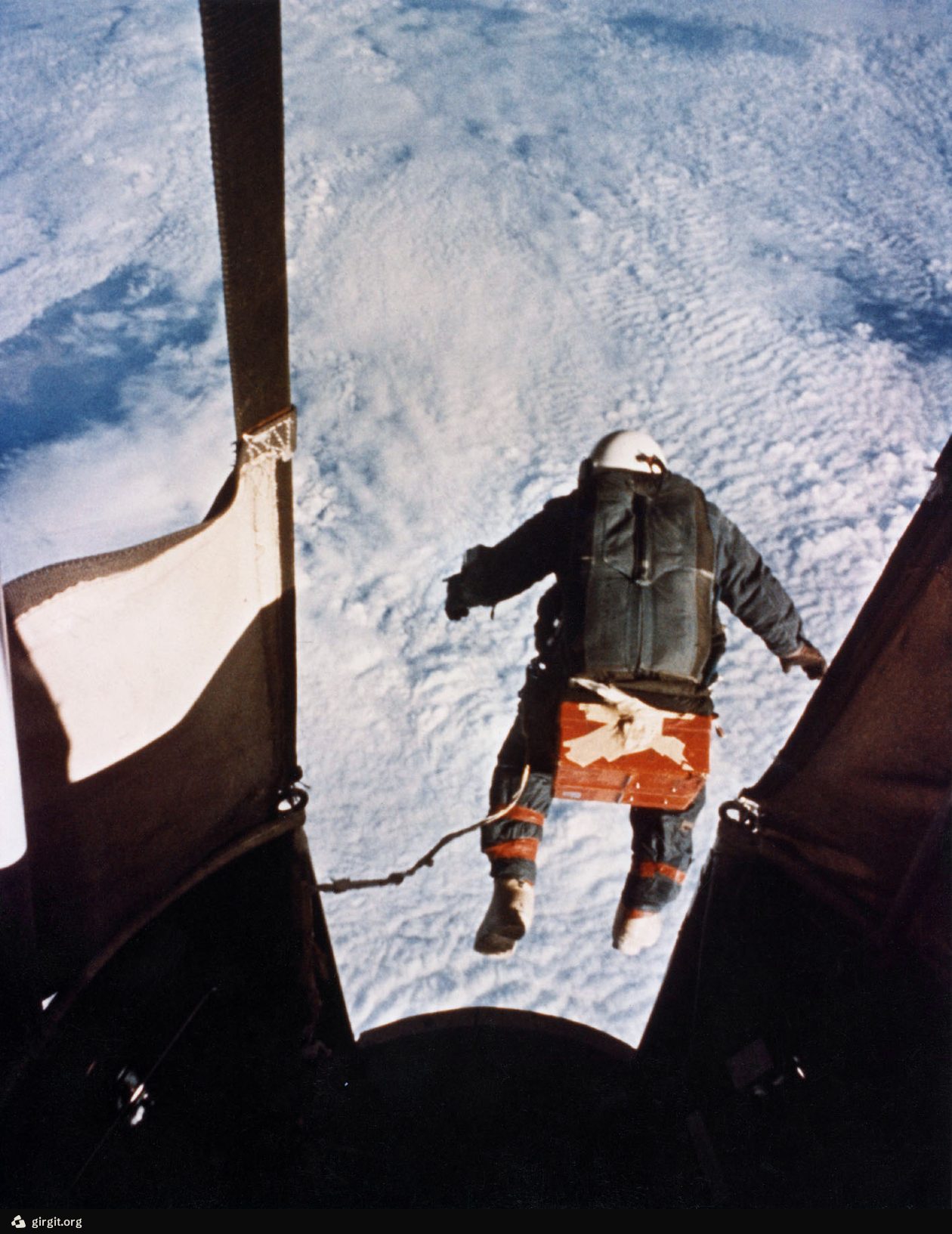 Kittinger, just stepped off
Solve it
Solve it
Scott let go from about 1.2 m above the ground, on the Moon, where g = 1.62 m s−2. How long did the fall take? How long would the same fall take on the earth?
Answer
Solve it
Test Galileo's notebook. Divide each of 32, 130, 298, 526 by 32. Then find the gaps between them (32, 98, 168, 228) and divide those by 33. What patterns do you get, and how close are they?
Answer
Solve it
Baumgartner's top speed was about 377 m s−1 (1,357.6 km/h). If there had been no air at all, how long a fall from rest, and how many metres, would that speed need? (Use g = 9.8 m s−2.) What does the answer tell you about the air at that height?
Answer
Connect it
Connect it
- Gravitation, Chapter 7. Why g is 9.8 m s−2 here, and how it changes with height and depth: g above and below the surface.
- Fluids, Chapter 9. The air's push on a falling object, and terminal velocity, in numbers: Stokes' law.
- Projectiles, Chapter 3. A thrown ball falls with the same g while it moves sideways: projectile motion.
- Relative velocity, this chapter. Two stones in free fall have zero relative acceleration, so each sees the other move steadily: relative velocity.
Still confused?
In real life, does a heavy ball land first?
If two balls are the same size, yes, very slightly: the air's push is about the same on both, but it is a smaller share of the heavy ball's weight. Dropped from a few metres, the difference is tiny. It is the air, not the weight itself, that makes the difference, as Galileo said of his cannonball and musket ball.
Is g the same everywhere on earth?
Nearly, but not exactly: it is a little larger at the poles than at the equator, and a little smaller on a high mountain. The differences are a fraction of a per cent, which is why one value, 9.8 m s−2, works for this chapter.
Sources
- Stanford Encyclopedia of Philosophy, "John Philoponus" and Sambursky, Dictionary of Scientific Biography: Aristotle's rule and Philoponus's experiment.
- Robert P. Crease, "The legend of the leaning tower", Physics World (2003).
- Galileo, Two New Sciences (1638), Third Day: the inclined plane and the water clock.
- Museo Galileo, Galileo's notes on motion, folio 107v, and Vergara Caffarelli, "How long is Galileo's punctus?" (2005).
- NASA Apollo Lunar Surface Journal, Apollo 15 close-out: Scott's words, the falcon feather, the drop.
- NASA Moon fact sheet: g on the Moon.
- U.S. Centennial of Flight Commission, Excelsior III and phys.org, Baumgartner's records confirmed (2013).
- NASA Glenn Research Center, terminal velocity: drag and air density.
Picture and video credits
Show 4 picture and video credits
- falling-ball-strobe.jpg: MichaelMaggs, CC BY-SA 3.0
- bouncing-ball-strobe.jpg: MichaelMaggs Edit by Richard Bartz, CC BY-SA 3.0
- leaning-tower-pisa.jpg: PaestumPaestum, CC BY 4.0
- inclined-plane-museo-galileo.jpg: Zde, CC BY-SA 4.0


