Act 03NCERT §2.2 · pp. 14–155 min
How fast right now?
The position-time graph of a local train leaving a station: a curve that gets steeper, then straight. A tangent touches it at 15 s; its slope, 15 m/s, is the velocity at that instant.
The curve keeps getting steeper. How fast is it at one instant?
From the textbookpp. 14–15
NCERT Physics Part I, Class 11 · Rationalised 2023-24
3.0The big idea
Shrink the interval until the answer stops changing.
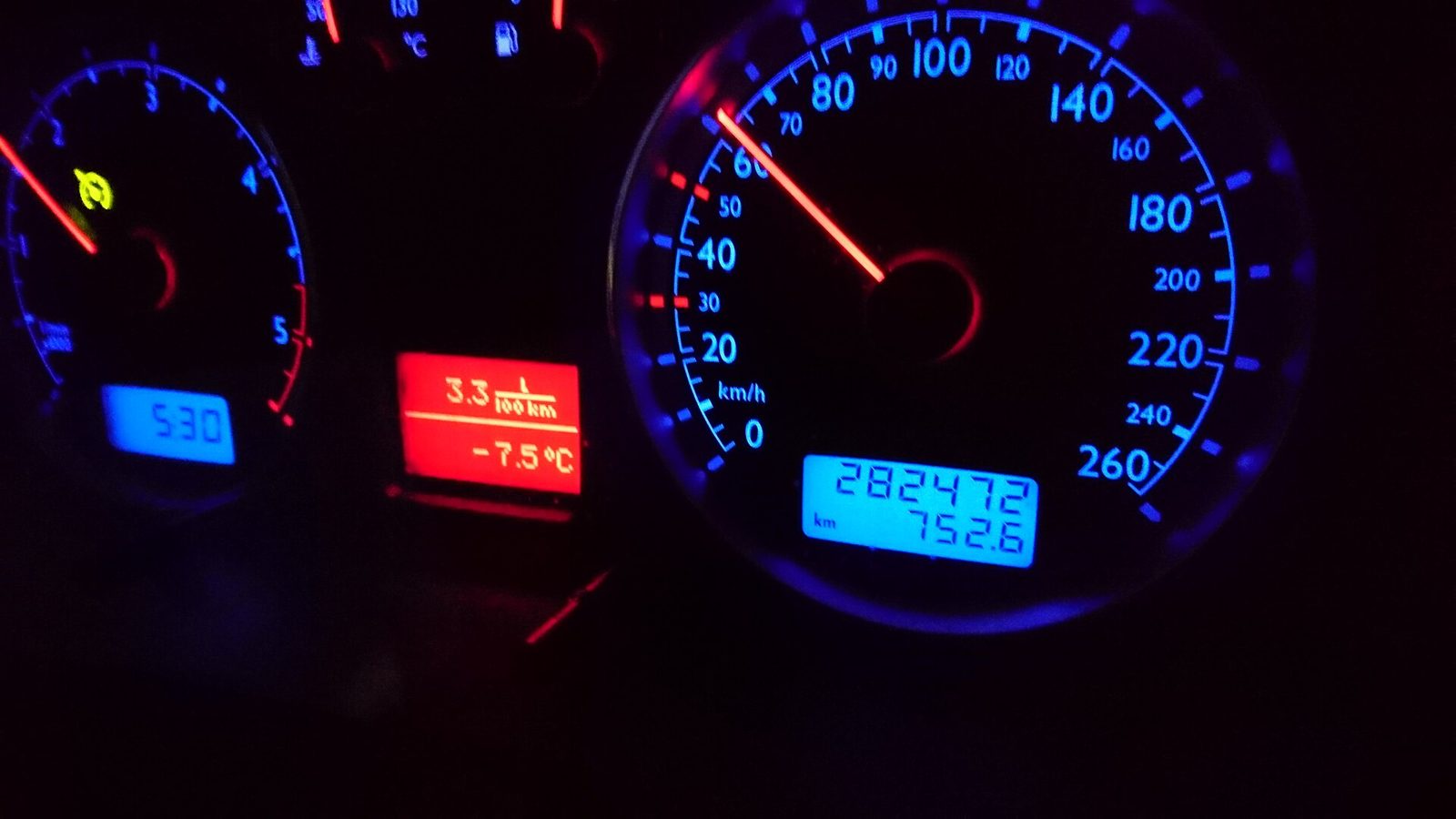
A speedometer never shows the trip's average. It shows how fast now: velocity at an instant. The needle answers "how fast now?"; the odometer, "how far in all?".
Full text
The big ideaVelocity at an instant is the average velocity over a time interval so short that it shrinks to zero: the slope of the tangent to the position-time graph.
In simple words
The average over a whole trip hides the fast parts and the slow parts. To know how fast you are going at one moment, look at a very, very short bit of the trip around that moment. Make the bit shorter and shorter. The answer stops changing. That steady answer is how fast you are going right then.
A car's speedometer does not tell you the average for the whole journey. It tells you how fast you are going now. That is what physics calls velocity at an instant.
3.1The definition
An average over almost no time
- Instantaneous velocity, or just velocity: the rate of change of position at that instant.
- Limit: not the value at zero, but where the fraction is heading.
- The derivative (differential coefficient) of x with respect to t.
Full text
The definition
The instantaneous velocity, or simply velocity, \( v \) at time \( t \) is the limit of the average velocity as the time interval \( \Delta t \) becomes infinitesimally small:
\[ v = \lim_{\Delta t \to 0} \frac{\Delta x}{\Delta t} = \frac{dx}{dt} \]"\( \lim_{\Delta t \to 0} \)" means: see what value the fraction settles down to as \( \Delta t \) gets closer and closer to zero. In calculus this limit is written \( dx/dt \), the derivative (differential coefficient) of \( x \) with respect to \( t \). It is the rate of change of position with time at that instant.
3.2x = t³ around t = 2 s
Zoom in until it is straight
The curve x = t³ near t = 2 s. A chord joins the points at 2 − Δt/2 and 2 + Δt/2. As Δt shrinks from 2 s to 0.01 s the view zooms in about 160 times; the curve inside the chord looks straighter and straighter, and the chord's slope falls from 13 to 12.25, 12.0625, 12.0025 and 12.000025 m/s. It settles on the slope of the tangent at 2 s: 12 m/s.
From 1 s to 3 s the chord's slope is 13 m/s.
12.25, then 12.0625, then 12.0025 m/s. Zoomed in, the curve straightens.
12.000025 m/s. The chord and the curve are one line.
The chord has become the tangent: velocity at 2 s is 12 m/s.
3.3Watching the limit with numbers
Closing in on 12
A toy car with x = t³. Intervals centred on 2 s, shrinking. Drawing tangents by hand is rough; numbers are sharp.
| Δt (s) | t1 (s) | t2 (s) | x(t1) (m) | x(t2) (m) | Δx/Δt (m s−1) |
|---|---|---|---|---|---|
| 2.0 | 1.0 | 3.0 | 1 | 27 | 13 |
| 1.0 | 1.5 | 2.5 | 3.375 | 15.625 | 12.25 |
| 0.5 | 1.75 | 2.25 | 5.359 | 11.391 | 12.0625 |
| 0.1 | 1.95 | 2.05 | 7.415 | 8.615 | 12.0025 |
| 0.01 | 1.995 | 2.005 | 7.940 | 8.060 | 12.000025 |
Calculus, one line
\( dx/dt = 3t^2 \)
At 2 s: 3 × 4 = 12 m s⁻¹.
The one rule you need
\( t^n \to n\,t^{n-1} \)
A constant gives zero; a constant multiplier stays in front.
Full text
Watching the limit with numbers
Drawing tangents by hand is not very accurate. Numbers make the idea clearer. Suppose a toy car moves so that \( x = t^3 \), with \( x \) in metres and \( t \) in seconds. What is its velocity at \( t = 2 \) s? Take intervals centred on 2 s and shrink them:
| Δt (s) | t1 (s) | t2 (s) | x(t1) (m) | x(t2) (m) | Δx/Δt (m s−1) |
|---|---|---|---|---|---|
| 2.0 | 1.0 | 3.0 | 1 | 27 | 13 |
| 1.0 | 1.5 | 2.5 | 3.375 | 15.625 | 12.25 |
| 0.5 | 1.75 | 2.25 | 5.359 | 11.391 | 12.0625 |
| 0.1 | 1.95 | 2.05 | 7.415 | 8.615 | 12.0025 |
| 0.01 | 1.995 | 2.005 | 7.940 | 8.060 | 12.000025 |
The average velocity closes in on 12 m s−1. That limit is the velocity at \( t = 2 \) s. Calculus gets it in one line: if \( x = t^3 \) then \( dx/dt = 3t^2 \), which is \( 3 \times 4 = 12 \) m s−1 at \( t = 2 \) s.
The one calculus rule you need for now: the derivative of \( t^n \) is \( n\,t^{n-1} \), the derivative of a constant is zero, and a constant multiplier just stays in front.
Worked example
A bead slides along a wire with \( x = 5 + 6t - t^2 \) (metres, seconds). Find its velocity at \( t = 0 \), 3 s and 4 s, and its average velocity and average speed from 0 to 4 s.
- Velocity: \( v = \dfrac{dx}{dt} = 6 - 2t \). So \( v(0) = 6 \) m s−1, \( v(3) = 0 \), \( v(4) = -2 \) m s−1. It stops for an instant at 3 s and then comes back.
- Positions: \( x(0) = 5 \) m, \( x(3) = 14 \) m, \( x(4) = 13 \) m.
- Average velocity, 0 to 4 s: \( \dfrac{13 - 5}{4} = 2 \) m s−1.
- Path length: 9 m out (5 to 14) plus 1 m back (14 to 13) = 10 m. Average speed = 10 ÷ 4 = 2.5 m s−1.
Notice that the average speed, 2.5 m s−1, is not the average of the two speeds 6 and 2. (The average velocity, 2 m s−1, does equal the plain average of 6 and −2, but only because the acceleration here is constant; concept 6 shows why.) Always go back to displacement, or path length, over time.
3.4On the graph: chord becomes tangent
Velocity is the tangent's slope
- Slide the two points together: the chord turns into the line that just touches.
- Steep tangent: fast.
- Flat tangent: velocity zero, for that moment.
- Sloping down: negative velocity.
Full text
On the graph: chord becomes tangent
On an x-t graph the average velocity between two times is the slope of the chord joining them. Now slide the two points towards each other, keeping the moment you care about in the middle. The chord turns slowly, and when the points meet it becomes the tangent: the straight line that just touches the curve at that one point.
So the velocity at an instant is the slope of the tangent to the x-t graph at that instant. Where the curve is steep, the object is fast. Where the tangent is flat, the velocity is zero for that moment. Where it slopes down, the velocity is negative.
CheckA flat tangent
What is zero there?
At one point on an x-t graph the tangent is horizontal. At that instant the object is
- momentarily at rest
- moving at its fastest
- moving in the negative direction
Worked example
A bead slides along a wire with \( x = 5 + 6t - t^2 \) (metres, seconds). Find its velocity at \( t = 0 \), 3 s and 4 s, and its average velocity and average speed from 0 to 4 s.
- Velocity: \( v = \dfrac{dx}{dt} = 6 - 2t \). So \( v(0) = 6 \) m s−1, \( v(3) = 0 \), \( v(4) = -2 \) m s−1. It stops for an instant at 3 s and then comes back.
- Positions: \( x(0) = 5 \) m, \( x(3) = 14 \) m, \( x(4) = 13 \) m.
- Average velocity, 0 to 4 s: \( \dfrac{13 - 5}{4} = 2 \) m s−1.
- Path length: 9 m out (5 to 14) plus 1 m back (14 to 13) = 10 m. Average speed = 10 ÷ 4 = 2.5 m s−1.
Notice that the average speed, 2.5 m s−1, is not the average of the two speeds 6 and 2. (The average velocity, 2 m s−1, does equal the plain average of 6 and −2, but only because the acceleration here is constant; concept 6 shows why.) Always go back to displacement, or path length, over time.
3.5A bead on a wire
It stops, then comes back
x = 5 + 6t − t², so v = 6 − 2t.
0 s6m/s
3 s0m/s
4 s−2m/s
0 to 4 s: average velocity 2 m/s, average speed 2.5 m/s. Not the mean of 6 and 2.
Try itGuess, then slide
Ride the bead's trip
Watch the tangent flatten at 3 s.
3.6Instantaneous speed
At an instant, speed is |v|
Instantaneous speed, or just speed: the size (magnitude) of the velocity. +15 m s⁻¹ and −15 m s⁻¹ are both 15 m s⁻¹.
Over an interval
Average speed ≥ |average velocity|
It may turn back.
At an instant
Speed = |velocity|, always
No time to turn round.
In uniform motion the velocity is the same at every instant, and equals the average velocity.
Full text
Instantaneous speed
Instantaneous speed, or simply speed, is the size (magnitude) of the velocity. A velocity of +15 m s−1 and a velocity of −15 m s−1 both mean a speed of 15 m s−1.
Over a long interval, average speed can be bigger than the size of the average velocity, because the object may turn back. But at a single instant, speed always equals |velocity|. Why? In a vanishingly short time there is no room to turn round, so the distance travelled and the size of the displacement become the same.
For uniform motion the velocity is the same at every instant, and equals the average velocity.
Try it
A particle has \( x = 3t^2 + 2t \) (metres, seconds). What is its velocity at \( t = 2 \) s?
Answer
Remember
- \( v = \lim_{\Delta t \to 0} \Delta x/\Delta t = dx/dt \).
- Velocity = slope of the tangent to the x-t graph.
- Speed = |velocity| at any instant.
- \( \dfrac{d}{dt}(t^n) = n\,t^{n-1} \).
CheckTwo straight lines
60° against 30°
Two x-t lines are straight. Line A makes 60° with the time axis, line B makes 30°. Which statement is right?
- B is faster
- A is three times as fast as B
- A is twice as fast as B
3.7Your turn
x = 3t² + 2t
Metres and seconds. Bring the power down, knock one off. What is the velocity at t = 2 s?
Answer
Check12 against 4
What must have happened?
Over 10 s a car's average speed is 12 m/s but its average velocity is 4 m/s. What must have happened?
- It moved in one direction the whole time
- It reversed direction at some point
- The numbers are impossible
3.8Don't mix these up
Speed now, speed overall
Myth
Speed at an instant can differ from |velocity|
Fact
Only an average speed can. At one instant they are equal.
Remember
- \( v = \lim_{\Delta t \to 0} \Delta x/\Delta t = dx/dt \).
- Velocity = slope of the tangent to the x-t graph.
- Speed = |velocity| at any instant.
- \( \dfrac{d}{dt}(t^n) = n\,t^{n-1} \).
KeepJust remember
Read the symbols aloud
Chosen by people, not by nature. Tap a card for its hook.
WordsTo know
Five words
- Instantaneous velocity
- Velocity at one moment; the limit of average velocity as the interval shrinks to zero.
- Limit
- The value a quantity settles down to as something gets closer and closer to a fixed value.
- Derivative, dx/dt
- The rate of change of x with t at an instant.
- Tangent
- A straight line just touching a curve at one point.
- Speed
- The size of the velocity, without direction.
NEETAsked in the exam
The real thing
RootsZoom in until the curve is straight
The error shrinks as Δt²
- At the instant itself: 0 ÷ 0, no value at all.
- Over a short interval the velocity hardly changes: zoomed in, the curve looks straight.
- Bedrock, a definition: velocity at an instant is the limit.
Full text
The roots: zoom in until the curve is straight
- Why not just divide distance by time at the instant?Because in one instant the distance is 0 and the time is 0, and 0 ÷ 0 has no value at all. Not zero: no answer.
- Then what does a "speed right now" mean?It is what \( \Delta x/\Delta t \) settles down to when you take shorter and shorter intervals around that instant.
- Why should it settle down at all?Because over a very short interval the velocity hardly has time to change, so the distance gained is almost exactly proportional to the time. On the graph, the curve looks straight when you zoom in close enough.
- How fast does the "almost" go away?Much faster than the interval shrinks. For \( x = t^3 \) at 2 s, the chord's slope is \( 12 + (\Delta t)^2/4 \): halve \( \Delta t \) and the error falls to a quarter. That is why the table on this page homes in so quickly.
- And the bedrock?A definition: velocity at an instant is that limit. It is not a number hidden inside one instant; it is a property of the motion in the moments around it.
This also tells you when there is no velocity at an instant. A ball that hits a wall and bounces straight back has a corner on its x-t graph. Zoom in on the corner as far as you like: it stays a corner, with one slope on the left and another on the right. The limit doesn't settle, so the textbook corner has no velocity at that moment. A real ball squashes for a few thousandths of a second, which rounds the corner off.
A photograph shows the problem in a different way. A perfectly sharp photo of a ball tells you where it is, but not how fast it goes: a ball at rest would look the same. A blurred photo does show speed, because the shutter stayed open for a short interval and the ball smeared across it. Blur length ÷ exposure time is an average velocity over a very short interval: a camera's version of the limit.
When there is noneA bounce off a wall
Some instants have no velocity
- A sharp corner on the x-t graph stays a corner however far you zoom: the limit never settles.
- A real ball squashes for a few thousandths of a second.
- A blurred photo shows speed: blur length ÷ exposure, a camera's limit.
Fifth century BCEElea, southern Italy · Zeno
A flying arrow is at rest.
- At each instant it fills a space equal to itself, so it isn't moving then.
- We know it from Aristotle, who argued against it in his Physics.
- Today's answer: velocity belongs to the instants around one, not to one alone.
Full text
The story
StoryTwo men, one limit
Fluxions, then dx/dt
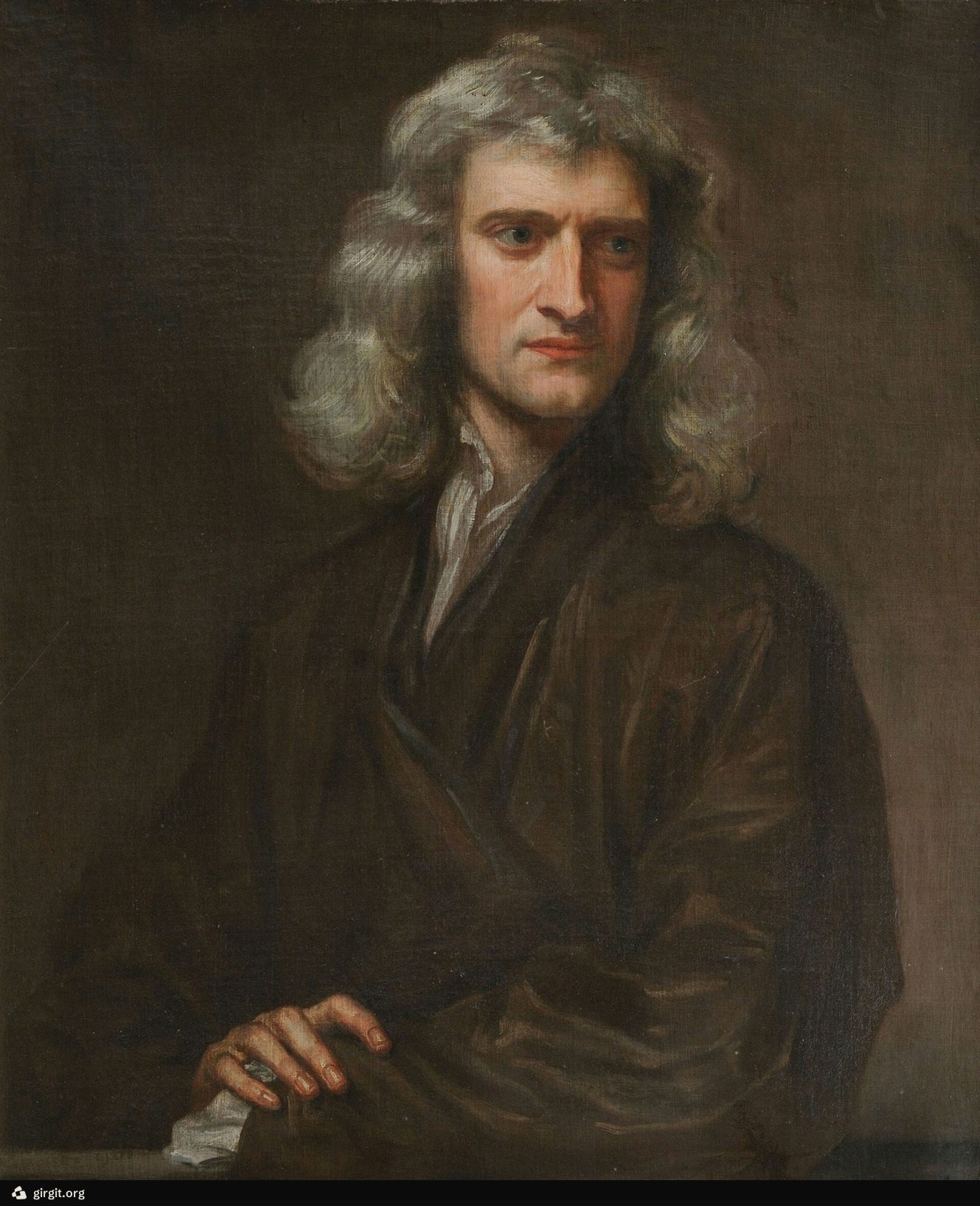
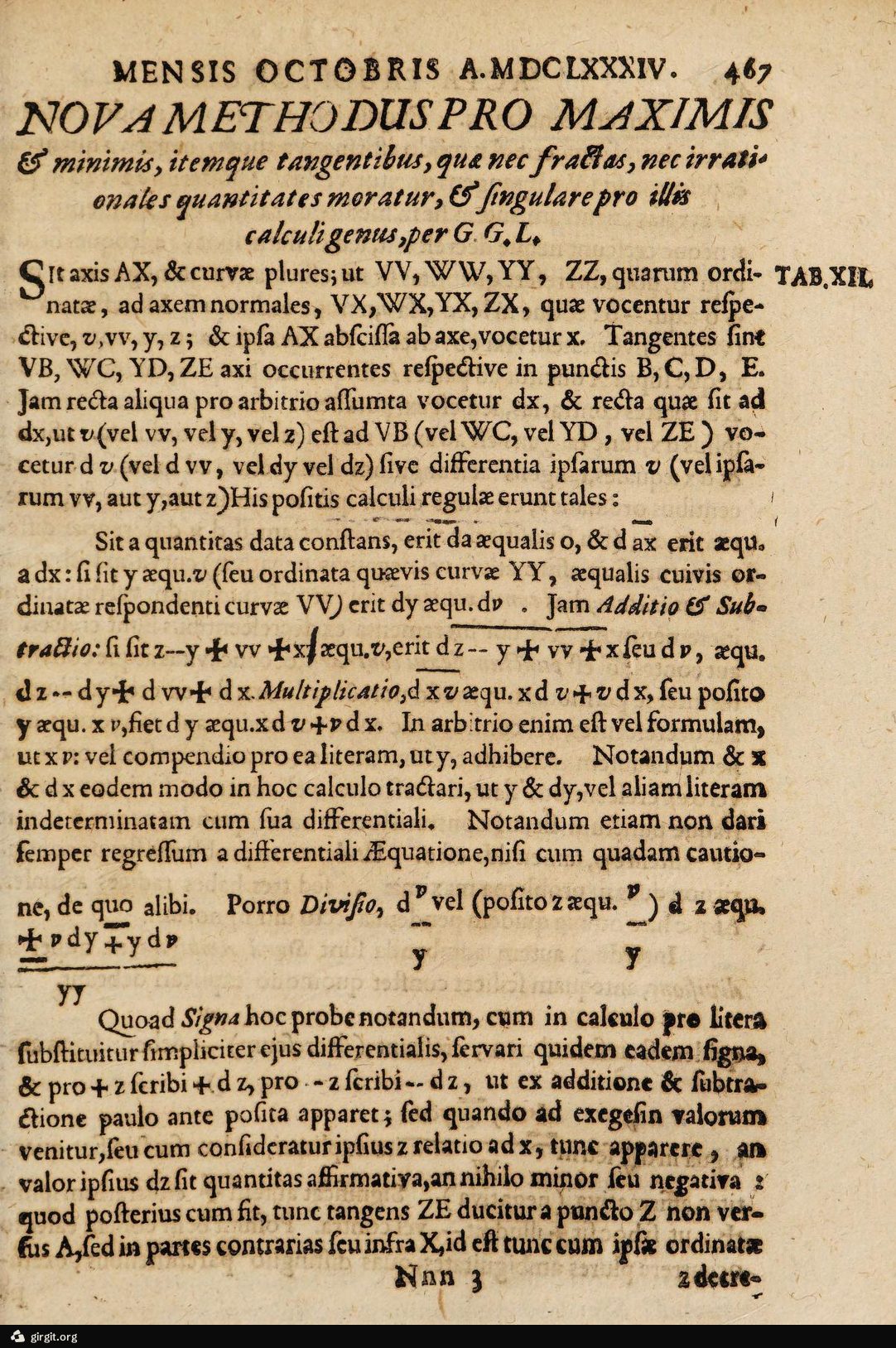 Nova Methodus, October 1684
- 1666Isaac Newton, CambridgeAn October tract on motions; later he calls rates "fluxions".
- 1671Method of FluxionsWritten now, printed only after his death.
- 1675Gottfried Wilhelm Leibniz, GermanyA small "d" for a tiny difference, in his notes.
- 1684Acta EruditorumLeibniz prints his rules: the dx/dt on this page.
- 1712The Royal SocietyA committee, Newton its President, rules for Newton. Historians now credit both.
See itZoom into the curve
Then try the bounce
Solve itThree problems
Your turn
Solve it
A cricket ball (7 cm across) leaves the bat at 40 m s−1. A camera photographs it with the shutter open for 1/1000 s. How long is the blur, and does the ball look sharp?
Answer
Solve it
For \( x = t^3 \), the chord centred on \( t = 2 \) s with width \( \Delta t \) has slope \( 12 + (\Delta t)^2/4 \). How short must the interval be for the average velocity to be within 0.01 m s−1 of the true 12 m s−1?
Hint
Answer
Solve it
Prove the formula in the last problem. Work out \( (2 + h)^3 - (2 - h)^3 \), where \( h = \Delta t/2 \), and divide by \( 2h \).
Answer
ConnectAnd still confused?
Where this goes next
Connect it
- Maths: limits and derivatives. The same limit, with the physics taken out: how fast at one instant? and derivatives from first principles.
- Acceleration, next. Do the same thing to velocity instead of position and you get acceleration at an instant: what is acceleration?
- Oscillations. A swinging pendulum is momentarily at rest at each end, exactly like the bead at 3 s here: velocity and acceleration in SHM.
- On the road. A police speed camera that times you between two marks a few metres apart is measuring an average velocity over a short interval, and calling it your speed.
If the interval is never actually zero, isn't the answer always a little wrong?
The average over any real interval is a little off, yes. The limit is not any one of those averages; it is the single number they all close in on. For a smooth motion that number exists and is exact, even though you never plug in Δt = 0.
Can speed at an instant be bigger than the average speed?
Of course: the average hides the fast and slow parts. Over any trip, the instantaneous speed must be at least the average speed at some moment and at most the average at some other moment (unless it is steady, when they are equal).
Sources
- Stanford Encyclopedia of Philosophy, "Zeno's Paradoxes", the arrow: Aristotle's report (Physics 239b) and the modern reply.
- The Newton Project: Newton's October 1666 tract on fluxions.
- Il Giardino di Archimede: Newton's Method of Fluxions (written 1671, printed 1736).
- Edward Worth Library, "Newton and Leibniz": Leibniz's 1684 paper in Acta Eruditorum.
- Trinity College Dublin, account of the Commercium Epistolicum (1712): the Royal Society's report on the priority dispute.