- 1. What is a cell?
- 2. Cell theory
- 3. What is inside a cell?
- 4. How big is a cell?
- 5. Bacteria: prokaryotic cells
- 6. Plant and animal cells
- 7. The cell membrane and cell wall
- 8. The endomembrane system
- 9. Mitochondria and plastids
- 10. Ribosomes, cytoskeleton, cilia and centrioles
- 11. The nucleus
- Review
11 of 11·NCERT §8.5.10 · §8.5.11·pp. 100–102·5 min
The nucleus
The big ideaThe nucleus is the control room: it keeps the DNA, and its pores let messages in and out.
In simple words
The nucleus is a round room with a double wall full of little doors. Inside are the cell's instruction books, written on very long threads. Most of the time the threads are loose like wool; when the cell is about to split, they wind up into tight, thick bundles we can see.
Robert Brown described the nucleus in 1831. Later Walther Flemming named the material that soaks up dye chromatin ("colour").
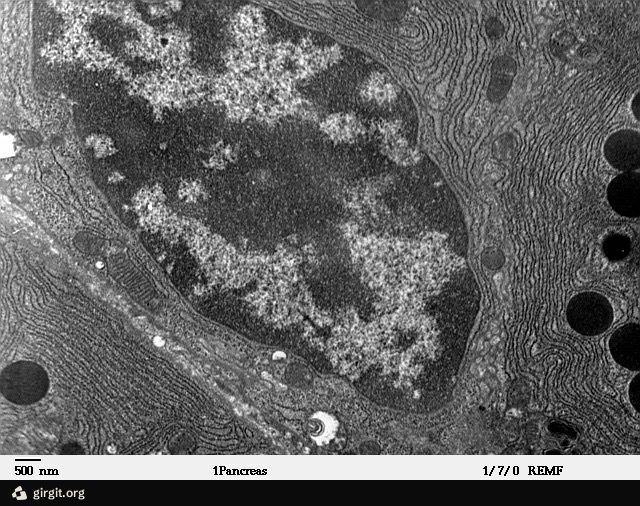 nucleusrough ERsecretory granule
A nucleus that isn't dividing (an interphase nucleus) contains:
- Chromatin: long, loose threads of DNA with proteins.
- The nuclear matrix (or nucleoplasm).
- One or more nucleoli (one: nucleolus): round bodies with no membrane, where ribosomal RNA (rRNA) is made. Protein-making cells have bigger, more nucleoli.
The nuclear envelope is two membranes with a gap of 10 to 50 nm, the perinuclear space. The outer membrane joins the ER and carries ribosomes. Where the two membranes fuse there are nuclear pores: RNA and proteins pass through them both ways.
Usually one nucleus per cell, but some cells have many (skeletal muscle fibres), and some mature cells have none: red blood cells of mammals and sieve tube cells of plants.
Textbook check · §8.5.10All mammals' red blood cells lack a nucleus
- The textbook says
- Some mature cells lack a nucleus, e.g. erythrocytes of many mammals.
- What we know now
- The mature red blood cells of all mammals lack a nucleus. The old claim that camels are an exception is an error: camel red cells are oval, but they have no nucleus. Other vertebrates (birds, reptiles, fish, frogs) keep nuclei in their red cells.Source: SIU School of Medicine, Histology: blood cells
- In the exam
- Mammalian erythrocytes and sieve tube cells are the textbook's examples of cells without a nucleus.
Chromatin and chromosomes
Chromatin is DNA plus basic proteins called histones, some non-histone proteins and RNA. A human cell holds about 2 metres of DNA, spread over 46 chromosomes (23 pairs). When a cell divides, chromatin coils up into visible chromosomes.
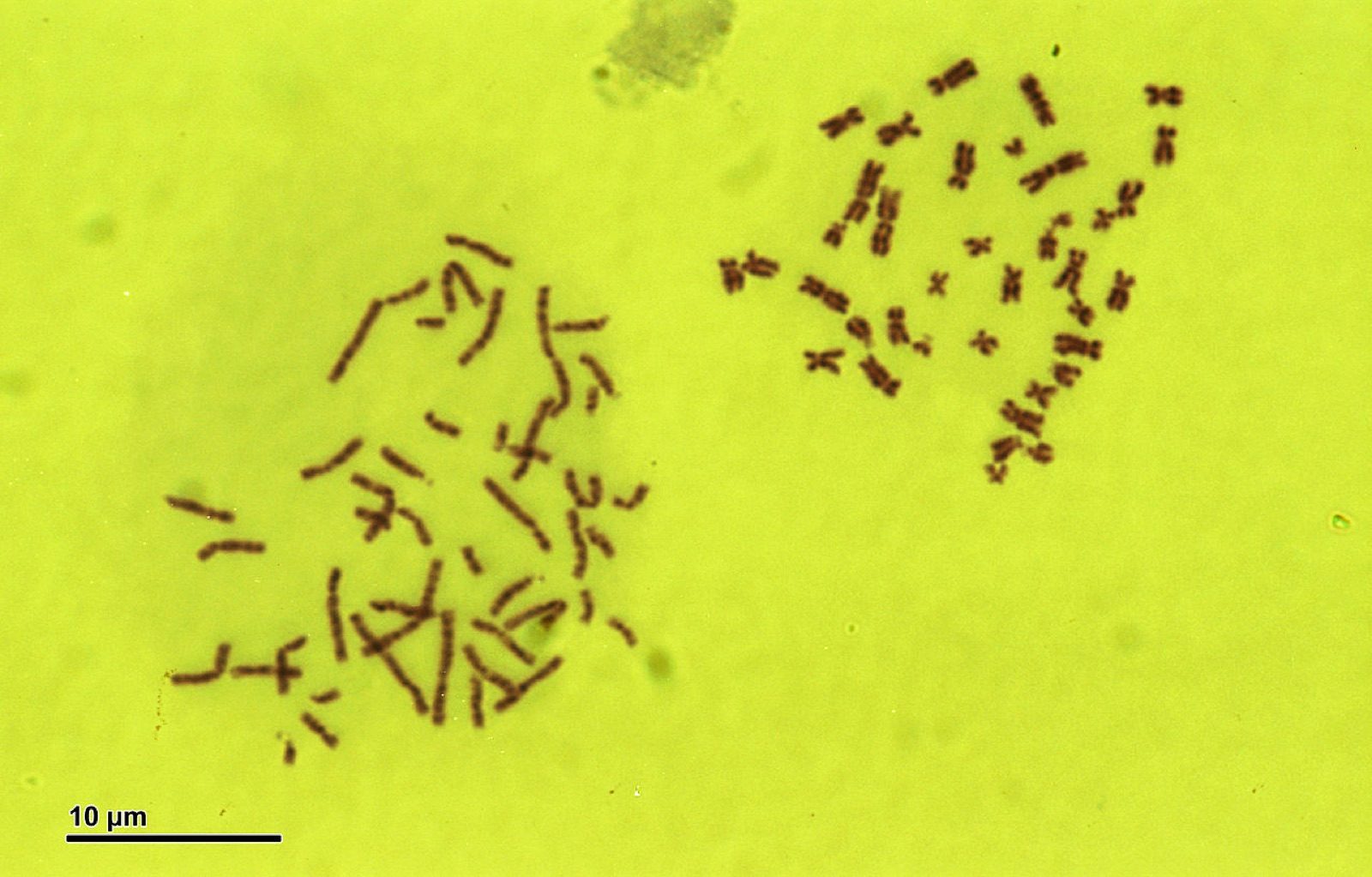 chromosome
Every chromosome has a pinch, the centromere (primary constriction), holding its two chromatids. On its sides sit discs called kinetochores, where spindle fibres attach. By where the centromere sits:
- Metacentric: in the middle, equal arms.
- Sub-metacentric: slightly off-centre, one shorter arm.
- Acrocentric: near one end, one very short arm.
- Telocentric: right at the end.
Some chromosomes have a secondary constriction that doesn't stain, cutting off a small knob, the satellite.
Microbodies
Both plant and animal cells have tiny membrane bags full of enzymes: microbodies.
Beyond the syllabusPeroxisomes and glyoxysomes
The best-known microbodies are peroxisomes, which break down fatty acids and destroy the toxic hydrogen peroxide this produces, and glyoxysomes in germinating oil seeds, which turn stored fat into sugar. You will meet peroxisomes again in photorespiration.
- Chromatin
- DNA + histones + non-histone proteins + RNA, loose in interphase.
- Nucleolus
- Membrane-less body making rRNA.
- Perinuclear space
- The 10–50 nm gap between the two nuclear membranes.
- Centromere, kinetochore
- The chromosome's pinch; the discs on it where spindle fibres attach.
- Satellite
- A small knob cut off by a secondary constriction.
Words to know
Picture and video credits
Show 1 picture and video credits
- karyotype.jpg: Doc. RNDr. Josef Reischig, CSc., CC BY-SA 3.0
