- 1. What is a cell?
- 2. Cell theory
- 3. What is inside a cell?
- 4. How big is a cell?
- 5. Bacteria: prokaryotic cells
- 6. Plant and animal cells
- 7. The cell membrane and cell wall
- 8. The endomembrane system
- 9. Mitochondria and plastids
- 10. Ribosomes, cytoskeleton, cilia and centrioles
- 11. The nucleus
- Review
6 of 11·NCERT §8.5·pp. 91–93·4 min
Plant and animal cells
The big ideaEukaryotic cells are divided into rooms. Plant and animal cells share most rooms, with a few differences.
In simple words
A plant cell and an animal cell are like two houses built from the same plan. Both have a control room, power rooms, a factory and a post office. The plant house also has a strong outer wall, green solar panels and one huge water tank. The animal house has a pair of tiny tools that help it split in two.
All protists, plants, animals and fungi are eukaryotes. Their cytoplasm is split into many rooms with membranes, called compartmentalisation, so different jobs can run side by side without getting in each other's way. They have a real nucleus with a nuclear envelope, DNA organised into chromosomes, and parts for moving and support.
Look at real ones first. In the leaf of a pond weed, every box has a wall, and the green chloroplasts crowd round the edges, pushed there by a big clear vacuole. A cheek cell scraped from inside your mouth has no wall, no chloroplasts and no big vacuole: just a soft skin, cytoplasm and a nucleus.
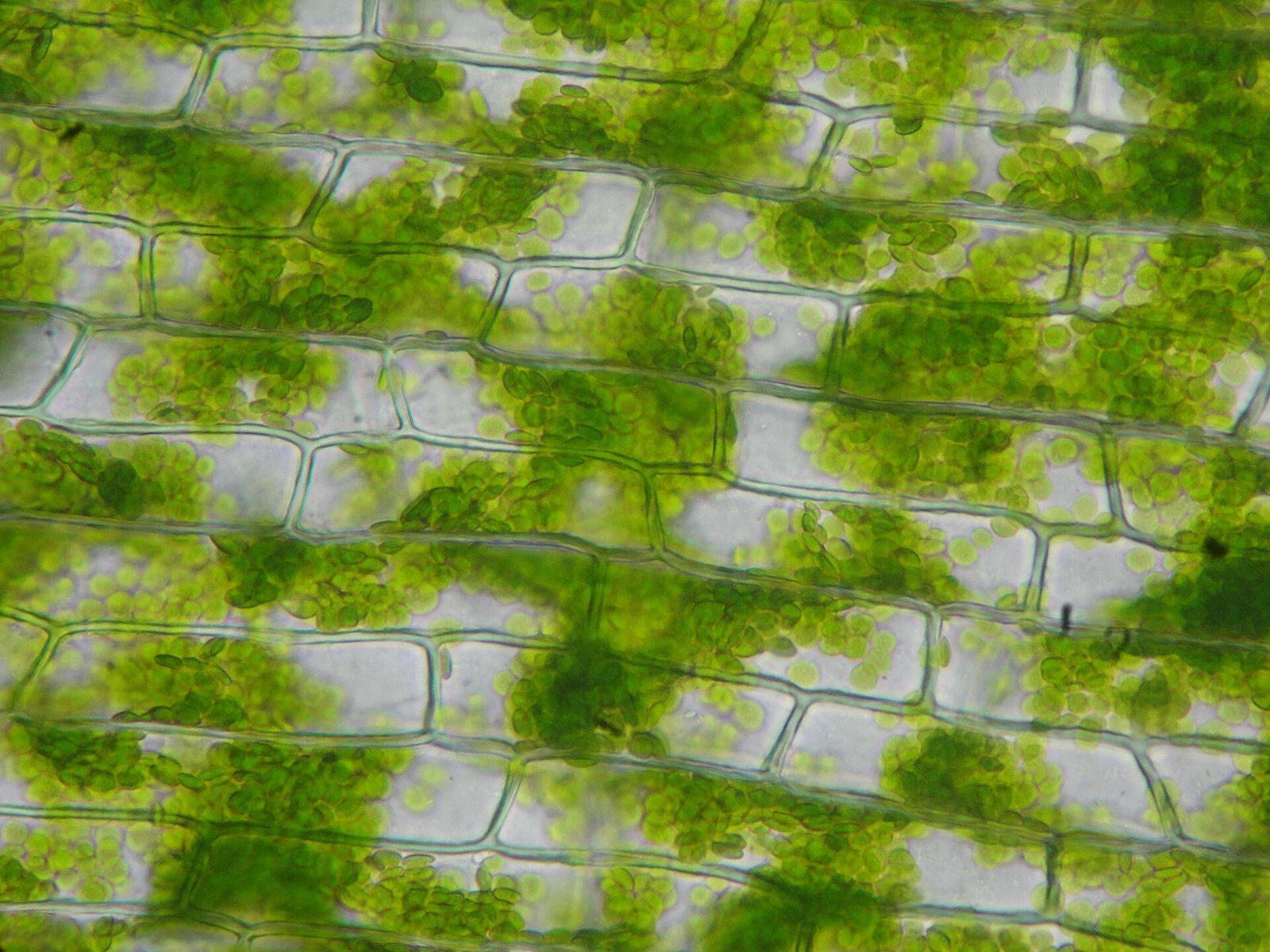 cell wallchloroplastscentral vacuole
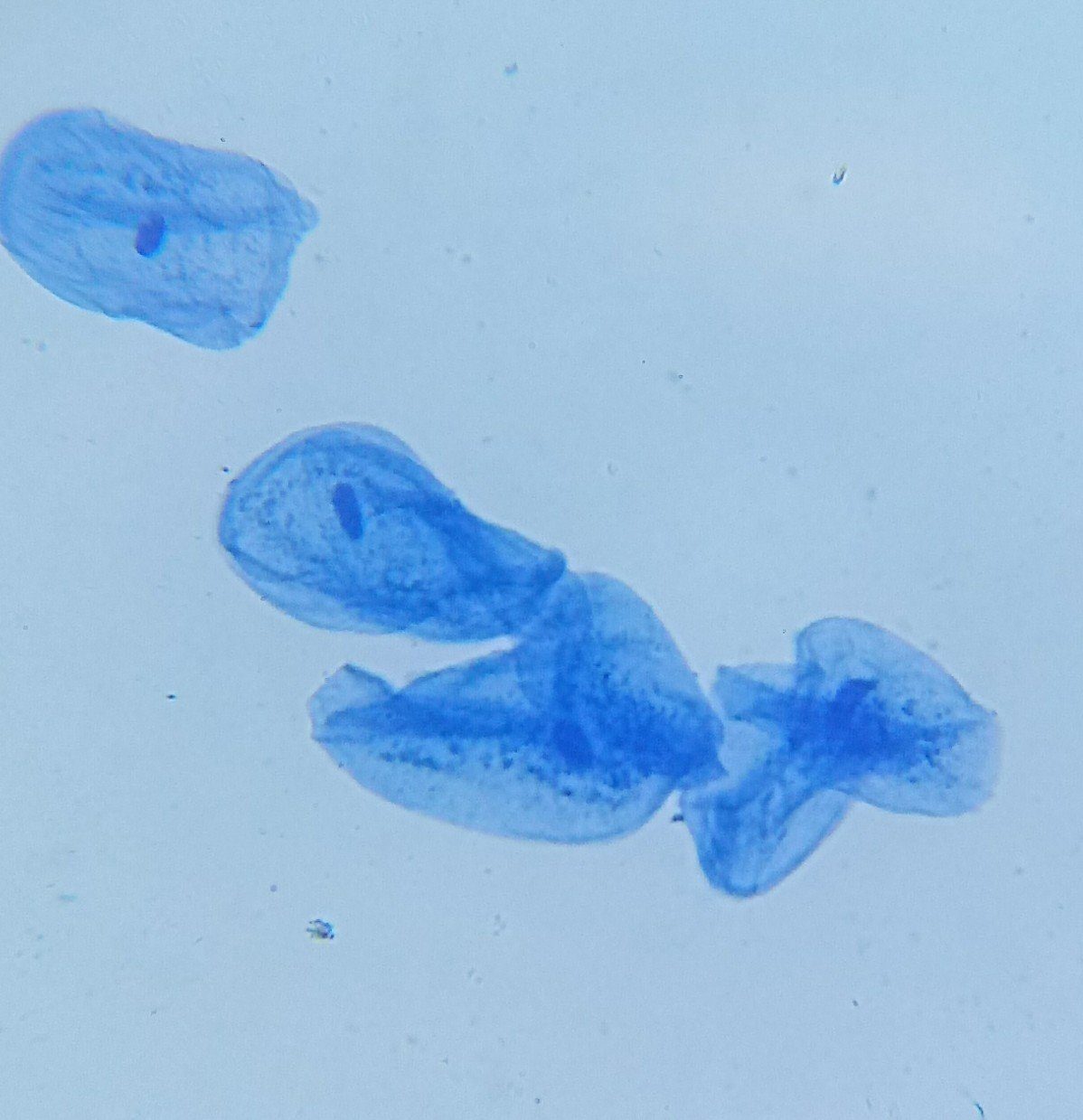 nucleuscell membranecytoplasm
Now take both kinds apart. Switch between the animal and the plant cell, and tap any part.
| Only in plant cells | Only in animal cells |
|---|---|
| Cell wall | Centrioles (almost all plant cells lack them) |
| Plastids (e.g. chloroplasts) | |
| One large central vacuole |
Just remember
No deeper reason for these lists: they are the textbook's sorting. Use the hooks (the deep dive below gives the reasons behind them).
- Eukaryotes: protists, plants, animals, fungi
- Four of the five kingdoms. Only the fifth, Monera (bacteria and blue-green algae), is prokaryotic: the odd one out, the one "before the kernel".
- Only in plant cells: cell wall, plastids, one large central vacuole
- A plant cell is a Water Pressure Vessel: Wall, Plastids, Vacuole. It stands still in the sun (plastids), swells with water (vacuole) and needs a strong tank (wall).
- Only in animal cells: centrioles
- Centrioles build the bases of swimming tails. Flowering plants have no cell that swims, so they have no centrioles. Centrioles for cells that cruise.
- Compartmentalisation
- Like the compartments of a train: the AC coach and the general coach run on the same train without mixing.
- Compartmentalisation
- Dividing the cytoplasm into membrane-bound rooms.
- Nuclear envelope
- The double membrane round the nucleus.
- Plastids
- Plant organelles with pigments, e.g. chloroplasts.
- Centrioles
- Two small tubes in animal cells that help in division.
Words to know
Which of these would you find in a cell from a mango leaf but not in a cell from your cheek?
- Mitochondria
- Ribosomes
- Chloroplasts
- A nucleus
Why does a eukaryotic cell divide its cytoplasm into rooms with membranes?
- So that different jobs, with different chemistry, can run side by side
- To make the cell heavier and stronger
- Because a cell without rooms cannot divide
Deep dive · optional
Why is a plant cell mostly a bag of water?
Why a plant cell fills itself with a huge vacuole and wraps itself in a wall, why an animal cell does neither, and how a Dutch botanist's leaf cells taught chemists how solutions push. The exam won't ask, but it makes the table above make sense.
The roots: water is cheap, cytoplasm is not
- Why does a plant cell carry one huge vacuole?Because it lets the cell grow big using mostly water. In real plant cells the vacuole fills about 30 to 90% of the cell. The living cytoplasm, packed with proteins that cost the cell a lot to make, is only a thin layer between the vacuole and the wall.
- Why would a plant want big cells made cheaply?A plant cannot walk to its food. It must grow out towards light, air and water, and spread wide leaves and long roots. Swelling cells with water is the cheapest and fastest way to do it: a young leaf can open out quickly using mostly water.
- What makes the water go in?The vacuole's sap is full of dissolved salts, sugars and other things, much more than the water outside. Water flows across a membrane towards the side with more dissolved stuff: osmosis. So water keeps moving into the vacuole, and the cell swells.
- Then why doesn't it burst?Because of the wall. The swelling cell presses on its wall, and the wall pushes back. This pressure, turgor, is what makes a fresh spinach leaf stiff and a wilted one floppy. A vacuole without a wall would be a balloon in a hose pipe.
- So why don't animal cells do the same?Because they live a different life. Animal cells must change shape, crawl, swallow food and press against each other in moving bodies. A stiff wall would stop all that. So they skip the wall, keep their water balanced with pumps instead, and get their support from bones and shells. And the bedrock is osmosis: water moves towards where more is dissolved, and a cell must either hold back that push with a wall or keep it small.
Geometry helps the plant too. Most of a ball's volume lies near its surface, so a vacuole that fills 90% of a cell's volume takes up 97% of its width. The cytoplasm is pressed into a skin about a micrometre thick, right against the wall, where light, carbon dioxide and water arrive. Every chloroplast gets a window seat.
Compartments are the same idea at a smaller scale. A vacuole is not just a water tank: its membrane, the tonoplast, pumps in salts and acid, and the acid sap lets digesting enzymes work there, like a giant lysosome. An animal cell keeps its acid in small lysosomes instead, which fill only about 1 to 15% of it. Because each room has its own membrane, the acid never touches the rest of the cell.
The story
See it
The living layer at work: in these cells of a green alga, sped up 15 times, the chloroplasts ride round the edge of each cell in a thin moving layer of cytoplasm. The clear middle of each cell is the vacuole.
Now find out how thin that layer must be. Guess first, then drag the vacuole's edge or the numbers.
Solve it
Solve it
Two cells are built from the same 1,000 µm³ of cytoplasm. One is an animal-like ball with no vacuole. The other is a plant cell whose vacuole fills 90% of it. Treat both as balls (volume \( V = \tfrac{\pi}{6} D^3 \)). How wide is each, and how many times more skin does the plant cell have to catch light and gas?
Hint
Answer
Solve it
De Vries found that the leaf cells of a plant just begin to plasmolyse in 0.15 M potassium nitrate at about 23 °C (296 K). At that moment the sap inside and the solution outside pull water equally. Use van 't Hoff's law, \( \Pi = iCRT \), with \( i = 2 \) for KNO3 (it splits into two ions) and R = 0.0821 L atm mol⁻¹ K⁻¹, to estimate the osmotic pressure of the sap.
Answer
Flowering plants have no centrioles. So when a mango leaf cell divides, what happens?
- It cannot divide
- It still builds a spindle, without centrioles
- It borrows centrioles from a neighbouring cell
Connect it
Connect it
- The wall and turgor, next page. Plasmolysis in red onion cells, and why a wall can hold a pressure a membrane cannot: the cell membrane and cell wall.
- Vacuoles and lysosomes. The tonoplast, the 90% vacuole and the acid bags of animal cells: the endomembrane system.
- Osmotic pressure, Chemistry Class 12. Van 't Hoff's law, which began with Pfeffer's pots and de Vries's leaves: osmosis and reverse osmosis and the van 't Hoff factor.
- Growth, Chapter 13. Plant cells grow mainly by enlarging with water as the wall loosens: what is growth.
- Division without centrioles, Chapter 10. How the spindle pulls chromosomes apart: prophase and metaphase.
- In your kitchen. Limp coriander or spinach perks up in a bowl of water within an hour: water flows back into the vacuoles and turgor returns.
Still confused?
If the vacuole is mostly water, is it just empty space?
No. Its sap holds salts, sugars, acids, pigments and wastes. The red of a red onion's skin is in its vacuoles. The tonoplast pumps substances in, against their gradient, and the acid sap lets digesting enzymes work, so the vacuole is a storeroom, a dustbin and a stomach in one.
Fungi have walls and vacuoles too. Are they plants?
No. Their walls are made of chitin, not cellulose, and they have no plastids: they cannot make their own food. A wall and a vacuole solve the water problem for any cell that stays put; plastids are what make a plant.
Do animal cells have no vacuoles at all?
They have small ones: little vesicles and food vacuoles, and their lysosomes do the digesting job of a plant vacuole. What they never have is one big central vacuole filling most of the cell. The contractile vacuole of Amoeba belongs to a protist, not an animal.
Sources
- Vacuole: history (Dujardin, Schleiden, de Vries's tonoplast 1885), turgor, growth using mostly water, acid sap
- BioNumbers BNID 107482: vacuoles fill 30 to 90% of plant and fungal cells; lysosomes 1 to 15% of mammalian cells
- van den Ende, H. (1998), Hugo de Vries and the plasmolysis method, Acta Botanica Neerlandica 47: 465–473
- Embryo Project Encyclopedia: Wilhelm Pfeffer (1845–1920) and his osmotic studies
- Jacobus van 't Hoff: solutions and gases, Nobel Prize in Chemistry 1901
- Centriole: absent from flowering plants and conifers, present in the swimming male cells of some land plants
- Turgor pressure
Picture and video credits
Show 3 picture and video credits
- elodea-leaf-cells-chloroplasts.jpg: Juan Carlos Fonseca Mata, CC BY-SA 4.0
- cheek-cells-methylene-blue.jpg: Fritzmann2002, CC BY-SA 4.0
- algal-cells-cyclosis.mp4: Andrei Savitsky, CC BY-SA 4.0

