- 1. What is a cell?
- 2. Cell theory
- 3. What is inside a cell?
- 4. How big is a cell?
- 5. Bacteria: prokaryotic cells
- 6. Plant and animal cells
- 7. The cell membrane and cell wall
- 8. The endomembrane system
- 9. Mitochondria and plastids
- 10. Ribosomes, cytoskeleton, cilia and centrioles
- 11. The nucleus
- Review
10 of 11·NCERT §8.5.6 · §8.5.7 · §8.5.8 · §8.5.9·pp. 98–100·6 min
Ribosomes, cytoskeleton, cilia and centrioles
The big ideaRibosomes build proteins; the cytoskeleton holds the cell up and moves it; cilia, flagella and centrioles are built from the same tubes.
In simple words
Ribosomes are tiny machines that read instructions and build proteins. A cell also has poles and ropes inside, which hold its shape and act as roads. Some cells grow hairs out of these poles that beat like oars to swim.
Ribosomes
First seen by George Palade (1953) under the electron microscope. They are made of RNA and protein, with no membrane. Every ribosome has a large and a small subunit.
| Found in | Whole | Large | Small |
|---|---|---|---|
| Eukaryotic cytoplasm | 80S | 60S | 40S |
| Prokaryotes, mitochondria, chloroplasts | 70S | 50S | 30S |
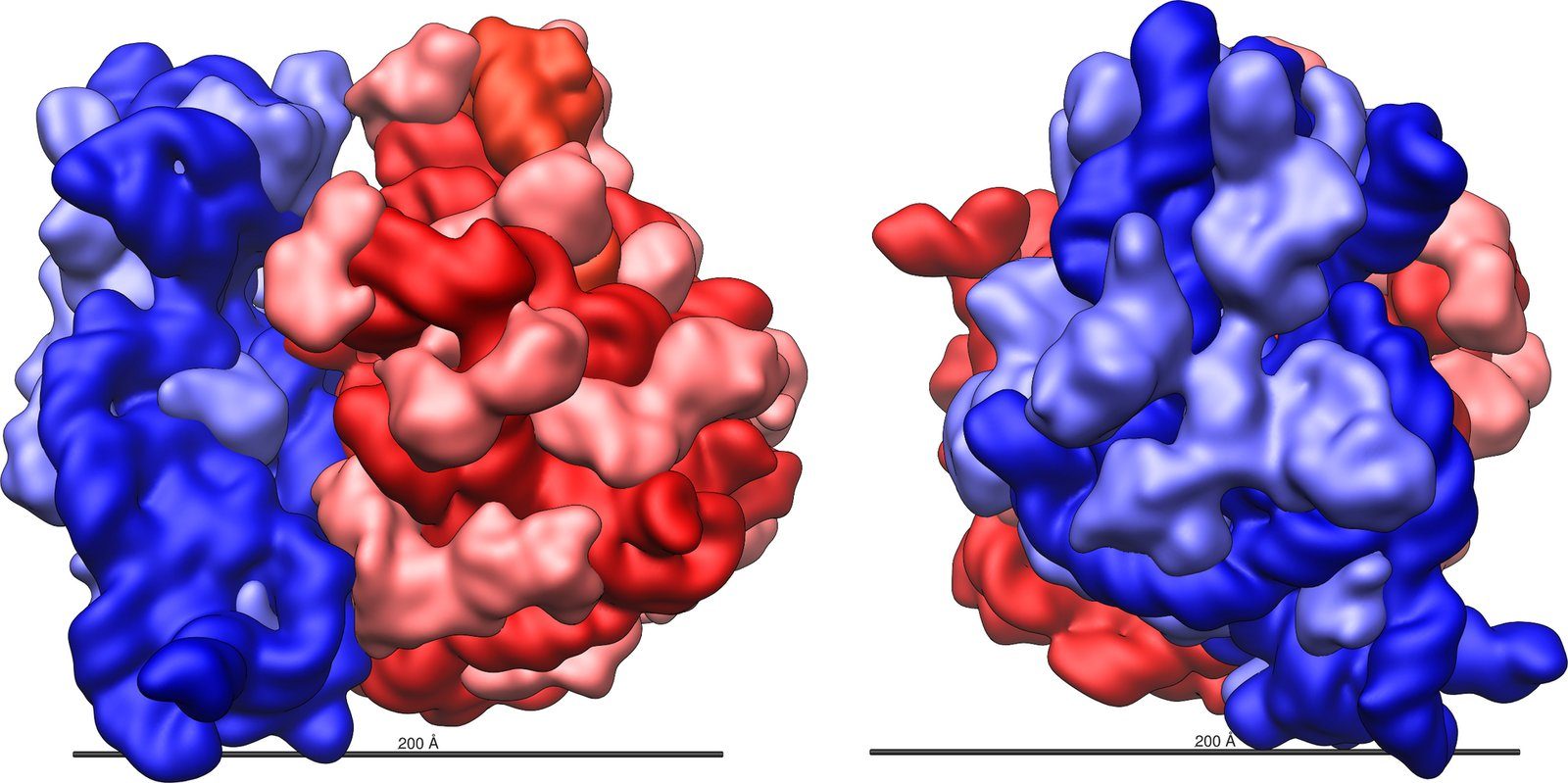 large subunit (50S)small subunit (30S)
"S" is the Svedberg unit: how fast a particle sinks when spun very fast (its sedimentation coefficient). It depends on size and shape, so the numbers don't add up.
The cytoskeleton
A network of protein threads, the cytoskeleton, made of microtubules, microfilaments and intermediate filaments. It gives mechanical support, movement and keeps the cell's shape.
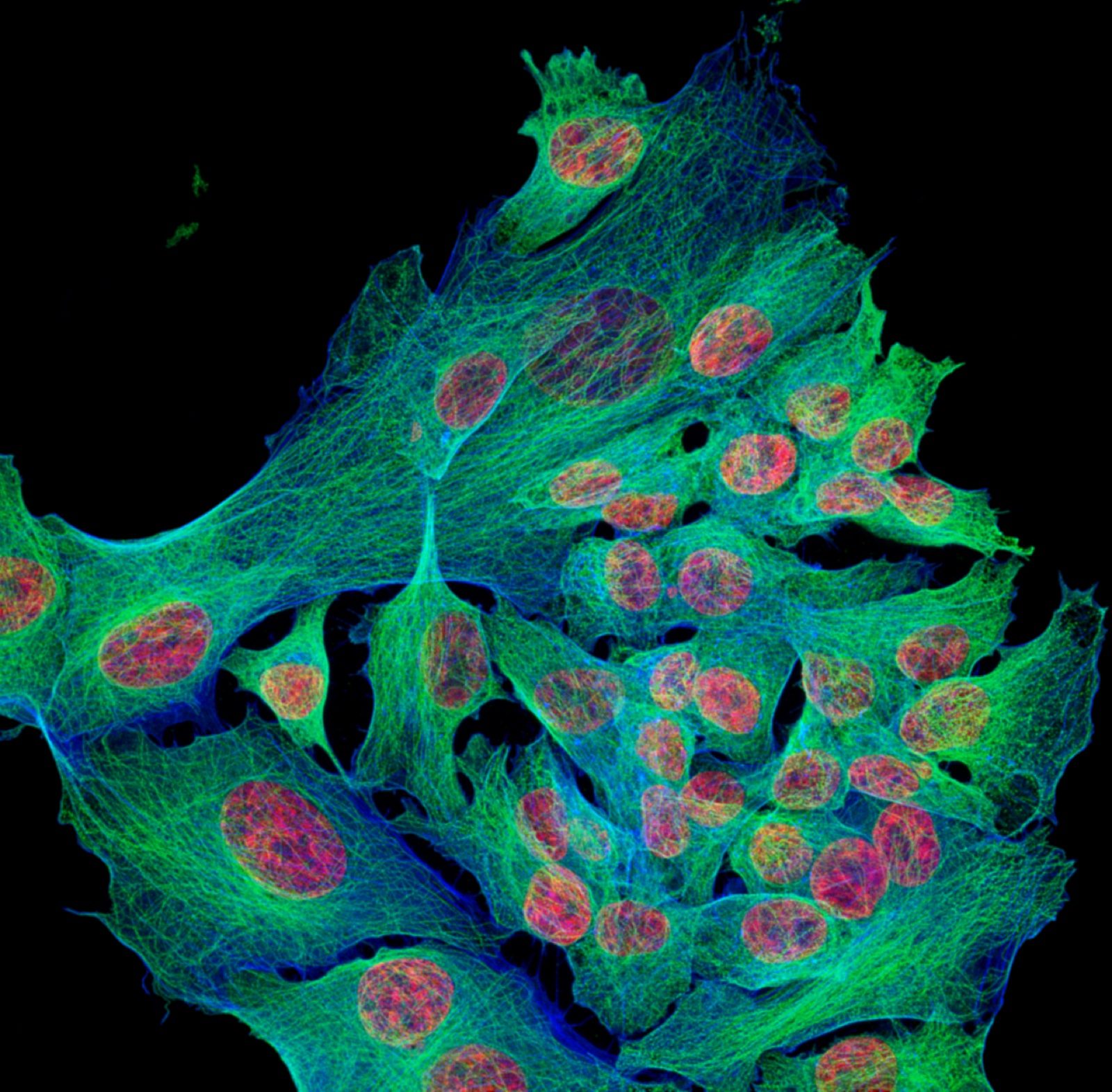 nucleuscytoskeleton fibres
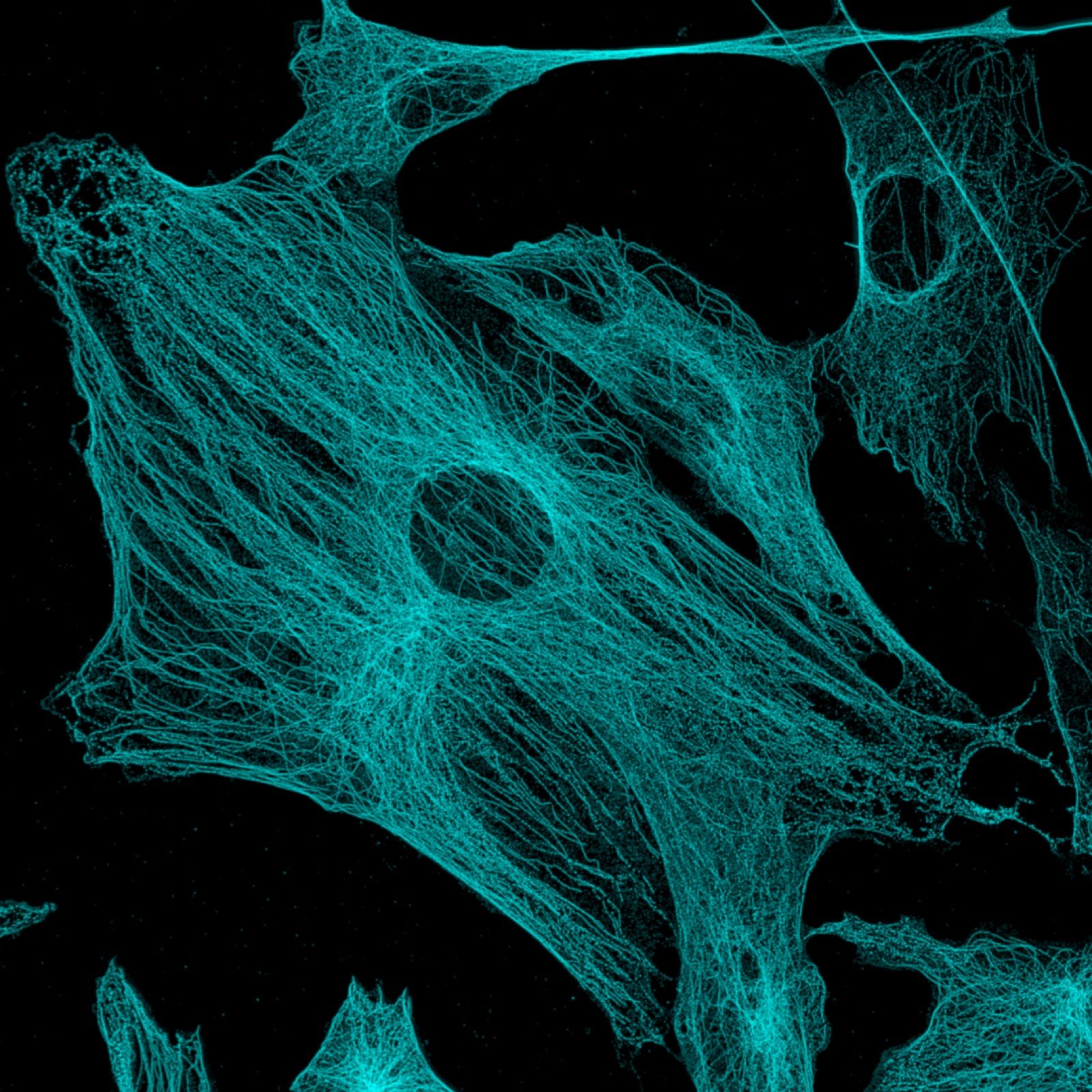 microtubulesnucleus (unstained)
Textbook check · §8.5, 8.5.7Bacteria have a cytoskeleton too
- The textbook says
- Eukaryotic cells have a variety of complex cytoskeletal structures (presented as a eukaryotic feature).
- What we know now
- Bacteria have a cytoskeleton too, discovered only in the 1990s and 2000s: FtsZ (a relative of tubulin) forms the ring that pinches a dividing bacterium in two, MreB (a relative of actin) shapes rod-shaped bacteria, and crescentin bends Caulobacter into a curve.Source: The Bacterial Cytoskeleton, CBE Life Sciences Education
- In the exam
- The textbook's statement about eukaryotes is still true; just don't write that prokaryotes have no cytoskeleton.
Cilia and flagella
Cilia are short hairs that row like oars, moving the cell or the fluid round it. Flagella are longer whips that drive the cell. Bacterial flagella are built differently.
Your own windpipe is lined with cilia. Each cell carries about 200 of them, and together they sweep a sheet of mucus, with the dust and germs stuck in it, up and out of your lungs.
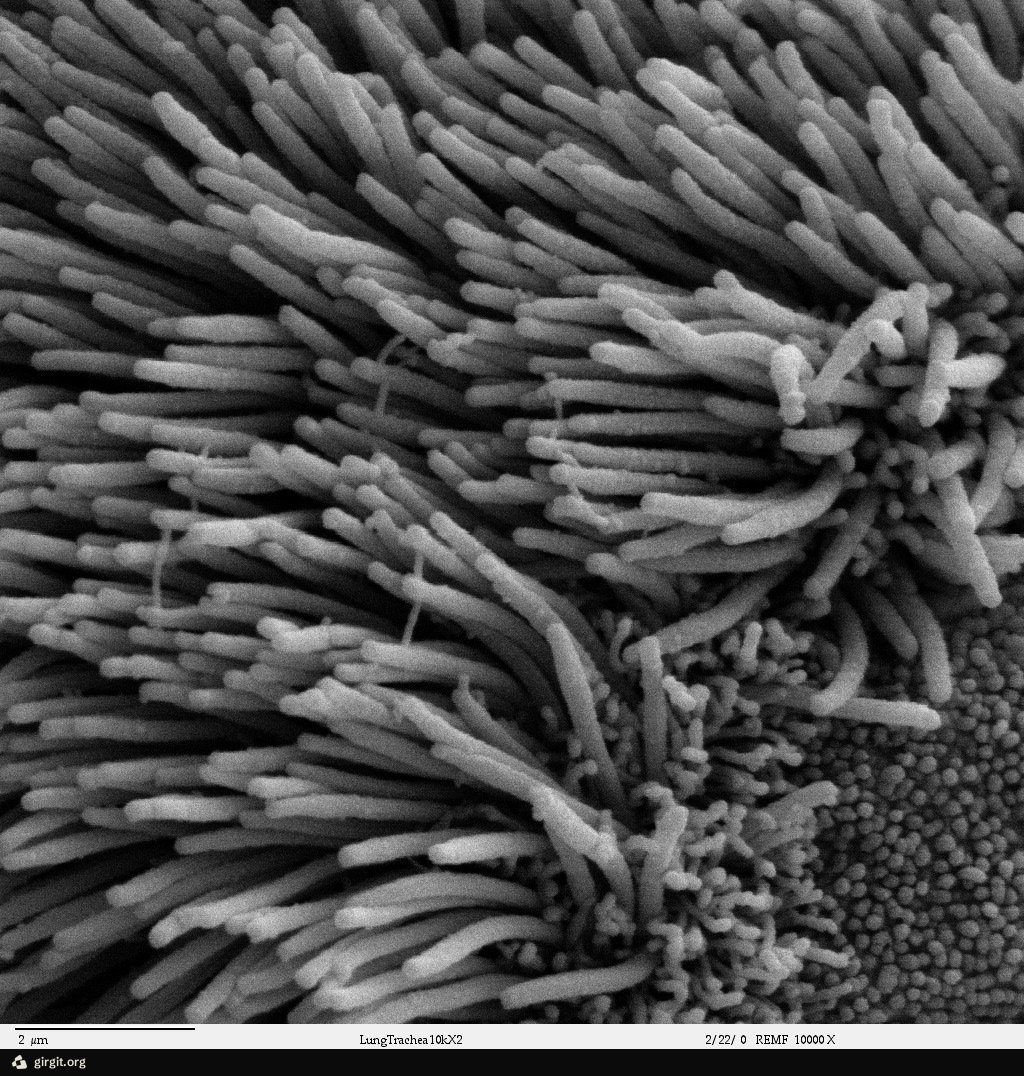 ciliamicrovilli (no cilia)
Inside, each has a core, the axoneme, with a famous pattern, the 9 + 2 array: nine pairs (doublets) of microtubules round the edge, two single microtubules in the middle in a central sheath, joined by nine radial spokes, with linkers between the pairs. They grow from basal bodies.
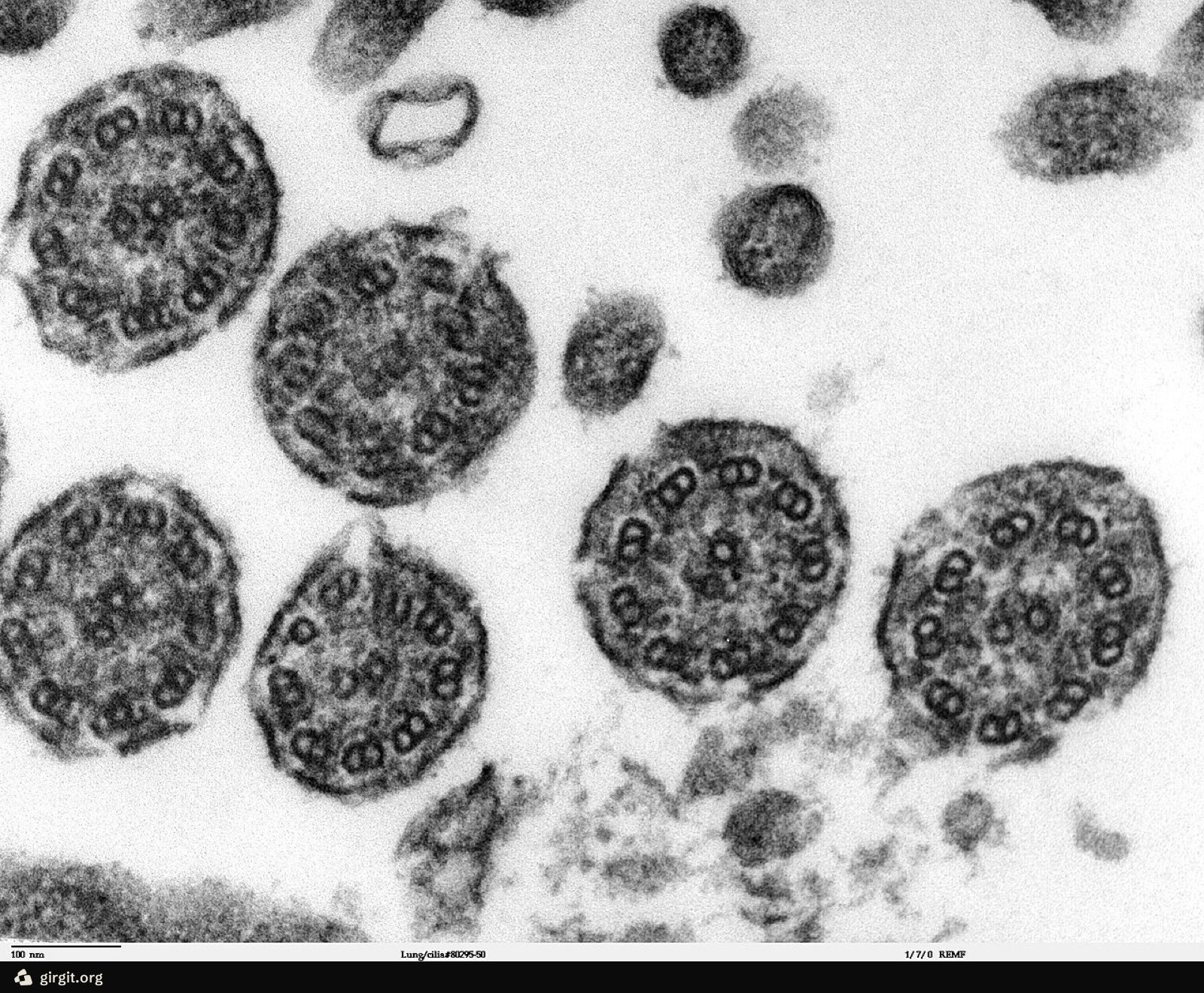 one cilium, cut across
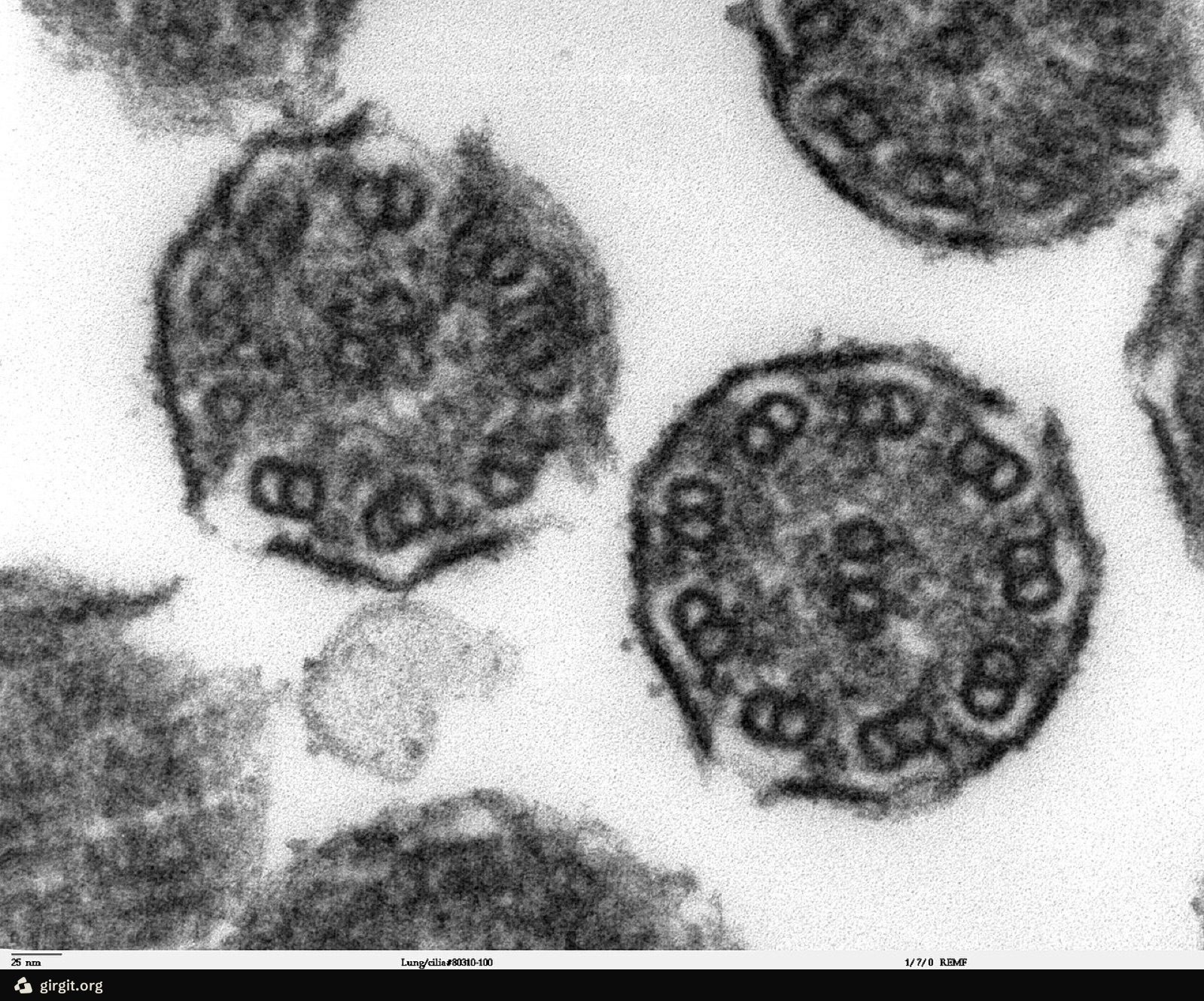 central pairdoubletmembrane
Centrosome and centrioles
The centrosome holds two centrioles at right angles, in pericentriolar material. Each centriole is a cartwheel of nine triplets of tubulin, with a central hub joined by spokes. Centrioles form the basal bodies of cilia and flagella, and the spindle fibres in animal cell division.
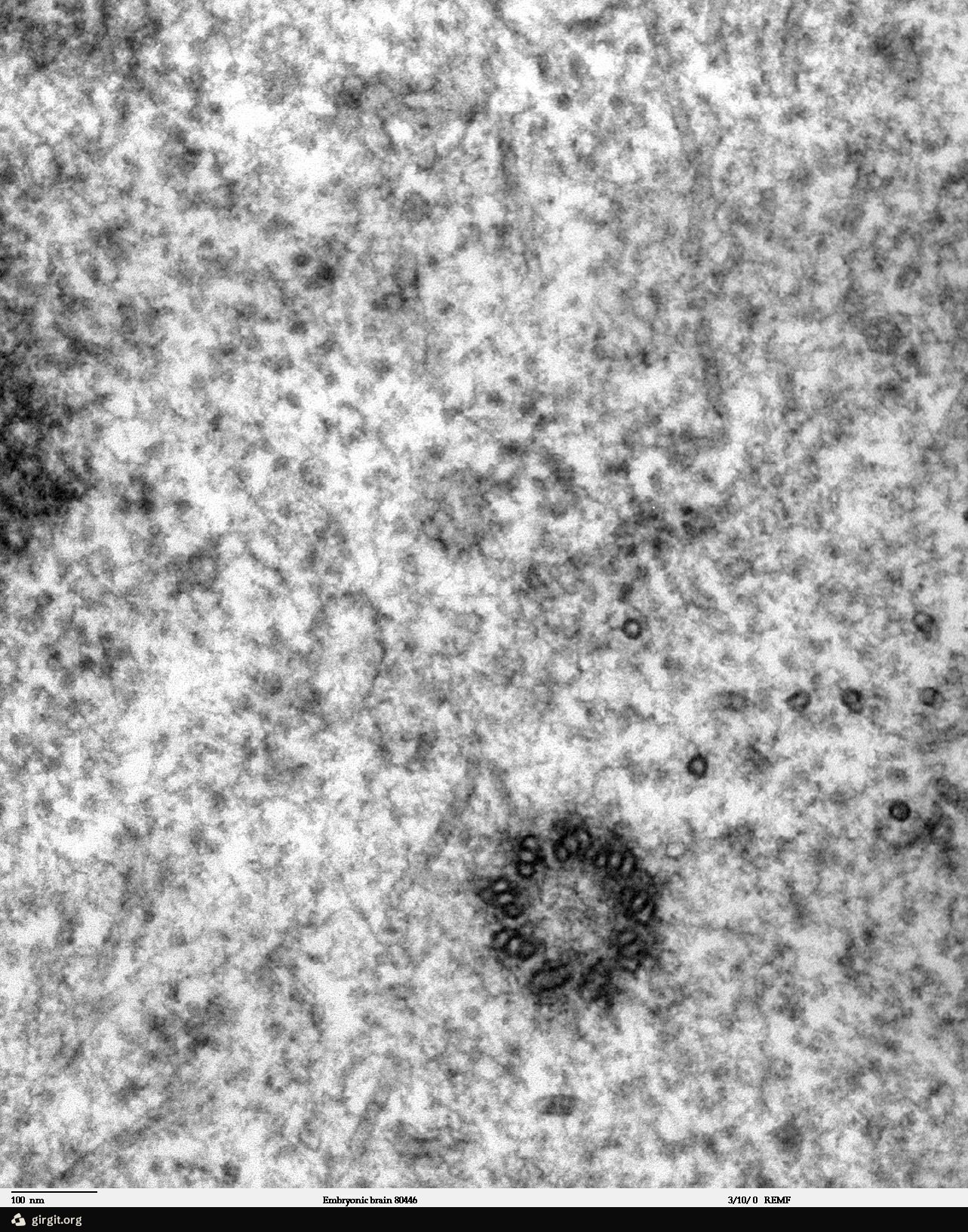 centrioletriplet microtubules
Don't mix these up
- Cilium or flagellum: 9 + 2, nine doublets + a central pair.
- Centriole and basal body: 9 + 0, nine triplets, cartwheel with a hub.
- Bacterial flagellum: no microtubules; filament, hook, basal body.
Just remember
No deeper reason for these: they are numbers, names and counts. Use the hooks.
- 80S = 60S + 40S (eukaryotic cytoplasm); 70S = 50S + 30S (prokaryotes)
- Count down in twos. Eukaryotes go 8-6-4, the even numbers; prokaryotes go 7-5-3, the odd ones. The first digit is always the whole, the next two the big and small pieces.
- 70S ribosomes also in mitochondria and chloroplasts
- They were bacteria once (concept 9), and they kept their bacterial-size ribosomes: "old tenants keep old furniture".
- Ribosomes first seen by Palade (1953 in the textbook)
- Palade saw particles. The textbook's year, 1953, is also the year Watson and Crick published the double helix.
- Cytoskeleton: microtubules, microfilaments, intermediate filaments
- Thick, thin and in-between: tubes, threads and the ones whose name says "in-between".
- Cilium and flagellum: 9 + 2, doublets. Centriole and basal body: 9 + 0, triplets in a cartwheel
- The beating hair has 2 in the middle and 2 in each pair. The cartwheel is hollow in the middle (0) and has 3 in each blade. Nine round the rim in both.
- Two centrioles at right angles; they form basal bodies and the spindle
- Like the letter L: one lies down, one stands up.
- Bacterial flagellum: filament, hook, basal body
- A fishing line, a hook and the reel that turns it: the basal body spins like a motor.
- Svedberg unit (S)
- A measure of how fast a particle sinks when spun.
- Axoneme
- The 9 + 2 core of a cilium or flagellum.
- Basal body
- The centriole-like base a cilium grows from.
- Tubulin
- The protein microtubules are made of.
Words to know
Which ribosomes would you find inside the mitochondria of one of your liver cells?
- 80S, like the rest of the cell
- 70S, like bacteria
- 60S
- None: mitochondria have no ribosomes
An electron micrograph shows a ring of nine triplets of microtubules with nothing in the middle. What are you looking at?
- A cilium
- A centriole or basal body
- A bacterial flagellum
- A microfilament
Deep dive · optional
How does a hair with no muscle beat?
How tiny motors that can only slide make a cilium bend, the experiments that caught the tubes sliding, the men whose cilia stood still, and the Indian physicist who mapped a ribosome atom by atom. The exam won't ask, but it makes the page stick.
The roots: a slide becomes a bend
- Why can't a muscle move a cilium?Because a cilium sticks out of the cell like a hair, far from any muscle. Whatever moves it has to be built into the hair itself, all the way along.
- So what is the motor?A protein called dynein. Rows of dynein "arms" are fixed to each of the nine doublets. Each arm grabs the next doublet, pulls, lets go and grabs again, burning one ATP each time. The result: one doublet slides past its neighbour, like your hands passing a rope along.
- Sliding tubes should just make the hair longer. Why does it bend?Because the doublets are tied down. They are all fixed into the basal body at the bottom, and tied to each other all along by stretchy nexin links. Tubes that are fixed at one end and cannot change length can take up a slide in only one way: by curving.
- How big a bend for how big a slide?Take two tubes a distance \( d \) apart, bent round an arc through an angle \( \theta \). The one on the inside of the curve sticks out past the other at the tip by \( \Delta = d\,\theta \) (\( \theta \) in radians). In a cilium the doublets on opposite sides are only about 0.2 µm apart, so a slide of just 0.2 µm turns the tip by one radian, about 57°.
- Why is the inside tube "longer" at the tip?Because the outside of any bend is a longer path than the inside: arc length is radius times angle. It is why runners in the outer lanes start ahead in a 400 m race: the outer lane is longer round the curves. Equal-length tubes round a curve must end at different places. That is the bedrock: plain geometry.
A beat is this, switched from side to side. The dynein arms on one side of the ring work and the cilium bends one way; the arms on the opposite side take over and it bends back. A cilium does a fast, stiff power stroke and a slow, bent return, like an oar; a flagellum passes waves of bending down its length. Exactly how the cell switches the two sides on and off in turn is still being worked out: the central pair and the radial spokes are thought to help.
Notice what dynein cannot do: it cannot pull a tube shorter. Muscle works by sliding too, but there the sliding threads are free to overlap more and the whole cell shortens. A cilium is a muscle whose threads are tied at the bottom, so the same sliding comes out as a bend.
The stories
See it
Be the dynein. Drag the tip, change how far apart the doublets are, then cut the links as Summers and Gibbons did.
The biggest animals that swim with cilia: comb jellies. Each shimmering line is a row of combs, and every comb is thousands of long cilia beating together.
Solve it
Solve it
The doublets on opposite sides of a cilium are about 0.2 µm apart. How far must dynein slide them at the tip to bend the cilium through 90°? What fraction is that of a cilium 10 µm long?
Hint
Answer
Solve it
Afzelius's patients had immotile sperm and bronchitis. Predict two more things you would expect in a person whose dynein arms are missing, and say which structures from this page explain each.
Answer
Summers and Gibbons added ATP to sperm tails whose nexin links had been cut by trypsin. What did the tubes do?
- They bent more strongly than before
- They slid apart past each other
- They shortened, like muscle
- Nothing: ATP does not affect them
Connect it
Connect it
- Centrioles at work, Chapter 10. The same centrioles that make basal bodies organise the spindle that pulls chromosomes apart: prophase and metaphase.
- Your airways, Chapter 14. The lining of the windpipe and bronchi, with its cilia and mucus, is on the path of air.
- Sperm, Class 12. A sperm's tail is one long flagellum, with a 9 + 2 axoneme and a mitochondria-wrapped middle piece to fuel the dynein: sperm and egg.
- Translation, Class 12. What the ribosome actually does, reading mRNA three letters at a time: tRNA and translation. The joining of amino acids is done by the ribosome's RNA, not its proteins: it is an RNA enzyme.
- Radians, Physics. Arc length = radius × angle is the same rule as in uniform circular motion.
- Antibiotics. Bacterial 70S ribosomes differ enough from our 80S ones that some antibiotics can jam theirs and spare ours. Ramakrishnan's 30S structures showed several of them sitting in the bacterial small subunit.
Still confused?
Are cilia and flagella different things?
In eukaryotes they are the same machine: a 9 + 2 axoneme growing from a basal body, driven by dynein. We call them cilia when they are short and many, and flagella when they are long and few, and they tend to beat differently (oar-like versus wave-like). The bacterial flagellum is a different thing altogether: no microtubules, no dynein, just a protein filament turned at its base by a rotary motor.
If the tubes slide, why don't they slide out of the top?
Because the slide is tiny compared with the length (a fraction of a micrometre on a 10 µm cilium), and because the tubes are tied to each other by nexin links and fixed in the basal body. They can shift only a little before the links pull back. Cut the links, as Summers and Gibbons did, and they do slide right out.
Is a centriole the same as a basal body?
Almost. Both are short cylinders of nine triplet microtubules in a cartwheel, 9 + 0. A centriole that moves to the cell surface and anchors a cilium is called a basal body; the doublets of the cilium grow out from two of the three tubes of each triplet.
Sources
- Gibbons, I. R. and Rowe, A. J. (1965), Dynein: a protein with adenosine triphosphatase activity from cilia, Science 149: 424
- Satir, P. (1968), Studies on cilia III: a "sliding filament" model of ciliary motility, J. Cell Biol. 39: 77–94
- Summers, K. E. and Gibbons, I. R. (1971), ATP-induced sliding of tubules in trypsin-treated flagella of sea-urchin sperm, PNAS 68: 3092
- Afzelius, B. A. (1976), A human syndrome caused by immotile cilia, Science 193: 317–319
- Primary ciliary dyskinesia: frequency, situs inversus, Kartagener 1933
- Palade, G. E. (1955), A small particulate component of the cytoplasm, J. Biophys. Biochem. Cytol. 1: 59–68
- Venki Ramakrishnan: life, 30S structure (2000), Nobel Prize 2009 and Ribosome: sizes, RNA catalysis, antibiotics
- Cilium: about 200 cilia per airway cell and Ctenophora: comb rows of cilia
- Atlas of Plant and Animal Histology: cilia about 0.25 µm across
Picture and video credits
Show 5 picture and video credits
- ribosome-70s-two-subunits.jpg: Vossman, CC BY-SA 3.0
- cytoskeleton-osteosarcoma.jpg: Howard Vindin, CC BY 4.0
- microtubules-fibroblast.jpg: Howard Vindin, CC BY 4.0
- venki-ramakrishnan-jaipur-2025.jpg: Sriya Sarkar, CC BY 4.0
- comb-jelly-cilia-rows.mp4: Eric Polk, CC BY-SA 4.0


