- 1. How fast is a falling stone at one instant?
- 2. What is a limit?
- 3. Left-hand and right-hand limits: when does a limit exist?
- 4. The algebra of limits and limits of polynomials
- 5. Limits of rational functions and the 0/0 puzzle
- 6. The standard limit (xⁿ − aⁿ)/(x − a) = naⁿ⁻¹
- 7. Why sin x / x tends to 1: the sandwich theorem
- 8. Solving limits of trigonometric functions
- 9. What is a derivative? From chord to tangent
- 10. Derivatives from first principles
- 11. Algebra of derivatives: sum, product and quotient rules
- 12. Derivatives of polynomials and trigonometric functions
- Review
10 of 12·NCERT §12.5·5 min
Derivatives from first principles
The big ideaDo the derivative calculation at a general point \( x \) instead of one number, and you get a whole new function, \( f'(x) = \lim_{h \to 0} \frac{f(x + h) - f(x)}{h} \), that gives the slope everywhere at once.
In simple words
Working out the steepness of a hill at one spot is useful. Working out a rule that tells you the steepness at every spot is much better, because then you never have to start again. You do the hard work once, with a letter instead of a number, and get a rule that answers every question about steepness.
The derivative function (Definition 2)
For a real valued function \( f \), the new function given by
\[ f'(x) = \lim_{h \to 0} \frac{f(x + h) - f(x)}{h} \]wherever this limit exists is the derivative of \( f \). Finding it straight from this limit is called finding the derivative from first principles (the textbook's "first principle of derivative"). The domain of \( f' \) is the set of points where the limit exists, which may be smaller than the domain of \( f \).
Many names for one thing
| Notation | Read as |
|---|---|
| \( f'(x) \) | f dash x (Lagrange's style) |
| \( \dfrac{d}{dx} f(x) \), or \( \dfrac{dy}{dx} \) if \( y = f(x) \) | d by dx of f of x; dy by dx (Leibniz's style) |
| \( D(f(x)) \) | D of f of x |
| \( f'(a) \), \( \left. \dfrac{df}{dx} \right|_a \), \( \left( \dfrac{df}{dx} \right)_{x = a} \) | the derivative at the point \( x = a \) |
All of them mean the same thing: the derivative of \( f(x) \), or of \( y \), with respect to \( x \). "With respect to \( x \)" means \( x \) is the input we are nudging. In \( \frac{dy}{dx} \), think "a tiny change in \( y \) for a tiny change in \( x \)"; it is one symbol, not a fraction you may cancel.
The four-step recipe
- Write \( f(x + h) \).
- Subtract \( f(x) \) and simplify the top until a factor \( h \) shows up.
- Divide by \( h \) (allowed, since \( h \ne 0 \)).
- Let \( h \to 0 \).
Worked example 1: the cube
\( f(x) = x^3 \). Expanding, \( (x + h)^3 - x^3 = 3x^2 h + 3x h^2 + h^3 = h(3x^2 + 3xh + h^2) \). Divide by \( h \): \( 3x^2 + 3xh + h^2 \). As \( h \to 0 \): \( f'(x) = 3x^2 \).
Worked example 2: a fraction
Find the derivative of \( f(x) = \dfrac{1}{x + 2} \) from first principles.
- \( f(x + h) - f(x) = \dfrac{1}{x + h + 2} - \dfrac{1}{x + 2} = \dfrac{(x + 2) - (x + h + 2)}{(x + h + 2)(x + 2)} = \dfrac{-h}{(x + h + 2)(x + 2)} \).
- Divide by \( h \): \( \dfrac{-1}{(x + h + 2)(x + 2)} \).
- As \( h \to 0 \): \( f'(x) = -\dfrac{1}{(x + 2)^2} \). Like \( f \) itself, \( f' \) is not defined at \( x = -2 \).
Worked example 3: a square root
Find the derivative of \( f(x) = \sqrt{x} \), \( x \gt 0 \).
- \( \dfrac{\sqrt{x + h} - \sqrt{x}}{h} \). Multiply top and bottom by \( \sqrt{x + h} + \sqrt{x} \) (rationalise).
- The top becomes \( (x + h) - x = h \), so the quotient is \( \dfrac{1}{\sqrt{x + h} + \sqrt{x}} \).
- As \( h \to 0 \): \( f'(x) = \dfrac{1}{2\sqrt{x}} \).
The same steps as example 2 give a result worth remembering: for \( f(x) = \frac{1}{x} \), \( f'(x) = -\frac{1}{x^2} \) (for \( x \ne 0 \)). And any straight line \( f(x) = mx + c \) has \( f'(x) = m \), its slope.
Guess first: steepness of a cube
The graph of \( y = x^3 \) climbs from bottom left to top right. Guess: is it steepest at the origin, where it crosses the axes?
Commit to an answer, then drag along the curve and watch the slope function build up underneath.
See what happens
Try it. From first principles, find the derivatives of (a) \( x^2 + 3x \), (b) \( 3x - 7 \).
Answer
Just remember
Notation is pure convention: four symbols for one limit, named after the people who used them. The three results below do have reasons, but they come up so often that you should know them on sight. Each line says how to rebuild it.
- Who wrote which
- \( \dfrac{dy}{dx} \) is Leibniz: "Leibniz loves little d's". \( f'(x) \) is the dash notation, made popular by Lagrange (Euler used it first). \( D \) is the operator form. Newton's own \( \dot{y} \), a speck of motion on top, survives in physics for rates in time. Rebuild: all of them mean \( \lim_{h \to 0} \frac{f(x + h) - f(x)}{h} \).
- \( \dfrac{d}{dx}\dfrac{1}{x} = -\dfrac{1}{x^2} \)
- "Flip, square, add a minus." Check the sign on the graph: both branches of \( y = \frac{1}{x} \) always slope down, so the slope must be negative everywhere. Rebuild: it is \( x^n \to nx^{n-1} \) with \( n = -1 \).
- \( \dfrac{d}{dx}\sqrt{x} = \dfrac{1}{2\sqrt{x}} \)
- "Half over root." Check on the graph: \( \sqrt{x} \) is very steep near 0 (huge slope, small root on the bottom) and flattens out later. Rebuild: \( n = \frac{1}{2} \) in the power rule, or rationalise as in worked example 3.
- \( \dfrac{d}{dx}(mx + c) = m \)
- A straight line has one steepness everywhere, its slope \( m \); the \( c \) only lifts it and changes no steepness.
- Derivative (function)
- \( f'(x) = \lim_{h \to 0} \frac{f(x + h) - f(x)}{h} \), wherever the limit exists.
- First principles
- Finding a derivative directly from this limit, without rules.
- \( \frac{dy}{dx} \)
- The derivative of \( y \) with respect to \( x \); one symbol, not a fraction.
- With respect to \( x \)
- \( x \) is the input being changed.
- Rationalise
- Multiply top and bottom by the "conjugate" to clear square roots.
Words to know
Using first principles, what is the derivative of \( x^3 \) at \( x = 2 \)?
- 8
- 12
- 6
In a first-principles calculation, why are we allowed to divide by \( h \)?
- Because \( h = 0 \)
- Because \( h \) tends to 0 but is never equal to 0
- Because \( h \) is always positive
The derivative of \( \frac{1}{x} \) is \( -\frac{1}{x^2} \). What does the minus sign tell you about the graph of \( y = \frac{1}{x} \)?
- It slopes downwards everywhere it is defined
- The graph lies below the x-axis
- The graph is flat for large \( x \)
Deep dive · optional
Two inventors, two notations, one fight
Why one idea has four symbols, how Newton's "speeds" and Leibniz's "little differences" give the same number, and the bitter quarrel over who came first. The exam needs only the table above; this is the story behind it.
The roots: each symbol is a picture
- Why are there so many ways to write one derivative?Because the derivative was invented twice, by two people who pictured it differently, and later writers added their own shorthand. Each symbol carries its inventor's picture.
- What did Newton picture?Motion. Every quantity "flows" in time, like water. He called a flowing quantity a fluent and its speed a fluxion, and marked the speed with a dot: \( \dot{x} \), \( \dot{y} \). The steepness of a curve is then a ratio of two speeds, \( \dot{y} / \dot{x} \): how fast the height grows compared with how fast you move across.
- What did Leibniz picture?Tiny steps. Move a tiny step \( dx \) across; the height changes by a tiny step \( dy \). The steepness is the ratio \( \frac{dy}{dx} \), the chord's rise over run when the run is as small as can be. No time anywhere.
- Why do the two give the same number?If the point moves along the curve, in a short time it goes \( \Delta x \) across and \( \Delta y \) up. Then \( \frac{\Delta y / \Delta t}{\Delta x / \Delta t} = \frac{\Delta y}{\Delta x} \): the time cancels. Go faster and both speeds grow together, so their ratio does not move. The slope belongs to the curve, not to the journey.
- And underneath?The limit. \( \dot{y}/\dot{x} \), \( \frac{dy}{dx} \), \( f'(x) \) and \( D f(x) \) are four names for \( \lim_{h \to 0} \frac{f(x + h) - f(x)}{h} \). The limit is what Berkeley demanded (page 9) and what Cauchy finally supplied.
Why did Leibniz's symbol win? Because it behaves so much like a fraction that rules become easy to remember. In Class 12 the chain rule reads \( \frac{dy}{dx} = \frac{dy}{du} \cdot \frac{du}{dx} \), as if the \( du \) cancelled. It is not really a fraction (it is the limit of one), but the notation never leads you wrong in these rules. Newton's dots, meanwhile, need a time. They survive where there is one: in physics, \( \dot{x} \) is still a common way to write a velocity.
The story: the quarrel over who came first
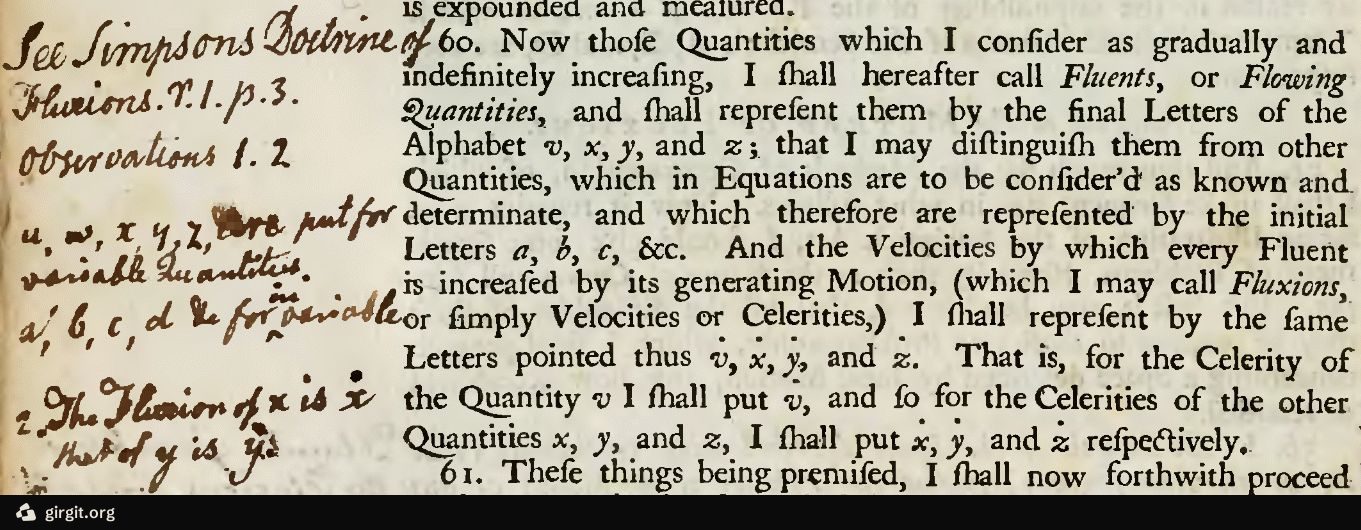 fluxions: speeds, written with a dot
See it: Newton's speeds give Leibniz's slope
The point flows along \( y = \frac{x^2}{2} \). Its two fluxions are drawn on it as arrows: \( \dot{x} \) across, \( \dot{y} \) up. Their ratio is printed under the picture beside the tangent's slope. Guess first, then change the speed, make the flow uneven, or show every speed at once.
Notice the ghosts: at an uneven speed they bunch up where the point is slow and spread out where it is fast. The arrows change length all the time, yet the ratio \( \dot{y}/\dot{x} \) always equals the slope \( x \) at that spot. Only when the point stops (\( \dot{x} = 0 \)) does Newton's ratio fail, which is one reason the time-free \( \frac{dy}{dx} \) is the better definition.
Solve it
Solve it: Newton's way
A circular ripple spreads on a pond. Its radius \( r \) grows at \( \dot{r} = 0.5 \) m/s. How fast is its area \( A = \pi r^2 \) growing at the moment \( r = 4 \) m?
Hint
Answer
Spot the error
A student says: "\( \frac{dy}{dx} \) is a fraction, so cancel the d's: \( \frac{dy}{dx} = \frac{y}{x} \)." Test the claim on \( y = x^2 \) at \( x = 3 \).
Answer
Solve it (first principles)
Find the derivative of \( f(x) = \frac{1}{x^2} \) from first principles, and check it against the power rule.
Answer
In physics you see \( \dot{x} \). What does it mean?
- \( x \) times something
- \( \frac{dx}{dt} \), how fast \( x \) changes with time
- \( \frac{dx}{dx} \)
Connect it
Connect it
- Berkeley, page 9. The "ghosts of departed quantities" were Newton's fluxions: the bishop's attack.
- The product rule, page 11. It is printed on the first page of Leibniz's 1684 paper, in his \( d \) notation: Leibniz's wrong guess.
- Physics: velocity. \( v = \frac{dx}{dt} = \dot{x} \) is a derivative in time, Newton's own picture: how fast right now.
- Class 12: the chain rule. Where Leibniz's notation shines, \( \frac{dy}{dx} = \frac{dy}{du}\frac{du}{dx} \): peeling an onion.
- Class 12: rates. The ripple problem above, done properly: related rates.
Still confused?
So who invented calculus?
Both, separately. Newton had the method first (1665 to 1666) but kept it to himself; Leibniz found his own version (1675) and published first (1684). Historians now agree Leibniz's notebooks show an independent path, even though he had seen some of Newton's results.
Why "differential" calculus?
Because Leibniz built it on differences: \( dy \) is the difference in \( y \) between two very close points, and he called such a tiny difference a differential. "Calculus" is Latin for a pebble: Romans counted with pebbles on a counting board. So the name means, roughly, "counting with differences".
If \( \frac{dy}{dx} \) is not a fraction, why does it act like one?
Because it is the limit of a real fraction, \( \frac{\Delta y}{\Delta x} \), and limits respect multiplication and division (the algebra of limits, page 4). So rules that are true for \( \frac{\Delta y}{\Delta x} \) often survive in the limit. Each such rule still needs its own proof.
Sources
- Leibniz–Newton calculus controversy (Newton's October 1666 manuscript; dots published 1693; Leibniz's d in 1675 notebooks and 1684; Fatio 1699; the committee and its report; independent invention), Wikipedia.
- Gottfried Leibniz (Paris and Huygens; FRS 1673; Nova Methodus, Acta Eruditorum 1684 and Jacob Bernoulli's verdict; Keill 1711; the committee; Commercium epistolicum; death in Hanover 1716) and Isaac Newton (plague years 1665 to 1667; President of the Royal Society from 1703; the committee report and anonymous review), MacTutor History of Mathematics, St Andrews.
- Newton's Account of the Commercium Epistolicum (Philosophical Transactions, 1715), ed. D. R. Wilkins, Trinity College Dublin.
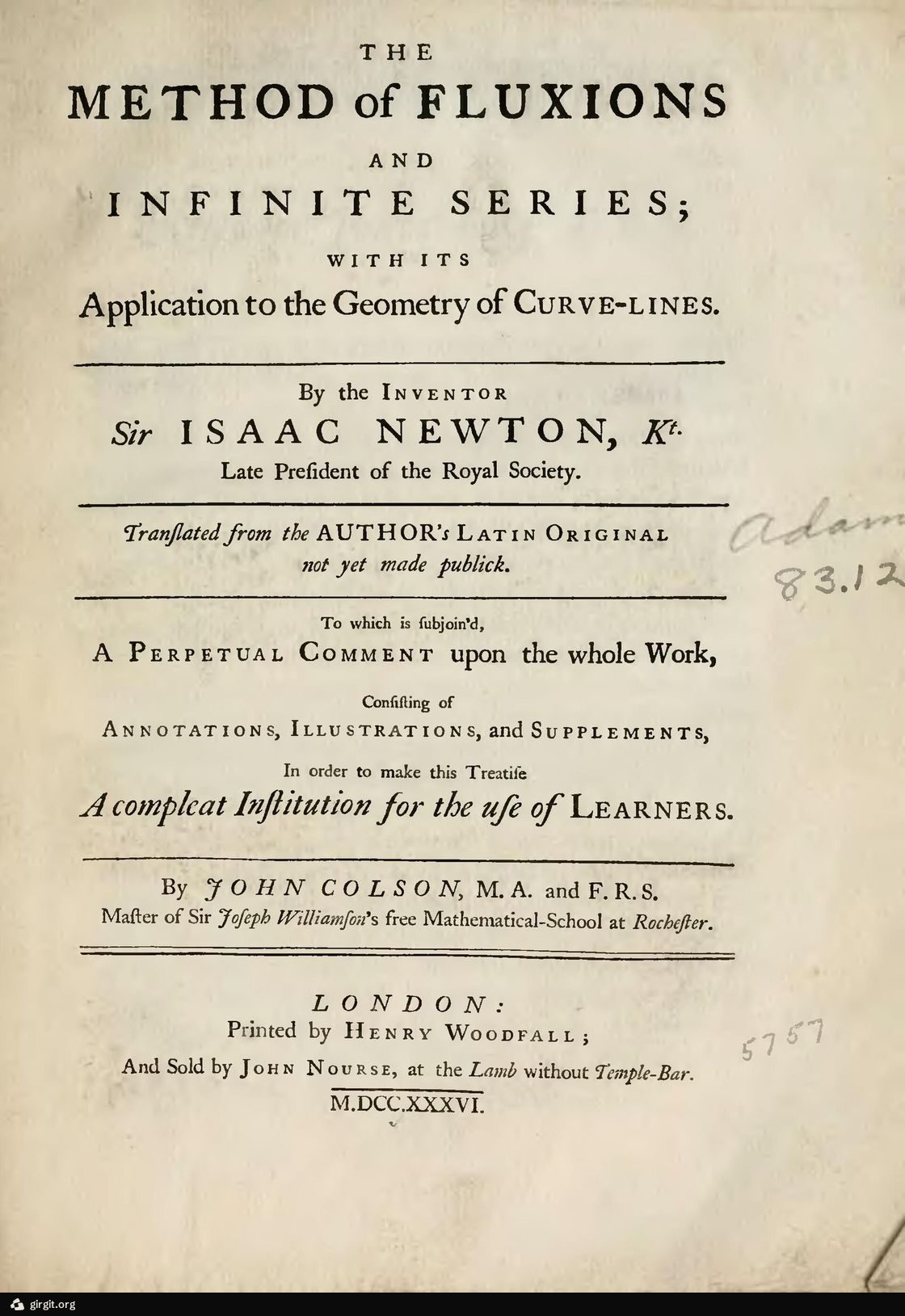
- Method of Fluxions (completed 1671, published 1736), Wikipedia; and the 1736 edition on Wikimedia Commons (p. 20, fluents and fluxions).
- Calculus: etymology (Latin calculus, a pebble used as a counter), Wikipedia.
- Notation for differentiation (Leibniz, Lagrange and Euler, Newton, D notation) and Analytical Society (Babbage, Herschel, Peacock; Cambridge examinations 1820 to 1821), Wikipedia.

Picture and video credits