- 1. How fast is a falling stone at one instant?
- 2. What is a limit?
- 3. Left-hand and right-hand limits: when does a limit exist?
- 4. The algebra of limits and limits of polynomials
- 5. Limits of rational functions and the 0/0 puzzle
- 6. The standard limit (xⁿ − aⁿ)/(x − a) = naⁿ⁻¹
- 7. Why sin x / x tends to 1: the sandwich theorem
- 8. Solving limits of trigonometric functions
- 9. What is a derivative? From chord to tangent
- 10. Derivatives from first principles
- 11. Algebra of derivatives: sum, product and quotient rules
- 12. Derivatives of polynomials and trigonometric functions
- Review
6 of 12·NCERT §12.3.2·5 min
The standard limit (xⁿ − aⁿ)/(x − a) = naⁿ⁻¹
The big ideaOne limit comes up again and again: \( \lim_{x \to a} \dfrac{x^n - a^n}{x - a} = n a^{n-1} \).
In simple words
Take a number, raise it to some power, and compare that with a nearby number raised to the same power. Divide the difference in the answers by the difference in the starting numbers. When the two starting numbers are very close, this always comes out to the same easy answer: the power, times the number raised to one less than the power.
The theorem (Theorem 2)
For any positive integer \( n \),
\[ \lim_{x \to a} \frac{x^n - a^n}{x - a} = n a^{n-1} \]At \( x = a \) the fraction is \( \frac{0}{0} \), so this is the cancelling trick from the last page, done once for every \( n \).
Why it is true
Long division of \( x^n - a^n \) by \( x - a \) has no remainder, and gives
\[ x^n - a^n = (x - a)\left(x^{n-1} + x^{n-2}a + x^{n-3}a^2 + \dots + x a^{n-2} + a^{n-1}\right) \]You know the small cases: \( x^2 - a^2 = (x - a)(x + a) \) and \( x^3 - a^3 = (x - a)(x^2 + xa + a^2) \). Cancel \( (x - a) \), which is allowed as \( x \ne a \), and let \( x \to a \). The bracket is a polynomial, so substitute \( x = a \). Each of its \( n \) terms becomes \( a^{n-1} \):
\[ a^{n-1} + a^{n-1} + \dots + a^{n-1} \;(n \text{ terms}) = n a^{n-1} \]Remark. The same formula holds when \( n \) is any rational number (a fraction like \( \frac{1}{2} \) or \( -\frac{2}{3} \)), as long as \( a \) is positive. The textbook states this without proof. It lets us handle square roots and cube roots.
Worked examples
Worked example 1: straight use
\( \lim_{x \to 2} \dfrac{x^5 - 32}{x - 2} \). Since \( 32 = 2^5 \), this is the theorem with \( n = 5 \), \( a = 2 \): \( 5 \cdot 2^4 = 80 \).
Worked example 2: two powers
Find \( \lim_{x \to 1} \dfrac{x^8 - 1}{x^3 - 1} \).
- Divide top and bottom by \( x - 1 \): \( \dfrac{x^8 - 1}{x^3 - 1} = \dfrac{x^8 - 1}{x - 1} \div \dfrac{x^3 - 1}{x - 1} \).
- Each piece is the theorem with \( a = 1 \): the top heads for \( 8 \cdot 1^7 = 8 \), the bottom for \( 3 \cdot 1^2 = 3 \).
- Quotient rule (bottom limit 3, not 0): the answer is \( \frac{8}{3} \).
Worked example 3: a root, by substitution
Find \( \lim_{x \to 0} \dfrac{\sqrt[3]{1 + x} - 1}{x} \).
- Put \( y = 1 + x \). As \( x \to 0 \), \( y \to 1 \), and \( x = y - 1 \).
- The limit becomes \( \lim_{y \to 1} \dfrac{y^{1/3} - 1^{1/3}}{y - 1} \).
- Theorem with \( n = \frac{1}{3} \), \( a = 1 \) (rational \( n \), positive \( a \)): \( \frac{1}{3} \cdot 1^{-2/3} = \frac{1}{3} \).
Worked example 4: a square root
\( \lim_{x \to 4} \dfrac{\sqrt{x} - 2}{x - 4} = \lim_{x \to 4} \dfrac{x^{1/2} - 4^{1/2}}{x - 4} = \frac{1}{2} \cdot 4^{-1/2} = \frac{1}{2} \cdot \frac{1}{2} = \frac{1}{4} \).
Guess first: how big is the answer?
Look at \( \lim_{x \to 3} \dfrac{x^4 - 81}{x - 3} \). Close to 3, both top and bottom are tiny. Guess: is the answer small (around 1), medium (around 10) or large (around 100)?
Commit to a guess, then drag X in towards A and read every term of the bracket.
See what happens
Don't mix these up
- The answer is \( n a^{n-1} \), not \( n a^n \) and not \( a^{n-1} \). Check with \( n = 2 \): \( \frac{x^2 - a^2}{x - a} = x + a \to 2a \).
- The bottom must be \( x - a \) with the same \( a \) as in \( a^n \). Rewrite numbers as powers first (\( 32 = 2^5 \), \( 81 = 3^4 \)).
- For fractional powers, \( a \) must be positive.
Try it. Find (a) \( \lim_{x \to 1} \dfrac{x^6 - 1}{x^2 - 1} \), (b) \( \lim_{x \to 0} \dfrac{\sqrt{1 + x} - 1}{x} \).
Answer
Just remember
The answer has a reason (the slabs in the deep dive below), but under exam pressure the exact shape slips easily, so learn it as a pattern and check it.
- \( \lim_{x \to a} \dfrac{x^n - a^n}{x - a} = n a^{n-1} \)
- "Bring the power down, then drop it by one." The same move gives the derivative of \( x^n \) later in the chapter. Rebuild: a square of side \( a \) growing by a thin \( h \) gains two strips of length \( a \), so the answer for \( n = 2 \) must be \( 2a \).
- Fractional \( n \) needs \( a \gt 0 \)
- "No roots of negatives." \( a^{1/2} \) is \( \sqrt{a} \), so \( a \) must be positive. Rebuild: try \( n = \tfrac{1}{2} \), \( a = -4 \) and the formula asks for \( (-4)^{-1/2} \), which is not a real number.
- Make the bottom match the top
- "Same \( a \) on top and bottom." Rewrite numbers as powers first (\( 32 = 2^5 \), \( 1 = 1^7 \)) and the bottom as \( x - a \) for that same \( a \). Rebuild: the formula came from cancelling exactly one factor \( (x - a) \).
- Theorem 2
- \( \lim_{x \to a} \frac{x^n - a^n}{x - a} = n a^{n-1} \) for every positive integer \( n \).
- Rational number
- A number that can be written as a fraction \( \frac{p}{q} \) of integers.
- Substitution
- Renaming \( 1 + x \) as \( y \) (and \( x \to 0 \) as \( y \to 1 \)) to reach a known form.
- Standard limit
- A limit worked out once and then used as a ready-made tool.
Words to know
What is \( \lim_{x \to 2} \dfrac{x^{10} - 1024}{x - 2} \)?
- 10240
- 5120
- 512
Which step in the proof uses the fact that \( x \ne a \)?
- Writing \( x^n - a^n = (x - a)(x^{n-1} + \dots + a^{n-1}) \)
- Cancelling the factor \( (x - a) \)
- Putting \( x = a \) into the bracket at the end
Deep dive · optional
Why n slabs? Fermat's tangents and Newton's fractional powers
Where \( n a^{n-1} \) comes from in a picture, the lawyer who did this calculation before calculus had a name, and how the same formula learned to handle square roots. The exam needs only the formula; this makes it impossible to forget.
The roots: growing a square and a cube
- Why is \( \frac{x^2 - a^2}{x - a} \) close to \( 2a \)?Let a square of side \( a \) grow to side \( x = a + h \). The new area is two strips, each \( a \) long and \( h \) wide, plus a tiny corner square \( h \times h \). So \( x^2 - a^2 = 2ah + h^2 \). Divide by \( h \): \( 2a + h \), which heads for \( 2a \).
- Why \( 3a^2 \) for a cube?A growing cube gains three slabs on three faces, each \( a \times a \times h \), plus three thin rods \( a \times h \times h \) along the edges and one tiny cube \( h^3 \). Divide by \( h \): \( 3a^2 + 3ah + h^2 \). Only the slabs survive.
- And for any whole number \( n \)?By the binomial theorem, \( (a + h)^n = a^n + n a^{n-1} h + (\text{terms with } h^2, h^3, \dots) \). The \( n \) "slabs" give \( n a^{n-1} h \); every other piece carries at least \( h^2 \), so after dividing by \( h \) it still has an \( h \) in it and fades away.
- Why does the long-division proof give the same answer?Its bracket \( x^{n-1} + x^{n-2}a + \dots + a^{n-1} \) has \( n \) terms. When \( x = a \) each becomes \( a^{n-1} \). Counting terms is counting slabs.
- And a power like \( \tfrac{1}{2} \)?Rationalise: \( \dfrac{\sqrt{x} - \sqrt{a}}{x - a} = \dfrac{1}{\sqrt{x} + \sqrt{a}} \to \dfrac{1}{2\sqrt{a}} = \tfrac{1}{2} a^{-1/2} \). The same pattern, \( n a^{n-1} \), with \( n = \tfrac{1}{2} \). Underneath it all: area and volume add up piece by piece (the distributive law).
So the limit measures how fast \( x^n \) grows near \( a \): per unit of growth in the side, the area grows by \( 2a \), the volume by \( 3a^2 \). That is why the physics rule for errors says the relative error in \( a^n \) is about \( n \) times the relative error in \( a \).
The story: a lawyer's "almost equal"
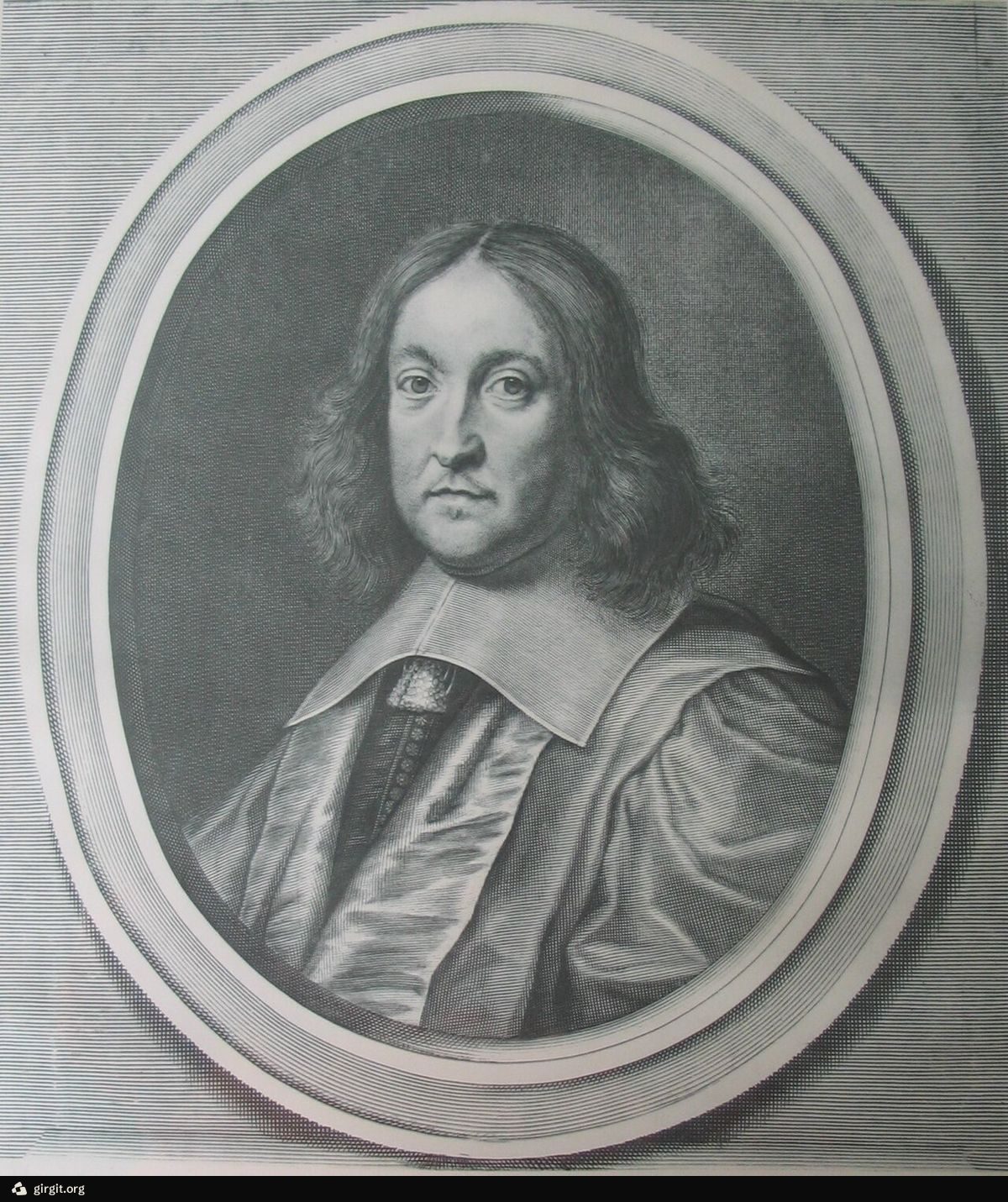 Pierre de Fermat, 1601–1665
See it: the slabs
Guess first. Then grow a square or a cube and watch the pieces. Scrub \( a \) and \( h \), or drag the far corner. Divide by \( h \) and see which pieces survive; the chart shows every \( h \) at once, closing on \( n a^{n-1} \).
Solve it
Solve it, Fermat's way
Split 10 into two parts whose product is as large as possible, using Fermat's recipe: replace \( x \) by \( x + e \), cancel, divide by \( e \), drop what still has \( e \).
Answer
Estimate without a calculator
Use the limit with \( n = \tfrac{1}{2} \) to estimate \( \sqrt{16.1} \).
Hint
Answer
Solve it (JEE style)
For \( a \gt 0 \), find \( \lim_{x \to a} \dfrac{x^{2/3} - a^{2/3}}{x^{3/4} - a^{3/4}} \).
Hint
Answer
A cube of side 10 cm grows to 10.1 cm. About how much volume does it gain?
- 10 cm³
- About 30 cm³
- About 0.001 cm³
Connect it
Connect it
- The power rule, page 11. \( \frac{d}{dx} x^n = n x^{n-1} \) is this limit with \( a \) renamed \( x \): sum, product and quotient rules.
- The binomial theorem, Ch 7. The "slabs" are the term \( {}^nC_1 a^{n-1} h \) of \( (a + h)^n \): the binomial theorem.
- Errors in measurement, Physics Ch 1. Measure a side with a small error and the area's relative error is about twice as big, the volume's three times: errors in results.
- Cancelling, page 5. This limit is the cancelling of \( (x - a) \), done for every power at once: rational functions and 0/0.
- Daily life. Order a pizza 10% wider and you get about 20% more pizza: area grows like \( 2a \) per unit of radius. Scale a water tank's side by 1% and it holds about 3% more.
Still confused?
Why do the thin pieces "not count"? They are really there.
They are, and for a real \( h \) the answer is \( 2a + h \), not \( 2a \). The limit asks what happens as \( h \) shrinks. The strips shrink like \( h \), the corner like \( h^2 \): after dividing by \( h \), the strips leave \( 2a \) and the corner leaves \( h \), which goes to 0. Halve \( h \) and the corner's share halves too.
Does the formula work for negative \( n \)?
Yes. For \( n = -1 \): \( \dfrac{\frac{1}{x} - \frac{1}{a}}{x - a} = \dfrac{a - x}{xa(x - a)} = -\dfrac{1}{xa} \to -\dfrac{1}{a^2} = (-1)a^{-2} \). The textbook proves the whole-number case and states the rational case.
Sources
- Pierre de Fermat (lawyer at Toulouse; method of maxima, minima and tangents c. 1636; the quarrel with Descartes and his "very good"), MacTutor History of Mathematics, St Andrews.
- Adequality (the recipe; the word from Diophantus via Bachet; the example bx − x²; Newton and Leibniz citing Fermat), Wikipedia.
- Binomial theorem: history (Newton 1664–65 and Wallis; Briggs 1624), Wikipedia.
- Binomial series: history (Newton's examples, no proof; Abel 1826), Wikipedia.
- Engraved portrait of Fermat by François de Poilly, Wikimedia Commons.

Picture and video credits