- 1. How fast is a falling stone at one instant?
- 2. What is a limit?
- 3. Left-hand and right-hand limits: when does a limit exist?
- 4. The algebra of limits and limits of polynomials
- 5. Limits of rational functions and the 0/0 puzzle
- 6. The standard limit (xⁿ − aⁿ)/(x − a) = naⁿ⁻¹
- 7. Why sin x / x tends to 1: the sandwich theorem
- 8. Solving limits of trigonometric functions
- 9. What is a derivative? From chord to tangent
- 10. Derivatives from first principles
- 11. Algebra of derivatives: sum, product and quotient rules
- 12. Derivatives of polynomials and trigonometric functions
- Review
12 of 12·NCERT §12.5.2·5 min
Derivatives of polynomials and trigonometric functions
The big ideaDifferentiate a polynomial term by term with the power rule; for trig functions, \( \frac{d}{dx}\sin x = \cos x \) and \( \frac{d}{dx}\cos x = -\sin x \) come from first principles, and the rules give the other four.
In simple words
A long formula made of powers of a number is just many small pieces added up, so you find the steepness of each piece and add. The wave-shaped sine curve has a lovely property: its steepness at every point follows another wave of exactly the same shape, just shifted along. Once you know that, the steepness of the other wave formulas follows.
Polynomials (Theorem 7)
For a polynomial \( f(x) = a_n x^n + a_{n-1} x^{n-1} + \dots + a_1 x + a_0 \), with the \( a_i \) real and \( a_n \ne 0 \),
\[ \frac{d}{dx} f(x) = n a_n x^{n-1} + (n - 1) a_{n-1} x^{n-2} + \dots + 2a_2 x + a_1 \]This is just the sum rule plus the power rule, and the constant \( a_0 \) disappears. Bring each power down in front, lower it by one.
Worked example 1
\( \frac{d}{dx}(4x^5 - 3x^2 + 7x - 2) = 20x^4 - 6x + 7 \).
Worked example 2: slope at a point
Find the derivative of \( f(x) = x^4 + x^3 + x^2 + x + 1 \) at \( x = -1 \).
- \( f'(x) = 4x^3 + 3x^2 + 2x + 1 \).
- \( f'(-1) = -4 + 3 - 2 + 1 = -2 \).
The sine, from first principles
Let \( f(x) = \sin x \). Use \( \sin A - \sin B = 2\cos\frac{A + B}{2}\sin\frac{A - B}{2} \) with \( A = x + h \), \( B = x \):
\[ \frac{\sin(x + h) - \sin x}{h} = \frac{2\cos\left(x + \frac{h}{2}\right)\sin\frac{h}{2}}{h} = \cos\left(x + \frac{h}{2}\right) \cdot \frac{\sin\frac{h}{2}}{\frac{h}{2}} \]As \( h \to 0 \), the first factor tends to \( \cos x \) and the second to 1. So
\[ \frac{d}{dx}\sin x = \cos x \]Check against the picture: at \( x = 0 \) the sine curve is climbing at slope \( \cos 0 = 1 \); at \( x = \frac{\pi}{2} \) it is at its top and flat, slope \( \cos\frac{\pi}{2} = 0 \).
The same steps with \( \cos A - \cos B = -2\sin\frac{A + B}{2}\sin\frac{A - B}{2} \) give \( \frac{d}{dx}\cos x = -\sin x \). The minus sign makes sense: just after \( x = 0 \) the cosine curve starts going down from its top.
Try it: turn the wheel and watch the rider's upward speed trace out the cosine.
tan, cot, sec and cosec by the rules
tan x. \( \tan x = \frac{\sin x}{\cos x} \). Quotient rule:
\[ \frac{d}{dx}\tan x = \frac{\cos x \cdot \cos x - \sin x \cdot (-\sin x)}{\cos^2 x} = \frac{1}{\cos^2 x} = \sec^2 x \](The textbook gets this from first principles too, using \( \sin(A - B) \).) The others follow the same way:
| \( f(x) \) | \( f'(x) \) | How |
|---|---|---|
| \( \sin x \) | \( \cos x \) | first principles |
| \( \cos x \) | \( -\sin x \) | first principles |
| \( \tan x \) | \( \sec^2 x \) | \( \frac{\sin x}{\cos x} \) |
| \( \cot x \) | \( -\csc^2 x \) | \( \frac{\cos x}{\sin x} \) or \( \frac{1}{\tan x} \) |
| \( \sec x \) | \( \sec x \tan x \) | \( \frac{1}{\cos x} \) |
| \( \csc x \) | \( -\csc x \cot x \) | \( \frac{1}{\sin x} \) |
(\( \csc x \) is cosec \( x \).) A memory hook: the three "co" functions (cos, cot, cosec) all carry a minus sign.
Worked examples
Worked example 3: product with a trig function
\( \frac{d}{dx}(x^2 \sin x) = 2x \sin x + x^2 \cos x \) (product rule).
Worked example 4: where sec x tan x comes from
Differentiate \( \sec x = \frac{1}{\cos x} \) with the quotient rule (\( u = 1 \), \( u' = 0 \)): \( \frac{0 \cdot \cos x - 1 \cdot (-\sin x)}{\cos^2 x} = \frac{\sin x}{\cos^2 x} = \frac{1}{\cos x} \cdot \frac{\sin x}{\cos x} = \sec x \tan x \).
Worked example 5: a trig quotient
Differentiate \( \dfrac{1 + \sin x}{\cos x} \).
- \( u = 1 + \sin x \), \( u' = \cos x \); \( v = \cos x \), \( v' = -\sin x \).
- \( \dfrac{\cos x \cdot \cos x - (1 + \sin x)(-\sin x)}{\cos^2 x} = \dfrac{\cos^2 x + \sin x + \sin^2 x}{\cos^2 x} = \dfrac{1 + \sin x}{\cos^2 x} \).
Guess first: degrees again
Guess: if we measured \( x \) in degrees, would the derivative of \( \sin x \) still be \( \cos x \)?
Commit to an answer, then trace the slope of each wave, in radians and in degrees.
See what happens
Try it. Differentiate (a) \( 3\sin x - 4\cos x \), (b) \( x\cos x \), (c) \( \dfrac{\sin x}{x} \).
Answer
Just remember
All six have reasons (first principles and the quotient rule), but in an exam you need them instantly. The hooks below get you there; each says how to rebuild the line in a few seconds.
- \( (\sin x)' = \cos x \), \( (\cos x)' = -\sin x \)
- "Sine goes to cosine; cosine goes to minus sine." Keep going and you go round in four steps: \( \sin \to \cos \to -\sin \to -\cos \to \sin \). Rebuild from the Ferris wheel: at \( x = 0 \) the sine is climbing at full speed (slope \( \cos 0 = 1 \)); the cosine is at its top and about to fall, so its slope must carry a minus.
- \( (\tan x)' = \sec^2 x \), \( (\sec x)' = \sec x \tan x \)
- "Tan gets sec squared; sec keeps itself and gains a tan." Rebuild: quotient rule on \( \frac{\sin x}{\cos x} \) and \( \frac{1}{\cos x} \) (worked example 4).
- \( (\cot x)' = -\csc^2 x \), \( (\csc x)' = -\csc x \cot x \)
- "Co- swaps, then adds a minus." Take the line above, swap every function for its co-partner (tan ↔ cot, sec ↔ cosec), and put a minus in front. The three co-functions, cos, cot and cosec, are exactly the three with a minus.
- Radians only
- In degrees every one of these picks up a factor \( \frac{\pi}{180} \). Rebuild: \( \frac{\sin h}{h} \to 1 \) only in radians (page 7).
- Term-by-term
- Differentiating a sum one piece at a time (sum rule).
- \( (\sin x)' \)
- \( \cos x \), with \( x \) in radians.
- \( (\cos x)' \)
- \( -\sin x \).
- \( (\tan x)' \)
- \( \sec^2 x \).
- Sum-to-product formula
- \( \sin A - \sin B = 2\cos\frac{A + B}{2}\sin\frac{A - B}{2} \), used to split the difference.
Words to know
What is \( \dfrac{d}{dx}(5x^{80} - x^{41} + x) \)?
- \( 400x^{79} - 41x^{40} + 1 \)
- \( 400x^{80} - 41x^{41} + 1 \)
- \( 400x^{79} - 41x^{40} \)
What is the slope of \( y = \cos x \) at \( x = \frac{\pi}{2} \)?
- 0
- −1
- 1
Which of these has a derivative with a minus sign in front?
- \( \sec x \)
- \( \tan x \)
- \( \cot x \)
Deep dive · optional
Why the slope of a sine is a cosine, and who saw it first
A picture proof that needs no limits at all, and the Indian astronomers who used "the jump in a sine follows the cosine" centuries before calculus had a name. The exam needs only the table; this is why the table is true.
The roots: walk round the circle
- Why is the slope of \( \sin x \) equal to \( \cos x \)?Walk round the unit circle: after a walk of length \( x \) you are at \( P = (\cos x, \sin x) \). The slope of \( \sin x \) is how fast your height grows as you walk.
- How fast do you walk?Exactly 1 unit of arc per unit of \( x \), because \( x \) is the arc length. That is what a radian means (radian measure).
- Which way are you walking?Along the tangent at \( P \), which is at right angles to the radius OP. The radius makes angle \( x \) with the horizontal, so your direction makes angle \( x \) with the vertical.
- So how fast does the height grow?A step of length 1 at angle \( x \) from the vertical has an upward part \( \cos x \) and a sideways part \( \sin x \) pointing left. So height grows at \( \cos x \): \( (\sin x)' = \cos x \). And the across-distance shrinks at \( \sin x \): \( (\cos x)' = -\sin x \). Both at once, and the minus sign is simply "moving left".
- And underneath?Two facts you already believe: a tangent to a circle is perpendicular to the radius, and radians measure angle by arc length.
The algebra on this page says the same thing in numbers. A jump in the sine, divided by the step, is exactly
\[ \frac{\sin(x + h) - \sin x}{h} = \cos\left(x + \tfrac{h}{2}\right) \cdot \frac{\sin \frac{h}{2}}{\frac{h}{2}} \]The first factor is the cosine at the middle of the step; the second is a number just below 1 that becomes 1 as the step shrinks. So even for a big step, the jump is almost exactly "cosine at the middle × step". A table of sines therefore hides a table of cosines in its differences.
The story: sine differences in India
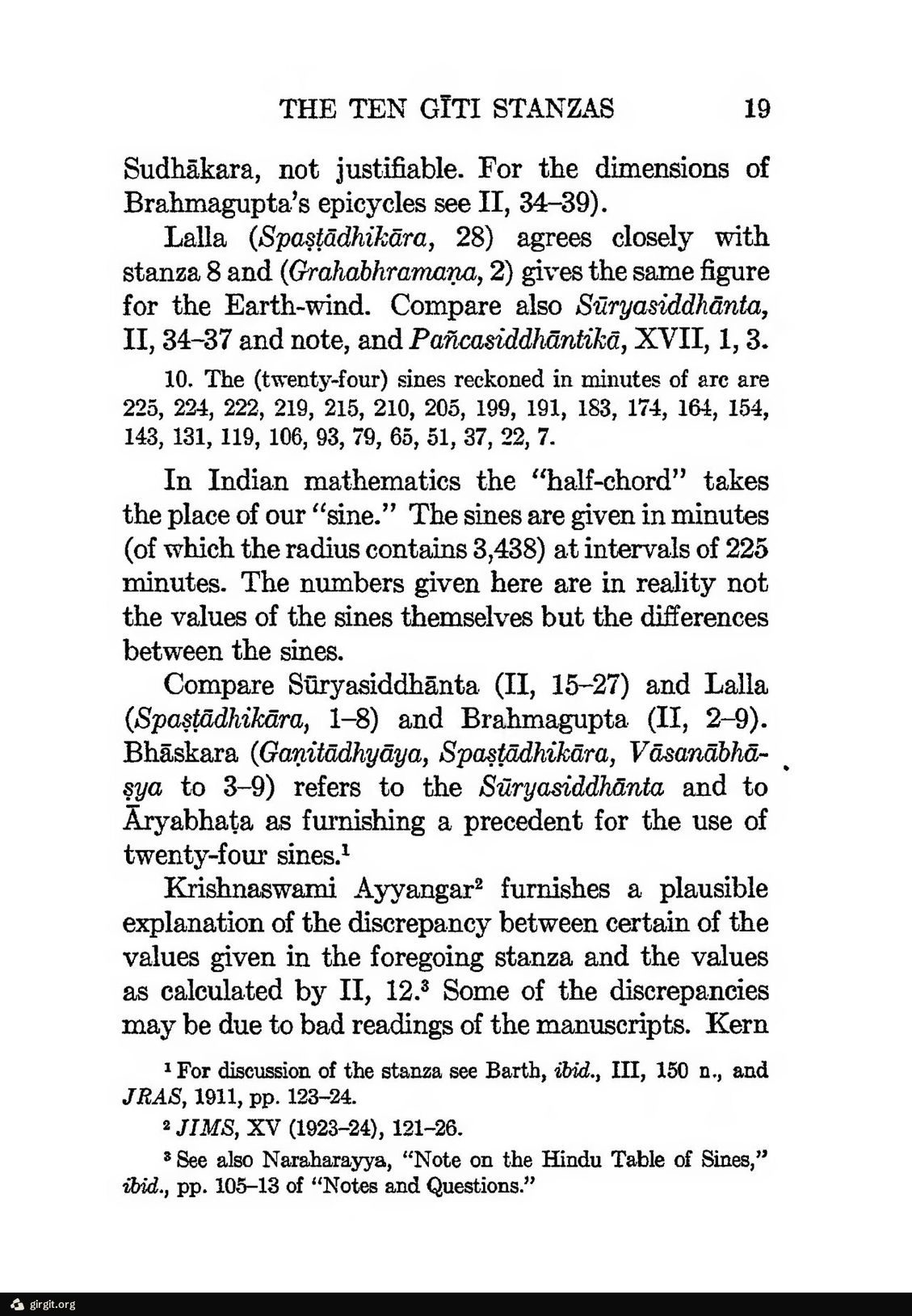 the 24 jumps: 225 … 7radius 3438
See it: a sine table's jumps are a cosine
Make a sine table with any step. Divide each jump by the step and draw it as a bar: the bars sit on the cosine. Turn on Aryabhata's own numbers to see a 1,500-year-old table do the same. Guess first.
Try the "Degrees" chip: the bars collapse to about a fiftieth of their height. Nothing about the sine changed; only the ruler for the step did. That factor \( \frac{\pi}{180} \) is the whole reason calculus uses radians.
Solve it
Solve it: a table without a calculator
You know \( \sin 30^\circ = 0.5 \) and \( \cos 30^\circ \approx 0.8660 \). Estimate \( \sin 31^\circ \) the way Bhāskara would, then do better with the middle of the step.
Hint
Answer
Check Aryabhata
Aryabhata's first jump is 225 and his last, from 86°15′ to 90°, is 7. Predict the last jump from the first using the derivative, without any table.
Answer
Solve it (JEE style)
Without using \( \sin^2 x + \cos^2 x = 1 \), show with the product rule that \( \sin^2 x + \cos^2 x \) has derivative 0 everywhere. What does that tell you?
Answer
If \( x \) is measured in degrees, what is the slope of \( \sin x \) at \( x = 0 \)?
- 1
- \( \frac{\pi}{180} \approx 0.0175 \)
- 0
Connect it
Connect it
- The unit circle, Ch 3. The walk round the circle that defines sine and cosine is the same walk that proves their derivatives: sine and cosine for any angle.
- sin x / x, page 7. The factor \( \frac{\sin(h/2)}{h/2} \to 1 \) is the sandwich-theorem limit: why sin x / x tends to 1.
- Physics: SHM. If \( x = A\sin\omega t \), the velocity is \( A\omega\cos\omega t \): fastest in the middle, zero at the ends: velocity and acceleration in SHM.
- Class 12: maxima. Bhāskara's "the instant change is zero at the extreme" is the first-derivative test: hills and valleys.
- Class 12: second derivative. \( (\sin x)'' = -\sin x \), the four-step cycle, and why springs and pendulums swing in sines: the rate of the rate.
Still confused?
Why is there a minus in \( (\cos x)' \) but not in \( (\sin x)' \)?
Just after \( x = 0 \), the point on the circle moves up and to the left. Its height (the sine) grows, so that slope is positive; its across-distance (the cosine) shrinks, so that slope is negative. The minus is the leftward motion.
Did Indian astronomers invent calculus, then?
They found key pieces for particular cases: Bhāskara II's sine-difference rule and instantaneous motion, and later the Kerala series. They did not build the general method (derivatives of any function, the product and chain rules) that Newton and Leibniz gave. Both statements are true, and neither cancels the other.
Sources
- Bhāskara II (Siddhānta Śiromaṇi, 1150; tātkālika gati; sin y − sin x ≈ (y − x) cos y, after R. Cooke, The History of Mathematics, 1997, pp. 213 to 215; extremum remark after P. P. Divakaran, 2018; Mañjula's Laghumānasa), Wikipedia.
- Bhaskara II (1114 to 1185, Ujjain), MacTutor History of Mathematics, St Andrews.
- Āryabhaṭa's sine table (the 24 differences; radius 3438; the computing rule and its second-derivative reading), Wikipedia.
- W. E. Clark, The Aryabhatiya of Aryabhata (Chicago, 1930), p. 19, Wikimedia Commons.
Picture and video credits