- 1. How fast is a falling stone at one instant?
- 2. What is a limit?
- 3. Left-hand and right-hand limits: when does a limit exist?
- 4. The algebra of limits and limits of polynomials
- 5. Limits of rational functions and the 0/0 puzzle
- 6. The standard limit (xⁿ − aⁿ)/(x − a) = naⁿ⁻¹
- 7. Why sin x / x tends to 1: the sandwich theorem
- 8. Solving limits of trigonometric functions
- 9. What is a derivative? From chord to tangent
- 10. Derivatives from first principles
- 11. Algebra of derivatives: sum, product and quotient rules
- 12. Derivatives of polynomials and trigonometric functions
- Review
9 of 12·NCERT §12.5·5 min
What is a derivative? From chord to tangent
The big ideaThe derivative of \( f \) at \( a \) is \( f'(a) = \lim_{h \to 0} \dfrac{f(a + h) - f(a)}{h} \): the rate at which \( f \) is changing at \( a \), and the slope of the tangent to its graph there.
In simple words
Pick a spot on a curvy road on a map. Zoom in on that spot, and zoom again, and again. The road looks less and less curved, until it looks like a perfectly straight bit of road. How steep that straight bit is: that is the derivative at that spot. It tells you how fast the road is going up or down right there.
Now that we can handle limits, we can say exactly what the falling stone's "speed at an instant" meant. Rates of change are everywhere: how fast a reservoir is filling before the monsoon, how fast a rocket is climbing at the moment a satellite is released, how fast a share price is moving. All of them are derivatives.
The definition (Definition 1)
Let \( f \) be a real valued function and \( a \) a point in its domain. The derivative of \( f \) at \( a \) is
\[ f'(a) = \lim_{h \to 0} \frac{f(a + h) - f(a)}{h} \]provided this limit exists. Read \( f'(a) \) as "f dash a" or "f prime a". In words: step from \( a \) to \( a + h \), see how much \( f \) changes, divide by the step, and let the step shrink to nothing. The fraction itself is called a difference quotient: the average rate of change over the step.
Worked example 1: a straight line
For \( f(x) = 5x \) at \( x = 1 \): \( \dfrac{5(1 + h) - 5}{h} = \dfrac{5h}{h} = 5 \), so \( f'(1) = 5 \). A straight line has the same steepness everywhere.
Worked example 2: a parabola
Find the derivative of \( f(x) = x^2 - 4x + 1 \) at \( x = 3 \).
- \( f(3) = 9 - 12 + 1 = -2 \), and \( f(3 + h) = 9 + 6h + h^2 - 12 - 4h + 1 = h^2 + 2h - 2 \).
- \( \dfrac{f(3 + h) - f(3)}{h} = \dfrac{h^2 + 2h}{h} = h + 2 \).
- As \( h \to 0 \), this tends to 2. So \( f'(3) = 2 \).
Worked example 3: sine and a constant
For \( \sin x \) at 0: \( \dfrac{\sin(0 + h) - \sin 0}{h} = \dfrac{\sin h}{h} \to 1 \). So the derivative of \( \sin x \) at 0 is 1: the sine graph leaves the origin at 45°.
For a constant \( f(x) = 7 \): \( \dfrac{7 - 7}{h} = 0 \) for every \( h \ne 0 \), so \( f'(a) = 0 \) at every \( a \). Something that never changes has zero rate of change.
The picture: chord becomes tangent
On the graph of \( y = f(x) \), take P \( = (a, f(a)) \) and a nearby point Q \( = (a + h, f(a + h)) \). Draw R so that PR is horizontal and RQ vertical. Then PR \( = h \) and RQ \( = f(a + h) - f(a) \), so the difference quotient is
\[ \frac{f(a + h) - f(a)}{h} = \frac{QR}{PR} = \tan(\angle QPR) = \text{slope of the chord PQ} \]As \( h \to 0 \), Q slides along the curve to P, and the chord PQ swings round to the tangent at P. So if \( \psi \) is the angle the tangent at P makes with the x-axis,
\[ f'(a) = \tan \psi = \text{slope of the tangent at } (a, f(a)) \]This is the zoom-in idea. Zoom in on a smooth curve near P and it looks more and more like a straight line, the tangent. The derivative is the slope of the line the curve turns into when you look closely enough.
Try it: zoom in on a point and see whether the curve straightens out.
Guess first: does every curve have a slope at every point?
The graph of \( y = |x| \) is a V with its corner at the origin. Guess: what is the derivative of \( |x| \) at 0? Is it 0, because the corner is at the bottom?
Commit to an answer, then slide Q in towards P from each side, on the V and on smooth curves.
See what happens
Don't mix these up
- The difference quotient \( \frac{f(a + h) - f(a)}{h} \) is the slope of a chord, an average rate. Its limit is the slope of the tangent, the instant rate.
- \( f'(a) \) is a number (the slope at one point). It is not \( f(a) \), which is the height of the graph there.
Try it. From the definition, find (a) the derivative of \( x^2 + 2x \) at \( x = 1 \), (b) the derivative of \( x^2 \) at \( x = -2 \).
Answer
Just remember
The idea has a reason (the chord turning into the tangent), but the way it is written down is a convention. Learn the shape once; the picture of P, Q and R rebuilds it.
- \( f'(a) = \lim_{h \to 0} \dfrac{f(a + h) - f(a)}{h} \)
- "New minus old, over the step." The later value \( f(a + h) \) comes first on top, and the step \( h \) goes underneath. Rebuild: in the triangle PRQ, the rise RQ is \( f(a + h) - f(a) \) and the run PR is \( h \); slope is rise over run.
- \( f'(a) \) is read "f dash a"
- The dash (prime) is only a mark meaning "slope of". It is not a power and not a multiplication. Indian classrooms say "dash"; most books abroad say "prime". Same thing.
- Slope \( = \tan\psi \), with \( \psi \) measured from the positive x-axis
- Same convention as in Straight Lines: turn anticlockwise from the positive x-axis to the tangent. Uphill to the right gives an acute \( \psi \) and a plus slope; downhill gives an obtuse \( \psi \) and a minus slope.
- Derivative at a point
- \( f'(a) = \lim_{h \to 0} \frac{f(a + h) - f(a)}{h} \), if it exists.
- Difference quotient
- \( \frac{f(a + h) - f(a)}{h} \): the average rate of change over a step \( h \).
- Slope of the tangent
- \( \tan \psi \), with \( \psi \) the angle the tangent makes with the x-axis; equals \( f'(a) \).
- Rate of change
- How fast the output changes per unit change of input.
Words to know
For \( f(x) = x^2 - 4x + 1 \), what does \( f'(3) = 2 \) tell you?
- The graph passes through \( (3, 2) \)
- The tangent at \( x = 3 \) has slope 2
- The average slope from 0 to 3 is 2
As \( h \to 0 \), what happens to the chord from \( P(a, f(a)) \) to \( Q(a + h, f(a + h)) \)?
- It turns into the tangent at P
- It disappears and has no slope
- It becomes horizontal
Deep dive · optional
Is dividing by h, then dropping it, cheating?
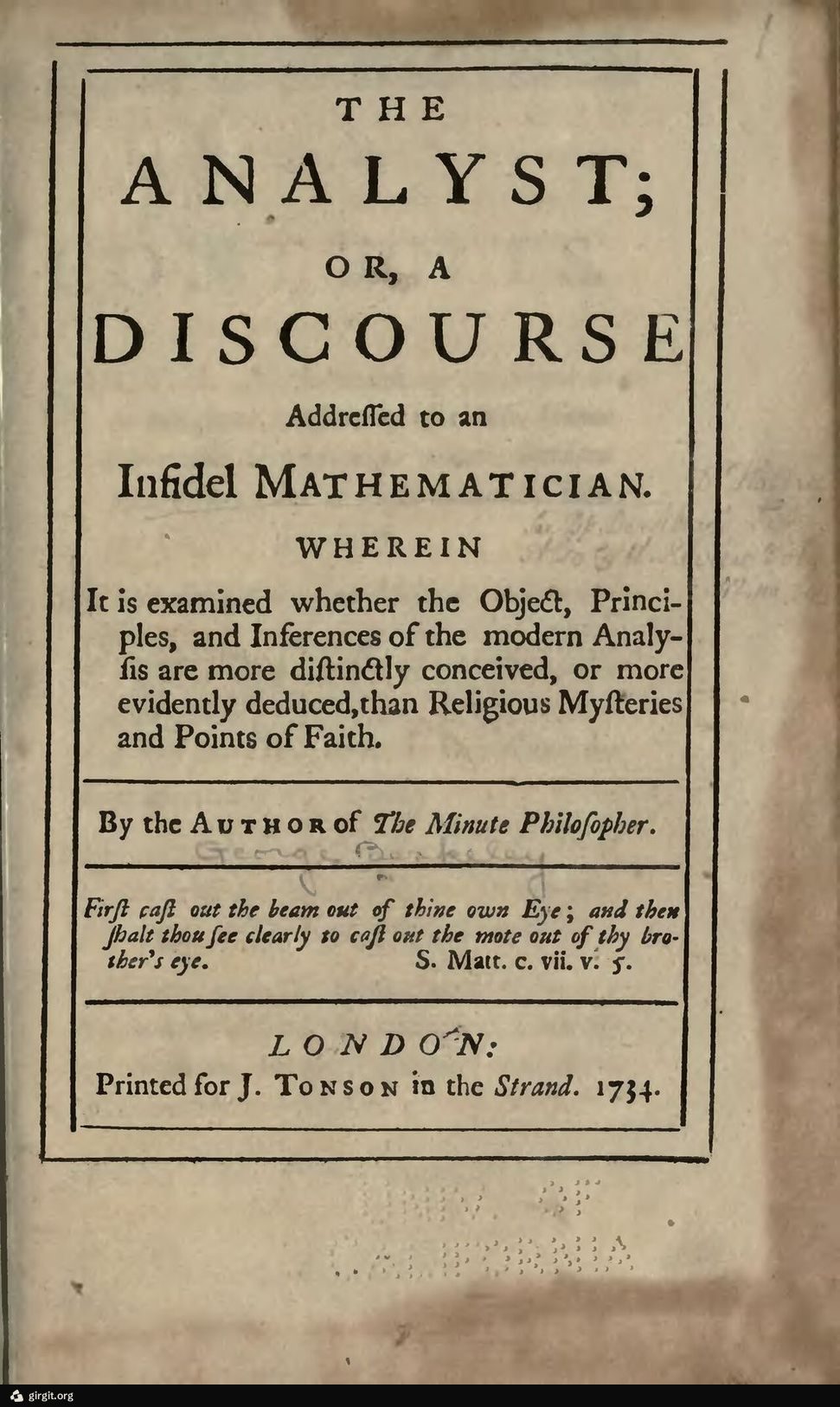
A bishop said yes, in 1734, and he had a point. Here is what he objected to, how limits answer him, and a curve that zooming can never straighten. Not needed for the exam, but it is the reason the definition says "limit" and "provided it exists".
The roots: why "limit" fixes the trick
- Why not just put \( h = 0 \) in the difference quotient?Because then it reads \( \frac{f(a) - f(a)}{0} = \frac{0}{0} \), which is no number at all. A step of zero tells you nothing about steepness.
- Then why does "simplify, then put \( h = 0 \)" give the right answer?For \( x^2 - 4x + 1 \) at 3 the quotient simplified to \( h + 2 \). That is true for every \( h \ne 0 \). The expression \( h + 2 \) is a polynomial in \( h \), and for a polynomial the limit is just the value (page 4). So putting \( h = 0 \) into \( h + 2 \) is a shortcut for "the limit as \( h \to 0 \)", not a division by zero.
- So where was the cheating Berkeley saw?The early way of speaking said: let the step be a tiny "increment", divide by it (so it is not zero), then throw away the leftover terms (as if it were zero). One argument, two opposite assumptions about the same quantity.
- How does the limit avoid that?It never uses \( h = 0 \) at all. Every \( h \) in the definition is a real, non-zero step. The limit only asks which single number the quotients crowd round as the steps get smaller. Nothing is first something and then nothing.
- And underneath?The meaning of a limit (page 2): name any tolerance, however tight, and there is a step size below which every quotient lies within that tolerance of the answer. That is a claim about non-zero steps only, and it can be checked.
There is a second way to read the definition that the zoom loop above shows. If \( f'(a) \) exists, then close to \( a \)
\[ f(a + h) \approx f(a) + f'(a)\,h , \]and the error is small even compared with \( h \): divide it by \( h \) and it still goes to 0. For \( x^2 \) at 3 the error is exactly \( h^2 \): with \( h = 0.01 \) the line is out by only 0.0001. That is why a smooth curve, magnified enough, cannot be told apart from its tangent. At the corner of \( |x| \) no single line does this, from both sides at once, so there is no derivative.
The story: a bishop and a monster
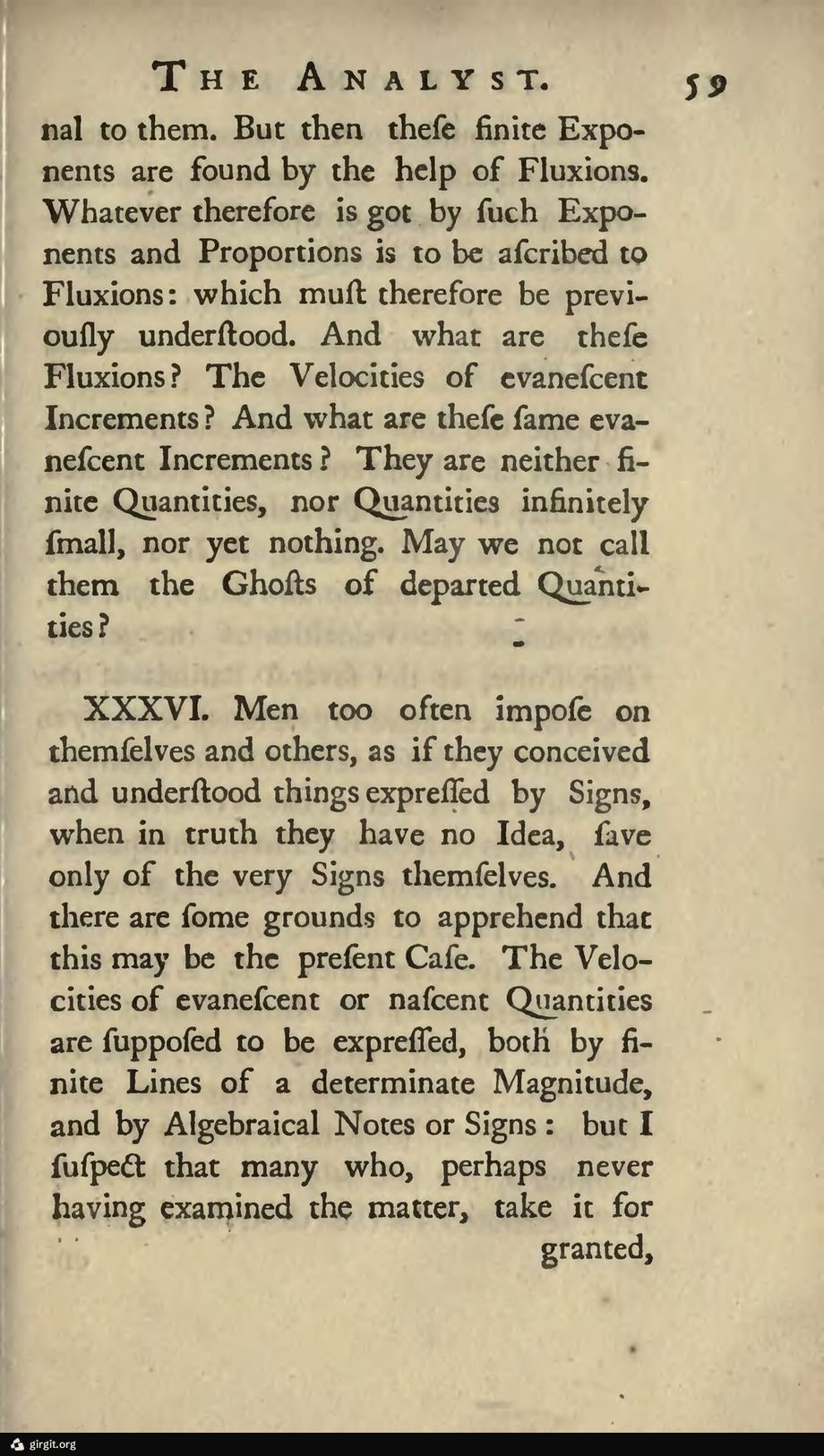 Fluxions = speeds of vanishing steps"the Ghosts of departed Quantities"
So the clause "provided this limit exists" in the definition is not fussiness. Without limits, Berkeley's objection stands. With them, his ghosts are gone, and Weierstrass's curve shows the clause is needed: there are continuous curves where the limit fails at every single point.
See it: a curve made only of corners
Below, the curve is a sum of cosine waves, each half as tall and three times as fast as the one before. With 2 waves it is smooth: zoom in and the bend drops to nothing. With 14 waves (as many as the screen can show), every zoom uncovers another layer. Guess first.
Watch the two chord slopes as you zoom in on the monster: they do not settle, they keep growing. For a smooth curve they close in on one number, \( f'(a) \). That settling is exactly what "the limit exists" means.
Solve it
Spot the error (or not)
A student writes: "\( \frac{(x + h)^2 - x^2}{h} = 2x + h \). Now put \( h = 0 \): the derivative is \( 2x \)." Berkeley would object. Is the answer wrong? Rewrite the argument so that no step divides by zero.
Answer
Solve it: the tangent as a shortcut
A square steel plate of side 3 m is heated and its side grows to 3.01 m. Use the derivative of \( A = x^2 \) to estimate the extra area, then find the exact value. How big is the error compared with the 0.01 m step?
Hint
Answer
Predict, then check (JEE style)
\( f(x) = x|x| \) has \( |x| \) inside it, and \( |x| \) has no derivative at 0. Does \( f \) have a derivative at 0? Predict first, then use the definition.
Answer
Which function has no derivative at \( x = 0 \)?
- \( x^2 \)
- \( x^{1/3} \), the cube root
- \( x^3 \)
Connect it
Connect it
- The falling stone, page 1. The table of average velocities closing on 29.4 m/s is the difference quotient with \( h \) shrinking: how fast at one instant.
- Slope of a line, Ch 9. \( \tan\psi \) for the tangent is the same inclination and slope you met for straight lines: slope of a line.
- Notation, page 10. Newton and Leibniz wrote the derivative differently, and fought about who came first: the priority dispute.
- Physics: instantaneous velocity. \( v = \lim_{\Delta t \to 0} \frac{\Delta x}{\Delta t} \) is this definition with time as the input: how fast right now.
- Class 12: differentiability. Corners, cusps and vertical tangents, and why every differentiable function is continuous: smooth or sharp?
Still confused?
Isn't a tangent a line that touches the curve at only one point?
That works for a circle, not in general. The tangent to \( y = x^3 \) at the origin is the x-axis, and the curve crosses it there. A tangent to a wavy curve can meet the curve again far away. The right test is local: near the point, the curve and the line agree so closely that their gap is small even compared with the step \( h \).
If the curve only "looks" straight when zoomed, is the derivative just an approximation?
No. The tangent line is an approximation to the curve, but its slope \( f'(a) \) is an exact number: the limit of the quotients. For \( x^2 - 4x + 1 \) at 3 it is exactly 2, not "about 2".
Does a continuous curve always have a derivative somewhere?
No, and that surprised the best mathematicians of the 19th century. Weierstrass's curve has no breaks and no derivative at any point. Continuity (no jumps) is a weaker promise than differentiability (no corners).
Sources
- George Berkeley, The Analyst (London: J. Tonson, 1734), scan of the Bancroft Library copy: title page and p. 59, section XXXV, Wikimedia Commons.
- The Analyst (Halley as the "infidel mathematician"; the shift of hypothesis; compensating errors; Grabiner's verdict; Bayes 1736 and Maclaurin 1742; Cauchy, Riemann, Weierstrass), Wikipedia.
- George Berkeley (Bishop of Cloyne from 1734), MacTutor History of Mathematics, St Andrews.
- Weierstrass function (the paper of 18 July 1872 to the Berlin Academy; Cellérier c. 1860; Gauss's assumption; Hardy 1916), Wikipedia.
Picture and video credits