- 1. How fast is a falling stone at one instant?
- 2. What is a limit?
- 3. Left-hand and right-hand limits: when does a limit exist?
- 4. The algebra of limits and limits of polynomials
- 5. Limits of rational functions and the 0/0 puzzle
- 6. The standard limit (xⁿ − aⁿ)/(x − a) = naⁿ⁻¹
- 7. Why sin x / x tends to 1: the sandwich theorem
- 8. Solving limits of trigonometric functions
- 9. What is a derivative? From chord to tangent
- 10. Derivatives from first principles
- 11. Algebra of derivatives: sum, product and quotient rules
- 12. Derivatives of polynomials and trigonometric functions
- Review
1 of 12·NCERT §12.1 · §12.2·5 min
How fast is a falling stone at one instant?
The big ideaTo find how fast something moves at one instant, work out its average speed over shorter and shorter time gaps around that instant and see which number the answers close in on: that number is the derivative.
In simple words
A stone falls off a cliff and goes faster and faster. How fast is it going at exactly three seconds? You can't time it over no time at all. So time it over one second, then a tenth of a second, then a hundredth. The answers get closer and closer to one number. That number is how fast the stone is going at that very moment.
This chapter is your first step into calculus: the part of mathematics that studies change, how much the output of a function changes when its input changes a little. It has two big tools. A limit tells you which value a function is heading for. A derivative tells you how fast a function is changing at one point. We first meet the derivative by feel, then build limits properly, then come back and define the derivative exactly.
Average speed and the speedometer
You drive 150 km from Mumbai to Pune in 3 hours. Your average speed is \( \frac{150}{3} = 50 \) km/h. But you were not doing 50 the whole way. On the expressway the needle showed 80; in the ghat traffic it showed 20. The speedometer shows your speed right now, at one instant. That is the instantaneous speed (or instantaneous velocity, if direction matters).
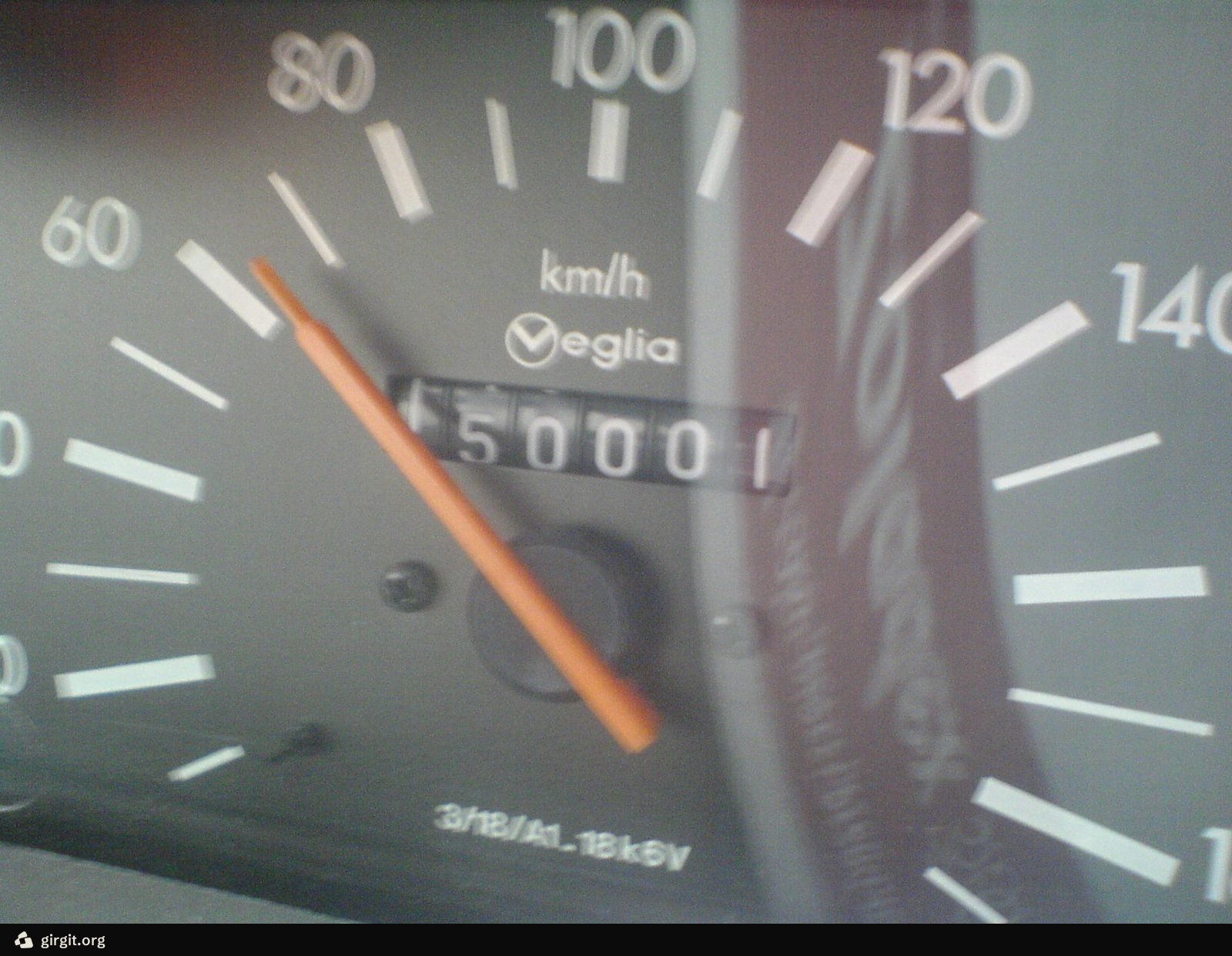 needle: speed right now, km/hodometer: total distance, 50 001 km
Here is the puzzle. Speed is distance divided by time. At a single instant the time gap is 0 and the distance covered is 0, and \( \frac{0}{0} \) tells you nothing. So how can a speed at one instant even make sense?
A falling stone, timed closer and closer
Experiments show that a stone dropped from a high cliff falls \( s = 4.9t^2 \) metres in \( t \) seconds (we ignore air). Here \( s \) is the distance fallen and \( t \) the time. Let's find its speed at \( t = 3 \) s, when it has fallen \( 4.9 \times 9 = 44.1 \) m.
The average velocity between times \( t_1 \) and \( t_2 \) is the distance fallen in that gap divided by the length of the gap, \( t_2 - t_1 \). Take gaps that end at 3 s, and gaps that start at 3 s:
| Time gap (s) | Average velocity (m/s) | Time gap (s) | Average velocity (m/s) | |
|---|---|---|---|---|
| 2 to 3 | 24.5 | 3 to 4 | 34.3 | |
| 2.9 to 3 | 28.91 | 3 to 3.1 | 29.89 | |
| 2.99 to 3 | 29.351 | 3 to 3.01 | 29.449 | |
| 2.999 to 3 | 29.3951 | 3 to 3.001 | 29.4049 |
The left column creeps up, the right column creeps down, and both are squeezing the same number: 29.4 m/s. That is the stone's instantaneous velocity at \( t = 3 \) s.
Algebra shows why. Over the gap from 3 to \( 3 + h \) seconds, the average velocity is
\[ \frac{4.9(3 + h)^2 - 4.9 \times 9}{h} = \frac{4.9(6h + h^2)}{h} = 29.4 + 4.9h \]As the gap \( h \) shrinks towards 0, the \( 4.9h \) part fades away and only 29.4 is left. We never put \( h = 0 \) (that would be \( \frac{0}{0} \)); we only watch where the answers are heading.
Try it: shrink the gap \( h \) in the sentence, from either side, and watch the chord turn into the tangent.
Velocity is the rate of change of distance with time. So we say the derivative of \( s = 4.9t^2 \) at \( t = 3 \) is 29.4. The textbook does the same at \( t = 2 \) and squeezes the speed between 19.551 and 19.649 m/s; the exact value is 19.6 m/s.
The same idea on a graph
Plot distance \( s \) against time \( t \): you get a curve that bends upwards. Pick a point A on it at \( t = 3 \) and another point B a little later. The average velocity between them is the slope (steepness) of the straight line through A and B, called a chord. Slide B closer and closer to A. The chord swings round and settles on the line that just grazes the curve at A: the tangent. So:
Watch it happen: Q slides along the curve into P, from the right and then from the left, and the chord's slope closes in on 29.4 from both sides.
Remember
- Average velocity over a gap = slope of a chord on the distance-time graph.
- Instantaneous velocity at an instant = slope of the tangent at that point.
- Both are the rate of change of distance; the second one is the derivative.
Guess first: the halfway time
The stone falls for 3 seconds, so its average velocity over the whole fall is \( \frac{44.1}{3} = 14.7 \) m/s. Guess: at which moment is its speedometer reading exactly 14.7 m/s? Most people say "somewhere near the end, since it is fast then".
Commit to an answer, then change the length of the fall.
See what happens
Try it. Find the average velocity of the stone between 1 s and \( 1 + h \) s, and use it to get the velocity at \( t = 1 \) s.
Answer
Just remember
Two numbers on this page are not reasons, just facts about our units and our planet. Learn them; each can be rebuilt in a few seconds.
- \( 1 \) km/h \( = \frac{5}{18} \) m/s
- Hook: "36 km/h is 10 m/s", easy to say on a cricket ground. Rebuild: 1 km is 1000 m and 1 h is 3600 s, so 1 km/h is \( \frac{1000}{3600} = \frac{5}{18} \) m/s. Going the other way, multiply by \( \frac{18}{5} \): the stone's 29.4 m/s is about 106 km/h.
- Falling distance \( s = 4.9t^2 \) (in metres, \( t \) in seconds)
- The 4.9 is half of 9.8, the pull of the Earth, \( g \approx 9.8 \) m/s². Hook: "half g, t squared". Rebuild: speed grows by 9.8 m/s every second, so after \( t \) seconds it is \( 9.8t \); the average over the fall is half of that, and distance = average speed × time \( = 4.9t \times t \).
- Calculus
- The maths of change: how outputs change as inputs change.
- Average velocity
- Distance covered in a time gap divided by the length of the gap.
- Instantaneous velocity
- Velocity at one instant: what the averages close in on as the gap shrinks.
- Rate of change
- How fast one quantity changes compared with another.
- Chord
- A straight line joining two points of a curve.
- Tangent
- The line that just grazes a curve at one point, in the curve's own direction there.
Words to know
For \( s = 4.9t^2 \), the average velocity from \( t = 3 \) to \( t = 3 + h \) is \( 29.4 + 4.9h \). Why can't we just put \( h = 0 \) in the original fraction?
- Because the original fraction becomes \( \frac{0}{0} \), which means nothing
- Because the stone is not moving at \( t = 3 \)
- Because time cannot be exactly 3 seconds
On a distance-time graph, what does the slope of the tangent at a point tell you?
- The average velocity over the whole trip
- The instantaneous velocity at that moment
- The distance covered so far
A car covers 120 km in 2 hours. Which statement must be true?
- Its speedometer showed 60 km/h the whole time
- Its average speed was 60 km/h
- Its speedometer never went above 60 km/h
Deep dive · optional
Can anything move in an instant?
A puzzle that is 2,400 years old, the experiment that gave us \( s = 4.9t^2 \), and what is really going on inside a speedometer. The exam does not ask any of this; it is here so that "speed at an instant" never feels like a trick again.
The roots: what "speed now" can possibly mean
- Why can't we divide distance by time at one instant?Because in one instant no time passes and the stone covers no distance. Distance ÷ time becomes \( 0 \div 0 \), which is not a number at all.
- Then what does a speedometer show?Never the speed "in" an instant. It shows the result of a very short measurement: how far the wheel turned in a tiny gap of time, or how hard a spinning magnet is dragging on the needle. Either way it is an average over a gap too short to notice.
- Why do the averages for the stone settle on one number?Because, worked out exactly, the average from 3 s to \( 3 + h \) s is \( 29.4 + 4.9h \). One part never changes; the other part shrinks with the gap. Make the gap small and only 29.4 is left.
- Why call 29.4 the speed at 3 s, and not 29.3 or 29.5?Because it is the only number that every short average closes in on, from both sides: gaps ending at 3 s give averages just below it, gaps starting at 3 s give averages just above it. Any other number gets left behind by one side or the other.
- And underneath?The plain idea of speed you already trust: distance covered ÷ time taken, over a gap. "Speed at an instant" is not a new kind of speed. It is where that old speed is heading as the gap shrinks.
So the instant speed is not "distance in an instant ÷ an instant". It is a limit: the value the averages approach. Nobody can ever measure an instant directly, but everybody can measure shorter and shorter gaps, and the limit is what those measurements agree on. That idea, made exact on the next pages, is the whole engine of calculus.
The story: a frozen arrow and a rolling ball
See it: bells, a magnet and a camera
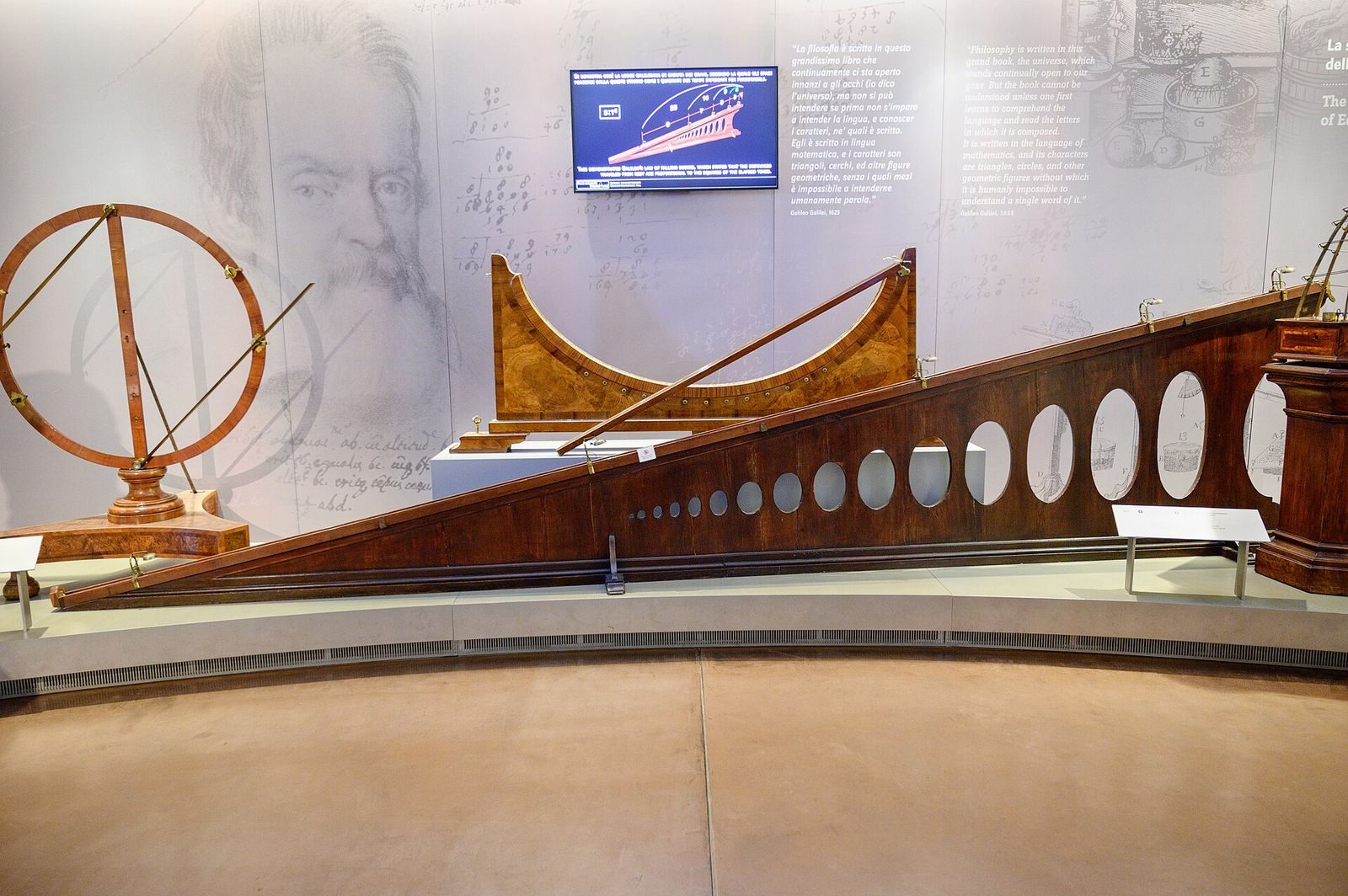 bells, spaced 1 : 3 : 5 : 7groove, 5.4 m long
A speedometer is a machine for taking that limit without fuss. In the older kind, a cable from the wheel spins a small magnet inside a light metal cup. The spinning magnet sets up electric currents in the cup (eddy currents) that drag it round; a fine spring holds it back. The faster the magnet spins, the harder the drag, so the cup and the needle settle further round. The German inventor Otto Schultze patented this design in 1902. Its partner on the dial, the odometer, simply counts total distance. So one dashboard shows both halves of this chapter: the odometer shows \( s \), and the needle shows how fast \( s \) is changing.
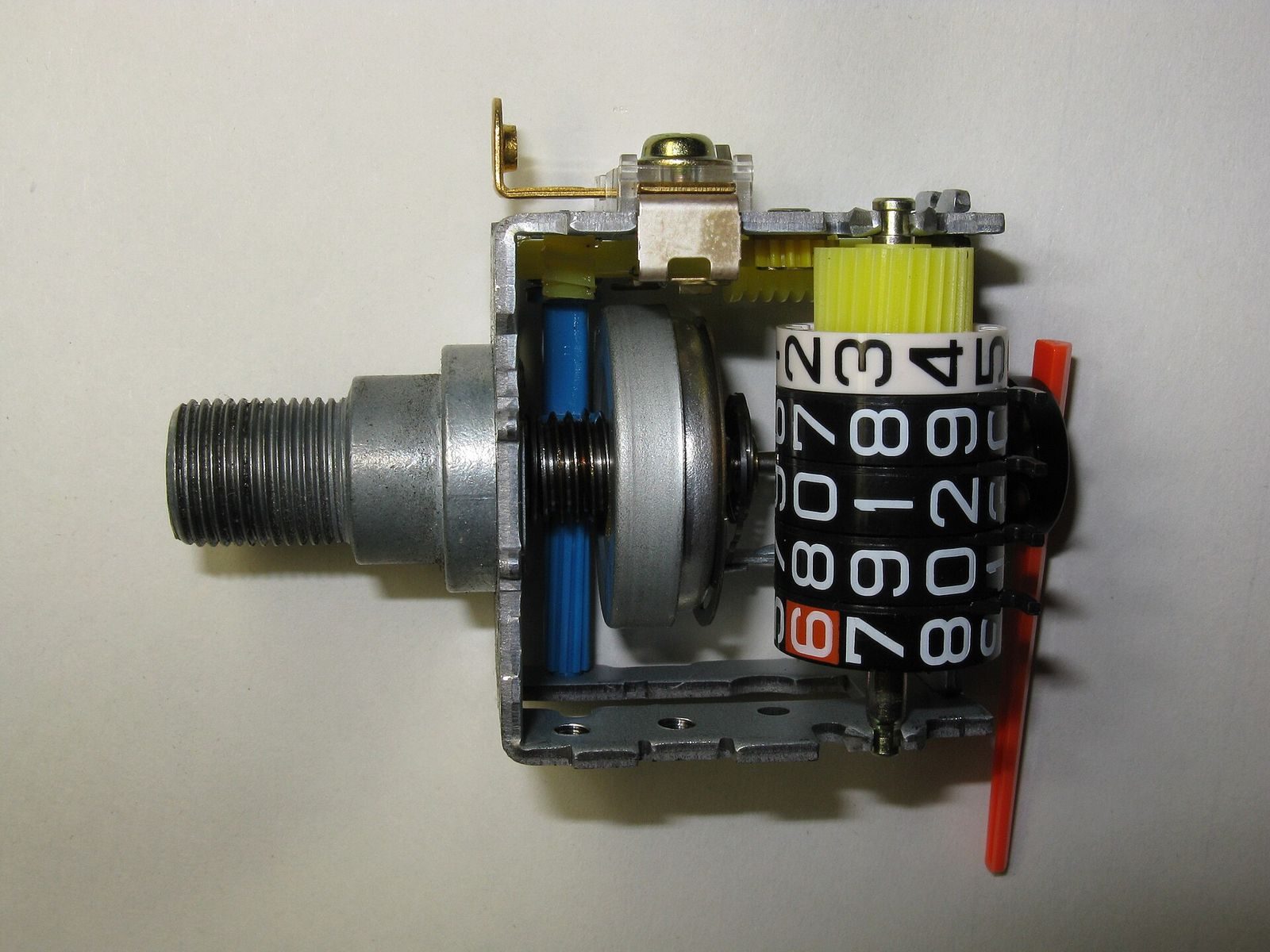 cable from the wheelspinning magnet drags this cupodometer drums: distanceneedle: speed
Newer vehicles count pulses instead: a sensor sends a pulse each time a toothed wheel or magnet goes past, and a small computer turns "so many pulses in so much time" into a speed. A phone's GPS speed works out how far you moved since its last fix and divides by the time since then. All of these are averages over a short gap, which is exactly the method of this page.
A camera makes the same point. With the shutter open for a time \( \Delta t \), a falling stone draws a blur as long as the distance it falls in that time. Shrink the shutter time: the blur shrinks, Zeno's frozen photo is waiting at \( \Delta t = 0 \), but blur ÷ shutter time does not shrink at all.
Solve it
Solve it
Show that the stone falls 4.9 m in the 1st second, 14.7 m in the 2nd, 24.5 m in the 3rd and 34.3 m in the 4th (Galileo's 1 : 3 : 5 : 7). Then explain why these four numbers, read as speeds in m/s, are the speedometer readings at \( t = 0.5, 1.5, 2.5 \) and \( 3.5 \) s.
Hint
Answer
Estimate it
A sports photographer shoots a fast bowler's delivery at 144 km/h with a shutter time of \( \frac{1}{1000} \) s. How long is the ball's blur? A cricket ball is about 7 cm across; will the photo look sharp?
Answer
Prove it
A bus covers a 2 km stretch of highway in exactly 1.5 minutes. Explain, without any formula for its motion, why its speedometer must have read at least 80 km/h at some moment on that stretch.
Hint
Answer
Connect it
Connect it
- Physics, Motion in a Straight Line. The same story told with velocity: how fast right now? and free fall, where \( s = \frac{1}{2}gt^2 \) comes from.
- The limit, page 2. "Where the averages are heading" gets a name and a symbol on what is a limit?
- The derivative, page 9. The chord-to-tangent picture becomes a definition: from chord to tangent.
- Class 12, rates of change. Every "how fast is it changing?" question, from an inflating balloon to a draining tank: the derivative as a rate.
- Daily life. Section speed cameras on some highways time a vehicle between two points far apart: they measure an average speed. A spot speed gun measures over a tiny gap: as close to an instant speed as a machine gets.
Still confused?
If the stone is "at" one place at 3 s, how can it have a speed there?
Being at one place at one instant is true, and Zeno was right about that much. But speed is not a property of one instant alone; it describes how the position changes around that instant. The stone is at 44.1 m at 3 s, a bit lower just after, a bit higher just before, and the rate of that change, measured over shrinking gaps, settles on 29.4 m/s.
Isn't 29.4 just an approximation, since we never use \( h = 0 \)?
No. The averages are approximations; 29.4 is exact. The algebra \( 29.4 + 4.9h \) shows every average is off by exactly \( 4.9h \), and the limit is the number with that error removed completely. Nothing is rounded.
Did Galileo drop balls from the Leaning Tower of Pisa?
Perhaps not. The story comes from a life of Galileo by his pupil Vincenzo Viviani, written in 1654 (more than 60 years after the date it gives) and printed in 1717, and most historians treat it as a thought experiment rather than a real test. What Galileo does describe, in detail, is the inclined-plane experiment above: slowing the fall down so that it can be timed.
Sources
- Zeno's paradoxes (Zeno of Elea, c. 490 to 430 BCE; the arrow in Aristotle, Physics VI.9, 239b; Aristotle's reply; Parmenides), Wikipedia; Aristotle, Physics, Book VI, tr. R. P. Hardie and R. K. Gaye, The Internet Classics Archive.
- Two New Sciences (1638, Elzevir, Leiden; the Inquisition ban; inclined plane of 12 cubits; water clock; Koyré's doubts and the 1604 notes), Wikipedia.
- Galileo's law of odd numbers, Wikipedia.
- Inclined plane, early 19th century, inv. 1041 (five bells at odd-number spacings, timed by a pendulum), Museo Galileo, Florence.
- Speedometer (eddy-current design, Otto Schultze's patent of 7 October 1902; electronic pulse sensors; GPS speed), Wikipedia.
- Galileo's Leaning Tower of Pisa experiment (Viviani, written 1654, printed 1717; most historians: a thought experiment), Wikipedia.
- Quantum Zeno effect (Misra and Sudarshan 1977; observed at Austin, 2001) and E. C. George Sudarshan, Wikipedia.
Picture and video credits
Show 2 picture and video credits
- galileo-inclined-plane-museo-galileo.jpg: Zde, CC BY-SA 4.0
- scooter-speedometer.jpg: KENPEI, CC BY-SA 3.0

