Act 08NCERT §3.3.2 · pp. 53–576 min
What the graphs look like, and why they repeat
The arc walked by P peels off the circle and lies flat along an axis; P's height draws the sine wave and its run the cosine wave. After 2π the point is back where it began and the wave repeats.
P is back where it began, and the wave starts again.
From the textbookpp. 53–57
NCERT Mathematics, Class 11 · Reprint 2026-27
8.0The big idea
One shape, copied for ever.
Trigonometric functions repeat: sine, cosine, secant and cosecant every 2π; tangent and cotangent every π. Each graph is one shape, again and again.
Full text
The big ideaTrigonometric functions repeat: sine, cosine, secant and cosecant every \( 2\pi \), tangent and cotangent every \( \pi \), so their graphs are one basic shape copied again and again.
In simple words
A ceiling fan blade comes back to the same spot after each full turn. So anything you measure about it, such as its height, also comes back to the same value. Draw that height against time and you get the same hump and dip over and over, like waves on the sea. To find the value for a huge angle, throw away the full turns and look only at what is left.
Try itSlide a copy
It fits only at whole 2π
8.1The period: the smallest gap
π
for tan and cot; 2π for sin, cos, sec, cosec
- sin(2nπ + x) = sin x, cos too; their reciprocals follow.
- Half a turn sends P to (−a, −b): −b/−a = b/a, so tan(π + x) = tan x.
Full text
Repeating after a fixed gap
We saw that \( \sin(2n\pi + x) = \sin x \) and \( \cos(2n\pi + x) = \cos x \): the values of sine and cosine repeat after an interval of \( 2\pi \). Their reciprocals, \( \operatorname{cosec} x \) and \( \sec x \), must repeat after \( 2\pi \) too.
Tangent repeats sooner. Going half a turn round, from P to the opposite point, changes the signs of both coordinates, and \( \tfrac{-b}{-a} = \tfrac{b}{a} \). So \( \tan(\pi + x) = \tan x \) (proved properly in the next pages), and tan repeats after an interval of \( \pi \). Its reciprocal, \( \cot x \), repeats after \( \pi \) too.
The smallest such gap is called the period of the function.
See itRun the point round twice
Which repeats soonest?
8.2The graph of sine
Unroll the circle
The wave rises to a peak of 1 at π/2.
Back down, crossing the x-axis.
Its lowest value, −1. Never above 1, never below −1.
The same hump and dip; it crosses at every multiple of π.
8.3To the left as well
The left half, upside down
The hump and dip repeat to the left too, −2π to 0, and on. Because sin(−x) = −sin x, the sine wave is symmetric about the origin.
Full text
The graphs of sine and cosine
\( y = \sin x \) is a smooth wave. It passes through the origin, rises to a peak of 1 at \( x = \tfrac{\pi}{2} \), comes back down to cross the \( x \)-axis at \( \pi \), sinks to a lowest value of \( -1 \) at \( \tfrac{3\pi}{2} \), and returns to 0 at \( 2\pi \). Then the same hump and dip repeat to the right (\( 2\pi \) to \( 4\pi \), and on) and to the left (\( -2\pi \) to 0, and on). It crosses the \( x \)-axis at every multiple of \( \pi \) and never goes above 1 or below \( -1 \). Because \( \sin(-x) = -\sin x \), the left half is the right half turned upside down: the graph is symmetric about the origin.
\( y = \cos x \) is exactly the same wave, slid \( \tfrac{\pi}{2} \) to the left. It starts at its peak, \( (0, 1) \), falls through 0 at \( \tfrac{\pi}{2} \) to \( -1 \) at \( \pi \), climbs through 0 at \( \tfrac{3\pi}{2} \) and is back at 1 at \( 2\pi \). Because \( \cos(-x) = \cos x \), its left half is the mirror image of its right half in the \( y \)-axis.
8.4The graph of cosine
The same wave, π/2 to the left
8.5A lamp on a giant wheel, in the dark
From the side, sine; from above, cosine
Its up-and-down path spread over time draws the sine wave; its left-right path, the cosine. Same wheel, a quarter turn out of step.
CheckThe cosine graph
Which is true?
Which statement about the graph of \( y = \cos x \) is true?
- It passes through the origin
- It is symmetric about the \( y \)-axis
- It has vertical lines at odd multiples of \( \tfrac{\pi}{2} \)
8.6Tangent and cotangent
A row of pieces, one every π
- tan: dashed lines at ±π/2, ±3π/2; crosses at 0, π, 2π; always rising.
- cot: lines at 0, ±π, ±2π; crosses at π/2, 3π/2; always falling.
Full text
The graphs of tangent and cotangent
\( y = \tan x \) is not one wave but a row of separate pieces. There are vertical dashed lines at \( x = \pm\tfrac{\pi}{2}, \pm\tfrac{3\pi}{2}, \dots \), where tan is not defined. Between two neighbouring lines, the curve comes up from far below, crosses the \( x \)-axis at the middle point (\( 0, \pi, 2\pi, \dots \)), and climbs steeply towards the next line, getting closer and closer to it without touching. Every piece is an identical, always-rising copy, one every \( \pi \).
\( y = \cot x \) looks like tan reflected: the vertical lines are at \( 0, \pm\pi, \pm 2\pi, \dots \), and in each gap the curve comes down from very high, crosses the \( x \)-axis at \( \tfrac{\pi}{2}, \tfrac{3\pi}{2}, \dots \), and falls away to very low. Each piece is always falling.
CheckHalf a turn
Is tan(x + π) = tan x?
Is \( \tan\left(x + \pi\right) = \tan x \) for every \( x \) in the domain of tan?
- No, half a turn changes the sign of tan
- Yes, tan repeats every \( \pi \)
- Only for \( x \) in the first quadrant
8.7Secant and cosecant
U-shaped cups skip the middle strip
- sec: lines at ±π/2, ±3π/2. Up cups, lowest 1 at 0, ±2π; down cups, highest −1 at ±π, ±3π.
- cosec: lines at multiples of π; up cup 1 at π/2, down −1 at 3π/2; every 2π.
Full text
The graphs of secant and cosecant
\( y = \sec x \) is a row of U-shaped cups. Vertical lines stand where \( \cos x = 0 \) (\( \pm\tfrac{\pi}{2}, \pm\tfrac{3\pi}{2}, \dots \)). Where \( \cos x \) is positive, the cup opens upward with its lowest point at height 1 (at \( x = 0, \pm 2\pi, \dots \)). Where \( \cos x \) is negative, the cup opens downward with its highest point at \( -1 \) (at \( x = \pm\pi, \pm 3\pi, \dots \)). No part of the graph lies in the strip between \( y = -1 \) and \( y = 1 \): that is its range in picture form.
\( y = \operatorname{cosec} x \) is the same cup pattern built on the sine wave: vertical lines at the multiples of \( \pi \), an upward cup with lowest point 1 at \( \tfrac{\pi}{2} \), a downward cup with highest point \( -1 \) at \( \tfrac{3\pi}{2} \), and so on, repeating every \( 2\pi \).
8.8Don't mix these up
π for two, 2π for four
sin and cos
Removing one π flips the sign
tan and cot
Remove whole multiples of π freely
Don't mix these up
- Sin, cos, sec and cosec repeat every \( 2\pi \); tan and cot every \( \pi \).
- For tan and cot you may remove whole multiples of \( \pi \), not just \( 2\pi \). For sin and cos, removing a single \( \pi \) changes the sign.
- The dashed vertical lines in the tan, cot, sec and cosec graphs are not part of the graph; they mark where the function is not defined.
8.9Using the period
Throw away whole periods
Add or subtract periods until the angle is one you know.
Worked example
- \( \sin \tfrac{25\pi}{6} \): \( \tfrac{25\pi}{6} = 4\pi + \tfrac{\pi}{6} \), so the value is \( \sin \tfrac{\pi}{6} = \tfrac{1}{2} \).
- \( \sin 1110^\circ \): \( 1110^\circ = 3 \times 360^\circ + 30^\circ \), so the value is \( \sin 30^\circ = \tfrac{1}{2} \).
- \( \operatorname{cosec}(-690^\circ) \): add \( 2 \times 360^\circ = 720^\circ \) to get \( 30^\circ \). So the value is \( \operatorname{cosec} 30^\circ = 2 \).
- \( \tan \tfrac{13\pi}{4} \): tan has period \( \pi \), and \( \tfrac{13\pi}{4} = 3\pi + \tfrac{\pi}{4} \), so the value is \( \tan \tfrac{\pi}{4} = 1 \).
Full text
Using the period to find values
To find a function of a large or negative angle, add or subtract whole periods until the angle is one you know.
Worked example
- \( \sin \tfrac{25\pi}{6} \): \( \tfrac{25\pi}{6} = 4\pi + \tfrac{\pi}{6} \), so the value is \( \sin \tfrac{\pi}{6} = \tfrac{1}{2} \).
- \( \sin 1110^\circ \): \( 1110^\circ = 3 \times 360^\circ + 30^\circ \), so the value is \( \sin 30^\circ = \tfrac{1}{2} \).
- \( \operatorname{cosec}(-690^\circ) \): add \( 2 \times 360^\circ = 720^\circ \) to get \( 30^\circ \). So the value is \( \operatorname{cosec} 30^\circ = 2 \).
- \( \tan \tfrac{13\pi}{4} \): tan has period \( \pi \), and \( \tfrac{13\pi}{4} = 3\pi + \tfrac{\pi}{4} \), so the value is \( \tan \tfrac{\pi}{4} = 1 \).
Don't mix these up
- Sin, cos, sec and cosec repeat every \( 2\pi \); tan and cot every \( \pi \).
- For tan and cot you may remove whole multiples of \( \pi \), not just \( 2\pi \). For sin and cos, removing a single \( \pi \) changes the sign.
- The dashed vertical lines in the tan, cot, sec and cosec graphs are not part of the graph; they mark where the function is not defined.
Answer
Try itAs big as you like
What is left after the turns go?
CheckFour turns clockwise
cos(−1440°)
What is \( \cos(-1440^\circ) \)?
- 1
- 0
- \( -1 \)
Try itThree quick ones
750°, −11 π/4, the lowest point
(a) cos 750°. (b) cot(−11 π/4). (c) Where y = sin x is lowest between 0 and 4π.
Answer
KeepJust remember
A t in your name
A one-second check. Tap the card for its hook.
WordsTo know
Four words
- Period
- The smallest gap after which a function's values repeat.
- Sine wave
- The smooth repeating hump-and-dip graph of \( y = \sin x \).
- Vertical line in a graph
- A value of \( x \) where the function is not defined and shoots off towards \( \pm\infty \).
- Period of tan and cot
- \( \pi \), half that of the other four.
RootsWhy exactly 2π, and π
Test one clever x
- A full walk is the circumference, 2π × 1.
- If sin(x + p) = sin x always, sin(π/2 + p) = 1: the top, so whole turns. Smallest 2π.
- tan: tan p = tan 0 = 0, so p is a multiple of π.
Full text
Why exactly 2π, and why exactly π?
- Why does \( \sin x \) repeat after \( 2\pi \)?Because \( \sin x \) only depends on where P stands, and a walk of \( 2\pi \) round the unit circle brings P back to the same spot.
- Why is a full walk \( 2\pi \) long?The unit circle has radius 1, so its circumference is \( 2\pi \times 1 \). In radians, the angle is the distance walked.
- Could some smaller gap \( p \) also work, for every \( x \)?No. If \( \sin(x + p) = \sin x \) for every \( x \), it must hold at \( x = \tfrac{\pi}{2} \), so \( \sin\left(\tfrac{\pi}{2} + p\right) = 1 \). Sine is 1 only at the very top of the circle, so \( p \) has to be a whole number of full turns: \( 2\pi, 4\pi, \dots \) The smallest is \( 2\pi \).
- Why does tan get away with \( \pi \)?\( \tan x \) is the slope of the line OP. Half a turn takes P to the other end of the same line through O, and a line has one slope. For tan the same test gives: \( \tan p = \tan 0 = 0 \), so \( p \) is a multiple of \( \pi \), smallest \( \pi \).
- So what is the bedrock?A full turn is the circumference of the unit circle, and the functions read off one point of it. Same point, same values.
The test in step 3 is worth keeping: to prove a gap is the smallest period, pick one clever \( x \) where the function takes a value it reaches only once per turn. And notice what a period does to a real motion. The cabin of a giant wheel of radius 20 m on an axle 22 m high, starting at the bottom and turning once every \( T \) seconds, is at height
\[ h(t) = 22 - 20\cos\left(\frac{2\pi t}{T}\right), \]because after \( t \) seconds it has turned through the angle \( \tfrac{2\pi t}{T} \). Put in \( t = T \): the angle is \( 2\pi \) and the height is back where it began. The wheel's period becomes the graph's period.
RootsA giant wheel as an equation
The wheel's period is the graph's
At t = T the angle is 2π and the cabin is back at the start.
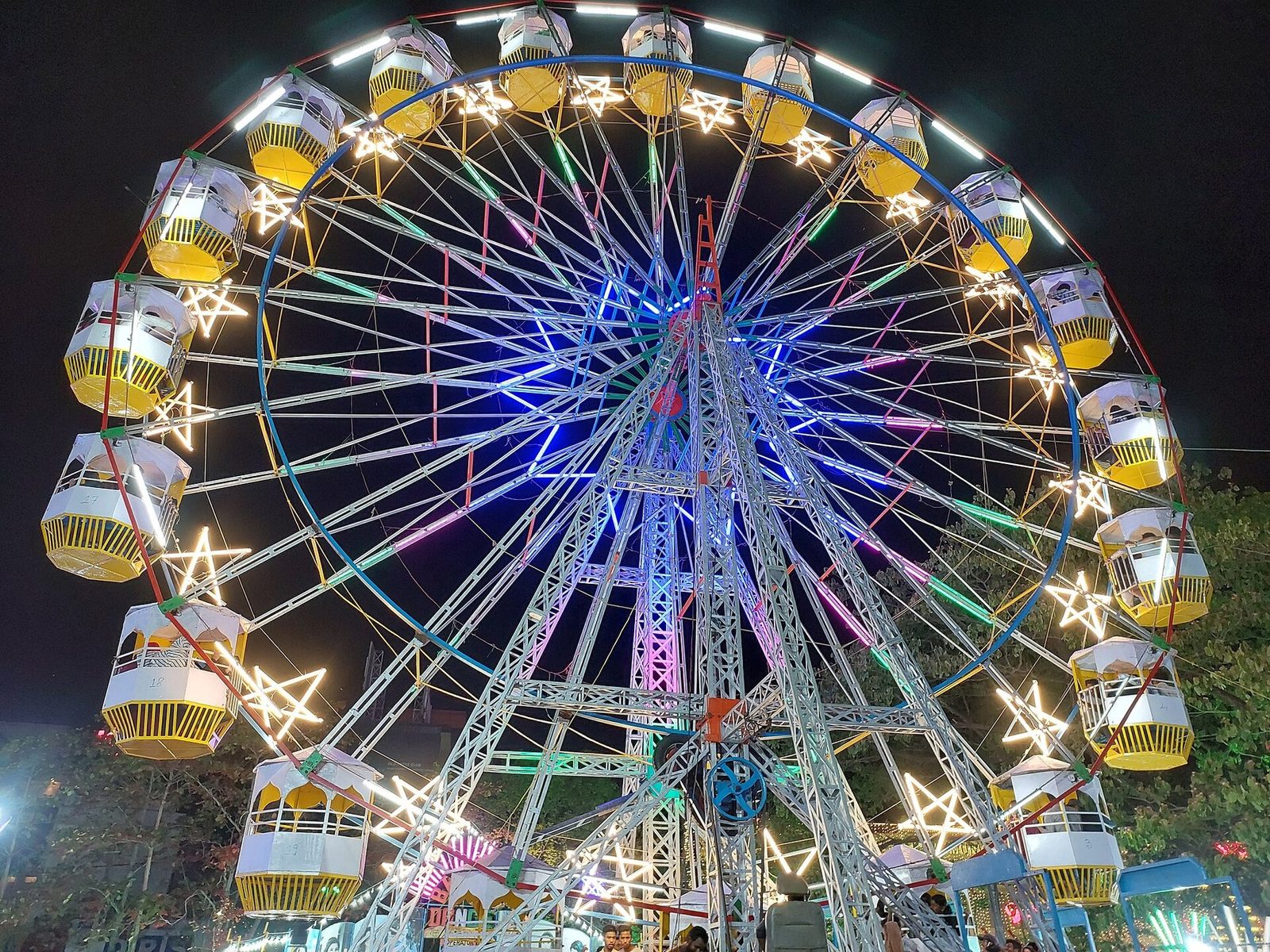 axle: the centrecabinrim: radius from the axle
Story7th century, India · Bhaskara I
A sine with no table
Teacher of Aryabhata's school, born probably in Saurashtra, working in Ashmaka. Chapter 7 of his Mahabhaskariya: one fraction for any angle from 0° to 180°, credited to Aryabhata. Also the first known to write a small circle for zero in place-value numbers.
StoryMultiply and divide
Exact at five angles
Exact at 0°, 30°, 90°, 150° and 180°. How it was found, nobody knows: a corrected parabola, or a fraction fitted to five values.
See itGuess the worst gap first
Why the plain parabola loses
4x(180 − x)/180² gives 0.56 at 30°, not 0.5. Bhaskara's bottom line bends it onto the true value.
Solve itA cabin, a period, sin 45°
Your turn
Solve it
The giant wheel above has its axle 22 m up and a radius of 20 m, and it turns once every 2 minutes. A cabin starts at the bottom. How long until it is first 32 m above the ground?
Hint
Answer
Predict, then check
Without a calculator, use Bhaskara's fraction to estimate \( \sin 45^\circ \). Is the answer a little too big or a little too small? Then check against \( \tfrac{1}{\sqrt{2}} \approx 0.7071 \) and in the interactive.
Answer
What is the period of \( y = \tan 2x \)?
- \( \pi \)
- \( \tfrac{\pi}{2} \)
- \( 2\pi \)
- \( 4\pi \)
ConnectWhere this goes next
Every graph here is the circle, unrolled
Connect it
- Period and frequency, Physics Class 11. A swinging pendulum or a spring repeats every \( T \) seconds; its displacement is a sine of \( \tfrac{2\pi t}{T} \), just like the wheel. See period and frequency.
- Waves, Physics Class 11. A wave repeats in space too: its wavelength is a period measured in metres. See wavelength, frequency and speed.
- The unit circle, this chapter. Every graph on this page is the circle of sine and cosine for any angle, unrolled.
- Limits, Class 11. Near \( 0^\circ \) Bhaskara's fraction is about 1.9% too big, because its slope at 0 is slightly wrong. The true slope is the limit \( \tfrac{\sin x}{x} \to 1 \) (in radians), proved in the sandwich theorem.
- At home. India's mains voltage repeats 50 times a second: its period is \( \tfrac{1}{50} \) s = 20 milliseconds (see domain and range).
Sources
- Bhāskara I, Wikipedia (dates, works, zero, attribution of the rule to Aryabhata).
- Bhāskara I's sine approximation formula, Wikipedia (the formula, Mahabhaskariya chapter VII verses 17 to 19, error under 0.0016, proposed derivations).
- K. Stroethoff, "Bhaskara's approximation for the sine", The Mathematics Enthusiast 11(3), 2014, pp. 485 to 494.