Act 02NCERT §3.2.2–3.2.3 · pp. 45–465 min
What is a radian?
A piece of rope as long as the radius is laid round the edge of the circle, again and again: six fit, with about 0.28 of a piece left over.
Lay the radius round the edge: six pieces, and a bit.
From the textbookpp. 45–46
NCERT Mathematics, Class 11 · Reprint 2026-27
2.0The big idea
Arc as long as radius: one radian.
An arc l on a circle of radius r makes an angle θ = l / r at the centre. People chose 360; the circle chose this.
Full text
The big ideaOne radian is the angle at the centre of a circle made by an arc exactly as long as the radius, so an arc of length \( l \) in a circle of radius \( r \) makes an angle of \( \theta = l / r \) radians.
In simple words
Cut a piece of string as long as the distance from the middle of a round plate to its edge. Lay the string along the edge of the plate. Draw lines from the middle to both ends of the string. The gap between those two lines is one radian. A little over six such strings go all the way round.
2.1Radian measure
Bend the radius onto the edge
- A unit circle has radius 1 unit.
- An arc of 1 unit subtends 1 radian at the centre.
- Anticlockwise +1 radian, clockwise −1; an arc of 1½ gives 1½ radian.
Full text
One radian
Degrees are a human choice: someone decided a full turn should be 360. The radian measure comes from the circle itself.
Take a unit circle, a circle of radius 1 unit. An arc of length 1 unit on it subtends (makes, at the centre) an angle of 1 radian. If the arc is laid off anticlockwise from the initial side, the angle is \( +1 \) radian; laid off clockwise, it is \( -1 \) radian. An arc of length \( 1\tfrac{1}{2} \) gives \( 1\tfrac{1}{2} \) radian, and so on.
A whole turn: the circumference of the unit circle is \( 2\pi \times 1 = 2\pi \). So one complete revolution is an angle of \( 2\pi \) radian, about 6.28 radian. That is the "little over six strings" from the box above.
2.2Round the edge
Six strings, then 0.28
Lay radius-long strings round the edge, one after another. Six fit, and a small piece is left over.
2.3A whole turn
2πradian
in one revolution, about 6.28
The unit circle's circumference is 2π × 1 = 2π: that many radius-lengths fit round it.
CheckArc equal to radius
A 6 cm arc on 6 cm
In a circle of radius 6 cm, an arc of 6 cm subtends what angle at the centre?
- 1 radian
- \( 60^\circ \) exactly
- 6 radians
Try itCount the string
How many radius-lengths?
2.4Any circle
Arc = radius × angle
An arc of length r subtends 1 radian; an arc l subtends l / r.
Same angle, double the arc. Arc ÷ radius does not change.
Length ÷ length: so we often leave out the word "radian".
2.5θ = l / r
Same turn, longer walk
- Arc length l and radius r in the same unit.
- θ in radians only. Degrees would need an extra factor.
Two children run round a giant wheel, one near the hub, one on the rim. Ground covered ÷ distance from the hub: the same number.
Full text
Any circle: \( l = r\theta \)
Nothing special happens on bigger circles. In a circle of radius \( r \), an arc of length \( r \) subtends 1 radian. Equal arcs of the same circle subtend equal angles at the centre, so an arc of length \( 2r \) subtends 2 radians, and an arc of length \( l \) subtends \( l / r \) radians:
\[ \theta = \frac{l}{r} \qquad \text{or} \qquad l = r\theta \]Here \( l \) is the arc length, \( r \) the radius (same unit as \( l \)) and \( \theta \) the angle at the centre in radians. This formula only works with radians; with degrees you would need an extra factor.
Because \( \theta \) is a length divided by a length, a radian is really a pure number. That is why we often leave out the word "radian".
Worked example
- A swing seat hangs on ropes 2.4 m long and moves along an arc of 1.8 m. Through what angle do the ropes turn? \( \theta = \dfrac{l}{r} = \dfrac{1.8}{2.4} = 0.75 \) radian.
- What arc length gives an angle of 2.5 radians at the centre when the radius is 14 cm? \( l = r\theta = 14 \times 2.5 = 35 \) cm.
- An arc 30 cm long subtends 1.2 radians at the centre. Find the radius. \( r = \dfrac{l}{\theta} = \dfrac{30}{1.2} = 25 \) cm.
2.6Worked example
Find θ, then l, then r
Worked example
- A swing seat hangs on ropes 2.4 m long and moves along an arc of 1.8 m. Through what angle do the ropes turn? \( \theta = \dfrac{l}{r} = \dfrac{1.8}{2.4} = 0.75 \) radian.
- What arc length gives an angle of 2.5 radians at the centre when the radius is 14 cm? \( l = r\theta = 14 \times 2.5 = 35 \) cm.
- An arc 30 cm long subtends 1.2 radians at the centre. Find the radius. \( r = \dfrac{l}{\theta} = \dfrac{30}{1.2} = 25 \) cm.
See itA swing
1.8 m of arc on 2.4 m ropes
CheckTwo circles, one angle
Which arc is longer?
The same angle of 0.5 radian is drawn at the centre of a circle of radius 10 cm and one of radius 20 cm. How do the arcs compare?
- They are equal
- The second arc is twice as long
- The first arc is twice as long
2.7Radians and real numbers
Wrap the number line round
- Tangent at A: 0 at A; up AP is 1, 2, 3 …; down AQ is −1, −2 ….
- Wind it on like thread: AP anticlockwise, AQ clockwise.
- Thread used = arc length = the angle in radians.
Full text
Radians and real numbers are the same thing
Here is a neat way to see that every real number is an angle in radians.
- Draw the unit circle with centre O and mark a point A on it. Take OA as the initial side.
- Draw the tangent line to the circle at A. Mark A as the number 0 on this line. Going up from A (call that part AP) are the positive numbers 1, 2, 3, …; going down (AQ) are the negative numbers −1, −2, ….
- Now wrap the line round the circle like thread round a spool: the positive part AP anticlockwise, the negative part AQ clockwise.
Each real number lands on a point of the circle, and the length of thread used is exactly the arc length, which on a unit circle is the angle in radians. So the number 2 corresponds to the angle 2 radians, the number \( -0.5 \) to the angle \( -0.5 \) radian, and every radian measure corresponds to exactly one real number. Radian measures and real numbers can be treated as one and the same.
This is why we can write \( \sin 2 \) or \( \cos(-0.5) \) and treat sine and cosine as functions of a real number, which is what the rest of this chapter does.
Don't mix these up
- \( l = r\theta \) needs \( \theta \) in radians. Using \( \theta = 60 \) (degrees) gives a nonsense answer.
- 1 radian is not a tiny angle: it is a bit less than 60°. A full turn is \( 2\pi \) radians, not \( \pi \).
Answer
2.8One and the same
Every real number is an angle
The number 2 is the angle 2 radians; −0.5 is −0.5 radian. So sin 2 and cos(−0.5) make sense: sine and cosine become functions of a real number.
CheckWhy it works
sin x for any real x?
Why can we treat \( \sin x \) as a function of any real number \( x \)?
- Because every real number is less than 360
- Because every real number is the radian measure of some angle
- Because only positive real numbers are used
2.9Don't mix these up
Degrees in l = rθ? Never
Myth
Put θ = 60 into l = rθ
Fact
θ must be in radians. 1 radian is a bit less than 60°; a full turn is 2π, not π
Don't mix these up
- \( l = r\theta \) needs \( \theta \) in radians. Using \( \theta = 60 \) (degrees) gives a nonsense answer.
- 1 radian is not a tiny angle: it is a bit less than 60°. A full turn is \( 2\pi \) radians, not \( \pi \).
Try itThree quick ones
Radius 5, pendulum 50, half a turn
(a) Arc for 3 radians on radius 5 cm. (b) A 50 cm pendulum tip moves 20 cm: the angle? (c) Half a revolution in radians.
Answer
WordsTo know
Five words
- Radian
- The angle at the centre made by an arc as long as the radius.
- Unit circle
- A circle of radius 1 unit.
- Subtend
- To make an angle at a point; an arc subtends an angle at the centre.
- Arc length
- The distance along the curve of the circle.
- \( l = r\theta \)
- Arc length equals radius times angle in radians.
RootsThe circle's own ruler
No π/180 to drag along
l
Arc
- Radians
- l = rθ
A
Sector area
- Radians
- ½ r²θ
v
Speed on a wheel
- Radians
- v = rω
In degrees, each drags along a π/180. On a unit circle the angle is the arc: no human 360 to cancel.
Full text
The roots: the circle's own ruler
- Why bother with radians when degrees work?Because formulas come out clean. Arc \( l = r\theta \), sector area \( \tfrac{1}{2}r^2\theta \), speed of a point on a wheel \( v = r\omega \): in degrees each of these drags along a \( \tfrac{\pi}{180} \).
- Why are they clean in radians?Because a radian measures the turn with the circle's own ruler, its radius. On a unit circle the angle is the arc length. There is no human number like 360 that has to be cancelled later.
- Where else does that pay off?For a small angle, the arc and the half-chord under it are almost the same length. On the unit circle the half-chord is \( \sin\theta \) and the arc is \( \theta \), so \( \sin\theta \approx \theta \). This is true only when \( \theta \) is an arc length, that is, in radians. In degrees, \( \sin 2^\circ \approx 2 \) would be nonsense.
- Why does that matter so much?Because everything built on it inherits it: the endless sum \( \sin x = x - \tfrac{x^3}{3!} + \tfrac{x^5}{5!} - \cdots \), the limit \( \tfrac{\sin x}{x} \to 1 \) you will meet in the Limits chapter, and the rule that the slope of \( \sin x \) is \( \cos x \). In degrees, each one picks up an extra factor.
- So what is a radian, really?A length divided by a length: arc ÷ radius. It is a pure number. That is the bedrock: functions of pure numbers can be added, multiplied and put into sums, so the radian is the only angle measure that fits into the rest of algebra without a conversion.
Here is a picture proof of step 3 that you can check yourself. On a unit circle, take a small angle \( \theta \) at the centre O, with A = (1, 0) and P on the circle. Three shapes sit inside one another: the triangle OAP, the sector OAP, and the bigger triangle OAT whose side AT stands on the tangent at A. Their areas are \( \tfrac{1}{2}\sin\theta \), \( \tfrac{1}{2}\theta \) and \( \tfrac{1}{2}\tan\theta \) (the sector area is \( \tfrac{1}{2}r^2\theta \), which needs radians). Since each shape fits inside the next,
\[ \sin\theta < \theta < \tan\theta \qquad (0 < \theta < \tfrac{\pi}{2}) \]As \( \theta \) shrinks, \( \tan\theta \) and \( \sin\theta \) close in on each other (their ratio is \( \cos\theta \), which goes to 1), and \( \theta \) is squeezed between them.
RootsA picture proof
sin θ < θ < tan θ
- Areas: triangle OAP ½ sin θ, sector ½ θ, triangle OAT ½ tan θ, each inside the next.
- Shrink θ: the ratio is cos θ, going to 1; θ is squeezed.
- So sin θ ≈ θin radians only: sin 2° ≈ 2 is nonsense.
RootsEverything built on it
A sine made of powers
Also the limit sin x / x → 1 and "the slope of sin x is cos x". A radian is arc ÷ radius, a pure number: it fits into algebra with no conversion.
StoryKerala, then Britain
Radians before the word
- About 1400Madhava of SangamagramaAbout 1350 to 1425, Kerala: the sine as an endless sum, starting from the arc.
- About 1530Jyeṣṭhadeva, YuktibhāṣāIn Malayalam, the sums explained with reasons. Europe: only in the 1600s.
- 1722Roger Cotes, EnglishDied 1716, aged 33; his cousin Robert Smith publishes his papers. For 150 years: "circular measure".
- 1873James Thomson5 June, exam questions at Queen's College, Belfast. Lord Kelvin's elder brother.
- 1874Thomas MuirTorn between rad, radial and radian: settles on radian.
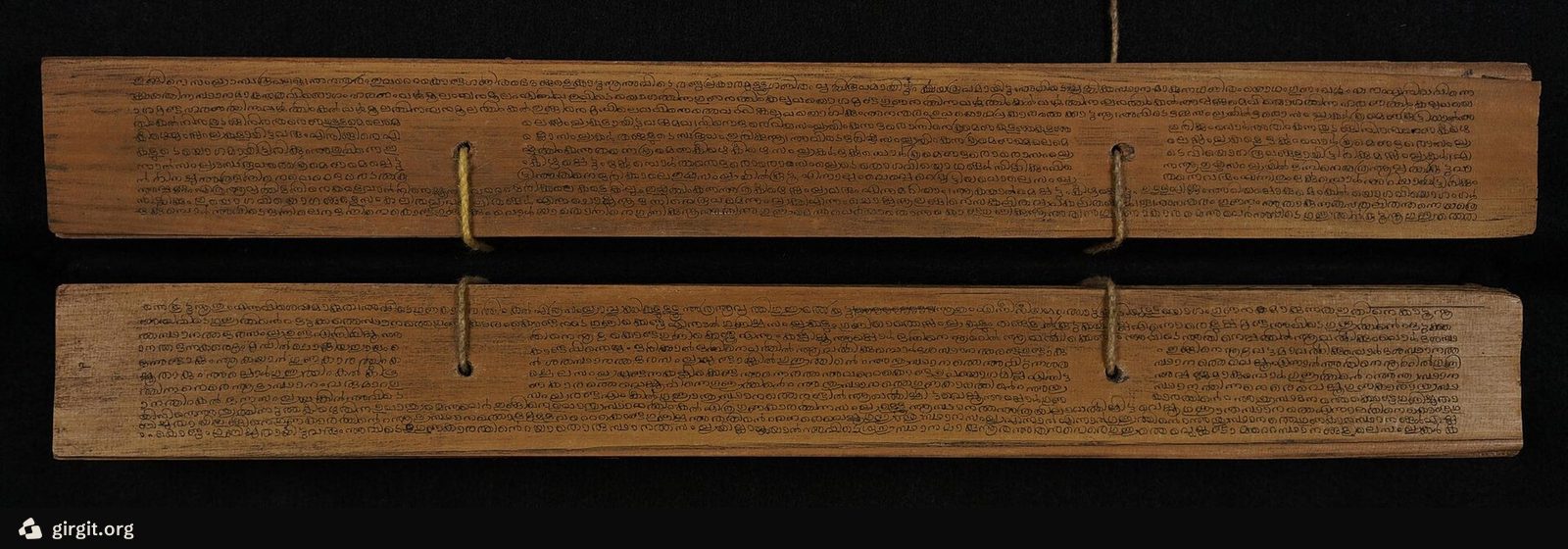 Malayalam text, scratched into palm leaf
StoryNo book by Madhava survives
Credited by later Kerala writers
Their rule is in words: take the arc, subtract arc × arc² ÷ radius² ÷ 6, keep going. In today's symbols, exactly the series above, with the angle as arc ÷ radius.
See itBuild a sine from powers
Then feed it degrees
Near 0, one term (sin x ≈ x) is already excellent. Each extra term holds the fit longer: n! grows faster than any power of x.
Solve itsin 1° and the Moon
Your turn
Solve it
Find \( \sin 1^\circ \) to five decimal places with no calculator and no table.
Hint
Answer
Solve it
The Moon is about 3,475 km across and about 3,84,400 km away. Estimate the angle it covers in the sky, in radians and in degrees. Can your thumb at arm's length (about 2 cm wide, 60 cm from your eye) hide it?
Hint
Answer
On a calculator in degree mode, you work out \( \dfrac{\sin 1.001 - \sin 1}{0.001} \). Calculus says the slope of \( \sin x \) is \( \cos x \). What do you get?
- about \( \cos 1 \approx 0.540 \)
- about \( 0.01745 \)
- exactly 1
ConnectAnd still confused?
Where this goes next
Connect it
- Changing units, next page. Now that the radian is the "real" angle, degrees are just a conversion: degrees and radians.
- The unit circle. Sine and cosine of a number \( x \) are read off after walking a distance \( x \) round the unit circle: sine and cosine for any angle.
- Limits, Chapter 12. The squeeze \( \sin\theta < \theta < \tan\theta \) above becomes the proof that \( \tfrac{\sin x}{x} \to 1 \): the sandwich theorem, and then the derivative of sin x.
- Physics: wheels and pendulums. \( v = r\omega \) only holds with \( \omega \) in radians per second (angular velocity), and a pendulum swings in simple harmonic motion because \( \sin\theta \approx \theta \) for small swings (the simple pendulum).
If a radian is "just a number", why do we say "radian" at all?
For clarity, the same way we say "per cent" for a ratio. Arc ÷ radius is metres ÷ metres, so the units cancel. Writing "rad" reminds the reader that the number is an angle, but you may drop it, and the textbook usually does.
Why is a full turn \( 2\pi \) and not a nice whole number?
Because the circumference of a circle is \( 2\pi r \): that many radii fit round the edge. The radian lets the circle decide, and the circle's answer is \( 2\pi \approx 6.28 \). It is exact as \( 2\pi \); only its decimal form goes on forever.
Sources
- Radian, Wikipedia: Cotes, Smith's Harmonia mensurarum (1722), James Thomson (5 June 1873), Thomas Muir (1869, 1874), radians in calculus.
- Madhava series, Wikipedia: the Kerala sine and cosine series stated with arc and radius, and their attribution to Madhava.
- Yuktibhāṣā, Wikipedia: Jyeṣṭhadeva, about 1530, Malayalam, proofs of the sine and cosine series.
- Pages from Yuktibhasa, Wikimedia Commons.
- Moon fact sheet, NASA: the Moon's diameter and mean distance.
