- 1. How do we measure an angle?
- 2. What is a radian?
- 3. Changing degrees into radians and back
- 4. Sine and cosine for any angle
- 5. Tan, cot, sec and cosec
- 6. Which functions are positive where?
- 7. Domain and range of the six functions
- 8. What the graphs look like, and why they repeat
- 9. Sine and cosine of a sum or difference
- 10. Angles like π − x, and tan of a sum
- 11. Double and triple angles
- 12. Turning sums into products and back
- Review
7 of 12·NCERT §3.3.2·5 min
Domain and range of the six functions
The big ideaSine and cosine accept every real number and never leave \( [-1, 1] \); the other four lose the points where they would divide by zero, and their ranges follow from that.
In simple words
Ask two questions of each of the six machines. Which numbers can I feed it? Which answers can come out? Sine and cosine take any number and always answer something between minus one and one. The other four refuse a few numbers. Two of them can answer anything at all. The other two can answer anything except the numbers strictly between minus one and one.
Sine and cosine
Every real number is an angle, and every angle gives a point on the unit circle, so \( \sin x \) and \( \cos x \) are defined for all real \( x \). And since the coordinates of that point lie between \( -1 \) and \( 1 \):
- \( y = \sin x \) and \( y = \cos x \): domain \( \mathbf{R} \), range \( [-1, 1] \), that is \( -1 \le y \le 1 \).
The other four
| Function | Domain | Range |
|---|---|---|
| \( y = \operatorname{cosec} x \) | \( \{x : x \in \mathbf{R},\ x \ne n\pi,\ n \in \mathbf{Z}\} \) | \( \{y : y \in \mathbf{R},\ y \ge 1 \text{ or } y \le -1\} \) |
| \( y = \sec x \) | \( \{x : x \in \mathbf{R},\ x \ne (2n+1)\tfrac{\pi}{2},\ n \in \mathbf{Z}\} \) | \( \{y : y \in \mathbf{R},\ y \le -1 \text{ or } y \ge 1\} \) |
| \( y = \tan x \) | \( \{x : x \in \mathbf{R},\ x \ne (2n+1)\tfrac{\pi}{2},\ n \in \mathbf{Z}\} \) | \( \mathbf{R} \) |
| \( y = \cot x \) | \( \{x : x \in \mathbf{R},\ x \ne n\pi,\ n \in \mathbf{Z}\} \) | \( \mathbf{R} \) |
Try it: pick a function and slide the line to every height you can. Where does it stop meeting the graph?
Why cosec and sec never lie strictly between −1 and 1. \( \sin x \) is a number of size at most 1. Turning a number of size at most 1 upside down gives a number of size at least 1: \( \tfrac{1}{0.5} = 2 \), \( \tfrac{1}{-0.25} = -4 \), \( \tfrac{1}{1} = 1 \). So \( |\operatorname{cosec} x| \ge 1 \) always. In interval form the range is \( (-\infty, -1] \cup [1, \infty) \). The same holds for \( \sec x \).
Why tan and cot can be anything. \( \tan x \) is the slope of the line OP. As P goes from the bottom of the circle to the top on the right-hand side, that line tilts from nearly straight down, through flat, to nearly straight up, and its slope takes every real value.
How each function changes, quadrant by quadrant
Follow the point round the circle and watch its height. In the first quadrant, as \( x \) goes from 0 to \( \tfrac{\pi}{2} \), \( \sin x \) climbs from 0 to 1. In the second it falls from 1 back to 0. In the third it keeps falling, from 0 to \( -1 \). In the fourth it climbs from \( -1 \) back to 0. The full picture for all six:
| I quadrant | II quadrant | III quadrant | IV quadrant | |
|---|---|---|---|---|
| sin | increases from 0 to 1 | decreases from 1 to 0 | decreases from 0 to −1 | increases from −1 to 0 |
| cos | decreases from 1 to 0 | decreases from 0 to −1 | increases from −1 to 0 | increases from 0 to 1 |
| tan | increases from 0 to ∞ | increases from −∞ to 0 | increases from 0 to ∞ | increases from −∞ to 0 |
| cot | decreases from ∞ to 0 | decreases from 0 to −∞ | decreases from ∞ to 0 | decreases from 0 to −∞ |
| sec | increases from 1 to ∞ | increases from −∞ to −1 | decreases from −1 to −∞ | decreases from ∞ to 1 |
| cosec | decreases from ∞ to 1 | increases from 1 to ∞ | increases from −∞ to −1 | decreases from −1 to −∞ |
What "∞" means here. "tan \( x \) increases from 0 to ∞ in the first quadrant" means: as \( x \) grows from 0 towards \( \tfrac{\pi}{2} \), \( \tan x \) keeps growing and becomes larger than any number you name, as \( x \) gets close to \( \tfrac{\pi}{2} \). It never reaches a value called infinity; \( \tan \tfrac{\pi}{2} \) is still not defined. Likewise, "cosec \( x \) decreases from −1 to −∞ in the fourth quadrant" means it keeps falling, taking huge negative values, as \( x \) approaches \( 2\pi \). The symbols \( \infty \) and \( -\infty \) describe a behaviour, not a number.
You do not need to memorise the table. Each row can be read off the unit circle: watch the coordinate, or its reciprocal, as the point moves.
Before the examples, try it: stretch and lift \( \sin x \) and watch the band of values it covers.
Worked example
- Can \( \sin x = 1.2 \)? No: 1.2 is outside the range \( [-1, 1] \).
- Can \( \sec x = 0.5 \)? No: \( \sec x = 0.5 \) would need \( \cos x = 2 \).
- Can \( \tan x = 1000 \)? Yes: tan takes every real value. (It happens for an \( x \) just a little less than \( \tfrac{\pi}{2} \).)
- Find the range of \( y = 3\sin x + 2 \). From \( -1 \le \sin x \le 1 \): \( -3 \le 3\sin x \le 3 \), so \( -1 \le y \le 5 \). Range \( [-1, 5] \).
Try it. (a) Is \( x = \tfrac{3\pi}{2} \) in the domain of \( \tan x \)? Of \( \cot x \)? (b) Which of these can be a value of \( \operatorname{cosec} x \): \( 0.9,\ -1,\ \sqrt{2},\ -0.3 \)? (c) Find the range of \( y = 5 - 2\cos x \).
Answer
Just remember
These all have reasons (above), but in an exam you want them in a second. Use the hook, and if you blank, rebuild from the circle.
- tan and sec drop the odd multiples of \( \tfrac{\pi}{2} \); cot and cosec drop the multiples of \( \pi \)
- "Tan and Sec Stand on cos; Cot and Cosec Cling to sin": each pair dies where the one it divides by is 0. Rebuild: cos is 0 at the top and bottom of the circle (\( \pm\tfrac{\pi}{2}, \pm\tfrac{3\pi}{2}, \dots \)), sin is 0 at the left and right ends (\( 0, \pm\pi, \dots \)).
- Ranges: sin, cos in \( [-1, 1] \); tan, cot everything; sec, cosec everything except \( (-1, 1) \)
- "Boxed, free, and banned from the box." sin and cos live inside the box from −1 to 1; tan and cot are free; sec and cosec are their upside-down partners, so they live everywhere outside the box. Rebuild: coordinates of a point on a radius-1 circle; then flip.
- Domain
- All the \( x \) a function can take.
- Range
- All the values the function actually gives.
- \( [-1, 1] \)
- Range of sine and cosine.
- \( (-\infty, -1] \cup [1, \infty) \)
- Range of sec and cosec: everything except the numbers strictly between −1 and 1.
- Increases to ∞
- Keeps growing beyond every bound; not a value that is reached.
Words to know
What is the domain of \( y = \sec x \)?
- \( \mathbf{R} \)
- \( \mathbf{R} \) except \( n\pi \)
- \( \mathbf{R} \) except \( (2n+1)\tfrac{\pi}{2} \)
As \( x \) goes through the third quadrant (from \( \pi \) to \( \tfrac{3\pi}{2} \)), what does \( \cos x \) do?
- Increases from \( -1 \) to 0
- Decreases from 0 to \( -1 \)
- Increases from 0 to 1
Which value can \( \tan x \) never take?
- \( -500 \)
- 0
- None: every real number is possible
Deep dive · optional
How high can a wave go?
Why the ranges are what they are, how to find the range of a mixed wave like \( 3\sin x + 4\cos x \) by adding two turning arrows, and why your wall socket swings to 325 volts. Not needed for the exam's basic questions, but JEE loves the result.
Why sine is trapped between −1 and 1
- Why can \( \sin x \) never be 1.2?Because \( \sin x \) is the height of a point P on the unit circle, and no point of that circle is 1.2 above the centre.
- Why is no point of the circle higher than 1?Every point is exactly 1 away from O. Drop a line from P to the \( x \)-axis: the height is one side of a right triangle whose longest side, the slanting one, is that 1.
- Why is the slanting side the longest?Pythagoras: \( \sin^2 x + \cos^2 x = 1 \). A square is never negative, so \( \sin^2 x \le 1 \), which means \( -1 \le \sin x \le 1 \).
- And why is \( \sec x \) never 0.5?\( \sec x = \tfrac{1}{\cos x} \), and \( \cos x \) is at most 1 in size. Dividing 1 by something no bigger than 1 gives something no smaller than 1.
- So where does it all rest?On two things you already believe: the definition (sine and cosine are coordinates on a circle of radius 1) and Pythagoras' theorem.
The domains follow the same way. Sine and cosine are coordinates, and every angle has a point, so nothing is ever refused. The other four are fractions made from sine and cosine, and a fraction only breaks when its bottom is 0. That is the whole reason for every gap in the table.
The mixed wave. What about \( y = 3\sin x + 4\cos x \)? The lazy guess is "at most \( 3 + 4 = 7 \)", but that needs \( \sin x = 1 \) and \( \cos x = 1 \) at the same \( x \), which never happens. The true answer comes from a trick. Draw a right triangle with sides 3 and 4; its long side is \( \sqrt{3^2 + 4^2} = 5 \) and one of its angles, call it \( \alpha \), has \( \cos\alpha = \tfrac{3}{5} \), \( \sin\alpha = \tfrac{4}{5} \). Then
\[ \begin{aligned} 3\sin x + 4\cos x &= 5\left(\sin x \cos\alpha + \cos x \sin\alpha\right) \\ &= 5\sin(x + \alpha). \end{aligned} \]The bracket is the sine of a sum (you prove it two pages on). A sine is between −1 and 1, so \( y \) is between −5 and 5, and it really reaches both. The same works for any numbers:
\[ -\sqrt{a^2 + b^2} \;\le\; a\sin x + b\cos x \;\le\; \sqrt{a^2 + b^2}. \]The story
See it
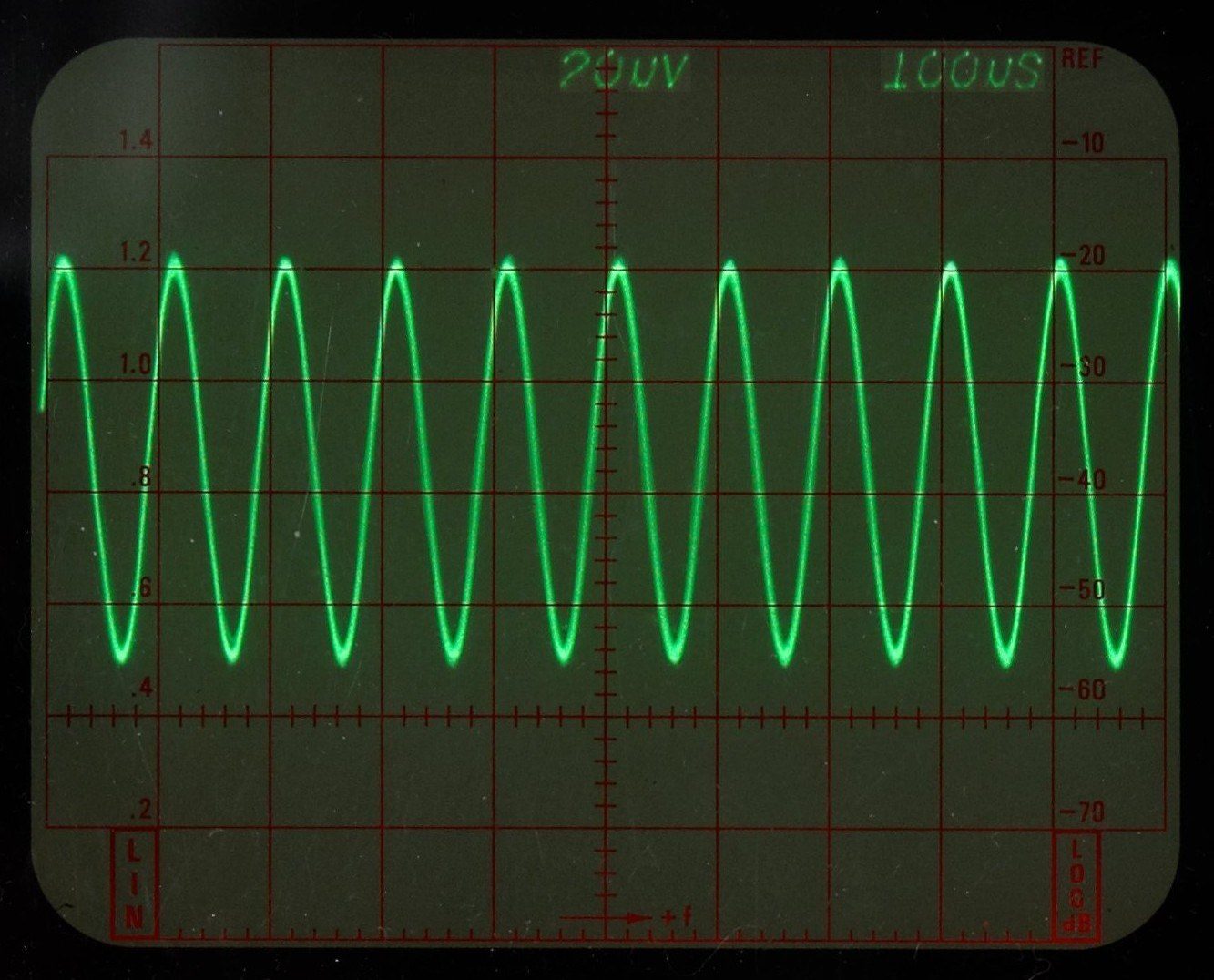 peak: top of the rangetrough: bottom of the range
Now add two waves yourself. Arrow \( a \) turns with \( x \); arrow \( b \) rides on its tip, always at right angles. Because the corner stays square, the long arrow keeps the same length, \( \sqrt{a^2 + b^2} \), however it turns, and the height of its tip is the whole wave.
Notice the peak does not come at \( x = 90^\circ \) (where \( a\sin x \) peaks) or at \( 0^\circ \) (where \( b\cos x \) peaks), but in between, where the long arrow points straight up. That shift is the \( \alpha \) in \( \sqrt{a^2 + b^2}\,\sin(x + \alpha) \).
Solve it
Solve it
Find the greatest and least values of \( y = 5\sin x - 12\cos x + 7 \).
Hint
Answer
Spot the error
A student writes: "\( \sin x \) and \( \cos x \) are each between −1 and 1, so \( \sin x + \cos x \) is between −2 and 2. Its range is \( [-2, 2] \)." What is wrong, and what is the real range?
Answer
Solve it
Find the range of \( y = \dfrac{1}{2 + \sin x} \).
Hint
Answer
Connect it
Connect it
- Sine of a sum, this chapter. The step \( a\sin x + b\cos x = \sqrt{a^2 + b^2}\,\sin(x + \alpha) \) is the sum formula read backwards.
- Phasors and rms, Physics Class 12. The arrows above are the phasors of alternating current, and 230 V vs 325 V is explained in rms values.
- Oscillations, Physics Class 11. A swinging mass has \( x = A\sin(\omega t + \phi) \); its range is \( [-A, A] \) and \( A \) is the amplitude.
- Inverse functions, Class 12. The range of sine becomes the domain of \( \sin^{-1} \): you can only ask "which angle has sine 0.3?" for numbers in \( [-1, 1] \). See why the domain is restricted.
- Complex numbers. The length \( \sqrt{a^2 + b^2} \) is the modulus of \( a + ib \): Steinmetz's arrows are complex numbers.
Still confused?
Is ∞ in the range of tan?
No. The range of tan is \( \mathbf{R} \), the real numbers, and ∞ is not one of them. "tan increases to ∞" describes a behaviour: it passes every number you name. No angle gives the value ∞.
Can sec x be exactly 1?
Yes: at \( x = 0, \pm 2\pi, \dots \), where \( \cos x = 1 \). The range of sec includes 1 and −1; it only leaves out the numbers strictly between them.
Sources
- Charles Proteus Steinmetz, Wikipedia (the 1893 paper "Complex Quantities and Their Use in Electrical Engineering").
- Phasor, Wikipedia.
- Mains electricity by country, Wikipedia (India: 230 V, 50 Hz).
- NCERT Physics Part I, Class 12, Chapter 7 (Alternating Current): rms and peak values, \( v_m = \sqrt{2}\,V \).
Picture and video credits
Show 1 picture and video credits
- oscilloscope-sine-wave.jpg: Pittigrilli, CC BY-SA 4.0
