Act 05NCERT §3.3 · pp. 50–515 min
Tan, cot, sec and cosec
The line OP is stretched until it meets the line touching the circle at A: the length along that touching line is tan x, the cutting line OT is sec x. The same at the top, at B, gives cot x and cosec x.
Every one of them is built from sine and cosine.
From the textbookpp. 50–51
NCERT Mathematics, Class 11 · Reprint 2026-27
5.0The big idea
Four more, all from sine and cosine.
Tan, cot, sec and cosec divide sin and cos. Each one is undefined exactly where it would divide by zero.
Full text
The big ideaTangent, cotangent, secant and cosecant are all built from sine and cosine, and each one is undefined exactly where it would mean dividing by zero.
In simple words
Sine and cosine are the two main numbers. The other four are just these two divided by each other, or one divided by them. That works fine until the number on the bottom is zero. You cannot share sweets among zero friends, so at those angles the other four simply have no value.
5.1Four more functions
Definition, and where it fails
cosec x
cosecant
- Is
- 1 / sin x
- Not defined
- x = nπ
sec x
secant
- Is
- 1 / cos x
- Not defined
- x = (2n + 1)π/2
tan x
tangent
- Is
- sin x / cos x
- Not defined
- x = (2n + 1)π/2
cot x
cotangent
- Is
- cos x / sin x
- Not defined
- x = nπ
n is any integer. sin on the bottom (cosec, cot): fails at multiples of π. cos on the bottom (sec, tan): fails at odd multiples of π/2.
Full text
Four more functions
For any real \( x \) where the bottom is not zero:
| Function | Definition | Not defined when |
|---|---|---|
| cosecant, \( \operatorname{cosec} x \) | \( \dfrac{1}{\sin x} \) | \( x = n\pi \) |
| secant, \( \sec x \) | \( \dfrac{1}{\cos x} \) | \( x = (2n + 1)\tfrac{\pi}{2} \) |
| tangent, \( \tan x \) | \( \dfrac{\sin x}{\cos x} \) | \( x = (2n + 1)\tfrac{\pi}{2} \) |
| cotangent, \( \cot x \) | \( \dfrac{\cos x}{\sin x} \) | \( x = n\pi \) |
Here \( n \) is any integer. Notice the pattern: the two with \( \sin x \) on the bottom (cosec and cot) fail where \( \sin x = 0 \), that is at multiples of \( \pi \); the two with \( \cos x \) on the bottom (sec and tan) fail where \( \cos x = 0 \), at odd multiples of \( \tfrac{\pi}{2} \).
On the unit circle, with \( P = (a, b) \): \( \tan x = \tfrac{b}{a} \) is the slope of the line OP. At \( x = \tfrac{\pi}{2} \) that line is vertical, and a vertical line has no slope. That is the picture behind "\( \tan \tfrac{\pi}{2} \) is not defined".
You meet this slope on every ramp. India's 2021 accessibility guidelines use a gradient of 1 in 12 for a 6 m ramp: 1 m up for every 12 m along, so \( \tan x = \tfrac{1}{12} \) and the ramp rises at about \( 4.8^\circ \).
See itZero on the bottom
Where each pair breaks
5.2tan x = sin x ÷ cos x
The slope of OP
- P = (a, b): tan x = b/a, the slope of the line OP.
- At π/2 OP is vertical: no slope, so tan π/2 is not defined.
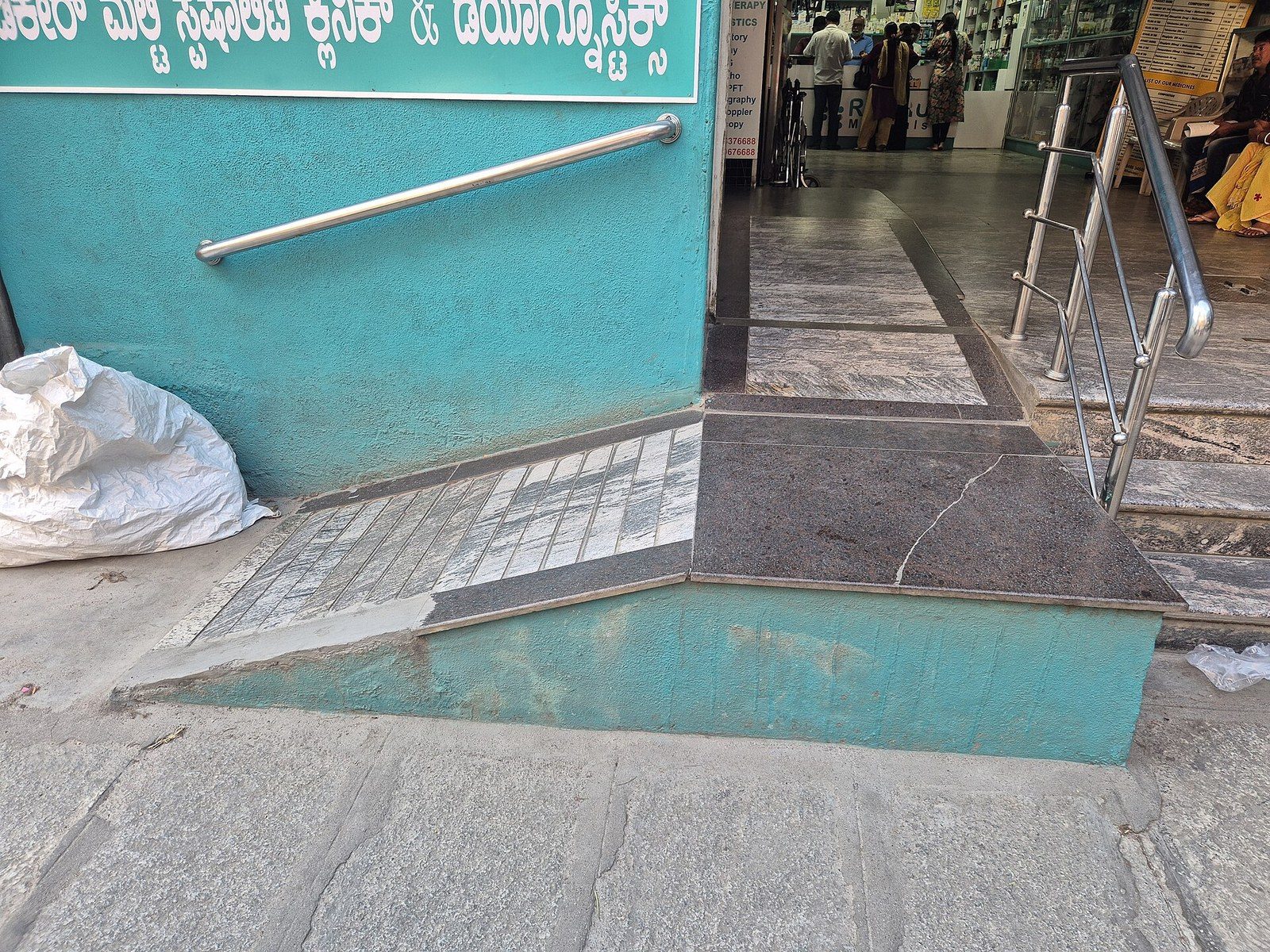 angle xriserunslope = rise ÷ run = tan x
5.3India's 2021 accessibility guidelines
1 in 12
for a 6 m ramp: 1 m up for every 12 m along
So tan x = 1/12, and the ramp rises at about 4.8°.
Try itTowards the top
Watch T run away
Checksin on the bottom
When is cot x undefined?
For which \( x \) is \( \cot x \) not defined?
- \( x = (2n + 1)\tfrac{\pi}{2} \)
- \( x = n\pi \)
- It is defined for every real \( x \)
5.4Two more identities
Pythagoras, twice more
sin²x + cos²x = 1, over cos²x (cos x ≠ 0).
Triangle OAT, right-angled at A: sides 1, tan x, sec x.
The same identity over sin²x (sin x ≠ 0).
Triangle OBC, right-angled at B: sides 1, cot x, cosec x.
5.5Every x, the same
Two grandparents, one family
Each new identity is the Pythagoras identity divided by one of its own terms. Know sin x and cos x, and you know every other function.
Full text
Two more identities
Start from \( \sin^2 x + \cos^2 x = 1 \).
- Divide every term by \( \cos^2 x \) (allowed when \( \cos x \ne 0 \)): \( \tfrac{\sin^2 x}{\cos^2 x} + 1 = \tfrac{1}{\cos^2 x} \), which is \[ 1 + \tan^2 x = \sec^2 x \]
- Divide every term by \( \sin^2 x \) (when \( \sin x \ne 0 \)): \( 1 + \tfrac{\cos^2 x}{\sin^2 x} = \tfrac{1}{\sin^2 x} \), which is \[ 1 + \cot^2 x = \operatorname{cosec}^2 x \]
These are the textbook's two "why?" questions, answered: each is the Pythagoras identity divided through by one of its own terms.
5.6The values table
Count 0, 1, 2, 3, 4
- sin, 0 to π/2: √0/2, √1/2, √2/2, √3/2, √4/2. cos: the same, backwards.
- Reciprocals: sec π/3 = 2, cosec π/4 = √2, cot π/2 = 0/1 = 0.
| Angle | sin | cos | tan |
|---|---|---|---|
| \( 0 \) | \( 0 \) | \( 1 \) | \( 0 \) |
| \( \tfrac{\pi}{6} \) | \( \tfrac{1}{2} \) | \( \tfrac{\sqrt{3}}{2} \) | \( \tfrac{1}{\sqrt{3}} \) |
| \( \tfrac{\pi}{4} \) | \( \tfrac{1}{\sqrt{2}} \) | \( \tfrac{1}{\sqrt{2}} \) | \( 1 \) |
| \( \tfrac{\pi}{3} \) | \( \tfrac{\sqrt{3}}{2} \) | \( \tfrac{1}{2} \) | \( \sqrt{3} \) |
| \( \tfrac{\pi}{2} \) | \( 1 \) | \( 0 \) | not defined |
| \( \pi \) | \( 0 \) | \( -1 \) | \( 0 \) |
| \( \tfrac{3\pi}{2} \) | \( -1 \) | \( 0 \) | not defined |
| \( 2\pi \) | \( 0 \) | \( 1 \) | \( 0 \) |
Full text
The values table
For \( 0, \tfrac{\pi}{6}, \tfrac{\pi}{4}, \tfrac{\pi}{3}, \tfrac{\pi}{2} \) the values are the same as the ratios you learnt in Class 10. Adding the quadrantal angles from the unit circle:
| Angle | sin | cos | tan |
|---|---|---|---|
| \( 0 \) | \( 0 \) | \( 1 \) | \( 0 \) |
| \( \tfrac{\pi}{6} \) | \( \tfrac{1}{2} \) | \( \tfrac{\sqrt{3}}{2} \) | \( \tfrac{1}{\sqrt{3}} \) |
| \( \tfrac{\pi}{4} \) | \( \tfrac{1}{\sqrt{2}} \) | \( \tfrac{1}{\sqrt{2}} \) | \( 1 \) |
| \( \tfrac{\pi}{3} \) | \( \tfrac{\sqrt{3}}{2} \) | \( \tfrac{1}{2} \) | \( \sqrt{3} \) |
| \( \tfrac{\pi}{2} \) | \( 1 \) | \( 0 \) | not defined |
| \( \pi \) | \( 0 \) | \( -1 \) | \( 0 \) |
| \( \tfrac{3\pi}{2} \) | \( -1 \) | \( 0 \) | not defined |
| \( 2\pi \) | \( 0 \) | \( 1 \) | \( 0 \) |
The values of \( \operatorname{cosec} x \), \( \sec x \) and \( \cot x \) are the reciprocals of \( \sin x \), \( \cos x \) and \( \tan x \). For example \( \sec \tfrac{\pi}{3} = 2 \), \( \operatorname{cosec} \tfrac{\pi}{4} = \sqrt{2} \), and \( \cot \tfrac{\pi}{2} = \tfrac{0}{1} = 0 \) (even though \( \tan \tfrac{\pi}{2} \) is not defined).
A memory trick for the sine column from 0 to \( \tfrac{\pi}{2} \): write \( \tfrac{\sqrt{0}}{2}, \tfrac{\sqrt{1}}{2}, \tfrac{\sqrt{2}}{2}, \tfrac{\sqrt{3}}{2}, \tfrac{\sqrt{4}}{2} \). The cosine column is the same list read backwards.
Worked example
Find \( \tan^2 \tfrac{\pi}{3} + 2\cos^2 \tfrac{\pi}{4} - \sec^2 \tfrac{\pi}{6} \).
- \( \tan \tfrac{\pi}{3} = \sqrt{3} \), so \( \tan^2 \tfrac{\pi}{3} = 3 \).
- \( \cos \tfrac{\pi}{4} = \tfrac{1}{\sqrt{2}} \), so \( 2\cos^2 \tfrac{\pi}{4} = 2 \times \tfrac{1}{2} = 1 \).
- \( \cos \tfrac{\pi}{6} = \tfrac{\sqrt{3}}{2} \), so \( \sec \tfrac{\pi}{6} = \tfrac{2}{\sqrt{3}} \) and \( \sec^2 \tfrac{\pi}{6} = \tfrac{4}{3} \).
- Total: \( 3 + 1 - \tfrac{4}{3} = \tfrac{8}{3} \).
Don't mix these up
- \( \sec x = \tfrac{1}{\cos x} \) and \( \operatorname{cosec} x = \tfrac{1}{\sin x} \). The "co" names do not pair up: cosec goes with sin.
- "Not defined" is not the same as "infinity" or "zero". \( \tan \tfrac{\pi}{2} \) has no value at all.
- \( \cot x \) can be 0 (at \( \tfrac{\pi}{2} \)) even where \( \tan x \) does not exist.
Answer
CheckA function and its reciprocal
sin π/3 × cosec π/3
What is \( \sin \tfrac{\pi}{3} \cdot \operatorname{cosec} \tfrac{\pi}{3} \)?
- \( \tfrac{3}{4} \)
- 1
- \( \tfrac{\sqrt{3}}{2} \)
5.7Worked example
Read three values, then add
Worked example
Find \( \tan^2 \tfrac{\pi}{3} + 2\cos^2 \tfrac{\pi}{4} - \sec^2 \tfrac{\pi}{6} \).
- \( \tan \tfrac{\pi}{3} = \sqrt{3} \), so \( \tan^2 \tfrac{\pi}{3} = 3 \).
- \( \cos \tfrac{\pi}{4} = \tfrac{1}{\sqrt{2}} \), so \( 2\cos^2 \tfrac{\pi}{4} = 2 \times \tfrac{1}{2} = 1 \).
- \( \cos \tfrac{\pi}{6} = \tfrac{\sqrt{3}}{2} \), so \( \sec \tfrac{\pi}{6} = \tfrac{2}{\sqrt{3}} \) and \( \sec^2 \tfrac{\pi}{6} = \tfrac{4}{3} \).
- Total: \( 3 + 1 - \tfrac{4}{3} = \tfrac{8}{3} \).
See itAt x = π/2
tan has no value; cot is 0
CheckUse the identity
sec x = 3, so tan²x is …
If \( \sec x = 3 \), what is \( \tan^2 x \)?
- 2
- 8
- 10
5.8Don't mix these up
Not defined is not infinity
Myth
tan π/2 is infinity
Fact
It has no value at all; cosec pairs with sin, sec with cos
Don't mix these up
- \( \sec x = \tfrac{1}{\cos x} \) and \( \operatorname{cosec} x = \tfrac{1}{\sin x} \). The "co" names do not pair up: cosec goes with sin.
- "Not defined" is not the same as "infinity" or "zero". \( \tan \tfrac{\pi}{2} \) has no value at all.
- \( \cot x \) can be 0 (at \( \tfrac{\pi}{2} \)) even where \( \tan x \) does not exist.
Try itThree quick ones
cosec π/6, tan x = 2, sec π
(a) cosec π/6 + cot π/4. (b) tan x = 2: find sec²x. (c) Is sec π defined? Is cosec π?
Answer
KeepJust remember
Exactly one "co" per pair
The names are history, not logic. Tap a card for its hook.
WordsTo know
Five words
- Tangent
- \( \tan x = \sin x / \cos x \); the slope of OP.
- Cotangent
- \( \cot x = \cos x / \sin x \), the reciprocal of tan.
- Secant
- \( \sec x = 1 / \cos x \).
- Cosecant
- \( \operatorname{cosec} x = 1 / \sin x \).
- Not defined
- The formula would divide by zero, so there is no value.
RootsFour lengths on one circle
Touching and cutting
- Latin tangens"touching": AT = tan x, touching at A.
- Secans"cutting": OT = 1/cos x. Bedrock: similar triangles.
- The "co" ones at B(0, 1): cot x = tan(90° − x).
- At 90° no T. OAT is Pythagoras: 1 + tan²x = sec²x.
Full text
The roots: four lengths on one circle
- Why is \( \tan x \) called the tangent?Draw the line that touches the unit circle at A(1, 0); it is a tangent line. Stretch OP until it meets that line at T. Then \( AT = \tan x \). Tangens is Latin for "touching": tan x is a length measured along the touching line.
- Why is AT equal to \( \tfrac{\sin x}{\cos x} \)?Triangles OMP and OAT have the same angles, so their sides are in the same ratio: \( \tfrac{AT}{OA} = \tfrac{MP}{OM} \), that is \( \tfrac{AT}{1} = \tfrac{\sin x}{\cos x} \).
- Why is \( \sec x \) called the secant?The line OT cuts right through the circle; secans means "cutting". In the same pair of triangles, \( \tfrac{OT}{OA} = \tfrac{OP}{OM} \), so \( OT = \tfrac{1}{\cos x} = \sec x \). The secant is the length of the cutting line.
- And the "co" ones?Do the same with the tangent line at B(0, 1). The length along it is \( \cot x \), and the cutting line is \( \operatorname{cosec} x \). They are the tangent and secant of the complementary angle \( 90^\circ - x \): \( \cot x = \tan(90^\circ - x) \).
- So why is tan not defined at 90°?At 90° the line OP is parallel to the tangent line at A. Parallel lines never meet: there is no point T, so there is no length to measure.
- Bedrock?Similar triangles: triangles with the same angles have their sides in the same ratio. Everything above is that one fact.
Triangle OAT is also where \( 1 + \tan^2 x = \sec^2 x \) lives: its sides are 1, \( \tan x \) and \( \sec x \), and it has a right angle at A. The identity is Pythagoras in that triangle.
StoryShadows first, names later
A stick, a wall, a sun
- 9th c.BaghdadA stick of height h casts h cot α on the ground; one out from a wall, h tan α.
- 830Habash al-HasibThe first known shadow tables, around 830 CE; in use by about 860.
- 1583Thomas Fincketangens and secans, in Geometria rotundi.
- 1620Edmund GunterFirst writes cotangens.
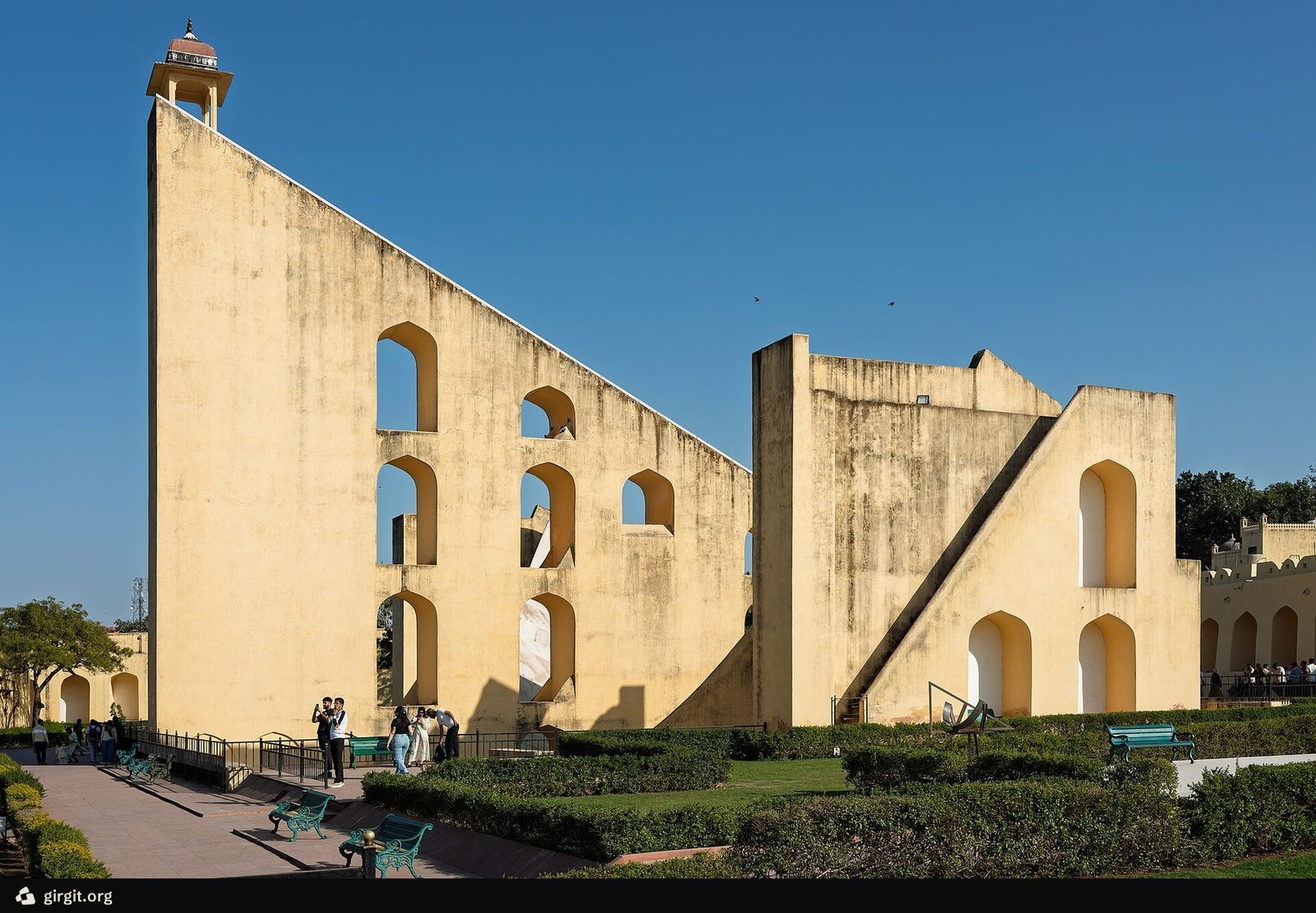 gnomon wall, 27 mpeople, for scale
Story1728–1734, Jaipur
27m
the triangular gnomon of Sawai Jai Singh's sundial at Jantar Mantar
Its shadow moves along curved scales; it is said to tell the time to about two seconds.
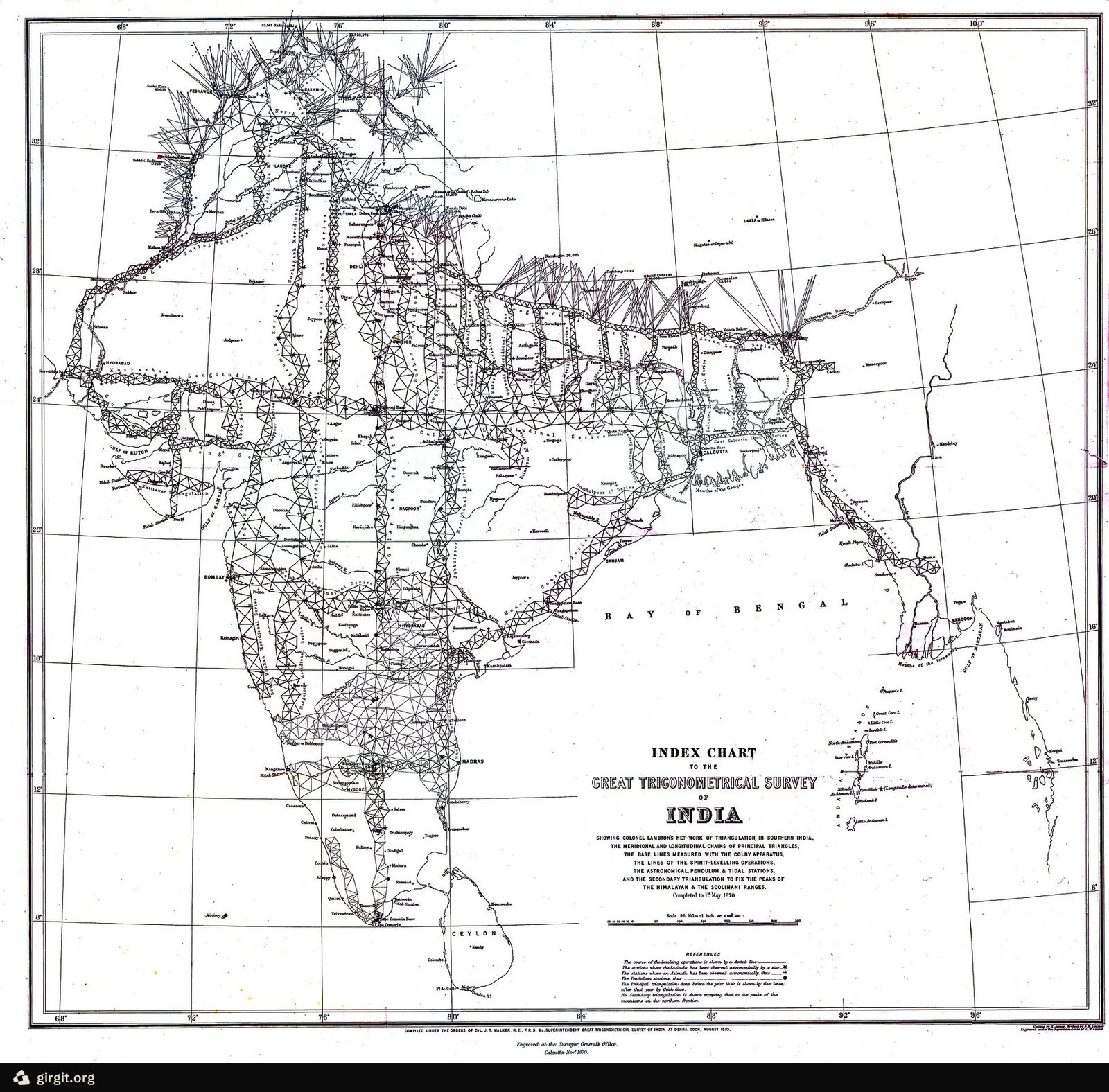 Great Arc, along 78° Esight lines to Himalayan peaksMadras: start, 1802
Story1802 to 1856, India
Triangles across a country
- 180210 AprilThe Great Trigonometrical Survey starts from a base line near Madras.
- 1831Radhanath Sikdar, 18From Hindu College, Calcutta: a "computer" on thirty rupees a month. Later, Chief Computer.
- 1849Peak "XV"November 1849 to January 1850: sighted from six stations, 160 to 190 km away.
- 1856MarchAndrew Waugh, the Surveyor General: the highest mountain then measured.
StoryThe height comes from a tangent
29,002 feet, from six sightings
Results 28,990 to 29,026 feet; mean 29,002. In 1955 an Indian survey gave 29,029 feet (8,848 m).
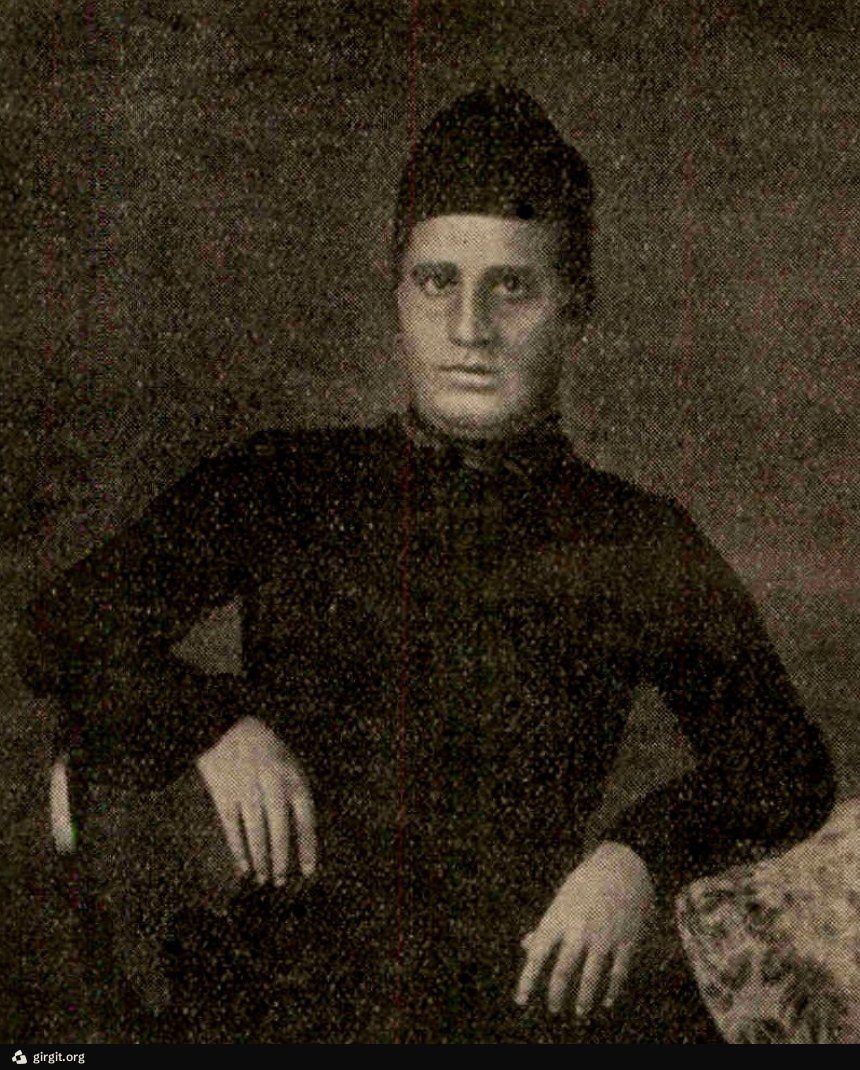
StoryA story you may have heard is shaky
Sir, I have discovered the highest mountain.
Said to be 1852, but traced to a single 1928 speech. Waugh was in Dehradun, Sikdar in Calcutta. That Sikdar was the Survey's top mathematician is not in doubt.
See itMeasure a mountain
The tangent, and the hidden part
Guess, then drag the peak. Green is d tan θ; red, what the Earth's curve hides: (R + h)² = R² + d², so h ≈ d²/2R.
Solve itRamp, shadow, surveyor
Your turn
Solve it
A school entrance is 0.6 m above the road (about four steps). A ramp must have a gradient of 1 in 12. How long must the ramp run along the ground, and at what angle does it rise?
Answer
Predict, then check
A vertical pole 27 m tall stands on flat ground. Its shadow is 27 m long at one moment. Later the sun is lower and the shadow is \( 27\sqrt{3} \) m. How high was the sun each time?
Answer
Solve it (estimation)
A surveyor 170 km from a peak misreads the angle of elevation by just 1 minute of arc. Roughly how wrong is the height? (Hint: the angle is small, about 2°.)
Hint
Answer
ConnectAnd still confused?
Where this goes next
Connect it
- Slope of a line, Ch 9. The slope of a straight line is \( m = \tan\theta \), where \( \theta \) is its angle with the \( x \)-axis: slope of a line, and the angle between two lines uses tan of a difference.
- Tan of a sum, page 10. Stacking two ramps on top of each other is \( \tan(A + B) \): page 10.
- Physics: resolving forces. On a slope of angle \( \theta \) a block starts to slide when \( \tan\theta \) reaches the coefficient of friction: friction.
- Inverse tan, Class 12. "What angle has tan 1/12?" is \( \tan^{-1}\tfrac{1}{12} \): tan and cot inverse.
- Daily life. Road signs that say "6% gradient" mean \( \tan x = 0.06 \); a staircase's steepness is riser ÷ tread, a tangent too.
tan x is a slope, but slope is "rise over run". Where are the rise and run on the unit circle?
For OP the run is OM = \( \cos x \) and the rise is MP = \( \sin x \), so the slope is \( \tfrac{\sin x}{\cos x} \). Stretch the triangle until its run is 1 (that is triangle OAT) and the rise becomes AT = \( \tan x \). Slope is the rise for a run of 1.
Why is \( \sec x \) never between −1 and 1?
It is the length of the cutting line OT, which goes from the centre to a point outside or on the circle, so it is at least 1 long. When \( \cos x \) is negative, T is on the other side and the sign is negative, but the size is still at least 1.
Sources
- The trigonometric functions (shadow tables c. 860; Fincke 1583; Gunter's cotangens 1620), MacTutor History of Mathematics, St Andrews.
- History of trigonometry (Habash al-Hasib's tangent and cotangent tables, c. 830; tangens = touching), Wikipedia.
- Thomas Fincke, Geometria rotundi (1583), Wikipedia.
- Jantar Mantar, Jaipur (Vrihat Samrat Yantra, 27 m; time to about 2 s; built 1728–1734), Wikipedia.
- Great Trigonometrical Survey (began 10 April 1802, base line near Madras; corrections for curvature and refraction), Wikipedia.
- Radhanath Sikdar (joined 19 December 1831, aged 18, as a computer; Waugh's announcement March 1856; 29,029 ft in 1955), Wikipedia.
- The five men who measured Mount Everest (six stations 160–190 km away; refraction of six or seven minutes), ExplorersWeb.
- Who measured the height of Mount Everest first? (observations Nov 1849–Jan 1850; results 28,990–29,026 ft, mean 29,002 ft; the 1928 Mason quote), The Wire Science.
- Harmonised Guidelines and Standards for Universal Accessibility in India 2021 (ramp gradient 1:12 for a 6 m run), summary, GKToday.