- 1. How do we measure an angle?
- 2. What is a radian?
- 3. Changing degrees into radians and back
- 4. Sine and cosine for any angle
- 5. Tan, cot, sec and cosec
- 6. Which functions are positive where?
- 7. Domain and range of the six functions
- 8. What the graphs look like, and why they repeat
- 9. Sine and cosine of a sum or difference
- 10. Angles like π − x, and tan of a sum
- 11. Double and triple angles
- 12. Turning sums into products and back
- Review
10 of 12·NCERT §3.4·6 min
Angles like π − x, and tan of a sum
The big ideaFeeding \( \tfrac{\pi}{2}, \pi, 2\pi \) into the sum formulas turns any angle into an acute one, and dividing the sine formulas by the cosine formulas gives \( \tan(x \pm y) \) and \( \cot(x \pm y) \).
In simple words
Any angle, however big, ends up in one of four quarters of the circle. In each quarter it looks just like a small angle near the start, only flipped or mirrored. So you only ever need the values for small angles. Find the small angle that matches, then fix the plus or minus sign from the quarter. And to find tan for two angles put together, divide the sine recipe by the cosine recipe.
Try it before the table: pick an angle, drag P, and watch Q keep the same triangle.
Angles like \( \pi - x \) and \( \pi + x \)
Choose special values in the four sum and difference formulas and these results drop out:
| Angle | cos | sin |
|---|---|---|
| \( \tfrac{\pi}{2} + x \) | \( \cos\left(\tfrac{\pi}{2} + x\right) = -\sin x \) | \( \sin\left(\tfrac{\pi}{2} + x\right) = \cos x \) |
| \( \pi - x \) | \( \cos(\pi - x) = -\cos x \) | \( \sin(\pi - x) = \sin x \) |
| \( \pi + x \) | \( \cos(\pi + x) = -\cos x \) | \( \sin(\pi + x) = -\sin x \) |
| \( 2\pi - x \) | \( \cos(2\pi - x) = \cos x \) | \( \sin(2\pi - x) = -\sin x \) |
Each takes one line. For example, \( \cos(\pi - x) = \cos\pi \cos x + \sin\pi \sin x = (-1)\cos x + 0 = -\cos x \), and \( \sin(\pi + x) = \sin\pi \cos x + \cos\pi \sin x = 0 - \sin x = -\sin x \).
The results for tan, cot, sec and cosec follow by dividing or taking reciprocals. In particular \( \tan(\pi + x) = \dfrac{-\sin x}{-\cos x} = \tan x \), the fact that gives tan its period of \( \pi \). Similarly \( \tan(\pi - x) = -\tan x \) and \( \tan(2\pi - x) = -\tan x \).
A quick way to remember all of them. Pretend \( x \) is a small acute angle and ask two questions.
- Does the name change? With \( \pi \) or \( 2\pi \), the name stays (sin stays sin). With \( \tfrac{\pi}{2} \) (or \( \tfrac{3\pi}{2} \)), it swaps (sin becomes cos, cos becomes sin).
- What is the sign? See which quadrant the whole angle lands in, and use the sign the original function has there. For \( \cos\left(\tfrac{\pi}{2} + x\right) \): the angle is in the second quadrant, where cos is negative; the name swaps to sin. Answer: \( -\sin x \).
This is why printed tables never needed more than one quadrant. Old tables went further and stopped at 45°: since \( \cos x = \sin(90^\circ - x) \), the same column read upwards gives the cosines.
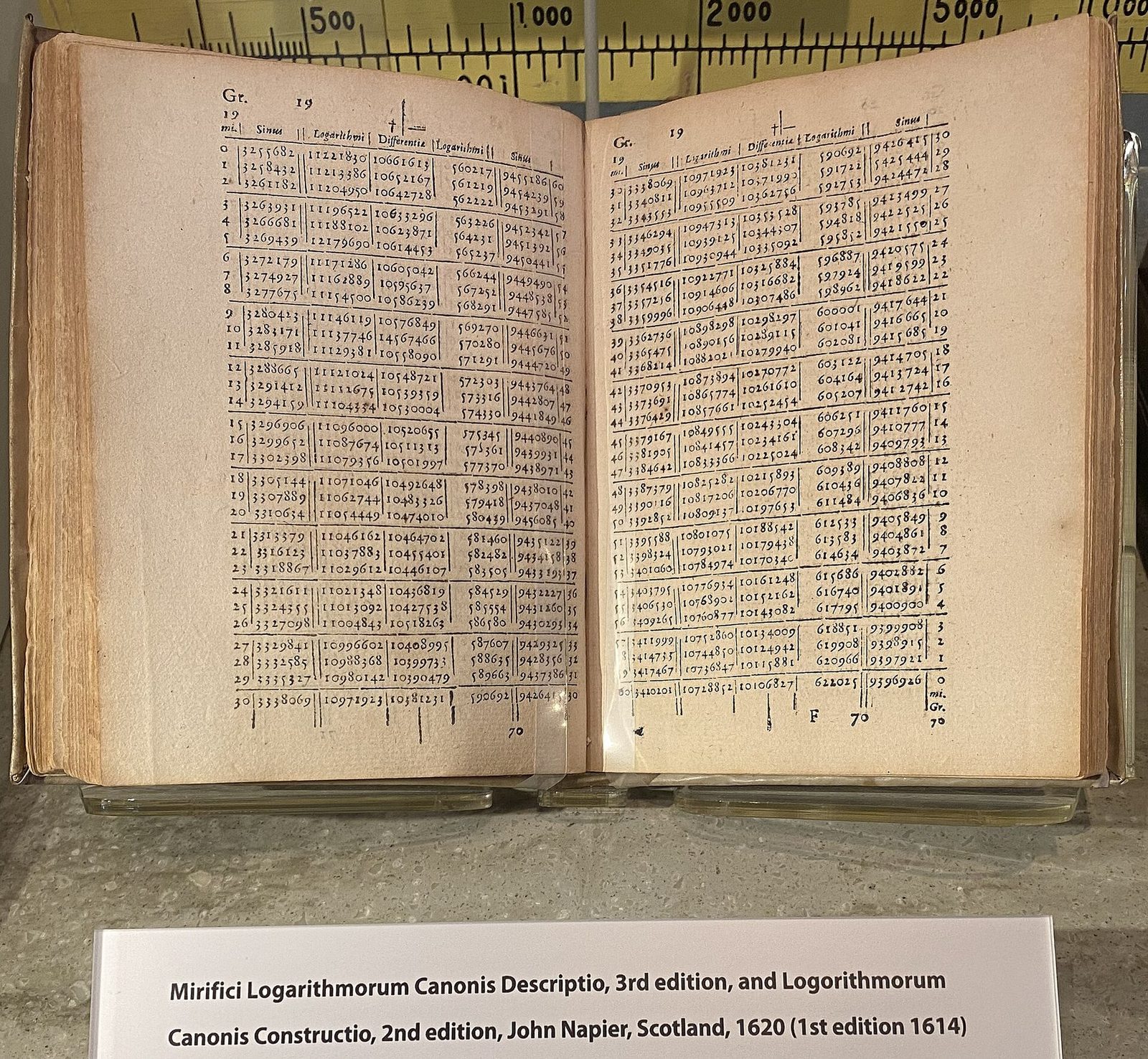 19° at the top: read downsines of 19° (× 10 000 000)same column read up: 70°70° at the foot
Worked example
- \( \sin 150^\circ = \sin(180^\circ - 30^\circ) = \sin 30^\circ = \tfrac{1}{2} \).
- \( \cos 240^\circ = \cos(180^\circ + 60^\circ) = -\cos 60^\circ = -\tfrac{1}{2} \).
- \( \tan 315^\circ = \tan(360^\circ - 45^\circ) = -\tan 45^\circ = -1 \).
- \( \sin \tfrac{5\pi}{3} = \sin\left(2\pi - \tfrac{\pi}{3}\right) = -\sin \tfrac{\pi}{3} = -\tfrac{\sqrt{3}}{2} \).
Before the formula, a puzzle you can check with your eyes.
Tangent of a sum and a difference
If none of \( x \), \( y \) and \( x + y \) is an odd multiple of \( \tfrac{\pi}{2} \), then \( \cos x \), \( \cos y \) and \( \cos(x + y) \) are all non-zero, and
\[ \tan(x + y) = \frac{\sin(x + y)}{\cos(x + y)} = \frac{\sin x \cos y + \cos x \sin y}{\cos x \cos y - \sin x \sin y} \]Divide the top and bottom by \( \cos x \cos y \). On top, \( \tfrac{\sin x \cos y}{\cos x \cos y} = \tan x \) and the other term gives \( \tan y \); on the bottom, the first term gives 1 and the second \( \tan x \tan y \):
\[ \tan(x + y) = \frac{\tan x + \tan y}{1 - \tan x \tan y} \]Replacing \( y \) by \( -y \), and using \( \tan(-y) = -\tan y \):
\[ \tan(x - y) = \frac{\tan x - \tan y}{1 + \tan x \tan y} \]Cotangent of a sum and a difference
If none of \( x \), \( y \) and \( x + y \) is a multiple of \( \pi \), then the sines are non-zero. Divide the top and bottom of \( \cot(x + y) = \tfrac{\cos(x + y)}{\sin(x + y)} \) by \( \sin x \sin y \) instead:
\[ \cot(x + y) = \frac{\cot x \cot y - 1}{\cot y + \cot x} \]And if none of \( x \), \( y \) and \( x - y \) is a multiple of \( \pi \):
\[ \cot(x - y) = \frac{\cot x \cot y + 1}{\cot y - \cot x} \]Worked example
- \( \tan 75^\circ = \tan(45^\circ + 30^\circ) = \dfrac{1 + \tfrac{1}{\sqrt{3}}}{1 - \tfrac{1}{\sqrt{3}}} = \dfrac{\sqrt{3} + 1}{\sqrt{3} - 1} \). Multiply top and bottom by \( \sqrt{3} + 1 \): \( \dfrac{4 + 2\sqrt{3}}{2} = 2 + \sqrt{3} \).
- \( \tan\left(\tfrac{\pi}{4} + x\right) = \dfrac{1 + \tan x}{1 - \tan x} \), since \( \tan \tfrac{\pi}{4} = 1 \).
- If \( \tan A = \tfrac{1}{2} \) and \( \tan B = \tfrac{1}{3} \), then \( \tan(A + B) = \dfrac{\tfrac{1}{2} + \tfrac{1}{3}}{1 - \tfrac{1}{6}} = \dfrac{5/6}{5/6} = 1 \). If A and B are acute, \( A + B = \tfrac{\pi}{4} \).
Don't mix these up
- \( \sin(\pi - x) = +\sin x \) but \( \cos(\pi - x) = -\cos x \). The second quadrant is good for sine only.
- In \( \tan(x + y) \) the bottom has a minus; in \( \tan(x - y) \) it has a plus. The top always matches the sign in the bracket.
- Name swapping happens only with odd multiples of \( \tfrac{\pi}{2} \), never with \( \pi \) or \( 2\pi \).
Try it. (a) Find \( \cos 135^\circ \) and \( \sin 210^\circ \). (b) Find \( \tan 15^\circ \). (c) Show that \( \tan \tfrac{7\pi}{12} = -(2 + \sqrt{3}) \).
Answer
Just remember
These are shortcuts, not new facts: every line can be rebuilt in a minute by drawing P on the unit circle or by putting the angle into the sum formulas. The hooks are a quick check.
- Name: odd multiples of \( \tfrac{\pi}{2} \) swap, \( \pi \) and \( 2\pi \) keep
- "Odd one out changes its kapde": with \( \tfrac{\pi}{2} \) or \( \tfrac{3\pi}{2} \), sin ↔ cos, tan ↔ cot, sec ↔ cosec. Why: those angles sit on the vertical axis, so x is measured from the up-down line and the triangle lies on its side (the quarter-turn picture above). With \( \pi \) or \( 2\pi \), x is measured from the across line and nothing swaps.
- Sign: the original function, in the quadrant where the angle lands
- Pretend x is a tiny angle like 1°, see where the whole angle lands, and use the quadrant sign rule from Which functions are positive where? Rebuild: cos has the sign of P's across, sin the sign of P's up.
- \( \tan(x \pm y) \): the top copies the sign, the bottom flips it
- "Cos is contrary": \( \cos(x + y) \) has a minus, and the bottom of \( \tan(x + y) \) comes from \( \cos(x + y) \), so it has the minus too. Check with \( x = y = 45^\circ \): \( \tan 90^\circ \) must blow up, and \( 1 - 1 \times 1 = 0 \) does.
- Allied angles
- Angles such as \( \tfrac{\pi}{2} \pm x \), \( \pi \pm x \), \( 2\pi - x \), linked to \( x \) by these formulas.
- \( \tan(x \pm y) \)
- \( \dfrac{\tan x \pm \tan y}{1 \mp \tan x \tan y} \).
- \( \cot(x \pm y) \)
- \( \dfrac{\cot x \cot y \mp 1}{\cot y \pm \cot x} \).
- Odd multiple of \( \tfrac{\pi}{2} \)
- \( \pm\tfrac{\pi}{2}, \pm\tfrac{3\pi}{2}, \dots \), where tan is not defined.
Words to know
What is \( \cos(\pi + x) \)?
- \( -\sin x \)
- \( -\cos x \)
- \( \cos x \)
\( \tan x = 2 \) and \( \tan y = 3 \). What is \( \tan(x + y) \)?
- 5
- \( -1 \)
- \( \tfrac{5}{7} \)
When is the formula for \( \cot(x + y) \) valid?
- When none of \( x, y, x + y \) is an odd multiple of \( \tfrac{\pi}{2} \)
- When none of \( x, y, x + y \) is a multiple of \( \pi \)
- For all real \( x \) and \( y \)
Deep dive · optional
Why does every trig table stop at 90°?
Why turning and mirroring the circle is all the allied-angle rules are, and how that let the old table-makers print one quadrant (even half of one) and get every angle free. Not needed for the exam, but it makes the rules impossible to forget.
The roots: mirrors and quarter turns
- Why do we only ever need sin and cos of angles from 0° to 90°?Because the point P for any angle is the point for an acute angle, moved by a mirror or a turn of the circle.
- Why does a mirror only change a sign?Reflecting in the y-axis sends \( (a, b) \) to \( (-a, b) \): the point is just as far from each axis as before, only on the other side. That is \( \pi - x \): same height, across flipped, so \( \sin(\pi - x) = \sin x \), \( \cos(\pi - x) = -\cos x \).
- Why does a quarter turn swap the names?Turn the right triangle under P through 90° about O. It now stands on its side: the leg that lay along the ground (cos x) points up, and the upright leg (sin x) now lies along the ground, pointing left. So the quarter turn sends \( (a, b) \) to \( (-b, a) \), and \( \cos(\tfrac{\pi}{2} + x) = -\sin x \), \( \sin(\tfrac{\pi}{2} + x) = \cos x \).
- Why can we trust the turned triangle?Turning or mirroring a shape does not change any length or angle: the new triangle is congruent to the old one, with the same legs, just placed differently.
- And why do lengths decide sin and cos?Because sin x and cos x are nothing but the up and across of P on a circle of radius 1. Know the legs of the triangle and you know both values; the quadrant tells you the signs. That is the bedrock.
Every allied angle is one of these moves or two of them in a row. \( \pi + x \) is two quarter turns: \( (a, b) \to (-b, a) \to (-a, -b) \), so both values flip and no name changes, because two swaps undo each other. That is the real reason behind the rule "odd multiples of \( \tfrac{\pi}{2} \) swap, even ones keep": each quarter turn swaps once, so an odd number of them leaves the names swapped.
One more mirror halves the work again. Reflect in the line \( y = x \) (at 45°): \( (a, b) \to (b, a) \). The point for x goes to the point for \( 90^\circ - x \), so \( \sin(90^\circ - x) = \cos x \). A table from 0° to 45° therefore holds every value: read it down for sines, and the same column read up gives the cosines of the complementary angles. Look at the picture of Napier's page higher up: Gr. 19 at the top, 70 at the foot, and the minutes counting the other way on the right.
The story: tables that only went to 90°
See it
 Rheticus began itOtho finished it
Pick any angle, as big or as negative as you like. Watch the triangle under P: it is always a copy of one acute triangle (dashed), turned or mirrored. Switch "x from the y-axis" to see the same number written with the other name.
Solve it
Solve it · spot the error
A student writes \( \cos(270^\circ + x) = -\sin x \). Right or wrong? Decide without the table.
Hint
Answer
Solve it · a 0° to 45° table only
Your table book has values only from 0° to 45°. Write each of these as a value you can read from it: \( \sin 160^\circ \), \( \tan 250^\circ \), \( \cos(-300^\circ) \).
Answer
Solve it · a JEE favourite
If \( A + B = 45^\circ \), show that \( (1 + \tan A)(1 + \tan B) = 2 \). Then use it to find \( (1 + \tan 1^\circ)(1 + \tan 2^\circ) \cdots (1 + \tan 44^\circ) \).
Hint
Answer
Solve it · two roads
On a town map with a square grid, one road from a chowk rises 2 squares for every 1 across, and another rises 1 for every 3 across. What is the angle between the roads?
Answer
Connect it
Connect it
- Signs in quadrants, this chapter. The sign half of every allied rule is the quadrant sign chart; the name half is the quarter turn.
- Sum formulas, this chapter. Each line of the allied table is the sum formula with \( y = \tfrac{\pi}{2}, \pi \) or \( 2\pi \); the mirrors and turns are the same fact seen as a picture.
- Straight Lines, Ch 9. \( \tan(A - B) \) for two slopes is the angle between two lines, \( \tan\theta = \left| \dfrac{m_1 - m_2}{1 + m_1 m_2} \right| \); when \( m_1 m_2 = -1 \) the bottom is 0 and the lines are perpendicular.
- Complex numbers, Ch 4. On the Argand plane, multiplying by \( i \) sends \( a + ib \) to \( -b + ia \): the same quarter turn \( (a, b) \to (-b, a) \).
- Physics, resolving forces. On a ramp of angle θ the weight splits into \( mg\sin\theta \) along the slope and \( mg\cos\theta \) into it: measured from the vertical, the names swap, just as in the rule (resolution of vectors).
Still confused?
Why do I have to pretend x is acute when x could be anything?
You don't have to: the formulas \( \sin(\pi - x) = \sin x \) and the rest are true for every real x. Pretending x is small is only a trick for reading off the sign: the formula is the same for all x, so checking it at one convenient x (where you know the quadrant) fixes the sign for all of them.
Should I measure x from the x-axis or the y-axis?
Either. \( \sin 240^\circ = \sin(180^\circ + 60^\circ) = -\sin 60^\circ \) and also \( = \sin(270^\circ - 30^\circ) = -\cos 30^\circ \): the same number, \( -\tfrac{\sqrt{3}}{2} \). Measuring from the x-axis keeps the name; from the y-axis swaps it. The widget above shows both.
Sources
- Aryabhata, Wikipedia (age 23 in 499 CE; Kusumapura).
- Āryabhaṭa's sine table, Wikipedia (24 differences, step 3°45′, radius 3438; Āryabhaṭīya, Daśagītikā verse 12).
- "Tables, Mathematical", Encyclopaedia Britannica, 11th ed. (1911), vol. 26 (Opus Palatinum: ten-decimal canon for every ten seconds of the quadrant, semiquadrantal, Otho, Frederick IV; Pitiscus on twelve years of computers).
- Title page of the Opus Palatinum (1596), Wikimedia Commons.
- Napier's table, page for 19°, Computer History Museum display, photographed by ArnoldReinhold, Wikimedia Commons.


Picture and video credits
Show 1 picture and video credits
- napier-sine-table-1620-page-19-degrees.jpg: ArnoldReinhold, CC BY-SA 4.0