- 1. Does a moving thing need a push to keep going?
- 2. Inertia and Newton's first law
- 3. Momentum and Newton's second law
- 4. Why does a fielder pull his hands back?
- 5. Newton's third law: every push has a partner
- 6. Conservation of momentum
- 7. Equilibrium of a particle
- 8. The common forces in mechanics
- 9. Friction: static and kinetic
- 10. Rolling friction, and why we need friction
- 11. What keeps a car on a curve?
- 12. Solving problems with free-body diagrams
- Review
8 of 12·NCERT §4.9·pp. 59–60·5 min
The common forces in mechanics
The big ideaIn mechanics, gravity acts from a distance; every other everyday force (normal reaction, friction, tension, spring force, buoyancy, drag) is a contact force, and all contact forces come from electric forces between atoms.
In simple words
There are only a few kinds of push and pull you need for most problems. The earth pulls everything down. Anything that touches a body can push on it: a floor pushes up, a rope pulls along itself, a spring pushes or pulls back when you squash or stretch it, water pushes things up. Deep down, all those touching pushes are tiny electric pushes between the atoms of the two things.
Gravity: the force at a distance
The gravitational force is everywhere. The earth pulls every object near it, and gravity also holds the moon and planets in their orbits. It acts across empty space, with nothing in between. The earth's pull on a body of mass \( m \) is its weight, \( W = mg \), pointing down.
Contact forces
Every other common force in mechanics is a contact force: it acts only where the body touches something else, solid or fluid. (We leave out charged and magnetised bodies here; they can also feel electric and magnetic forces from a distance.) Contact forces come in third-law pairs, one on each body.
When two solid surfaces press together, the contact force between them can be split into two parts:
- the part at right angles to the surfaces is the normal reaction (or normal force), usually written \( N \) or \( R \);
- the part along the surfaces is friction, which opposes the surfaces sliding over each other.
Fluids (liquids and gases) give contact forces too:
- a body in a fluid feels an upward buoyant force equal to the weight of the fluid it pushes aside (displaces). That is why a bucket of water feels lighter while still under the water in a well;
- a body moving through a fluid feels a drag: viscous force in liquids, air resistance in air.
Don't mix these up
- The normal force is not always equal to \( mg \). It just becomes whatever is needed. Press down on a book and \( N \) is bigger than \( mg \); on a slope, \( N = mg\cos\theta \); in a lift speeding up, \( N = m(g + a) \).
- When \( N = mg \) for a book at rest, that equality comes from the first law (the book is not accelerating), not from the third law. They act on the same body, so they are not a pair.
Try it: guess first, then press, lift, and ride the book up and down in a lift.
Where does a surface's push come from? It squashes a little, and pushes back the more it is squashed. Watch a ball land in slow motion:
Spring force
Squash or stretch a spring and it pushes or pulls back, trying to return to its natural length. This is a restoring force. For small changes in length it is proportional to the stretch or squash:
\[ F = -kx \]Here \( x \) is how far the end has moved from its unstretched position, and \( k \) is the force constant (or spring constant) in N m−1: a stiff spring has a large \( k \). The minus sign says the force always points opposite to the displacement: stretch it right, it pulls left.
Worked example
A spring with \( k = 200 \) N m−1 is stretched by 5 cm. What force does it exert?
\( |F| = kx = 200 \times 0.05 = \) 10 N, pulling back towards its natural length.
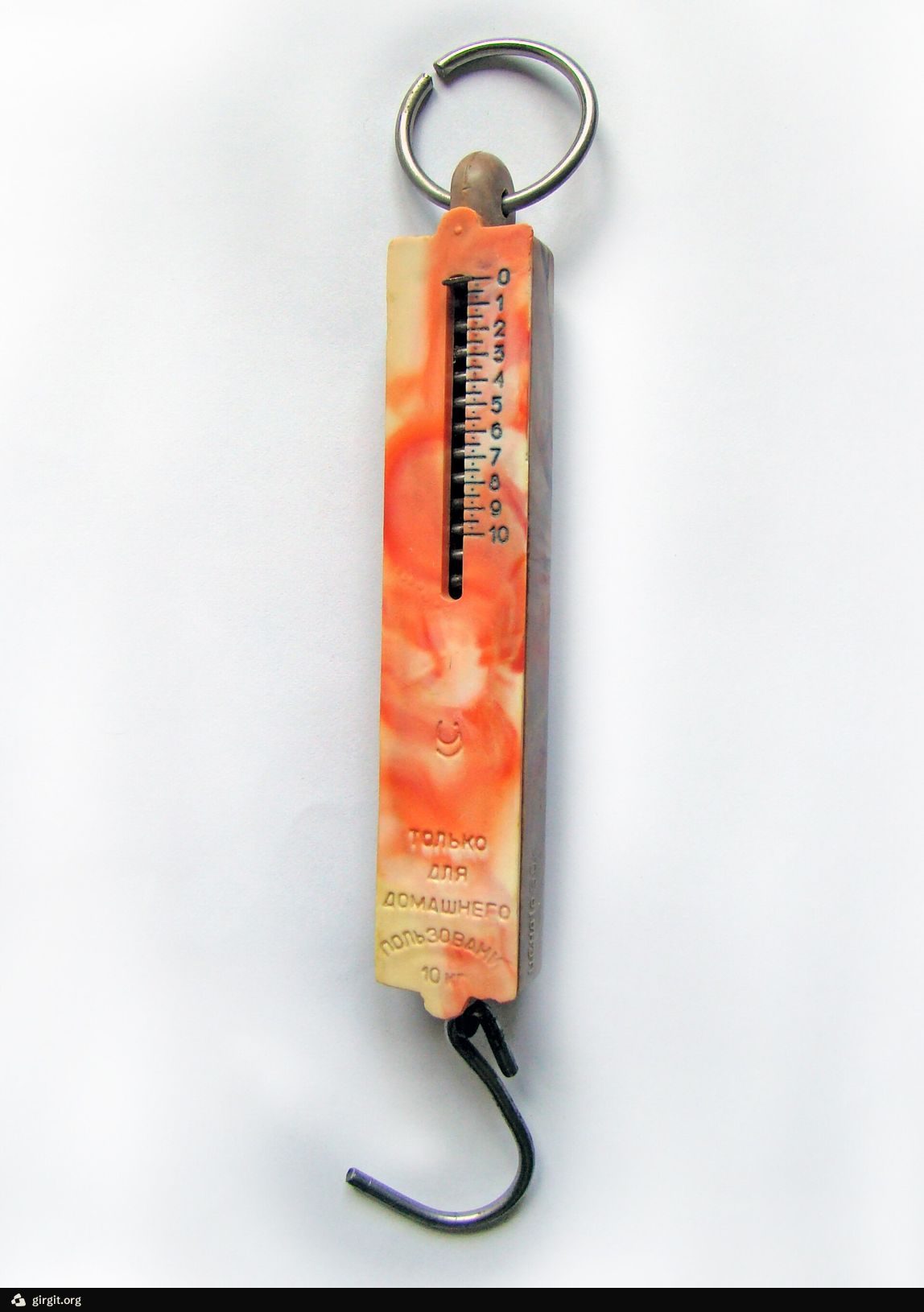 ring: hold it herespring insidescale: 0 to 10 kghook: the load pulls here
Tension
A string, rope or cable pulls along its own length. Think of it as a very stiff spring: an inextensible string (one that does not stretch) has an enormous force constant, so a tiny stretch gives a big force. The restoring force in a string is its tension, \( T \). A string can only pull, never push.
In problems we usually take the tension to be the same all along the string. That is exactly true only for a string of negligible mass (a "light" string), and over a smooth (frictionless) pulley the tension is the same on both sides.
Where contact forces really come from
Physics knows four fundamental forces: gravitational, electromagnetic, strong nuclear and weak nuclear. The strong and weak forces act only inside atomic nuclei, so in mechanics only gravity and electric forces matter.
That may surprise you, because the bodies in mechanics problems are not charged. But every body is made of charged particles: positive nuclei and negative electrons. When two surfaces touch, the electrons of their atoms push on each other. The normal force, friction, tension, spring force and the push of a fluid all come, in the end, from these electric forces.
 toe pads: millions of tiny hairspressed flat against the glass
Working out a contact force atom by atom would be hopelessly complicated, and it would not help with a sliding box or a hanging lamp. So in mechanics we treat each type as its own force, with rules found by experiment (like \( F = -kx \) for a spring, or the laws of friction in the next concept).
Remember
- Gravity: non-contact, weight \( mg \) downward.
- Contact force between surfaces = normal reaction (perpendicular) + friction (parallel).
- Spring: \( F = -kx \). Light string: same tension \( T \) throughout; it only pulls.
- Buoyant force = weight of fluid displaced, upward.
- All contact forces are electric in origin.
Just remember
The forces have reasons (see the deep dive). These are names, a sign and a list to learn as they are.
- The minus in \( F = -kx \)
- It only says "back": stretch it right, it pulls left. A spring always argues with you.
- Normal = at right angles to the surface
- From Latin norma, a carpenter's square: the tool for drawing right angles. Nothing to do with "ordinary".
- The four fundamental forces: gravitational, electromagnetic, strong, weak
- "Girgit Eats Six Worms." Only the first two reach far enough to matter in mechanics.
- A string can only pull
- "You can't push a rope." Tension in a light string is the same all along it.
- Contact force
- A force that acts only where two bodies touch.
- Normal reaction
- The part of a contact force at right angles to the surfaces.
- Buoyant force
- The upward push of a fluid, equal to the weight of fluid displaced.
- Restoring force
- A force that tries to bring a stretched or squashed thing back to normal.
- Force constant, k
- How stiff a spring is: force per metre of stretch, in N m⁻¹.
- Tension
- The pull along a string or rope.
- Fundamental forces
- Gravitational, electromagnetic, strong and weak: the four basic forces of nature.
Words to know
Friction between a box and the floor is
- the part of the contact force at right angles to the floor
- the part of the contact force along the floor
- a force that acts from a distance
At the level of atoms, the normal force of a table on a book comes mainly from
- gravity between the book and the table
- electric forces between the atoms of the surfaces
- the strong nuclear force
A spring is squashed by 2 cm and pushes back with 6 N. Squashed by 6 cm (still small), it pushes back with
- 6 N
- 18 N
- 54 N
Deep dive · optional
How does a table know how hard to push?
Why every surface behaves like a very stiff spring, why that gives Hooke's law, and how electric forces between atoms end up holding your books up. The exam needs only the core page; this makes it stick.
The roots: atoms are springs
- How does a table know to push up with exactly the book's weight?It doesn't "know". The table top squashes a tiny bit under the book, and the more it is squashed, the harder it pushes back. It keeps squashing until its push equals the weight. Push less and the book would sink further; push more and the book would rise back. It settles where they are equal.
- Why does a squashed solid push back?Its atoms sit at a preferred distance from each other. Pull them apart and electric attraction pulls them back; push them closer and their electron clouds repel. Each pair of neighbours acts like a tiny spring.
- Why does that give Hooke's law, force proportional to stretch?The force between two atoms changes smoothly with their distance, and any smooth curve looks like a straight line if you zoom in close enough. Small stretches or squashes stay on that straight part, so the force is proportional to them. Stretch too far and you leave the straight part: that is the elastic limit of Chapter 8.
- Then why can't we see a table squash?Solids are astonishingly stiff. Under a 1 kg book, a 2 cm steel slab squashes by about 33 picometres, a third of the width of one atom. Too small to see, but not zero, and that tiny squash is enough.
- And the bedrock?The electric force between charges, the same force that makes a rubbed balloon cling to a wall. Every contact force in mechanics is a crowd of these tiny electric pushes and pulls.
The same picture explains the other contact forces. A rope is a chain of atoms pulled slightly apart; its tension is the springs' pull. Friction comes from atoms of two surfaces gripping each other where they touch (next page). A fluid's push is the drumming of its molecules on a surface. And a gecko clings to glass by the weak electric attraction between molecules: on their own these forces are tiny, but its toe pads carry millions of microscopic hairs that get close enough for them to add up.
How weak is gravity by comparison? A small fridge magnet holds itself up against the pull of the entire Earth. The electric and magnetic forces of a few grams of material beat the gravity of six million billion billion kilograms.
The story
See it
 printed in London, 1678by Robert Hooke
Guess first, then change the book and the material, and look through the magnifier at the atoms doing the pushing.
Solve it
Solve it
Estimate how much a concrete floor slab 15 cm thick squashes under a 60 kg person standing on it, if her two feet press on 0.03 m2 in all. Treat only the concrete right under her feet as squashed, with Young's modulus 30 × 109 N m−2 (g = 9.8 m s−2).
Hint
Answer
Solve it
A spring has force constant \( k \). You cut it into two equal halves. What is the force constant of each half? Explain it with "atoms as springs".
Answer
Solve it
Think it through. Electric forces between atoms are enormously stronger than gravity. Then why does a table push up on a 1 kg book with only 9.8 N, and not some huge force?
Answer
Connect it
Connect it
- Friction, this chapter. The other half of the contact force, also electric, with its own rules: static and kinetic friction.
- Elasticity, Chapter 8. Hooke's law for wires and beams, Young's modulus and the elastic limit: Young's modulus and the stress-strain curve.
- Oscillations, Chapter 13. A mass on a spring bounces back and forth because of \( F = -kx \): spring and mass.
- Electric charges, Class 12. The force underneath all contact forces: Coulomb's law.
- Daily life. A bathroom scale, a spring balance at the sabzi mandi and a motorcycle's shock absorbers all measure or use a spring's push.
Still confused?
If contact forces are electric, why doesn't my book act charged?
Overall the book has as much positive charge as negative, so from far away the electric forces cancel. Only when atoms come very close, a few tenths of a nanometre apart as in a contact, does the cancelling fail: the electron clouds of the two surfaces repel each other before the nuclei can.
Why is the tension the same all along a light string?
Take any small piece of the string. The string on one side pulls it one way, the string on the other side pulls it the other way. If the piece has no mass, any difference between the two pulls would give it an infinite acceleration, so they must be equal. Piece by piece, the tension is the same all along.
Is buoyancy a contact force too?
Yes. Water presses on every part of an object's surface, and presses harder deeper down. The upward push on the bottom beats the downward push on the top, and the difference is the buoyant force. Each of those pushes is molecules striking the surface.
Sources
- Wikipedia, "Hooke's law": the 1676 anagram, the 1678 solution ut tensio, sic vis, known since 1660.
- Hooke, Lectures de Potentia Restitutiva, or of Spring (London, 1678), title page.
- Wikipedia, "Gecko feet", citing Autumn and others (2002), "Evidence for van der Waals adhesion in gecko setae", PNAS: setae, spatulae and their sizes.
- Wikipedia, "Young's modulus" and NCERT Physics Class 11, Chapter 8 table: rubber, polystyrene, wood, concrete, steel.
- Wikipedia, "Atom": atoms are typically around 100 picometres across.

Picture and video credits
Show 1 picture and video credits
- gecko-foot-on-glass.jpg: Bjørn Christian Tørrissen, CC BY-SA 3.0
