- 1. Does a moving thing need a push to keep going?
- 2. Inertia and Newton's first law
- 3. Momentum and Newton's second law
- 4. Why does a fielder pull his hands back?
- 5. Newton's third law: every push has a partner
- 6. Conservation of momentum
- 7. Equilibrium of a particle
- 8. The common forces in mechanics
- 9. Friction: static and kinetic
- 10. Rolling friction, and why we need friction
- 11. What keeps a car on a curve?
- 12. Solving problems with free-body diagrams
- Review
7 of 12·NCERT §4.8·pp. 58–59·5 min
Equilibrium of a particle
The big ideaA particle is in equilibrium when the forces on it add up to zero; then it is either at rest or moving with a constant velocity.
In simple words
In a tug of war, when both teams pull equally hard, the rope does not move. The pulls cancel. When all the pushes and pulls on a thing cancel like this, nothing changes for it: if it was still, it stays still; if it was moving, it keeps moving the same way at the same speed.
What equilibrium means
Equilibrium of a particle means the net external force on it is zero. By the first law, the particle is then either at rest or in uniform motion. So equilibrium is not only about things standing still: a parcel on a conveyor belt moving at a steady speed is in equilibrium too.
For a real body, which has size, being in full equilibrium also needs the forces not to turn it. That is rotational equilibrium (zero net torque), which you will study in Chapter 6. Here we treat bodies as points, so only the forces matter.
Two forces
If only two forces \( \vec F_1 \) and \( \vec F_2 \) act, they must be equal in size and opposite in direction:
\[ \vec F_1 = -\vec F_2 \]A lamp hanging from a single wire: the wire pulls it up, gravity pulls it down, with equal sizes.
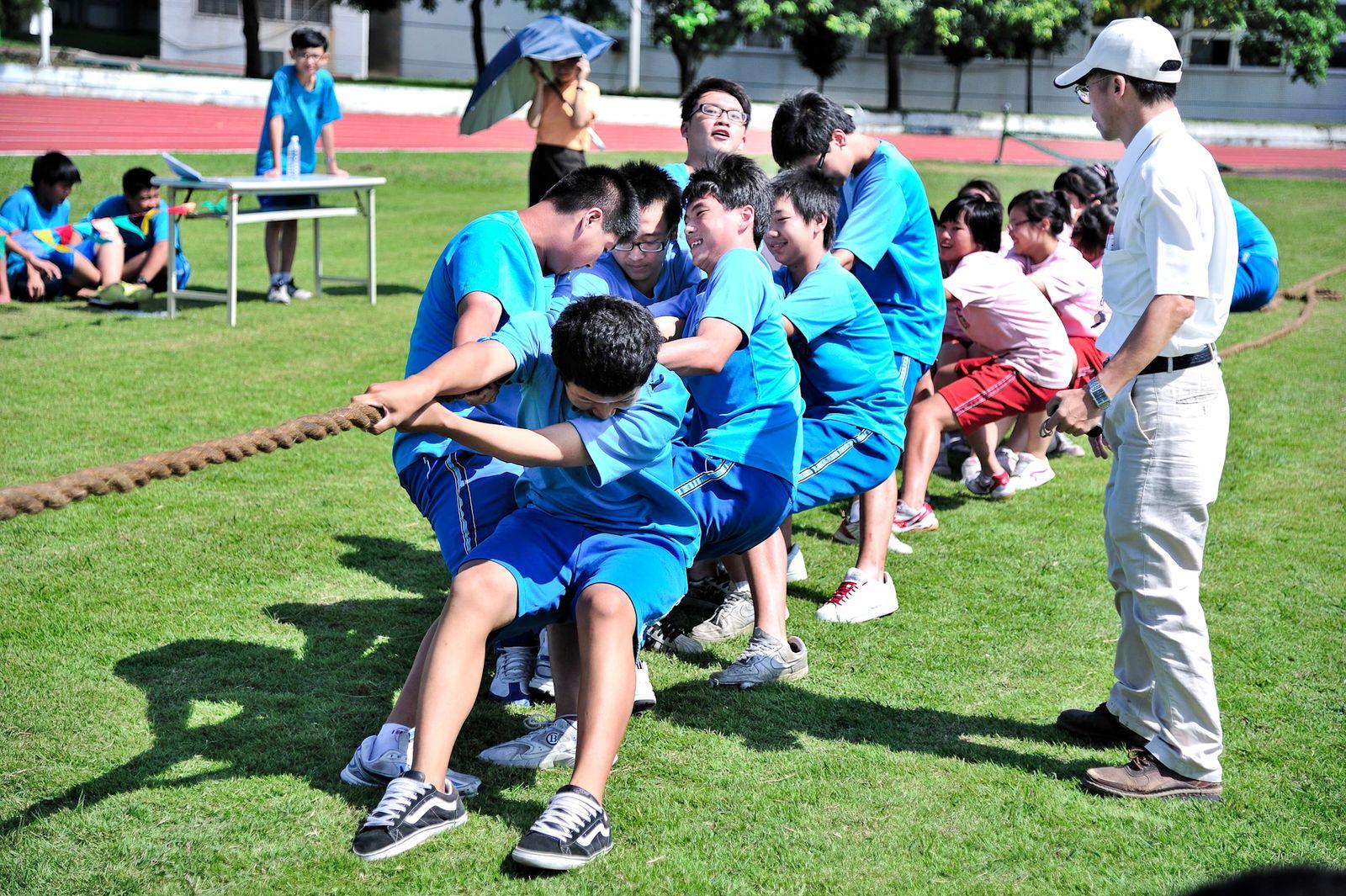 rope pulls them this wayground pushes their feet back
Three forces: the triangle
When three forces act at one point (they are concurrent forces), equilibrium needs their vector sum to be zero:
\[ \vec F_1 + \vec F_2 + \vec F_3 = 0 \]Put another way, the resultant of any two of them, found by the parallelogram law, must be equal and opposite to the third.
There is a neat picture for this. Draw the three force arrows head to tail, one after another, keeping their directions and lengths. If the particle is in equilibrium, the last arrow ends exactly where the first began: the three arrows form a closed triangle, all going round the same way. This is the triangle of forces.
The idea works for any number of forces. A particle is in equilibrium under forces \( \vec F_1, \vec F_2, \ldots, \vec F_n \) if they can be drawn head to tail as the sides of a closed polygon with the arrows all going the same way round.
Using components
In practice we usually split every force into parts along x, y and z. A vector is zero only if each of its parts is zero, so
\[ \sum F_x = 0, \qquad \sum F_y = 0, \qquad \sum F_z = 0 \]Here \( \sum F_x \) means the x-parts of all the forces added up, with signs. For a problem in a flat plane, two equations (x and y) are enough, which lets you find two unknowns.
Worked example
A 4 kg lantern hangs from a hook by a light rope. A boy pulls the middle point P of the rope sideways with a horizontal force of 30 N and holds it still. What angle does the upper part of the rope make with the vertical, and what is its tension? (\( g = 10 \) m s−2.)
- Lantern alone. Its free-body diagram, in words: the lantern as a dot, with its weight of 40 N pointing straight down and the tension \( T_2 \) of the lower rope pointing straight up. In equilibrium, \( T_2 = 40 \) N.
- Point P alone. Three forces act on it: \( T_2 = 40 \) N straight down (the lower rope pulls P towards the lantern), 30 N horizontal from the boy, and the upper rope's tension \( T_1 \) pulling up towards the hook at angle \( \theta \) to the vertical, leaning away from the boy.
- Vertical: \( T_1\cos\theta = 40 \). Horizontal: \( T_1\sin\theta = 30 \).
- Divide: \( \tan\theta = 30/40 = 0.75 \), so \( \theta \approx \) 37°. Square and add: \( T_1 = \sqrt{40^2 + 30^2} = \) 50 N.
The three forces on P, 40 N, 30 N and 50 N, form a closed 3-4-5 right triangle, just as the triangle of forces says. The answer does not depend on how long the rope is or where along it the boy pulls.
Try it: guess first, then pull P sideways and watch the triangle of forces.
Don't mix these up
- Equilibrium means zero net force, not zero velocity. A body moving at a constant velocity is in equilibrium.
- A body momentarily at rest (a ball at the top of its throw) is not in equilibrium: the net force on it is mg.
- A string can never be pulled perfectly straight horizontal while holding up a weight: its tension would have no upward part to balance the weight.
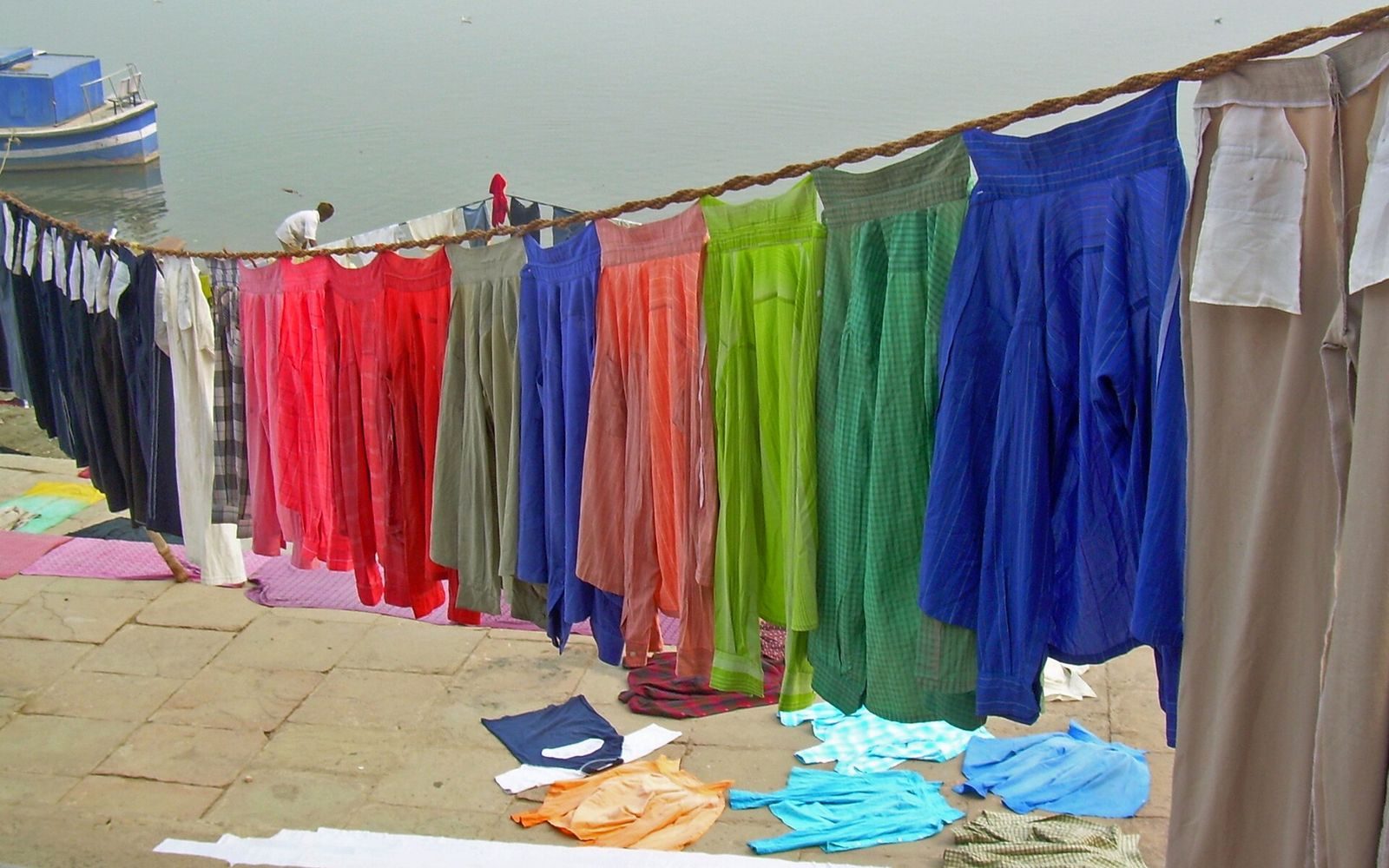 the rope is never quite straightwet clothes pull it down
Try it
A 10 kg sign hangs from two equal ropes, each making 30° with the vertical. Find the tension in each rope. (\( g = 10 \) m s−2.)
Answer
Remember
- Equilibrium of a particle: \( \sum\vec F = 0 \); it is at rest or in uniform motion.
- Two forces: equal and opposite. Three forces: a closed triangle, head to tail.
- Any number of forces: a closed polygon.
- Component form: \( \sum F_x = \sum F_y = \sum F_z = 0 \).
Just remember
The rule (forces add to zero) has a reason. These are habits and handy numbers to learn as they are.
- Equilibrium means a = 0, not v = 0
- "Balanced, not stopped": a lift gliding up at a steady speed is as balanced as one standing still.
- Polygon of forces: head to tail, all arrows the same way round
- Like walking round a park and coming back to the gate: every leg in the same direction of travel.
- 3-4-5 triangle: angles about 37° and 53°
- \( \sin 37^\circ \approx 0.6 \), \( \cos 37^\circ \approx 0.8 \). Exam setters love 30 N, 40 N, 50 N: spot it and skip the trigonometry.
- Concurrent forces
- Latin con + currere, "running together": the forces all run to one point, like roads at a chowk.
- Equilibrium of a particle
- The state where the net external force on it is zero.
- Concurrent forces
- Forces that all act at the same point.
- Resultant
- The single force equal to several forces added as vectors.
- Parallelogram law
- Two forces drawn as sides of a parallelogram; the diagonal is their resultant.
- Triangle of forces
- Three forces in equilibrium form a closed triangle when drawn head to tail.
- Polygon of forces
- Any number of forces in equilibrium form a closed polygon head to tail.
Words to know
Three forces act on a moving particle, and drawn head to tail they form a closed triangle. Its velocity will
- increase
- decrease
- stay constant
Forces of 3 N and 4 N act on a particle at right angles. What third force keeps it in equilibrium?
- 7 N
- 5 N, opposite to the resultant of the two
- 1 N
Which of these is in equilibrium?
- A ball at the top of its flight
- A lift moving up at a steady 2 m s⁻¹
- A stone whirled in a circle at a steady speed
Deep dive · optional
Why must balanced forces close a triangle, and why does every loaded rope sag?
Where the triangle of forces comes from, the neat rule it hides (Lami's theorem), and why no amount of pulling straightens a washing line. The exam needs only the core page; this makes it stick.
The roots: a rope can only pull along itself
- Why do three balanced forces make a closed triangle?Drawing arrows head to tail is how vectors are added. If the sum is zero, the last arrow must end where the first began: you are back at the start.
- Why may forces be added like arrows at all?Because each force acts on its own, and its effect along any direction is just its component in that direction. Components add as ordinary numbers, so whole forces add as arrows. Experiments with a force table confirm it to the accuracy we can measure.
- Why must a loaded rope sag?A rope is floppy: it can only pull along its own length. To hold a weight up, its pull must have an upward part, \( T\sin\theta \), where θ is the rope's slope. A perfectly straight, level rope has θ = 0, so its upward part is zero, whatever T is.
- Why does the pull grow so fast as the sag shrinks?With the load W in the middle, the two halves share it: \( 2T\sin\theta = W \), so \( T = W/(2\sin\theta) \). For small slopes, \( \sin\theta \) is about θ itself (in radians), so halving the sag roughly doubles the tension. At zero sag it would be infinite.
- And the bedrock?Newton's first law applied to the point where the load hangs: it is not accelerating, so the forces on it must add to zero.
The triangle hides a tidy rule. In any triangle, each side divided by the sine of the angle facing it gives the same number (the sine rule). Applied to the triangle of forces, it says: for three forces in equilibrium, each force is proportional to the sine of the angle between the other two:
\[ \frac{F_1}{\sin\alpha} = \frac{F_2}{\sin\beta} = \frac{F_3}{\sin\gamma} \]where α is the angle between \( \vec F_2 \) and \( \vec F_3 \), and so on. This is Lami's theorem. Check it on the lantern of the worked example: between the 30 N pull and the 40 N weight the angle is 90°, and \( 50/\sin 90^\circ = 50 \); between the 50 N rope and the weight it is 143°, and \( 30/\sin 143^\circ = 30/0.6 = 50 \); between the 50 N rope and the 30 N pull it is 127°, and \( 40/\sin 127^\circ = 40/0.8 = 50 \). The same number every time.
A real rope also has its own weight, spread all along it, so even an empty rope sags into a smooth curve (a catenary, from the Latin for "chain"). Engineers use the sag: a suspension bridge's main cables and the power lines along every highway are hung with a planned dip, because a deeper curve means a smaller pull on the towers.
The story
See it
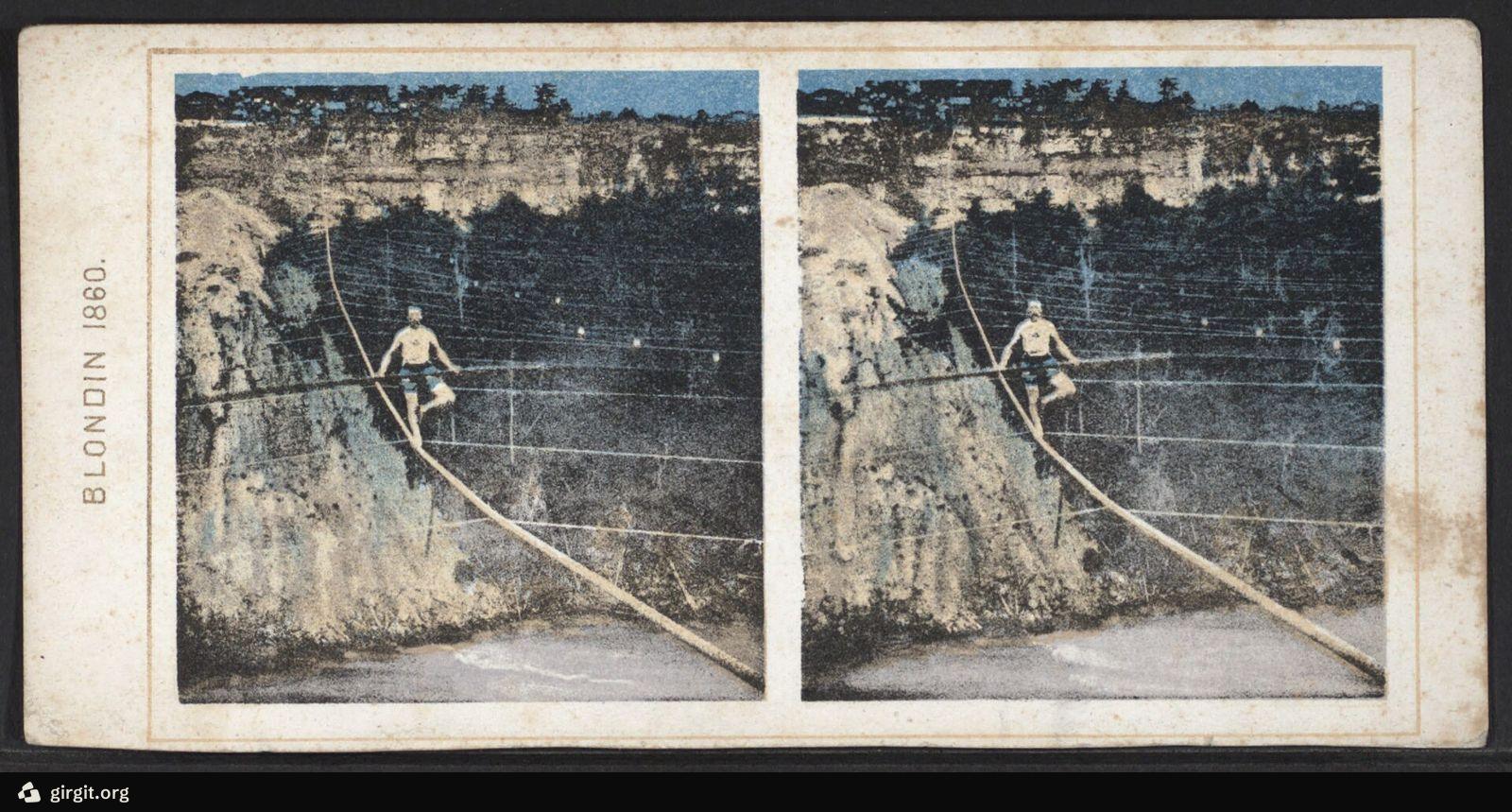 Blondinthe rope dips away
Guess first, then drag the middle of the line up towards straight and watch the pull at each end.
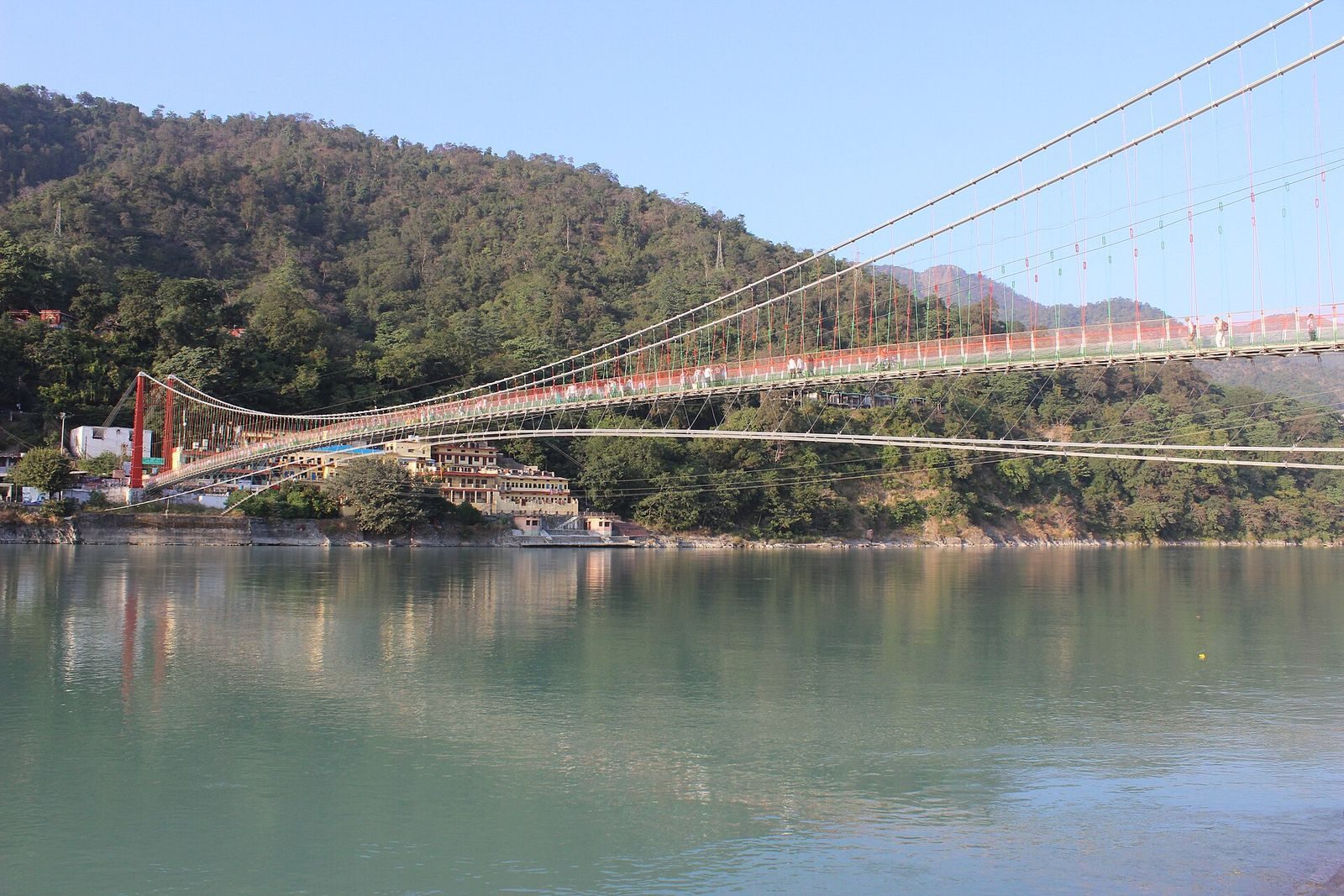 main cable sagshangers carry the decktower
Solve it
Solve it
A 60 kg slackliner stands in the middle of a line 10 m long between two trees, and the line sags 30 cm under her. Estimate the tension in the line (g = 9.8 m s−2). Is a line rated for 1000 N safe?
Hint
Answer
Solve it
Your car is stuck in mud. You tie a rope tight from its bumper to a tree, then push sideways on the middle of the rope with 400 N, bending it until each half makes 5° with the old straight line. How hard does the rope pull the car?
Answer
Solve it
A 10 kg box hangs from two strings tied to a ceiling. One string makes 30° with the ceiling, the other 60°. Find both tensions (g = 9.8 m s−2), then check your answer with Lami's theorem.
Hint
Answer
Connect it
Connect it
- Adding vectors, Chapter 3. The triangle and parallelogram laws, and Stevin's wreath of spheres: adding vectors.
- Free-body diagrams, this chapter. Equilibrium is the special case a = 0 of the method: free-body diagrams.
- Rigid bodies, Chapter 6. A real body also needs zero turning effect to stay balanced: equilibrium and centre of gravity.
- Stretching wires, Chapter 8. How much a cable stretches under these big tensions: stretching wires.
- Thermal expansion, Chapter 10. Power lines sag more on hot days and are hung with slack so they don't snap on cold nights: thermal expansion.
Still confused?
If the forces at the middle cancel, why is the rope so tight?
Cancelling is about the sum at one point, not the size of each force. Two 4900 N pulls slanting slightly upwards and a 588 N weight add to zero, but each rope half still carries its full 4900 N, and that is what stretches it and loads the trees.
Does it matter in which order I draw the forces head to tail?
No. Adding vectors does not depend on order, so any order closes the triangle. The triangle may come out turned or flipped, but its sides and angles are the same.
Can something moving be in equilibrium?
Yes, if its velocity is not changing. A raindrop falling at its steady final speed has air drag exactly balancing its weight; a parcel riding a steady conveyor belt has zero net force. Equilibrium is about acceleration, not about being at rest.
Sources
- MacTutor, Simon Stevin: De Beghinselen der Weeghconst (1586) and the triangle of forces.
- Wikipedia, "Bernard Lamy" and "Lami's theorem": Traité de mécanique (1679), the parallelogram of force, the theorem's name.
- Wikipedia, "Pierre Varignon": Projet d'une nouvelle mécanique (1687), composition of forces, friend of Newton.
- Wikipedia, "Charles Blondin": 30 June 1859; rope 340 m long, 8.3 cm thick, 49 m above the water; Harry Colcord.
- New York Public Library, Robert N. Dennis collection: Blondin, 1860.
- Wikipedia, "Lakshman Jhula": completed 1929, opened 1930.

Picture and video credits
Show 3 picture and video credits
- tug-of-war-school.jpg: 褒忠國中 雲端網, CC BY 2.0
- varanasi-laundry-line-ghat.jpg: McKay Savage from London, UK, CC BY 2.0
- lakshman-jhula-rishikesh.jpg: Snehrashmi, CC BY-SA 4.0


