- 1. Does a moving thing need a push to keep going?
- 2. Inertia and Newton's first law
- 3. Momentum and Newton's second law
- 4. Why does a fielder pull his hands back?
- 5. Newton's third law: every push has a partner
- 6. Conservation of momentum
- 7. Equilibrium of a particle
- 8. The common forces in mechanics
- 9. Friction: static and kinetic
- 10. Rolling friction, and why we need friction
- 11. What keeps a car on a curve?
- 12. Solving problems with free-body diagrams
- Review
4 of 12·NCERT §4.5·pp. 53–56·5 min
Why does a fielder pull his hands back?
The big ideaImpulse, a force multiplied by the time it acts, equals the change in momentum it causes; stretch out the time and the same change needs a smaller force.
In simple words
To stop a fast ball you have to take away all its "oomph". You can do it in one quick, hard stop, or in a slower, gentle stop. Both take away the same oomph. The quick stop needs a big push and it stings. The slow stop needs only a small push. That is why good catchers let their hands move back with the ball.
The fielder's trick
Watch a good fielder catch a fast cricket ball. As the ball lands in his palms, he draws his hands back towards his body. A beginner holds his hands stiff and stops the ball almost at once, and it hurts.
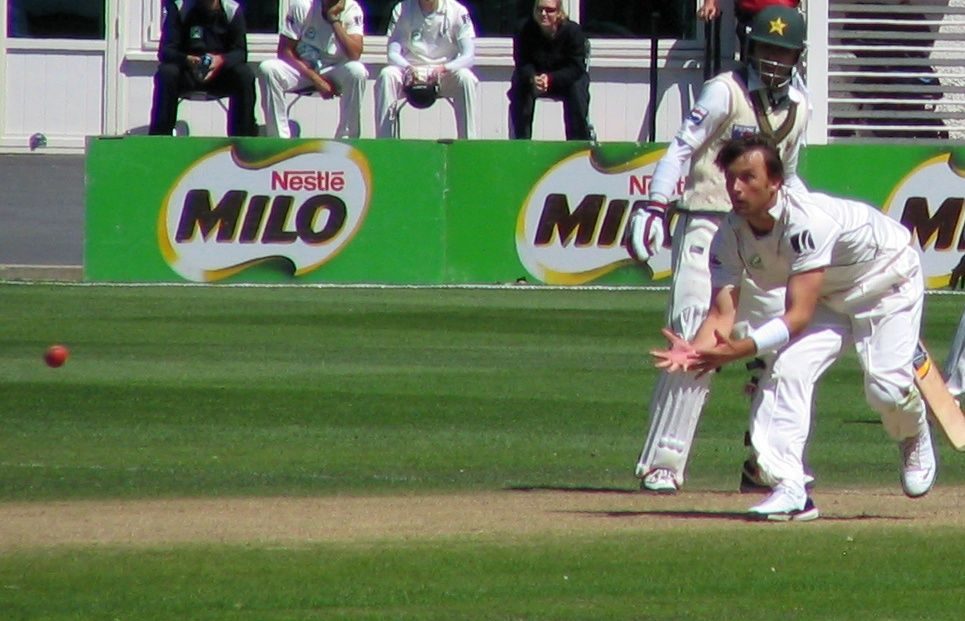 ball: 0.16 kghands ready to give
Both remove the same momentum from the ball: it arrives with \( mv \) and ends with zero. The difference is the time taken. From the second law, force is the rate of change of momentum:
\[ F = \frac{\Delta p}{\Delta t} \]Same \( \Delta p \), bigger \( \Delta t \), smaller \( F \). The fielder's hands move back over a longer time, so the force on them is smaller. So a force depends not just on how much the momentum changes, but on how quickly.
Try it: set how far the hands give, then let the ball arrive.
Impulse
Sometimes a very big force acts for a very short time: a bat hitting a ball, a hammer on a nail, a ball bouncing off a wall. The force and the contact time are each hard to measure, but their product is easy to find, because it equals the change in momentum. This product is the impulse:
\[ \vec J = \vec F\,\Delta t = \Delta\vec p = m\vec v - m\vec u \]Here \( \vec J \) is the impulse, \( \vec F \) the (average) force, \( \Delta t \) the time it acts, \( \vec u \) the velocity before and \( \vec v \) the velocity after. Impulse is a vector in the direction of the force, and its unit is N s, the same as kg m s−1.
A large force acting for a short time to give a finite change in momentum is called an impulsive force. People once thought these were a different kind of force. Newton's mechanics makes no such difference: an impulsive force is an ordinary force that happens to be big and brief. During the brief contact the body hardly moves, so we can take its position as unchanged while the impulse acts.
If the force changes during the contact (it usually does), the impulse is the area under the force-time graph, and \( F \) in \( F\Delta t \) is the average force.
Softer stops in daily life
- Long jumpers land in a pit of loose sand, and high jumpers on a thick foam bed: the stop takes longer, so the force on the body is smaller.
- Glassware is packed in straw, paper or foam so that a jolt is spread over more time.
- Car airbags and crumple zones make a crash stop last longer, cutting the force on passengers.
- Jumping down from a wall, you bend your knees as you land.
- The other way round: a karate chop or a hammer blow is made very short, so the force is huge.
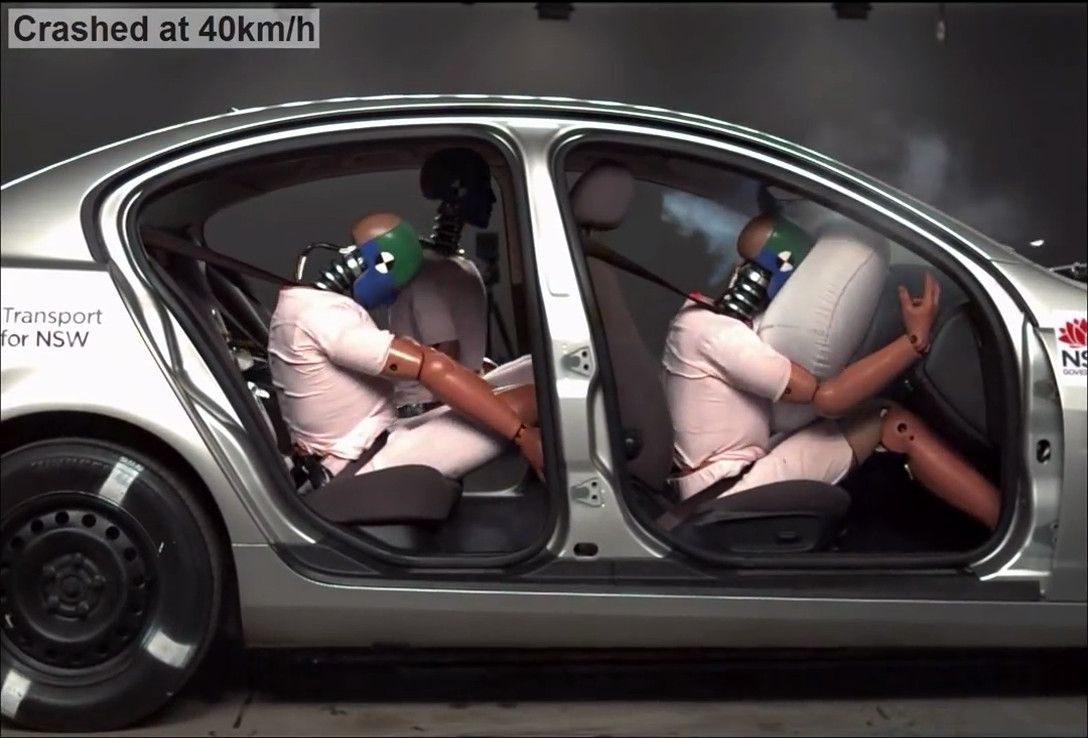 airbag: soft, slower stopbelt holds hips and chest
A crash filmed at high speed shows how short these stops are: the whole crumpling of the front is over in about a fifth of a second. Making that time longer is the point of every safety feature.
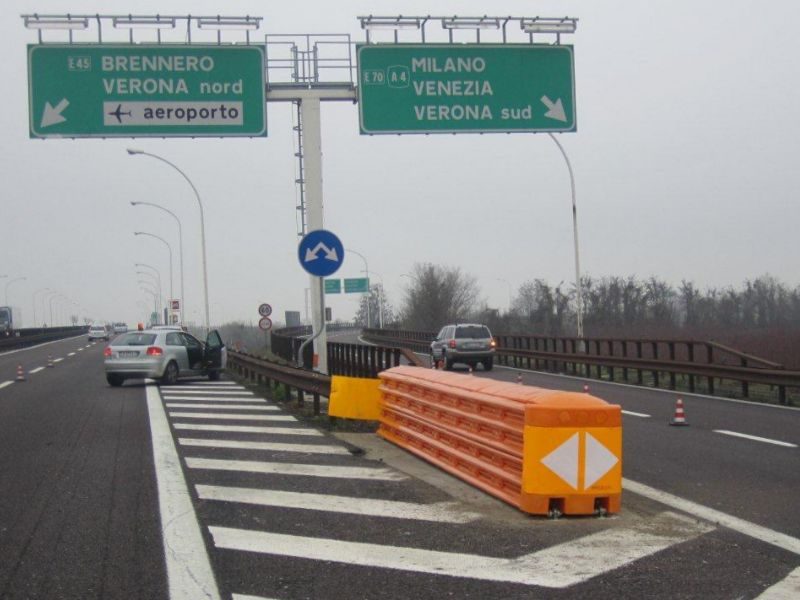 crumples to lengthen the stop
The bounce trap
A ball that bounces back has a bigger change in momentum than one that just stops. Momentum is a vector: going from \( +mu \) to \( -mu \) is a change of \( 2mu \), not zero. Forgetting the sign is the most common mistake in impulse problems.
Try it: guess first, then change how fast the ball leaves the bat.
Worked example
A 0.16 kg cricket ball comes at the bat at 20 m s−1 and is hit straight back at 30 m s−1. The contact lasts 0.01 s. Find the impulse on the ball and the average force of the bat.
- Take the direction towards the bowler as positive. Before: \( u = -20 \) m s−1. After: \( v = +30 \) m s−1.
- Impulse: \( J = m(v - u) = 0.16 \times (30 - (-20)) = 0.16 \times 50 = \) 8 N s, towards the bowler.
- Average force: \( F = J/\Delta t = 8/0.01 = \) 800 N.
If you had written \( 0.16 \times (30 - 20) \), you would get 1.6 N s, five times too small.
A ball hitting a wall at an angle
A ball of mass \( m \) hits a smooth wall at speed \( u \), its path making an angle \( \theta \) with the normal (the line at right angles to the wall), and bounces off at the same speed and angle. Take \( x \) along the normal and \( y \) along the wall.
- Along the wall: \( p_y \) is \( mu\sin\theta \) before and after. No change.
- Along the normal: \( p_x \) goes from \( +mu\cos\theta \) (into the wall) to \( -mu\cos\theta \). Change: \( -2mu\cos\theta \).
So the impulse on the ball has size \( 2mu\cos\theta \) and points straight out of the wall, along the normal. Your instinct might say the force on the wall is slanted, along the ball's path. It is not: the force on the ball, and so (by the third law) the force on the wall, is along the normal whatever the angle. Head-on (\( \theta = 0 \)) gives the largest impulse, \( 2mu \).
Don't mix these up
- The angle in \( 2mu\cos\theta \) is measured from the normal. If a question gives the angle with the wall, use \( 2mu\sin\theta \) instead.
- A ball dropped from height \( h \) hits the ground at \( \sqrt{2gh} \). If it rebounds to height \( h' \), it leaves at \( \sqrt{2gh'} \) upward, and the impulse is \( m(\sqrt{2gh} + \sqrt{2gh'}) \): the speeds add.
Try it
A 0.2 kg ball is dropped from 5 m. It bounces and rises to 1.25 m. What impulse did the floor give it? (\( g = 10 \) m s−2.)
Answer
Remember
- Impulse \( \vec J = \vec F\Delta t = \Delta\vec p \); unit N s.
- Same change of momentum over a longer time needs a smaller force.
- Bounce back: \( \Delta p = m(v + u) \) in size, the speeds add.
- Wall at angle \( \theta \) to the normal: \( J = 2mu\cos\theta \), along the normal.
Just remember
Symbols and angle conventions: choices people made, not physics.
- Impulse is written \( J \) (some books use \( I \)); unit N s = kg m s−1
- J for jolt. And N s is "newtons for seconds", the force-times-time it is made of.
- Wall at an angle: \( 2mu\cos\theta \) if θ is from the normal, \( 2mu\sin\theta \) if from the wall
- "cos is close": the cosine goes with the angle measured from the line the force acts along, the normal.
- "Impulsive force"
- Just an ordinary force that is big and brief. Hook: an impulse buy, sudden and over quickly.
- Impulse
- Force times the time it acts; equal to the change in momentum.
- Impulsive force
- A large force acting for a very short time.
- Average force
- The steady force that would give the same impulse in the same time.
- Normal (to a surface)
- The direction at right angles to the surface.
- Force-time graph
- A graph of force against time; the area under it is the impulse.
Words to know
Why does a fielder draw his hands back while catching a fast ball?
- To reduce the change in the ball's momentum
- To make the stop last longer, so the force is smaller
- To reduce the impulse on the ball
A ball of mass m hits a wall head-on at speed u and bounces straight back at the same speed. The impulse on it has size
- zero
- mu
- 2mu
A ball bounces off a smooth wall at an angle, keeping its speed. Which way is the force of the ball on the wall?
- Along the ball's incoming path
- At right angles to the wall, into it
- Along the wall
Deep dive · optional
Why does a longer stop save lives?
How a stopping distance turns into a force, why a dashboard is so much worse than a seat belt, and the engineers who made cars crumple on purpose. The exam doesn't need this; it makes the page stick.
The roots: from centimetres to newtons
- Why does a crash hurt at all?Your body arrives with momentum \( mv \) and must end with none. Something has to give it an impulse of \( mv \) backwards: the belt, the airbag, the dashboard or the windscreen.
- Why does a longer stop help?The impulse is fixed by your speed. The force is impulse divided by time, \( F = mv/\Delta t \). Double the time, half the force.
- And what sets the time?The distance over which you stop. If you slow down steadily from \( v \) to 0, your average speed is \( v/2 \), so stopping over a distance \( d \) takes \( \Delta t = 2d/v \). Put that in: \( F = \dfrac{mv^2}{2d} \). Double the stopping distance, half the force.
- Why is hitting the dashboard so dangerous?Because it stops you over a few centimetres. At 50 km/h (13.9 m s−1), stopping in 5 cm needs a deceleration of \( 13.9^2/(2 \times 0.05) \approx 1900 \) m s−2, about 200 times g. A belt that lets you move forward 80 cm while the car's front crumples gives about 12 times g instead.
- If the impulse is the same, why does the size of the force matter?Because what breaks a bone or bruises a brain is the force, and how much of the body it is pressed into, not the total impulse. A belt and an airbag also spread the force over the strong chest and hips, so each square centimetre carries less.
A handy shortcut for falls: dropping from a height \( h \) and stopping over a distance \( d \), the extra force while you stop is \( mg \times h/d \). Jump off a 1 m wall and land stiff-legged, stopping in 1 cm: about 100 times your weight. Bend your knees through 40 cm: two and a half times, plus your own weight.
The story
See it
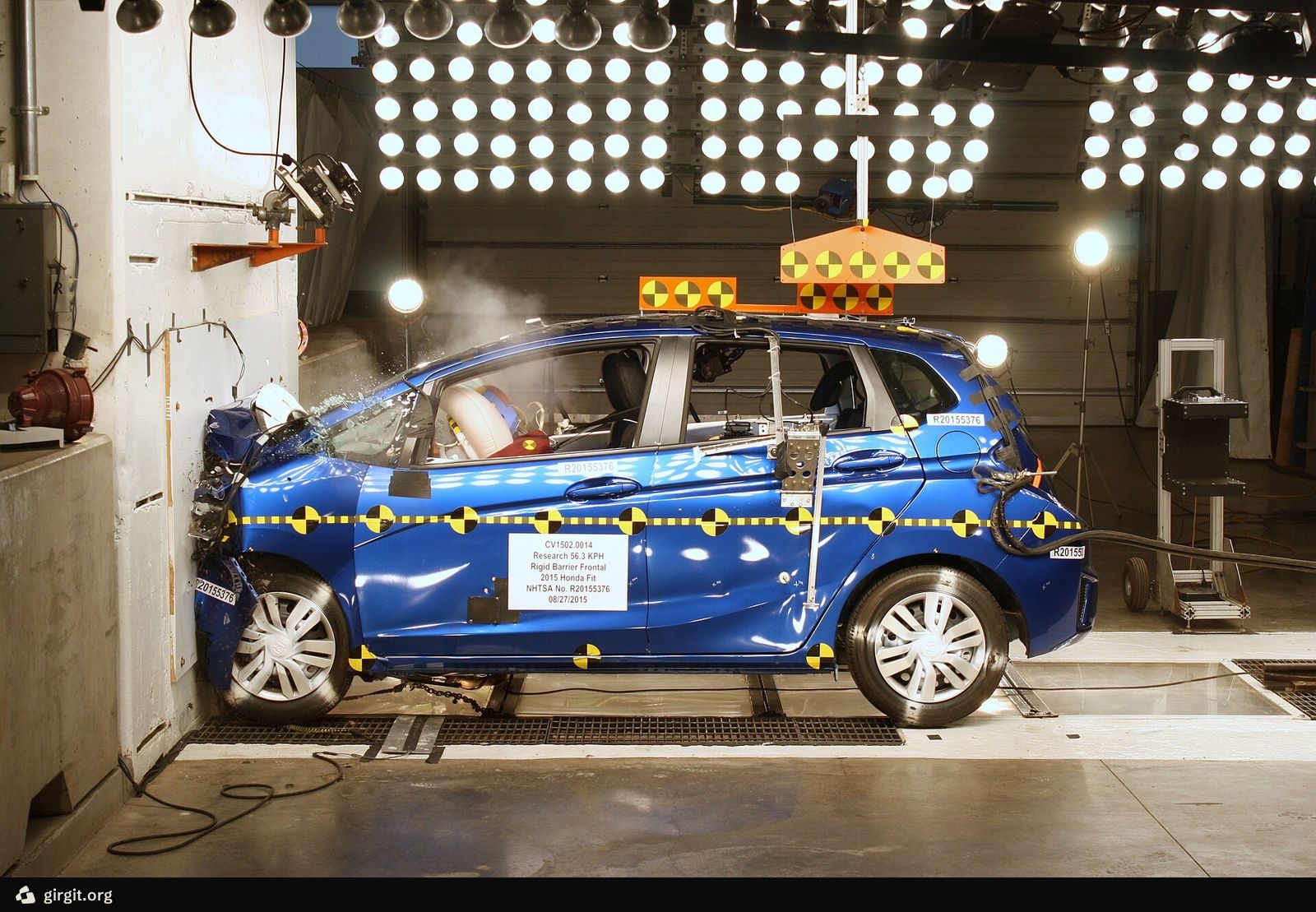 front crumplesairbagcabin stays whole
Guess first, then change the stopping distance and watch the force pulse: it gets taller and thinner, but its area never changes.
Solve it
Solve it
You jump down from a 1.0 m wall. (a) How fast are you going when your feet touch the ground? (b) Landing stiff-legged, you stop in 1 cm; bending your knees, in 40 cm. What is the average upward force from the ground in each case, in terms of your weight \( mg \)?
Hint
Answer
Solve it
A 0.16 kg cricket ball arrives at 30 m s−1 (108 km/h). One fielder's hands give 50 cm; another's give only 5 cm. Treating each stop as steady, find the impulse, the stopping time and the average force for each.
Answer
Solve it
Spot the error: "An airbag protects you because it reduces the momentum you lose in a crash."
Answer
Connect it
Connect it
- The second law, last page. Impulse is just \( F = dp/dt \) added up over the time of the push: momentum and the second law.
- Stopping distance, Chapter 2. The car's own braking distance grows as \( v^2 \), for the same reason the force here grows as \( v^2/d \): stopping distance and reaction time.
- Work and energy, Chapter 5. \( F \times d = \tfrac12 mv^2 \): force times distance takes away kinetic energy, force times time takes away momentum: the work-energy theorem.
- Collisions, Chapter 5. In a crash the impulses on the two bodies are equal and opposite: collisions.
- Daily life in India. A two-wheeler helmet's foam, the thermocol around a new mixer-grinder, the sand pit at the school long jump, the cricketer's soft hands: all longer stops.
Still confused?
Wouldn't a stronger, stiffer car be safer?
For the car, perhaps; for the people inside, no. A car that does not crumple stops in a few centimetres, and so do the people tied to it. The crumple zone gives up the front of the car to buy extra stopping distance for the cabin, while the cabin itself stays stiff so that it does not crush the people in it.
Why does the force on me depend on \( v^2 \), but the impulse only on \( v \)?
Going faster gives you more momentum to lose (one factor of \( v \)) and also gets you through the stopping distance sooner, so there is less time to lose it in (another factor of \( v \)). For the same stopping distance, double the speed means four times the force.
Is a soft landing "absorbing" the force?
Nothing absorbs force. A soft landing stretches the same impulse over more time, so the force at each moment is smaller. What foam, sand and crumpling metal do absorb is energy, by being squashed.
Sources
- Wikipedia, "Crumple zone": Barényi, the 1952 Mercedes-Benz patent, the 1959 W111.
- Wikipedia, "Seat belt" and "Nils Bohlin": Volvo 1959, the 28,000-accident study, free design from 1968.
- Wikipedia, "Airbag": inflation in under 30 milliseconds.
- Wikipedia, "Motorcycle helmet": polystyrene foam liner; risk of death reduced by 42%.
- NHTSA crash test film, Wikimedia Commons and NHTSA test photograph.

Picture and video credits
Show 3 picture and video credits
- cricket-catch-shane-bond.jpg: Benchill, CC BY-SA 3.0
- crash-test-airbag-seatbelt.jpg: Transport For NSW (https://www.transport.nsw.gov.au/), CC BY-SA 4.0
- crash-cushion-highway.jpg: Onethousandsixhundred, CC BY-SA 4.0


