- 1. Does a moving thing need a push to keep going?
- 2. Inertia and Newton's first law
- 3. Momentum and Newton's second law
- 4. Why does a fielder pull his hands back?
- 5. Newton's third law: every push has a partner
- 6. Conservation of momentum
- 7. Equilibrium of a particle
- 8. The common forces in mechanics
- 9. Friction: static and kinetic
- 10. Rolling friction, and why we need friction
- 11. What keeps a car on a curve?
- 12. Solving problems with free-body diagrams
- Review
5 of 12·NCERT §4.6·pp. 56–57·5 min
Newton's third law: every push has a partner
The big ideaForces always come in pairs: if A pushes or pulls B, then B pushes or pulls A just as hard in the opposite direction, at the same instant.
In simple words
You cannot touch without being touched. Push a wall and the wall pushes your hand back just as hard; you can feel it. The earth pulls a falling mango down, and the mango pulls the earth up just as hard. The earth is so big that this tiny pull does nothing we can see.
Forces come in pairs
The second law tells us what a force does. But where does a force come from? In Newton's mechanics, the answer is always another body. A force on a body is always a force by some other body.
Then a natural question: if B pushes A, does A push B? Press a spring with your thumb. The spring squashes, and you feel it pressing back on your thumb. Easy to see. But what about the earth pulling a stone down? Does the stone pull the earth? Newton's answer is yes, equally hard, upward. We never notice, because the earth is enormously heavy.
A force is a mutual interaction between two bodies. No force ever exists alone. Newton's third law of motion says:
Newton's third law
- To every action there is always an equal and opposite reaction.
- Plainer: the force on A by B is equal and opposite to the force on B by A.
Read \( \vec F_{AB} \) as "force on A by B". The minus sign says the two are opposite in direction; their sizes are equal.
Worked example
The earth pulls a 0.5 kg mango down with a force of 5 N. How much does the earth accelerate towards the mango? (Earth's mass \( \approx 6 \times 10^{24} \) kg.)
- By the third law the mango pulls the earth up with 5 N.
- \( a_{\text{earth}} = F/M = 5/(6 \times 10^{24}) \approx 8 \times 10^{-25} \) m s−2.
- The forces are equal, but the effects are wildly different, because the masses are. The mango accelerates at 10 m s−2; the earth's motion is far too small to detect.
Try it: guess first, then compare three pairs.
Three ways people misread it
Newton's wording is so short and catchy that it has entered everyday speech, and so it is often misunderstood. Keep these three points clear.
- "Action" and "reaction" are just forces. They are not special kinds of force, only two names for the two forces of one pair.
- Neither comes first. The words suggest the action happens and then the reaction follows, as cause and effect. Not so. Both forces act at the same instant, and either one can be called the action.
- They act on different bodies. One force acts on A, the other on B. So when you study the motion of A alone, only one of them, the one on A, matters. It is a mistake to add the pair together and say the net force on A is zero.
But if you study A and B together as one system, then \( \vec F_{AB} \) and \( \vec F_{BA} \) are both internal forces of that system, and they add up to zero. That is why internal forces in any body cancel out in pairs, and why the second law works for a whole body or group of particles using only the external forces.
The horse and the cart
Here is a famous puzzle that trips up almost everyone. A horse pulls a cart. By the third law, the cart pulls the horse back with an equal force. So the two forces cancel, and nothing should move. Yet they move. What is wrong?
The two forces act on different bodies, so they cannot cancel. To see whether the horse moves, list only the forces on the horse: the cart pulls it back, and the ground pushes it forward (the horse's hooves push back on the ground, and by the third law the ground pushes the horse forward). If the ground's push is bigger than the cart's pull, the horse speeds up. For the cart: the horse pulls it forward, and friction on its wheels holds it back. If the horse's pull wins, the cart speeds up.
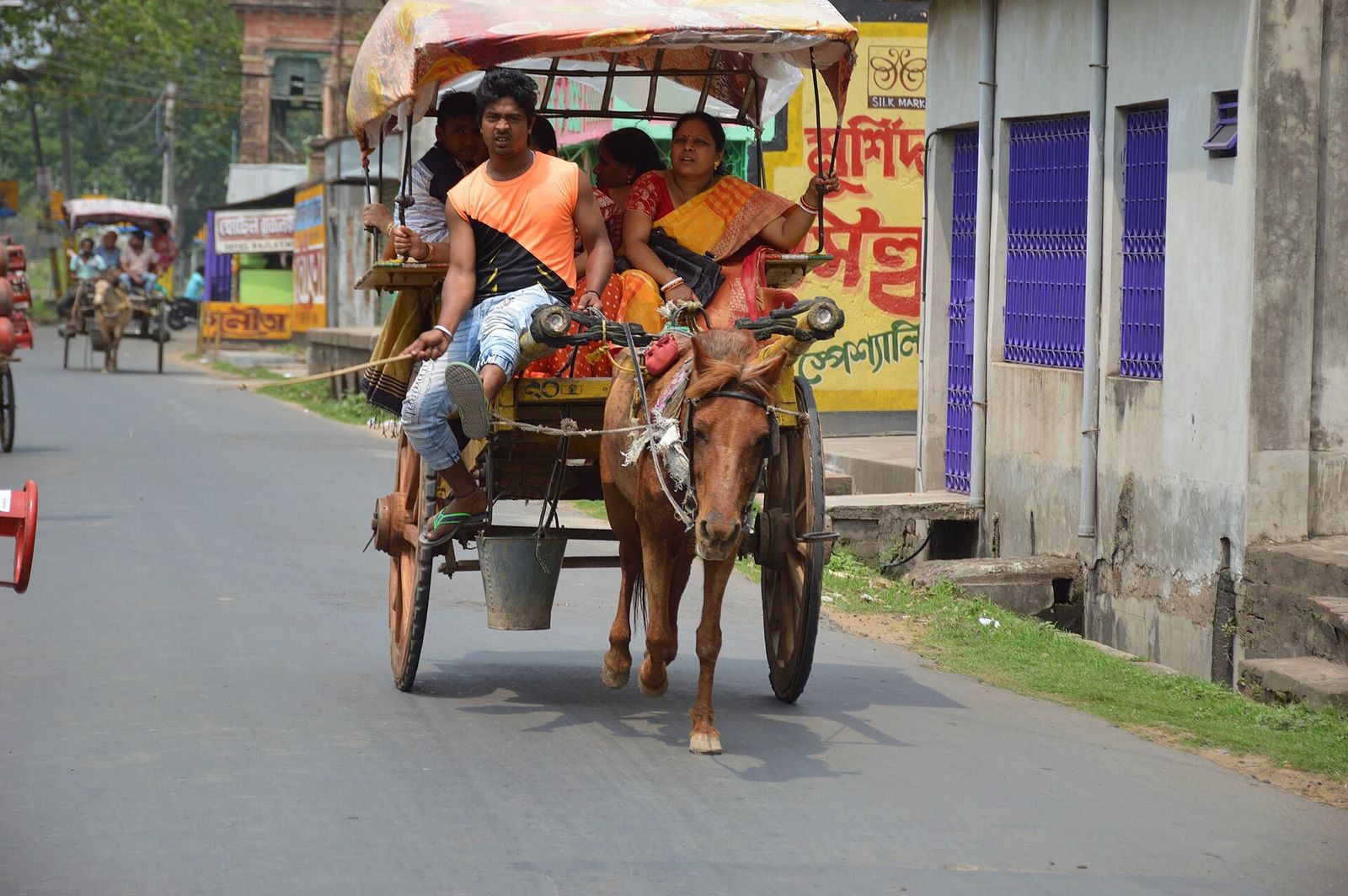 hooves push road backshafts: equal pulls both wayswheels drag back
This is also why a horse could not pull a cart while running in empty space: with no ground to push against, there would be no forward force on the horse-and-cart system.
A tug-of-war is the same puzzle. The rope pulls both teams equally hard, always. The team that wins is the one whose feet get the bigger push from the ground: so the teams lean back and dig their heels in.
Is it a pair or not?
A book lies on a table. Its weight (earth pulls book down) and the normal force (table pushes book up) are equal and opposite. Are they an action-reaction pair? No. Both act on the same body, the book, and they are equal only because the book is at rest. In a lift that is speeding up, they would not be equal at all. The true partners are:
- earth pulls book down, and book pulls earth up;
- table pushes book up, and book pushes table down.
Try it: tap any force to light up its true partner, then put a heavy matka on the block.
Don't mix these up
- Two forces on the same body that happen to be equal and opposite are never an action-reaction pair.
- An action-reaction pair is always the same type of force (both gravity, both contact) between the same two bodies.
Everyday examples: walking (your foot pushes the ground back, the ground pushes you forward); swimming (hands push water back, water pushes you forward); a rocket (it pushes hot gas down and out, the gas pushes it up); a gun (it pushes the bullet forward, the bullet pushes it back, which is its recoil).
Worked example
Two boxes touch on a smooth floor: A (1 kg) on the left, B (3 kg) on the right. A force of 12 N pushes A to the right. Find the force A exerts on B.
- Both move together. Whole system (4 kg): \( a = 12/4 = 3 \) m s−2.
- B alone: the only horizontal force on it is the push of A, so \( F_{BA} = 3 \times 3 = \) 9 N, to the right.
- Check with A alone: \( 12 - F_{AB} = 1 \times 3 \), so \( F_{AB} = 9 \) N, to the left. Equal and opposite, as the third law says.
Try it
The same 12 N push is now applied to B from the right, pushing it to the left. What force does B exert on A now?
Answer
Try it: the same idea with two wagons. Choose which end the engine works on.
Just remember
Two conventions with no physics behind them.
- \( \vec F_{AB} \) means the force on A by B
- "The first letter feels it." Some books use the opposite order, so always check; this chapter uses on-by.
- Which one is the "action"?
- Either. The names are just labels for the two forces of one pair; neither comes first. Hook: like asking which hand claps the other.
- Newton's third law
- The force on A by B is equal and opposite to the force on B by A.
- Action and reaction
- The two forces of one pair; either can be called the action.
- Mutual interaction
- Two bodies acting on each other at the same time.
- Internal forces
- Forces between parts of one system; they cancel in pairs.
- Recoil
- The backward motion of a gun as it pushes a bullet forward.
Words to know
A book rests on a table. The reaction to the earth's pull on the book is
- the table pushing the book up
- the book pulling the earth up
- the book pushing the table down
A truck hits a mosquito. Which is true about the forces during the hit?
- The truck pushes the mosquito harder
- The forces are equal; their effects are very different
- The truck's force comes first, then the reaction
Why can't action and reaction cancel each other out?
- They are not quite equal
- They act on different bodies
- One acts a little later than the other
Deep dive · optional
If every push has an equal partner, how does anything move?
Why the two forces of a pair never cancel, why they must be equal (Newton's own argument, with a magnet floating on water), how the third law turns into conservation of momentum, and what really decides a tug-of-war. The exam doesn't need this; it makes the page stick.
The roots: pairs, bodies and momentum
- Why don't action and reaction cancel?"Cancel" means adding forces on one body to find its net force. The two forces of a pair act on two different bodies, so they never meet in the same sum, unless you choose both bodies together as your system.
- Then what decides whether the horse moves?Only the forces on the horse: the road pushing its hooves forward, and the rope pulling it back. If the road's push is bigger, the horse speeds up. For the cart: the rope forward, the drag on its wheels back. The horse wins against the cart only through the road.
- Why must the two forces of a pair be equal?Newton's own argument: suppose A pulled B harder than B pulled A. Put a block between them. The block would be pressed harder from one side, so A, B and the block together would get a push from nowhere and, in empty space, speed up for ever. A body left alone cannot speed itself up: that is the first law. So the pulls must be equal.
- What does that have to do with momentum?Force is the rate of change of momentum. If \( \vec F_{AB} = -\vec F_{BA} \), then every second A gains exactly the momentum B loses. Their total momentum never changes. The third law and conservation of momentum are the same fact, seen two ways: that is the next page.
- Is it ever broken?In Newton's form, yes, in one place this course reaches later: moving electric charges push on each other through magnetic fields, and those pushes need not be equal and opposite at each instant. The field itself carries the missing momentum, so conservation of momentum still holds when the field is counted. For contact forces, gravity and everything in mechanics, the third law holds exactly.
A tug-of-war shows all of this at once. The rope is light, so it pulls on both teams with the same tension, whoever is winning. Each team is pushed forward (away from the middle) by the ground under its feet and pulled towards the middle by the rope. The team whose feet get the bigger push from the ground wins. That push is friction, and the biggest it can be grows with how hard the team presses on the ground: heavier teams, bodies leaning far back and heels dug into sand all help.
The story
See it
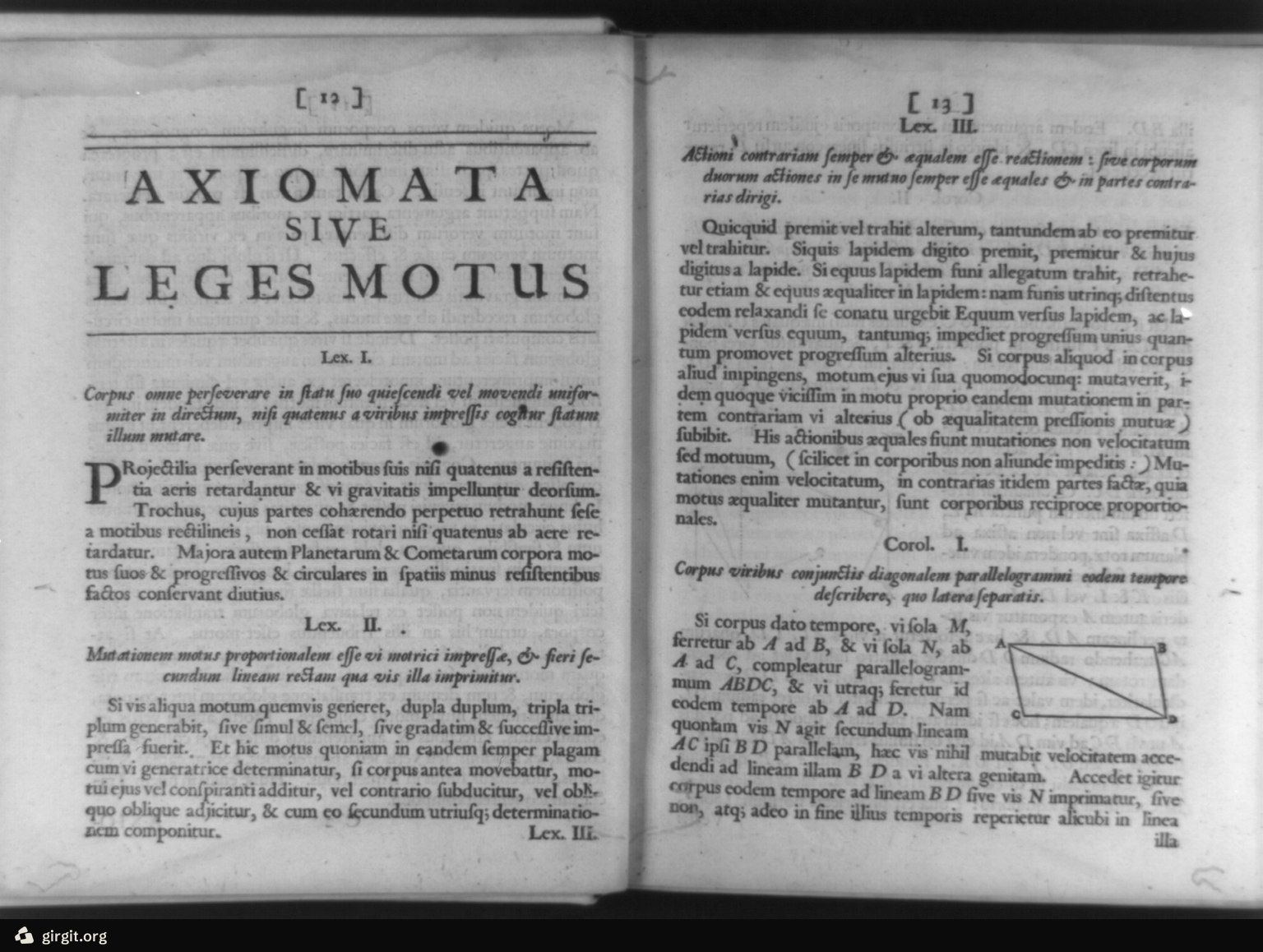 Lex IIIfinger presses stonehorse draws stone
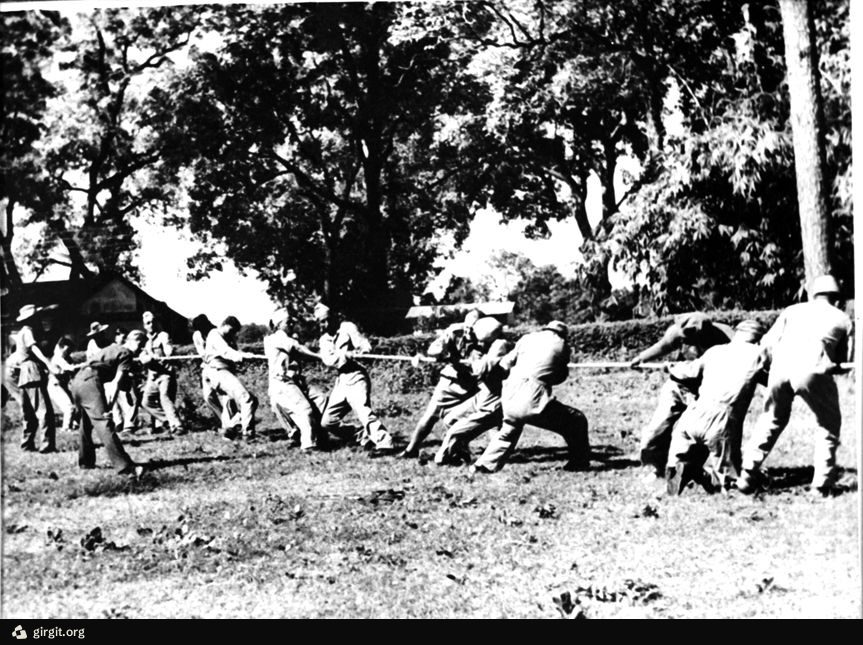 rope: same pull on both teamsfeet: the ground pushes back
Guess first, then change the road's push and the cart's drag. Tap any arrow to find its partner, and choose which body you are looking at.
Solve it
Solve it
A tug-of-war. Each team has a mass of 300 kg. The ground pushes team A (towards its own end) with 1700 N and team B with 1500 N. Treat the rope as light. Find the acceleration and the tension in the rope.
Hint
Answer
Solve it
Newton's floating magnet, with numbers. A 1 kg magnet and a 3 kg block of iron float on still water, 40 cm apart, both at rest. They pull each other together (ignore the water's drag). Where do they meet?
Answer
Solve it
Spot the error: "When I push a wall, it pushes me back just as hard. The two forces cancel, so I stay still."
Answer
Connect it
Connect it
- Conservation of momentum, next page. The third law, added up over time, is why a gun recoils and a boat moves back when you jump off: conservation of momentum.
- Free-body diagrams, this chapter. The two forces of a pair never appear on the same diagram: free-body diagrams.
- Friction, this chapter. The road's push on the horse and the ground's push on a tug-of-war team are friction: static and kinetic friction.
- Gravitation, Chapter 7. The Earth pulls the Moon exactly as hard as the Moon pulls the Earth: the universal law of gravitation.
- Electric charges, Class 12. Two charges at rest push or pull each other equally and oppositely: Coulomb's law.
- Daily life. A rower pushes water back with the oar and the water pushes the boat forward; a kabaddi raider pushes back on the mat to dart forward.
Still confused?
Can the horse pull the cart harder than the cart pulls the horse, if it is a strong horse?
No. The rope between them pulls both ways with the same tension, whatever the horse's strength. A stronger horse can make the road push it harder; the extra push goes into speeding up the horse and the cart together, and the tension rises with it, still the same at both ends.
Is the third law still true while things are accelerating?
Yes, always, at every instant. That is the difference from the equal weight and normal force of a book at rest: those two are equal only when the book is not accelerating. A pair is equal whatever the motion.
If I pull the earth up as hard as it pulls me down, why doesn't the earth jump towards me?
It does, a tiny bit. With a pull of 600 N on a mass of \( 6 \times 10^{24} \) kg, its acceleration is about \( 10^{-22} \) m s−2, far too small to notice. Equal forces, very unequal masses, very unequal accelerations.
Sources
- Newton, Principia (1687), Lex III, Latin Wikisource and Motte's translation: the finger and the stone, the horse and the stone, the scholium on attractions (the floating lodestone and iron) and on Wren, Wallis and Huygens.
- Wikipedia, "Newton's laws of motion": the third law and conservation of momentum; momentum carried by electromagnetic fields.
- Photo Division, Government of India (1951), tug-of-war at Dehra Dun and tug-of-war at the Hornbill Festival, Wikimedia Commons.

Picture and video credits
Show 2 picture and video credits
- tonga-murshidabad.jpg: Biswarup Ganguly, CC BY 3.0
- tug-of-war-hornbill.mp4: JyotiPN, CC BY-SA 4.0
