- 1. Does a moving thing need a push to keep going?
- 2. Inertia and Newton's first law
- 3. Momentum and Newton's second law
- 4. Why does a fielder pull his hands back?
- 5. Newton's third law: every push has a partner
- 6. Conservation of momentum
- 7. Equilibrium of a particle
- 8. The common forces in mechanics
- 9. Friction: static and kinetic
- 10. Rolling friction, and why we need friction
- 11. What keeps a car on a curve?
- 12. Solving problems with free-body diagrams
- Review
6 of 12·NCERT §4.7·pp. 57–58·5 min
Conservation of momentum
The big ideaWhen no external force acts on a group of bodies, their total momentum stays the same, however they push, pull, collide or fly apart.
In simple words
Two skaters stand still on ice and push each other. One slides left, the other slides right. Before the push, nobody was moving. After it, the "oomph" to the left exactly matches the "oomph" to the right, so it still adds up to nothing. Pushing each other can share out the oomph, but it cannot make any new oomph.
Why a gun kicks back
A gun fires a bullet. During the firing, the gun pushes the bullet forward with a force \( \vec F \). By the third law, the bullet pushes the gun backward with \( -\vec F \). The two forces last for the same short time \( \Delta t \).
By the second law, the bullet's momentum changes by \( \vec F\Delta t \) and the gun's by \( -\vec F\Delta t \). Both started at rest, so these changes are their final momenta:
\[ \vec p_{\text{bullet}} + \vec p_{\text{gun}} = 0 \]The gun moves back, or recoils, with exactly as much momentum as the bullet carries forward. The total momentum of the system (gun + bullet) was zero before and is still zero after. It is conserved.
The law
The same argument works for any group of bodies. An isolated system is a group of bodies with no net external force on it. Inside it, bodies may push and pull each other, and each one's momentum may change. But the forces come in equal and opposite pairs, so the changes they cause cancel in pairs too. This gives the law of conservation of momentum:
Conservation of momentum
- The total momentum of an isolated system of interacting particles is conserved (stays constant).
It is not a new law: it follows from Newton's second and third laws. And because momentum is a vector, it is conserved in each direction separately.
Collisions
Two bodies A and B start with momenta \( \vec p_A \) and \( \vec p_B \). They collide, and come apart with \( \vec p_A' \) and \( \vec p_B' \). While touching, for the same time \( \Delta t \), B pushes A with \( \vec F_{AB} \) and A pushes B with \( \vec F_{BA} \). By the second law,
\[ \vec F_{AB}\,\Delta t = \vec p_A' - \vec p_A, \qquad \vec F_{BA}\,\Delta t = \vec p_B' - \vec p_B \]By the third law \( \vec F_{AB} = -\vec F_{BA} \), so \( \vec p_A' - \vec p_A = -(\vec p_B' - \vec p_B) \). Rearranged:
\[ \vec p_A' + \vec p_B' = \vec p_A + \vec p_B \]Total momentum after equals total momentum before. This is true for every collision. In an elastic collision the total kinetic energy is also the same afterwards; in an inelastic collision some kinetic energy turns into heat, sound or a dent. You will meet this in the next chapter (Work, Energy and Power). But momentum is conserved in both.
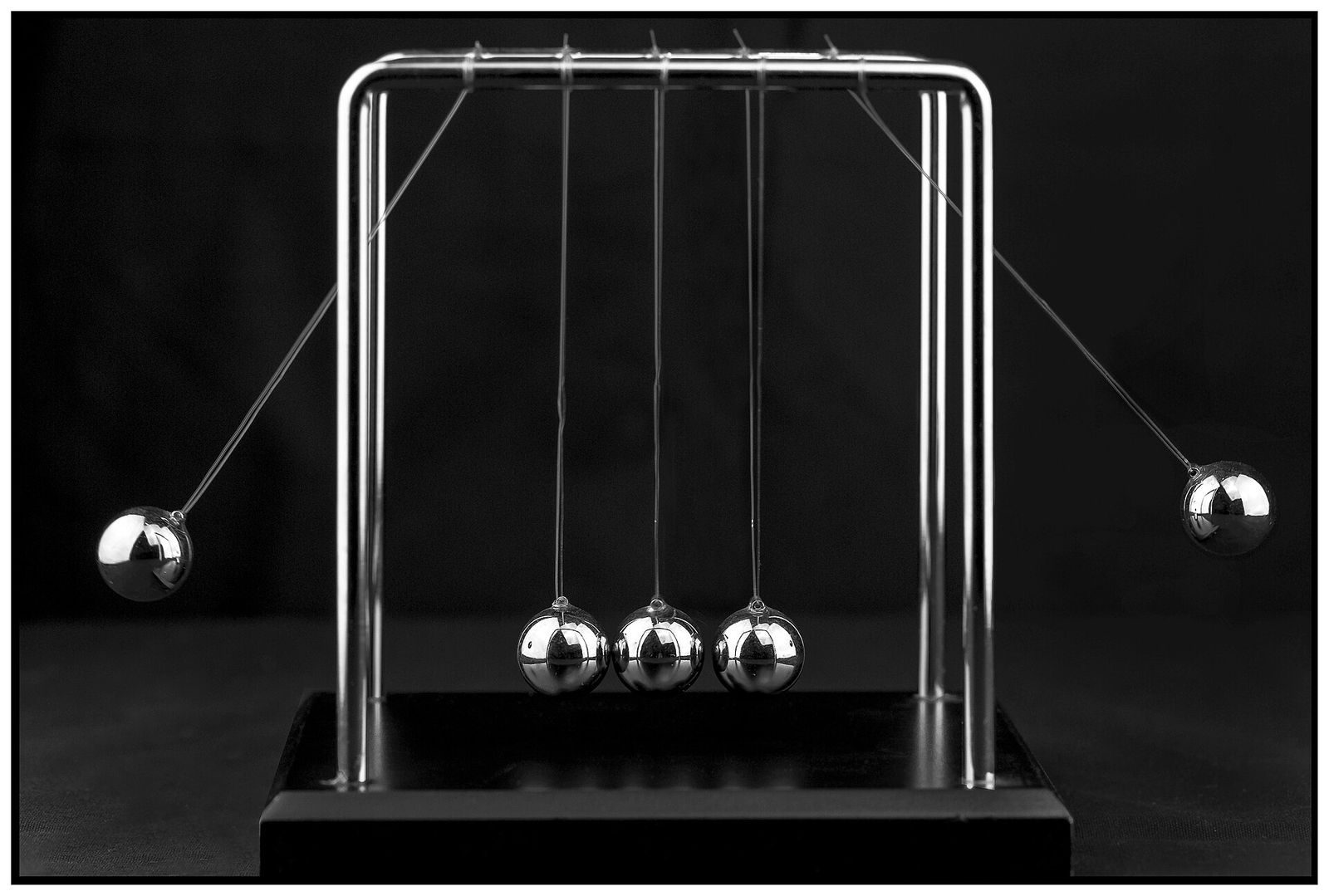 out to the leftout to the rightmiddle three: at rest
Don't mix these up
- Momentum is conserved in elastic and inelastic collisions alike. Kinetic energy is conserved only in elastic ones.
- Conservation needs zero net external force. Internal forces, however large, never change the total.
- Add momenta as vectors: signs in one dimension, components or a triangle in two.
Worked example
A 4 kg rifle fires a 20 g bullet at 400 m s−1. Find the rifle's recoil velocity.
- Total momentum before: 0.
- After: \( 0.020 \times 400 + 4 \times V = 0 \), so \( 8 + 4V = 0 \).
- \( V = -2 \) m s−1: the rifle moves back at 2 m s−1. That is why you hold it firmly against your shoulder, so that your body adds its mass and the kick is gentler.
Try it: choose a boat, then jump to the ghat. Watch the two momenta.
Worked example
A 2 kg trolley moving at 3 m s−1 hits a 1 kg trolley at rest, and they stick together. How fast do they move?
- Before: \( 2 \times 3 + 1 \times 0 = 6 \) kg m s−1.
- After: \( (2 + 1)V = 6 \), so \( V = \) 2 m s−1.
- Kinetic energy before: \( \tfrac12 \times 2 \times 9 = 9 \) J. After: \( \tfrac12 \times 3 \times 4 = 6 \) J. Momentum is conserved; kinetic energy is not. This is an inelastic collision.
Try it: guess first, then run the trolleys, stuck or bouncing.
Explosions
A body at rest that bursts into pieces has zero momentum before, so the pieces' momenta must add up to zero after. Two pieces must fly off in exactly opposite directions. With three pieces, the momentum of any one must be equal and opposite to the vector sum of the other two.
Worked example
A firecracker at rest bursts into three equal pieces. Two fly off at right angles to each other, each at 10 m s−1. Find the speed and direction of the third.
- Let each piece have mass \( m \). The two known momenta are \( 10m \) along x and \( 10m \) along y.
- Their sum has size \( \sqrt{(10m)^2 + (10m)^2} = 10\sqrt2\,m \), at 45° between them.
- The third piece must cancel it: \( mv = 10\sqrt2\,m \), so \( v = 10\sqrt2 \approx \) 14.1 m s−1, pointing at 135° from each of the other two (directly opposite their sum).
A burst does not have to start from rest. If the firework shell was moving, the pieces together still carry the shell's old momentum. Their average position goes on along the same path, as if the shell had never burst.
 burst: sparks fly out every waythe shell climbing
Try it
A 60 kg girl standing on a 40 kg raft at rest on still water jumps off horizontally at 2 m s−1. How fast does the raft move?
Answer
Just remember
The law itself has a reason (the third law, above). These are the bits to learn as they are: a condition, a sign habit and two names.
- Conserved only if the net external force is zero
- "Family money": brothers lending to each other never changes the family's total. Only money from outside (an external force) can change it.
- Pick one direction as + and keep it
- Write every velocity with its sign before you add: the recoiling gun's −2 m s−1 is what makes the total come out zero.
- Elastic: kinetic energy also kept · inelastic: some lost (most lost when they stick)
- An elastic band springs back fully; clay doesn't. Momentum is kept in both.
- Recoil
- From French reculer, "to go back" (cul = the rear): the gun goes back.
- Isolated system
- A group of bodies with no net external force on it.
- Conservation of momentum
- The total momentum of an isolated system stays constant.
- Recoil
- The backward motion of a gun (or anything) that throws something forward.
- Elastic collision
- A collision in which total kinetic energy is also unchanged.
- Inelastic collision
- A collision in which some kinetic energy is lost; momentum is still conserved.
Words to know
A heavy gun and a light bullet fly apart when fired from rest. Which is true just after firing?
- They move with equal speeds
- They have equal and opposite momenta
- They have equal kinetic energies
Two clay balls collide and stick together. Which is conserved?
- Kinetic energy only
- Momentum only
- Both momentum and kinetic energy
A nucleus at rest splits into two pieces. The pieces must
- move in exactly opposite directions
- move with equal speeds
- move in the same direction
Deep dive · optional
How does a rocket push on nothing?
A rocket is a gun that fires its own gas instead of bullets, again and again. Why that works in empty space, why a newspaper got it wrong for 49 years, and why rockets are mostly fuel. The exam doesn't need this; it makes the page stick.
The roots: the gas is the thing it pushes
- Why does a rocket go up?It throws hot gas out of its nozzle, very fast, all the time. The gas carries momentum one way, so the rocket gets the same momentum the other way, exactly as the gun does when it fires a bullet.
- Why must the rocket get exactly the gas's momentum?While the engine pushes the gas out, the gas pushes back on the engine. These two forces are a third-law pair: equal, opposite, and lasting the same time. So the momentum the gas gains is the momentum the rocket gains, with the sign flipped.
- Why can't those inside pushes change the total?Every internal push comes with its partner inside the same system, and the two changes cancel when you add them. Only a force from outside the system (gravity, air drag) can change the total.
- So what does the rocket push against?Against its own gas. The push happens inside the engine, between the rocket and the gas it is throwing out. Nothing else is needed. Air does not help at all; it only gets in the way as drag.
- And the bedrock?Newton's third law: a force is always an interaction between two bodies, and here the two bodies are the rocket and its exhaust.
Follow the bookkeeping for a burn. Say the rocket throws its fuel back as a series of small puffs, each leaving at speed \( u \) relative to the rocket. A puff of mass \( \Delta m \) thrown from a rocket of mass \( M \) changes the rocket's velocity by \( \Delta v = u\,\Delta m / M \). Two things follow.
- Late puffs count for more. The same puff gives a bigger kick to a lighter rocket, so the rocket gains most of its speed at the end of the burn, when the tanks are nearly empty. Adding up very many tiny puffs gives \( v = u \ln(M_0/M) \) (you will meet this "ln" in maths). With 90% of the rocket as fuel, \( M_0/M = 10 \) and the final speed is \( 2.3\,u \).
- The rocket can outrun its own exhaust. Once the rocket moves faster than \( u \), the gas it throws out still moves forwards over the ground, only more slowly than the rocket. It still pushes the rocket on, because what matters is the speed of the gas relative to the rocket.
Real exhaust speeds run from about 2.5 km/s for big solid-fuel boosters to about 4.4 km/s for the best hydrogen-burning engines. An orbit needs about 7.8 km/s. That is why launch rockets are mostly fuel and drop their empty tanks in stages.
The story
See it
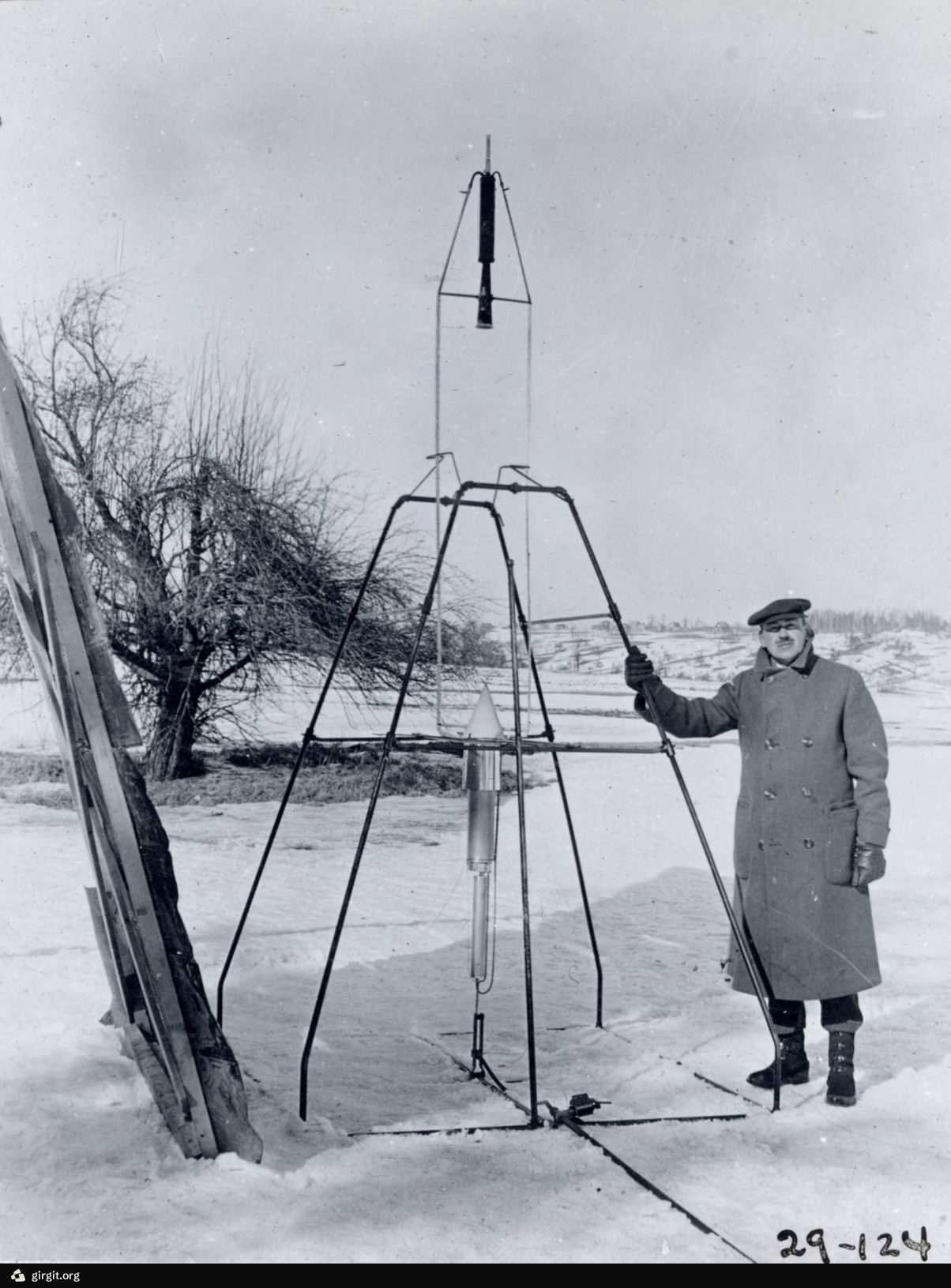 motor on toptanks belowGoddard
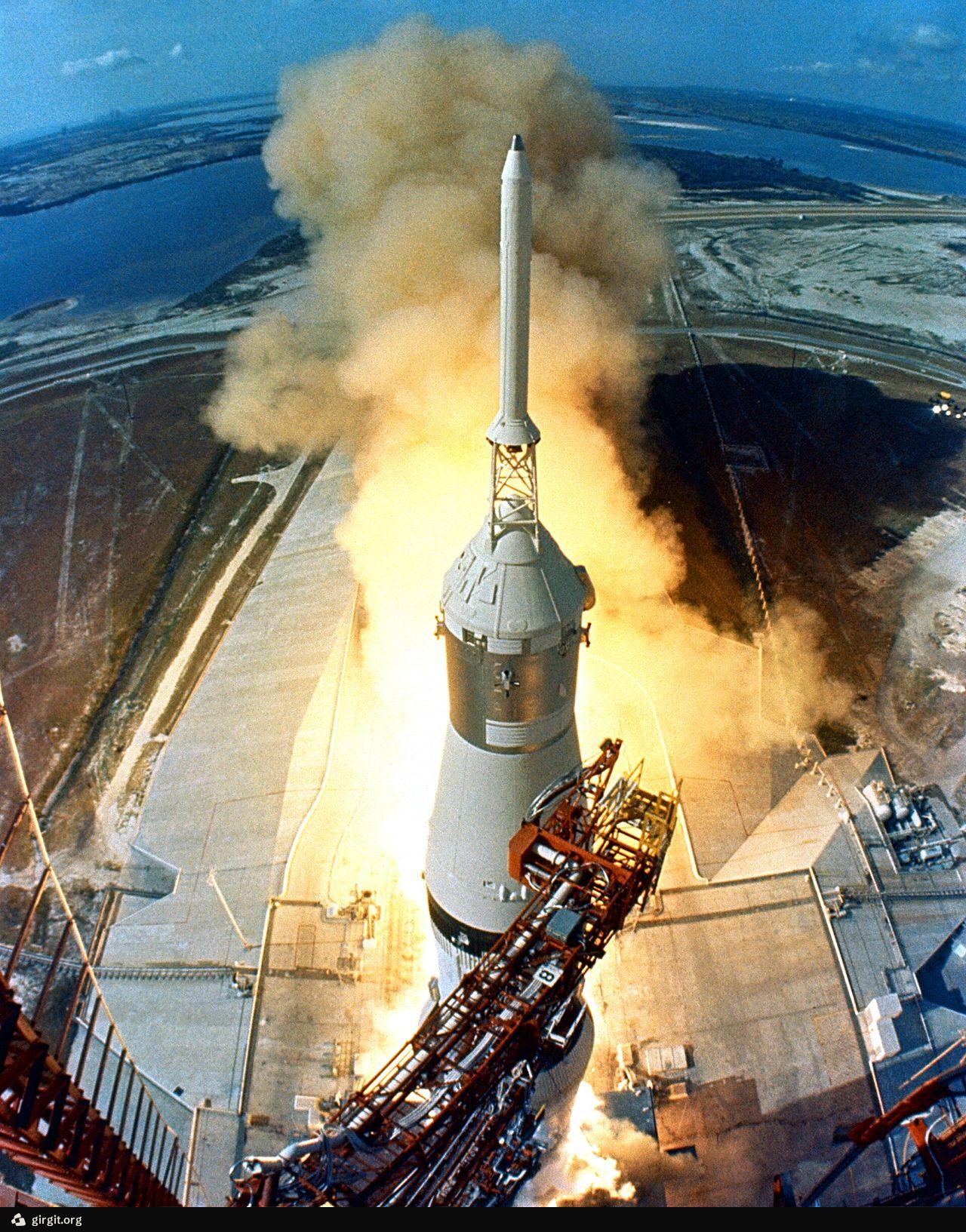 rocket goes upgas goes down
Guess first, then fire the engine in empty space, puff by puff. Watch the gas: each puff keeps its own velocity, and the two momentum bars always balance.
Solve it
Solve it
An astronaut, 80 kg with her suit, has drifted 10 m from the space station and her tether has broken. She is at rest relative to the station and has only a 2 kg spanner. What should she do, and how long will it take her to get back?
Hint
Answer
Solve it
A rocket of mass 5000 kg (with fuel) burns 50 kg of fuel every second and throws the gas out at 2.0 km/s relative to the rocket. Find the thrust, its acceleration just after lighting far out in space, and its acceleration just after lighting on the launch pad (g = 9.8 m s−2).
Hint
Answer
Solve it
Spot the problem. A sailor on a becalmed boat sets up a big electric fan on deck and points it at his own sail. Will the boat move forward?
Hint
Answer
Connect it
Connect it
- Third law, this chapter. The rocket and its gas are a textbook action-reaction pair, acting on two different bodies: Newton's third law.
- Impulse, this chapter. Thrust is impulse delivered every second: impulse.
- Collisions, Chapter 5. Momentum is kept in every collision; kinetic energy only in elastic ones: collisions.
- Centre of mass, Chapter 6. Why the firework's pieces keep the shell's path: internal forces cannot move the centre of mass: motion of the centre of mass.
- Satellites, Chapter 7. The speeds rockets have to reach: Earth satellites and escape speed.
- Daily life. A fire hose kicks back in the firefighters' hands; a balloon let go zooms round the room; a garden sprinkler spins. All are small rockets.
Still confused?
A ball falls and speeds up. Isn't momentum being created?
For the ball alone, yes: the Earth's gravity is an external force on it, so its momentum changes. Take the ball and the Earth together and the ball also pulls the Earth up with an equal force. The Earth gains an equal momentum upwards, far too small a speed to notice because its mass is so huge. The total stays the same.
If momentum is conserved in a crash, why is the car wrecked?
Conservation is about the total. Each car's own momentum changes a lot in a fraction of a second, and that needs huge forces between them: those forces crumple the metal. Kinetic energy is not conserved in such a crash; it goes into bending, heat and sound.
Does a rocket go faster in air, because it can push on the air?
No. The push is between the rocket and its exhaust, inside the engine. Air only adds drag, and the air pressing on the nozzle's opening slightly reduces the thrust, which is why engines give a little more thrust in vacuum than at sea level.
Sources
- Wikipedia, "Robert H. Goddard": the 1919 paper, the 1920 editorial, the 1926 flight, the 1969 correction.
- Astronautics Now, "Goddard and the New York Times": the wording of the 1920 column and the 1969 correction.
- NASA, "95 years ago: Goddard's first liquid-fueled rocket": engine on top, tanks below; 41 feet, 2.5 seconds, 184 feet.
- Wikipedia, "Specific impulse": effective exhaust speeds of real engines (about 2.5 to 4.4 km/s).
- Wikipedia, "Thumba Equatorial Rocket Launching Station": 21 November 1963, Nike-Apache, the church and the school.
- NASA, Apollo 11 launch photograph and NASA, Artemis I launch in slow motion.

Picture and video credits
Show 2 picture and video credits
- newtons-cradle-two-balls.jpg: Sheila Sund from Salem, United States, CC BY 2.0
- firework-rocket-bursts.jpg: Michael Gaylard from Horsham, UK, CC BY 2.0

