Motion in a Straight LineFull experience
- 1. What does it mean to move?
- 2. How fast, on average?
- 3. How fast right now?
- 4. What is acceleration?
- 5. Reading velocity-time graphs
- 6. The three equations of motion
- 7. Why does a ball fall faster and faster?
- 8. Stopping distance and reaction time
- 9. Relative velocity
- Review
2 of 9·NCERT §2.1 · §2.2·pp. 13–15·5 min
How fast, on average?
The big ideaAverage velocity is displacement divided by time; average speed is path length divided by time.
In simple words
If you want to know how fast a trip was overall, take how far you went and share it out over the time it took. You can count "how far" in two ways: only where you ended up, or every step you walked. The two ways give two different answers.
Average velocity
The average velocity of an object over a time interval is its displacement divided by the time taken:
\[ \bar v = \frac{x_2 - x_1}{t_2 - t_1} = \frac{\Delta x}{\Delta t} \]Here \( x_1 \) is the position at time \( t_1 \), \( x_2 \) is the position at the later time \( t_2 \), and the bar over \( v \) means "average". The SI unit is metre per second, m s−1.
Because displacement has a sign, so does average velocity. A negative value means the object ended up on the negative side of where it started. Velocity has both a size and a direction.
Average speed
Average speed is the total path length divided by the total time:
\[ \text{average speed} = \frac{\text{total path length}}{\text{total time}} \]Path length is never negative, so average speed is never negative. It has no direction.
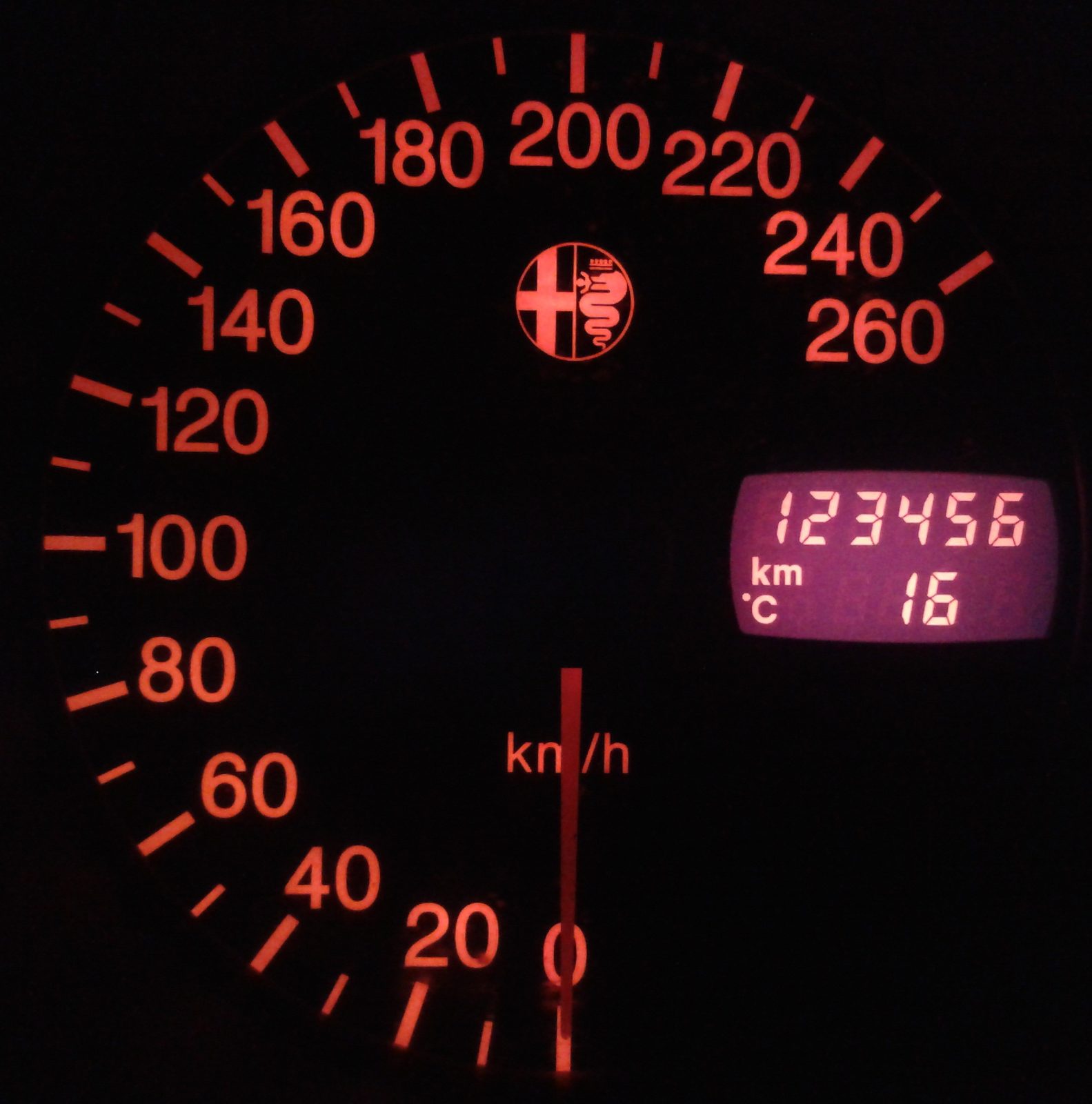 odometer: total path, never goes downneedle at 0: speed right now
Worked example
Back to the walk from concept 1: 300 m east to the shop in 5 minutes, then 500 m west to the temple in 10 minutes. Find the average velocity and average speed. (East is positive.)
- Total time = 15 min = 900 s.
- Displacement = −200 m, so average velocity = \( \dfrac{-200}{900} \approx -0.22 \) m s−1 (that is, 0.22 m s−1 towards the west).
- Path length = 800 m, so average speed = \( \dfrac{800}{900} \approx 0.89 \) m s−1.
The two numbers are very different because the walk turned back.
Over any time interval, average speed ≥ |average velocity|. They are equal only if the object never turns back.
Try it: walk to the market and back, and drag the clock.
On a position-time graph
A position-time graph (x-t graph) has time along the bottom and position up the side. Pick two points on it. The straight line joining them is a chord, and its slope, rise \( \Delta x \) over run \( \Delta t \), is exactly the average velocity between those two times.
- A flat line: the position does not change. The object is at rest.
- A straight sloping line: equal displacements in equal times. This is uniform motion, and the velocity is the same all the time.
- A steeper line means a bigger velocity. A line sloping down means negative velocity: moving in the negative direction.
The half-distance trap
Before you read on, make a guess.
Most people guess wrong here. A scooter rides 30 km at 30 km/h, then another 30 km at 60 km/h. What is its average speed? The tempting answer is 45 km/h. It is not.
Worked example
- Time for the first 30 km = 30 ÷ 30 = 1 h.
- Time for the second 30 km = 30 ÷ 60 = 0.5 h.
- Average speed = total distance ÷ total time = 60 ÷ 1.5 = 40 km/h.
The scooter spends more time at the slow speed, so the average leans towards 30. For two equal distances at speeds \( v_1 \) and \( v_2 \):
\[ \bar v = \frac{2 v_1 v_2}{v_1 + v_2} \]Only when the two speeds last for equal times is the answer the simple mean, \( (v_1 + v_2)/2 \).
Try it
An auto-rickshaw goes 4 km east in 10 min, then 1 km west in 5 min. Find its average speed and average velocity in km/h.
Answer
Remember
- \( \bar v = \Delta x / \Delta t \): uses displacement, has a sign.
- Average speed = path length ÷ time: never negative.
- Average speed ≥ |average velocity| over any interval.
- Equal distances: \( 2v_1v_2/(v_1+v_2) \). Equal times: \( (v_1+v_2)/2 \).
Just remember
These are names and symbols, chosen long ago. Use the hooks.
- \( \bar v \), "v bar", means average velocity
- The bar is a ruler laid flat across the ups and downs of the speed: it levels them into one value.
- Velocity has a direction; speed does not
- velocity: to reach a city you must know which way. Speed is just the speedometer number.
- m s−1 is read "metre per second"
- The −1 power means "per": s−1 = 1/s. So m s−2 later is "per second, per second".
- Average velocity
- Displacement divided by the time taken.
- Average speed
- Total distance travelled divided by the time taken.
- Position-time graph
- A graph of position (up) against time (along).
- Uniform motion
- Equal displacements in equal intervals of time; a straight x-t line.
- Chord
- A straight line joining two points of a curve; its slope is the average velocity.
Words to know
A cyclist goes up a hill at 10 km/h and comes back down the same road at 30 km/h. What is the average speed for the round trip?
- 20 km/h
- 15 km/h
- 0 km/h
On a position-time graph, a horizontal straight line means the object is
- moving with constant velocity
- at rest
- speeding up
Deep dive · optional
Why the slow part always wins
An average speed is not the average of the speeds you used. It leans towards the slow parts, sometimes so hard that no amount of speeding up later can rescue it. Here is why. The exam doesn't need this; it makes the page stick.
The roots: every second gets one vote
- Why isn't 30 km/h then 60 km/h, over equal distances, an average of 45?Because you spend twice as long at 30 as at 60. The slow half fills two-thirds of the trip's time.
- Why should time decide?Because average speed is defined as total distance over total time. Each second of the trip counts equally, not each kilometre.
- Why define it that way?So that it answers a useful question: what single steady speed would cover the same distance in the same time? That is what a timetable needs.
- What does that make the average, in symbols?For pieces of the trip at steady speeds: \( \bar v = \dfrac{v_1 t_1 + v_2 t_2 + \dots}{t_1 + t_2 + \dots} \). A time-weighted mean: each speed counts in proportion to how long it lasted.
- And the bedrock?Distance = speed × time for steady motion, and distances add. Nothing more.
Two things follow at once. First, an average of this kind always lies between the slowest and the fastest speed used: it is a weighted mean of them. Second, the slower a piece, the more time it eats, so the more weight it gets. When the distances are equal, the weights work out to give \( 2v_1v_2/(v_1+v_2) \), always below the plain mean.
Push it to the limit. Suppose the first half of a trip went slowly. Your whole time budget for a target average is fixed: total distance ÷ target speed. If the slow half has already used it all, the second half would need zero time, which means infinite speed. That is the trap in the widget below.
The same is true of velocity, with one change: displacement replaces distance, so pieces in opposite directions cancel. That is why an athlete can run 42 km and have an average velocity close to zero.
The story
See it
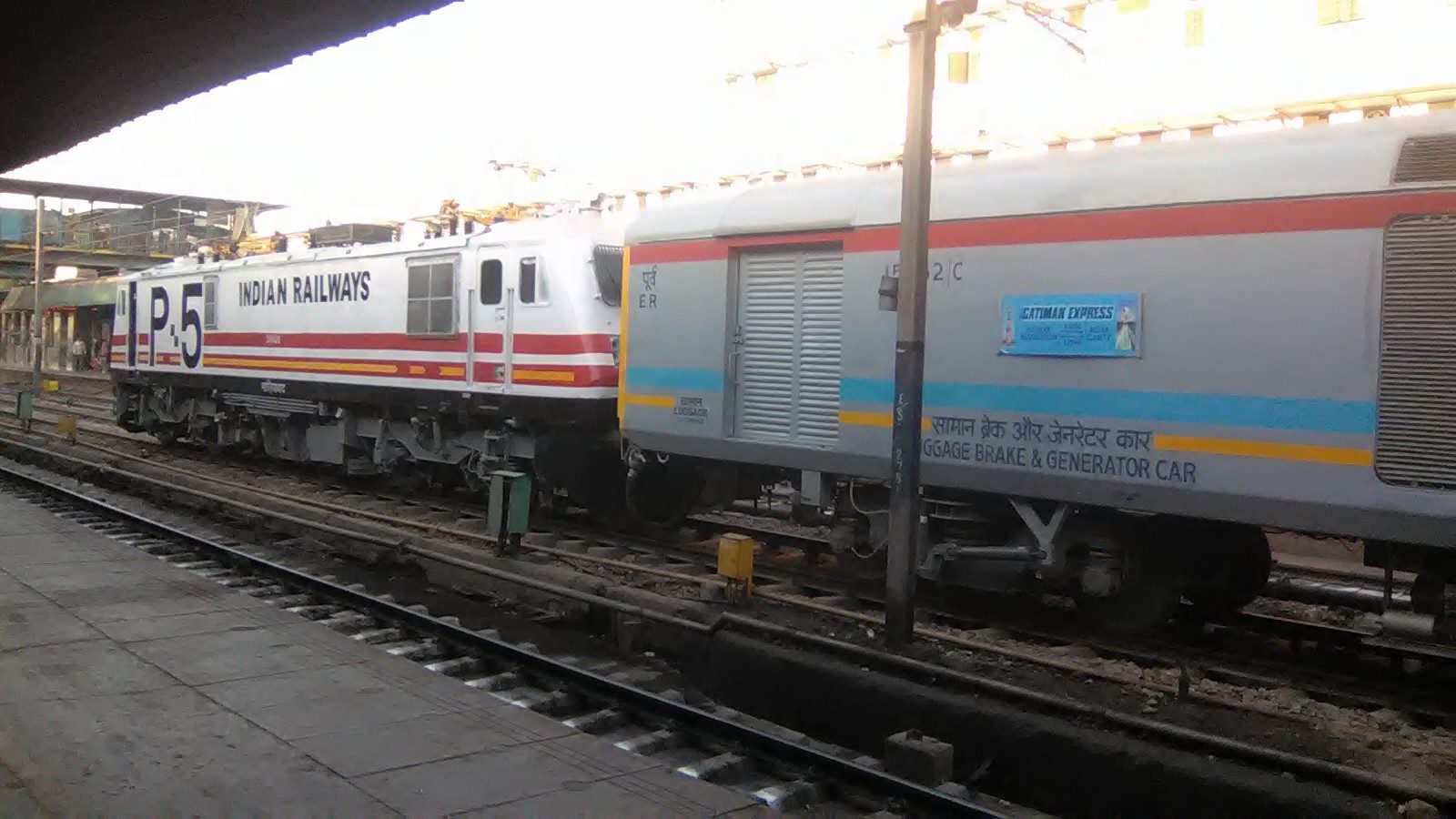 WAP-5 locomotiveGatimaan Express board
Before reading on, try to rescue a slow start: how fast must the second half be?
Solve it
Solve it
Suppose a train like the Gatimaan covered 188 km at a steady 160 km/h, except for the first and last 10 km, which it ran at 40 km/h. What would its average speed be?
Hint
Answer
Solve it
Can the average speed of a trip ever be less than the slowest speed used during it, if the vehicle never stops?
Answer
Solve it
A bus goes from A to B at 40 km/h and returns at 60 km/h. A second bus does the round trip at a steady 48 km/h. Which gets back first?
Answer
Connect it
Connect it
- The half-distance trap, above. The formula \( 2v_1v_2/(v_1+v_2) \) is a special case of the time-weighted mean, for two equal distances.
- Instantaneous velocity, next. Shrink one of the pieces to a tiny instant and the "average over that piece" becomes the velocity at an instant: how fast right now?
- Maths: other averages. The arithmetic mean, the geometric mean and this one (the harmonic mean) each answer a different question: why the A.M. is never less than the G.M.
- Daily life. A scooter's "km per litre" works the same way: half the petrol at 30 km/l and half at 50 km/l is not the same as half the distance at each.
Still confused?
So is average velocity ever the plain average of two velocities?
Yes, whenever the two velocities last for equal times. And for one more case: steady acceleration, where the velocity changes evenly with time, so the average is exactly half-way between the start and the end. You meet that in the equations of motion.
Why can average speed be bigger than average velocity, but never smaller?
Because path length is never smaller than the size of the displacement: turning back adds to the path and takes away from the displacement. Divide both by the same time and the inequality stays.
Sources
- Railway Gazette, "India launches first 160 km/h semi-high speed train" (2016): launch date, 188 km, 1 h 40 min, 160 km/h.
- World Athletics, Kiptum's world marathon record ratified: 2:00:35, Chicago, 8 October 2023.
- CBS Chicago, Chicago Marathon course map: start and finish on Columbus Drive in Grant Park.
Picture and video credits
Show 2 picture and video credits
- odometer-123456-km.jpg: Riley from Christchurch, New Zealand, CC BY 2.0
- gatimaan-express.jpg: Nikhilb239, CC BY-SA 4.0

