Motion in a Straight LineFull experience
- 1. What does it mean to move?
- 2. How fast, on average?
- 3. How fast right now?
- 4. What is acceleration?
- 5. Reading velocity-time graphs
- 6. The three equations of motion
- 7. Why does a ball fall faster and faster?
- 8. Stopping distance and reaction time
- 9. Relative velocity
- Review
9 of 9·NCERT §2.5·5 min
Relative velocity
The big ideaThe velocity of B as seen from A is B's velocity minus A's velocity: \( v_{BA} = v_B - v_A \).
In simple words
Sit in a train and look at a train next to you going the same way at the same speed. It seems to stand still. If it goes the other way, it rushes past. How fast something seems to move depends on how fast you are moving yourself.
Velocity as seen by someone else
So far every position was measured from a fixed origin on the ground. But motion is relative: the same object can be still for one observer and moving for another. A passenger asleep in a moving train is at rest compared with the train, and moving at 100 km/h compared with the platform.
Let two objects A and B move along the same line with constant velocities \( v_A \) and \( v_B \), both measured from the ground. The relative velocity of B with respect to A is
\[ v_{BA} = v_B - v_A \]Read \( v_{BA} \) as "velocity of B as seen from A". Turning it round, A as seen from B is \( v_{AB} = v_A - v_B = -v_{BA} \): the same size, opposite sign.
- Same direction: the speeds subtract. Two buses at 50 and 60 km/h seem to creep apart at only 10 km/h.
- Opposite directions: the speeds add. Two buses at 50 and 60 km/h heading at each other close the gap at 110 km/h.
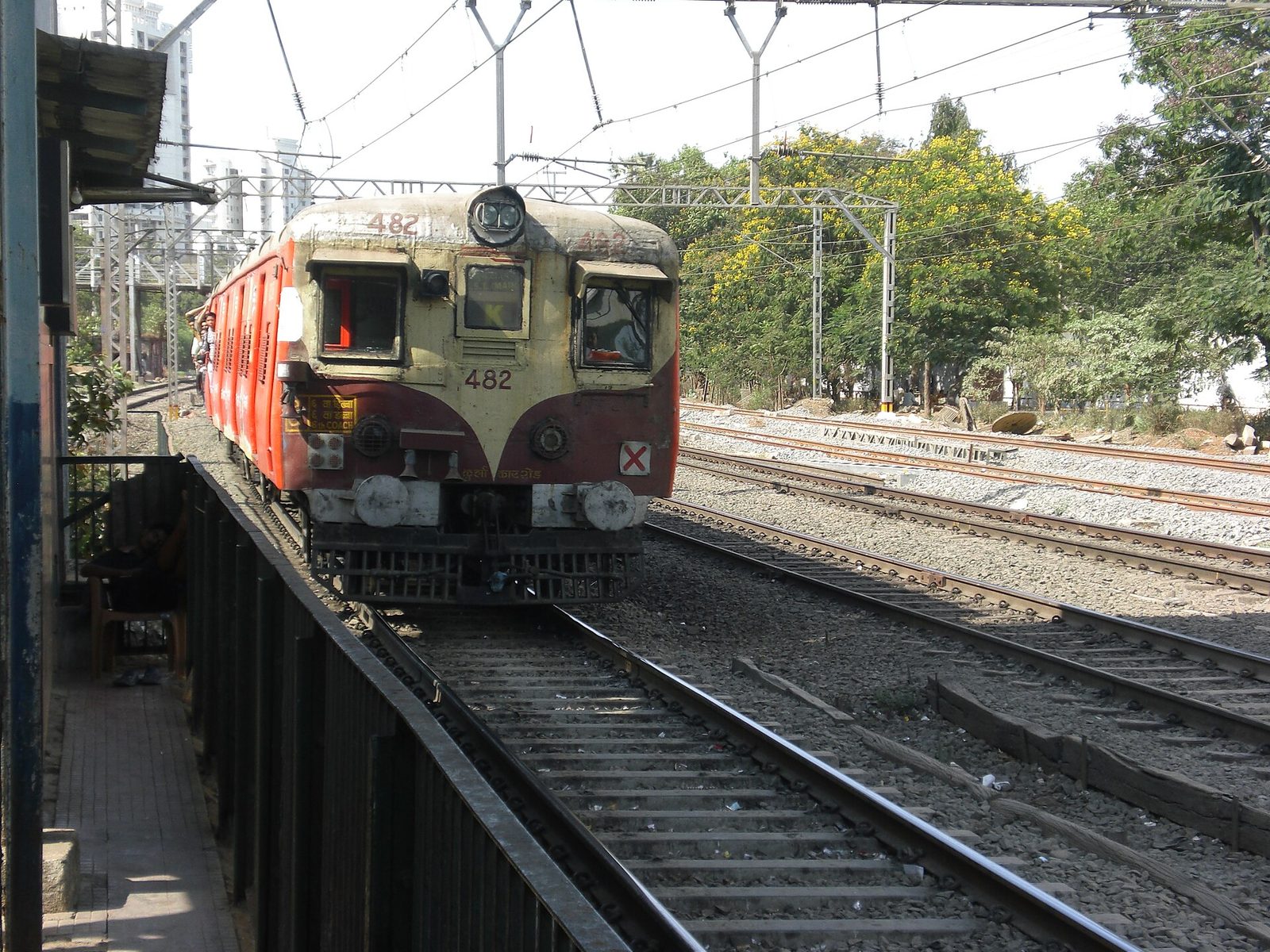 train on one trackparallel tracks
Try it: ride train A and set train B's speed.
 walking on the moving beltmoving walkway
What the x-t graphs show
Draw both objects on the same x-t graph. Each is a straight line, with slope equal to its velocity. The vertical gap between the lines, \( x_B - x_A \), is the position of B as seen from A, and it changes at the rate \( v_B - v_A \).
- Parallel lines (\( v_A = v_B \)): the gap never changes. Each sees the other at rest; \( v_{BA} = 0 \).
- Lines that spread apart: the gap grows; B is pulling away.
- Lines that cross: at the crossing, both have the same position. That is when one overtakes or meets the other.
Try it: a police jeep chases a speeding car.
Worked example
A Rajdhani Express 300 m long runs at 30 m s−1 on a track beside a goods train 400 m long going the same way at 20 m s−1. How long does the Rajdhani take to overtake it completely? How long would they take to pass each other if the goods train were going the other way?
- "Completely" means from the Rajdhani's engine reaching the goods train's tail until its own last coach passes the goods engine. Relative to the goods train, the Rajdhani must cover both lengths: 300 + 400 = 700 m.
- Same direction: \( v_{RG} = 30 - 20 = 10 \) m s−1. Time = 700 ÷ 10 = 70 s.
- Opposite directions: \( v_{RG} = 30 - (-20) = 50 \) m s−1. Time = 700 ÷ 50 = 14 s.
See it with two trains on a hillside.
Before the next example, a guess.
Worked example
Walking up a stopped moving walkway takes Ravi 60 s. Standing still on it when it runs takes 40 s. How long if he walks on it while it runs?
- Let the walkway's length be \( L \). Ravi's walking speed is \( L/60 \); the belt's speed is \( L/40 \).
- Walking on the running belt, the speeds add: \( \dfrac{L}{60} + \dfrac{L}{40} = \dfrac{5L}{120} = \dfrac{L}{24} \).
- Time = \( L \div (L/24) = \) 24 s. In general, \( t = \dfrac{t_1 t_2}{t_1 + t_2} \).
Notice the answer is shorter than both 40 s and 60 s, which makes sense: two pushes together beat either alone.
A neat case: two falling bodies
Drop one stone from a bridge and, at the same moment, throw another straight down at 5 m s−1. Both have the same acceleration \( g \) downward, so their relative acceleration is zero. Seen from the first stone, the second just moves away at a steady 5 m s−1. Relative velocity between two freely falling objects never changes.
Try it
A scooter rides at 40 km/h. A bus going the same way at 60 km/h overtakes it. (a) What is the bus's velocity relative to the rider? (b) The rider's relative to the bus? (c) What if the bus were coming the other way?
Answer
Remember
- \( v_{BA} = v_B - v_A \), and \( v_{AB} = -v_{BA} \).
- Same direction: subtract speeds. Opposite: add them.
- Parallel x-t lines: zero relative velocity; crossing lines: they meet.
- Overtaking or crossing a train: relative distance = sum of the lengths.
Just remember
The order of the letters is a convention. Get it backwards and every sign flips.
- \( v_{BA} \) = velocity of B as seen from A = \( v_B - v_A \)
- Read it "B from A": the first letter is the actor on stage, the second is the audience watching. The audience's own velocity is the one you subtract.
- Relative velocity
- The velocity of one object as seen from another.
- vBA
- Velocity of B relative to A, equal to vB − vA.
- Observer
- The person or object from whose point of view motion is measured.
- Relative acceleration
- The difference of two accelerations; zero for two freely falling bodies.
Words to know
Two trains on parallel tracks have straight x-t lines that are parallel. What does a passenger in one see of the other?
- It seems to stand still
- It is about to collide
- It seems to pull steadily away
Car A goes east at 15 m/s and car B goes west at 10 m/s. What is the velocity of B relative to A? (East positive.)
- −5 m/s
- −25 m/s
- +25 m/s
Deep dive · optional
Can you tell whether your train is moving?
Velocities change when the watcher changes, but some things never do. Why that is, the ship's cabin Galileo used to prove it, and the speed at which the simple rule finally breaks. The exam doesn't need this; it makes the page stick.
The roots: a moving origin
- Why do velocities just subtract when the watcher changes?Because the watcher is a moving origin. B's position measured from A is \( x_B - x_A \), and its rate of change is \( v_B - v_A \).
- Why does a moving origin change velocities but a fixed one doesn't?Shifting the origin by a fixed amount changes every position by the same constant, which drops out of every rate (page 1's deep dive). A moving origin shifts positions by an amount that grows steadily, \( v_A t \), so every velocity drops by \( v_A \).
- What stays the same for every steadily moving watcher?Differences of velocities (how fast B gains on C) and all accelerations. Subtracting the same constant \( v_A \) from every velocity can't change how fast any velocity changes.
- So why can't you feel a train moving smoothly?Everything you can check inside it, a dropped coin, a cup of tea, a ball tossed to a friend, depends on accelerations and on positions relative to the carriage. None of those change when the whole carriage moves steadily. Only a jolt, a change of velocity, gives it away.
- And the bedrock?Subtraction, once more, plus experiment: no test done inside a steadily moving room has ever shown which way, or whether, it moves.
On an x-t graph, changing the watcher tilts every line by the same amount: each slope drops by the watcher's velocity, and the watcher's own line becomes flat. Points where two lines cross stay crossings, at the same time. Two trains that meet, meet for everybody; only the speeds people report differ.
Your eyes judge motion the same way, by comparing. Sitting in a stopped train, you may feel your own train start when it is really the train on the next track that moves. Psychologists call the feeling of self-motion produced by a moving scene "vection"; Ernst Mach studied it in 1875 with a large rotating striped drum.
The rule \( v_{BA} = v_B - v_A \) has one limit. Close to the speed of light, c, velocities stop adding and subtracting simply. In 1905 Einstein showed that two velocities v and w combine to \( (v + w)/(1 + vw/c^2) \), never more than c. For trains the correction \( vw/c^2 \) is about one part in a hundred million million, so on earth the simple rule is as good as exact.
The story
See it
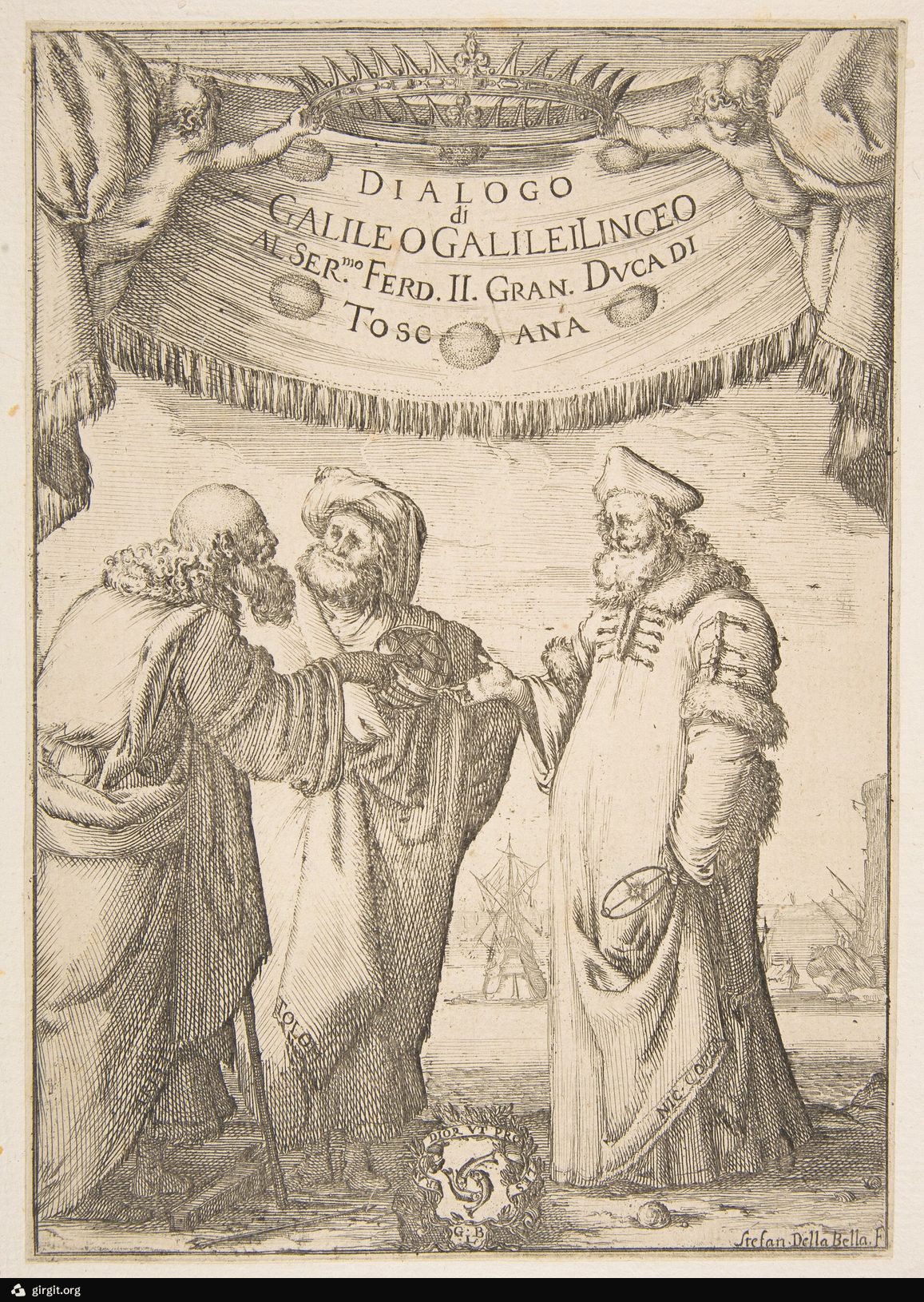 AristotlePtolemyCopernicusships in the harbour
Changing who is watching changes every velocity by the same amount. Ride along and watch the graph tilt.
Solve it
Solve it
You sit at the window of a train running at 130 km/h. A goods train on the next track runs at 50 km/h. Suppose each goods wagon is 15 m long. How many wagons pass your window each second if the goods train goes (a) the same way, (b) the other way?
Answer
Solve it
In a train moving steadily at 25 m s−1, you drop a coin from a height of 1.25 m. Where does it land, and where does a person on the platform see it land? (g = 10 m s−2.)
Answer
Solve it
Use Einstein's rule to find how wrong the simple rule is for two trains approaching each other at 30 m s−1 each. (c = 3 × 10⁸ m s−1.)
Answer
Connect it
Connect it
- Laws of motion, Chapter 4. Galileo's ship leads straight to the law of inertia: steady motion needs no cause. Inertia and the first law.
- Vectors, Chapter 3. In a plane, relative velocity is vector subtraction, \( \vec v_B - \vec v_A \): adding (and subtracting) vectors.
- Collisions, Chapter 5. How fast two bodies approach and separate, relative velocity again, decides how bouncy a collision is: collisions in one dimension.
- Page 1's deep dive. Moving the origin by a fixed amount changed nothing that mattered; moving it steadily changes velocities but not accelerations: where is zero?
Still confused?
Which velocity is the "real" one, then?
None of them, and all of them. A velocity is always measured from something. "Relative to the ground" is the everyday default, so that is what a question means when it doesn't say.
Why does a train going round a curve or braking give itself away, when a steady one doesn't?
Because those are changes of velocity, accelerations, and accelerations are the same for every steadily moving watcher. Your tea sloshes because the carriage accelerates and the tea doesn't, at first.
Sources
- Galileo, Dialogue Concerning the Two Chief World Systems (1632), Second Day, the ship passage (Drake's translation, excerpt).
- Einstein, "On the Electrodynamics of Moving Bodies" (1905), §5, the composition of velocities.
- "Measuring vection", Behavior Research Methods (2024): the train illusion and Mach's 1875 drum.
Picture and video credits
Show 2 picture and video credits
- mumbai-local-train.jpg: Arne Hückelheim, CC BY-SA 3.0
- moving-walkway.jpg: Trougnouf, CC BY 4.0

