Motion in a Straight LineFull experience
- 1. What does it mean to move?
- 2. How fast, on average?
- 3. How fast right now?
- 4. What is acceleration?
- 5. Reading velocity-time graphs
- 6. The three equations of motion
- 7. Why does a ball fall faster and faster?
- 8. Stopping distance and reaction time
- 9. Relative velocity
- Review
1 of 9·NCERT §2.1·pp. 13–14·4 min
What does it mean to move?
The big ideaSomething is moving when its position changes as time goes on.
In simple words
Pick a spot to count from, like your front door. Now say how far a thing is from that spot, and on which side. If that number keeps changing while the clock ticks, the thing is moving. If the number stays the same, it is still.
Everything moves. You walk to school, a cricket ball flies to the boundary, blood flows in your veins, and the earth spins once a day while going round the sun once a year. Even the sun is moving through our galaxy. Physics starts by asking a simple question: how do we describe motion with numbers?
Motion is a change in the position of an object with time. In this chapter we only look at things moving along a single straight line, like a train on a straight track or a stone dropped from a roof. This is called rectilinear motion: "recti" means straight.
The study of how things move, without asking why they move, is called kinematics. The causes of motion, forces, come later in the chapter on laws of motion.
Treating things as points
A bus is long and has wheels, seats and people. But if it goes from Delhi to Agra, about 200 km, its 12 m length hardly matters. We can treat the whole bus as a single dot. An object treated like this is a point object.
This works when the object is tiny compared with how far it travels. It fails when the size matters: for a train 300 m long crossing a 200 m bridge, you must count its length.
 train: a few hundred metresrail bridge: over 2 km
Where is it? Position on a line
To say where something is, you need three things, together called a frame of reference:
- an origin O, the zero point you measure from;
- a straight line through it, the x-axis, with one direction called positive;
- a clock to note the time.
The position of an object is its x-coordinate. By habit, points to the right of the origin get positive x and points to the left get negative x. So x = +40 m means 40 m to the right, and x = −40 m means 40 m to the left. The sign carries the direction.
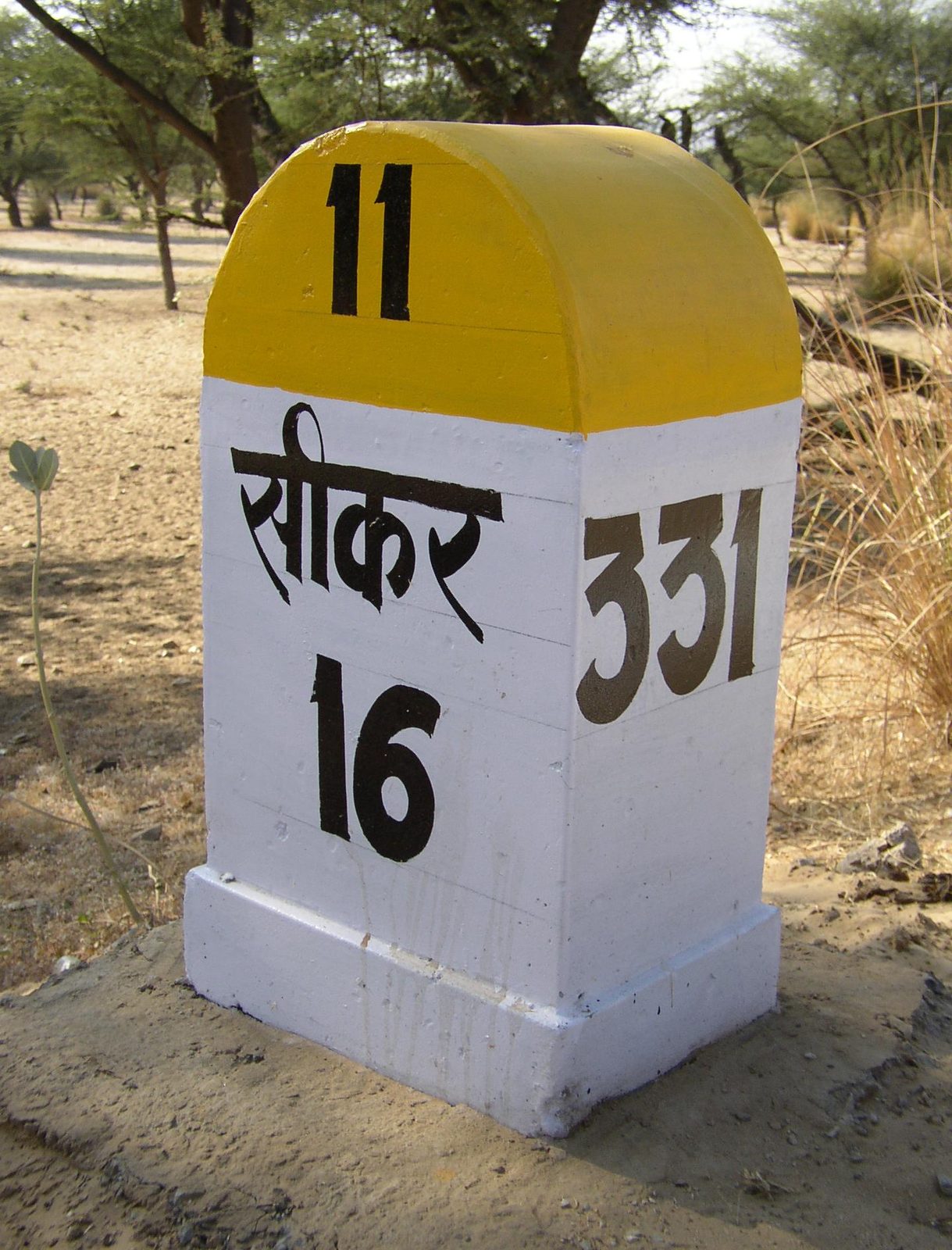 Sikar: 16 km from herehighway number (NH 11)
Path length and displacement
Two different numbers describe how far something went.
- Path length (distance travelled) is the total length of the road actually covered. It is always positive, and it only grows.
- Displacement is the change in position: final position minus initial position, \( \Delta x = x_2 - x_1 \). It can be positive, negative or zero.
The symbol \( \Delta \) (Greek capital "delta") just means "change in". So \( \Delta x \) is read "change in x".
Worked example
You stand at a bus stop (the origin, positive towards the east). You walk 300 m east to a sweet shop, then 500 m west to a temple. Find the path length and the displacement.
- Position at the shop: \( x_1 = +300 \) m. Position at the temple: \( 300 - 500 = -200 \) m.
- Path length = 300 m + 500 m = 800 m.
- Displacement = final − initial = \( -200 - 0 = \) −200 m, that is 200 m west of the bus stop.
If you then walked back to the bus stop, the path length would be 1000 m but the displacement would be zero.
The size of the displacement can never be more than the path length. They are equal only when the object moves in one direction without turning back.
Try it: guess first, then walk the road yourself and watch the two numbers part ways.
Try it
A lift goes from the ground floor up 30 m, then down 12 m. Taking up as positive, what are its displacement and path length?
Answer
Remember
- Motion = change of position with time. Rectilinear = along a straight line.
- Position needs an origin and a positive direction; the sign shows the side.
- Displacement \( \Delta x = x_2 - x_1 \) can be negative or zero; path length cannot.
- |displacement| ≤ path length.
Just remember
No deeper reason for these: they are agreements, so everyone's numbers match. Use the hooks.
- Right of the origin is +, left is −
- The number line you drew in Class 6: numbers grow to the right. Same for lifts: up is +, basements are −.
- \( \Delta \) means "change in", always final minus initial
- Δ is a little triangle, a "delta" of a river where the water has arrived: end first, then subtract where you began.
- Rectilinear = along a straight line
- Rectus is Latin for straight, as in a rectangle's straight sides.
- Kinematics = motion without its causes
- Greek kinema, movement: the same root as "cinema", pictures that move.
- Kinematics
- Describing motion without asking what causes it.
- Rectilinear motion
- Motion along a straight line.
- Point object
- An object treated as a dot because it is tiny compared with the distance it moves.
- Frame of reference
- An origin, an axis with a positive direction, and a clock.
- Displacement
- Change in position, final minus initial; has a sign.
- Path length
- Total distance actually travelled; never negative.
Words to know
A runner does exactly 4 laps of a 400 m track and stops where she started. What is her displacement?
- 1600 m
- 400 m
- Zero
When can we treat a moving car as a point object?
- When it travels a distance much larger than its own length
- Only when it moves very slowly
- When it is parking in a small space
An object goes from x = +5 m to x = −3 m. Its displacement is
- +8 m
- −8 m
- +2 m
Deep dive · optional
Where is zero, and does it matter?
Every position on this page was measured from an origin we picked ourselves. Here is why that is allowed, why the answer that matters never depends on it, and how a galloping horse became the first position-time graph made with a camera. The exam doesn't need this; it makes the page stick.
The roots: why we may put zero anywhere
- Why do we need an origin at all?Because a position is always a distance from something. "40 m" is not a place; "40 m east of the bus stop" is.
- Why doesn't nature hand us an origin?Because empty space has no marks on it. No point of a road, a room or the sky is labelled "zero". Any point is as good as any other.
- Then won't different people get different answers?Their positions differ, yes. But what physics cares about is how much the position changed, and that comes out the same for everyone.
- Why does the change come out the same?Moving the origin adds the same number \( c \) to every position. In the difference, it cancels: \( (x_2 + c) - (x_1 + c) = x_2 - x_1 \).
- And the bedrock?Subtraction itself. A difference does not care where you started counting, just as your height is the same whether you measure it from the floor or from the basement.
Flipping the positive direction is different: it multiplies every position by −1, so a displacement of −200 m becomes +200 m. The size and the real direction (towards the temple) are unchanged; only the label changed. Path length never changes at all, because it only adds up sizes.
The same idea decides when an object may be a point. What matters is a ratio: the object's size compared with the distance it moves. The earth is 12,742 km across, but its orbit has a radius of about 150 million km, more than 11,000 earth-widths. Drawn to scale, if the orbit were a circle 12 m across, the earth would be a speck about half a millimetre wide. For the yearly trip round the sun, the earth is a point. For a cricket ball spinning off the pitch, the ball is not.
The story
See it
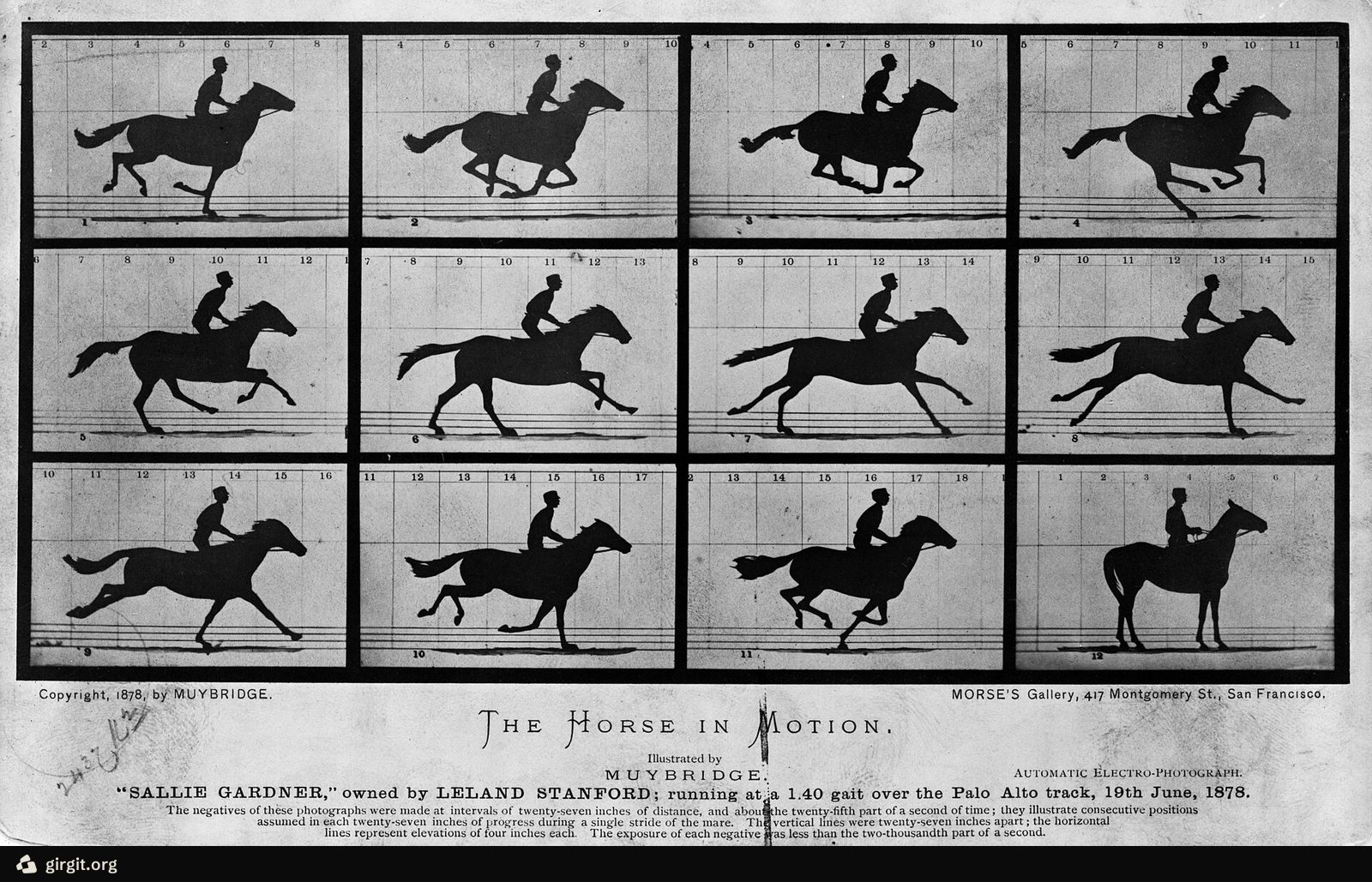 all four hooves off the groundlines 27 in apart
Now try the roots for yourself. Move the origin anywhere along the road and flip which way is positive. Watch which numbers change and which one never does.
India has its own long tradition of positions measured from a chosen zero.
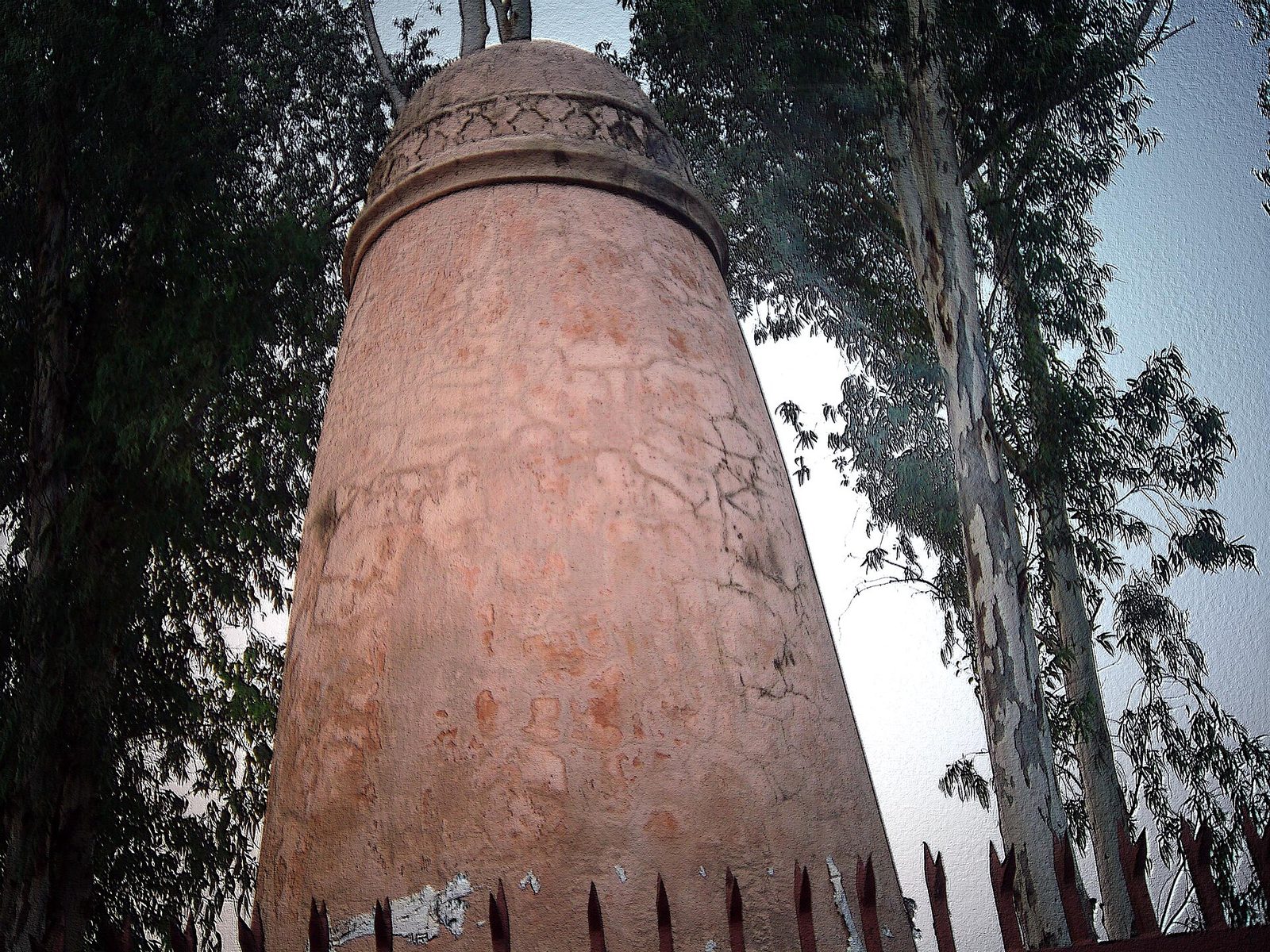 kos minar: a Mughal milestone
Solve it
Solve it
Muybridge's card says each photograph came after 27 inches (0.686 m) of progress and about 1/25 s. It also says the mare was running at a "1.40 gait", racing language for a pace of one mile (1609 m) in 1 minute 40 seconds. Do the two statements agree? Find her average speed both ways.
Hint
Answer
Solve it
A friend draws the earth's orbit as a circle of radius 10 cm on a sheet of paper. How wide should the earth be on that drawing? (Orbit radius 1.5 × 10⁸ km, earth's diameter 1.27 × 10⁴ km.)
Answer
Solve it
Spot the error. Riya says: "With the bus stop as origin, the car went from x = 30 m to x = 80 m, a displacement of 50 m. With the petrol pump 100 m west as origin, it went from 130 m to 180 m, so its displacement is 180 m." What went wrong?
Answer
Connect it
Connect it
- Relative velocity, this chapter. Choosing an origin is half of choosing a frame of reference. The other half, letting the origin itself move, is the subject of relative velocity.
- Vectors, Chapter 3. On a line, position needs one number with a sign. In a plane it needs two, and the signed number grows into a vector: scalars and vectors.
- Maths: coordinate geometry. The x-axis here is the same number line you use to plot points: coordinate geometry recap. Shifting the origin there also leaves distances unchanged.
- Planets as points. Kepler's laws treat the sun and planets as points because their sizes are tiny next to their orbits: Kepler's laws.
- On the road. Every kilometre stone, and the old kos minars before them, is a position measured from a chosen town. Two stones, read one after the other, give you a displacement.
Still confused?
If displacement is the "real" quantity, why bother with position at all?
Because displacement is defined from positions: you cannot subtract until you have two numbers. Position is the bookkeeping, and you are free to choose where the book starts. Choose the origin that makes the numbers easiest, usually the starting point, so that x₁ = 0 and the final position equals the displacement.
Is anything truly at rest?
Only compared with something. A sleeping passenger is at rest compared with the train, and moving at 100 km/h compared with the platform; the platform itself turns with the earth. "At rest" always means "at rest in the frame I chose". There is no special origin in empty space that could say otherwise.
Can a point object rotate?
No: a point has no sides to turn. That is exactly when the point model fails. A spinning top, a wheel or a bat swung round need their size, and later chapters treat them as extended bodies.
Sources
- Stanford Magazine, "The man who stopped time": Muybridge, the 1878 cameras and why historians reject the $25,000 bet.
- IEEE Spectrum, "June 1878: Muybridge photographs a galloping horse": date, Sallie Gardner, trip threads, tucked legs.
- The Horse in Motion card (1878): the printed notes on distance, time and the 1.40 gait.
- NASA Earth fact sheet: earth's radius and orbit.

Picture and video credits
Show 3 picture and video credits
- pamban-bridge-train.jpg: Shaswat Nimesh, CC BY-SA 4.0
- kilometre-stone-sikar.jpg: Doris Antony, Berlin, CC BY-SA 3.0
- kos-minar.jpg: Anupamg, CC BY-SA 3.0


