- 1. What is a vector?
- 2. How do you add two arrows?
- 3. Breaking a vector into parts
- 4. Adding vectors with numbers
- 5. Velocity and acceleration in a plane
- 6. Motion in a plane with constant acceleration
- 7. How does a thrown ball move?
- 8. How high, how long, how far?
- 9. Why is steady circling still accelerating?
- Review
9 of 9·NCERT §3.10·pp. 40–43·6 min
Why is steady circling still accelerating?
The big ideaAn object going round a circle at steady speed is always accelerating towards the centre, with acceleration \( v^2/R \), because its direction keeps changing.
In simple words
Swing a stone on a string in a circle. It goes round at the same speed, but it is always turning. Turning is a kind of change, and any change in motion needs a pull. The string pulls the stone towards your hand, the middle of the circle. Let go and the stone flies off straight, because nothing is turning it any more.
What is uniform circular motion?
When an object moves along a circle at constant speed, its motion is called uniform circular motion. "Uniform" refers to the speed only. Examples: a point on a ceiling fan running steadily, a child on a merry-go-round, a satellite in a circular orbit.
The speed stays the same, but the velocity does not: velocity is along the tangent, and the tangent turns as the object goes round. A changing velocity means an acceleration. We want its direction and its size.
Try it: guess first, then let go of the string anywhere on the circle.
Which way does the acceleration point?
Let the circle have centre C and radius R. At point P the object has position vector \( \mathbf{r} \) (from C) and velocity \( \mathbf{v} \); a moment \( \Delta t \) later, at P′, it has \( \mathbf{r}' \) and \( \mathbf{v}' \).
- On a circle the velocity is always perpendicular to the radius: \( \mathbf{v} \perp \mathbf{r} \) and \( \mathbf{v}' \perp \mathbf{r}' \).
- Draw \( \mathbf{v} \) and \( \mathbf{v}' \) tail to tail. They have the same length and differ by a small turn. The change \( \Delta\mathbf{v} = \mathbf{v}' - \mathbf{v} \) joins their heads.
- Because each velocity is the radius turned through 90°, \( \Delta\mathbf{v} \) is perpendicular to \( \Delta\mathbf{r} = \mathbf{r}' - \mathbf{r} \). The average acceleration \( \Delta\mathbf{v}/\Delta t \) is therefore also perpendicular to \( \Delta\mathbf{r} \), and placed midway between P and P′ it points towards the centre.
- Make \( \Delta t \) smaller and smaller. P′ closes in on P, and \( \Delta\mathbf{v} \) still points to the centre. In the limit the average acceleration becomes the instantaneous acceleration, which points straight at the centre.
Try it: shrink the angle between two snapshots of an ant running round a thali, and watch where the change in velocity points.
This is the centripetal acceleration, \( a_c \). "Centripetal" is from Greek and means centre-seeking; the term was proposed by Newton. The Dutch scientist Christiaan Huygens (1629–1695) worked it out in detail and published his analysis in 1673; Newton had probably found it a few years before that.
How big is it?
Let the angle between \( \mathbf{r} \) and \( \mathbf{r}' \) be \( \Delta\theta \). Since each velocity is at right angles to its radius, the angle between \( \mathbf{v} \) and \( \mathbf{v}' \) is also \( \Delta\theta \). So two triangles have the same shape (they are similar): the one made by \( \mathbf{r}, \mathbf{r}', \Delta\mathbf{r} \) (two sides R) and the one made by \( \mathbf{v}, \mathbf{v}', \Delta\mathbf{v} \) (two sides v). Matching base to side,
\[ \frac{|\Delta\mathbf{v}|}{v} = \frac{|\Delta\mathbf{r}|}{R} \quad\Rightarrow\quad |\Delta\mathbf{v}| = \frac{v}{R}\,|\Delta\mathbf{r}| \]For a very short time, the chord \( |\Delta\mathbf{r}| \) is almost the same as the arc PP′, which is \( v\,\Delta t \). So
\[ a_c = \lim_{\Delta t \to 0}\frac{|\Delta\mathbf{v}|}{\Delta t} = \frac{v}{R}\lim_{\Delta t \to 0}\frac{|\Delta\mathbf{r}|}{\Delta t} = \frac{v}{R}\cdot v \] \[ a_c = \frac{v^2}{R} \]Since \( v \) and \( R \) do not change, the size of the centripetal acceleration is constant. But its direction keeps turning, always towards the centre. So centripetal acceleration is not a constant vector, and the constant-acceleration equations of the last concepts do not apply to circular motion.
Try it: open the throttle on the same 1 km loop and watch the pull to the centre grow.
Angular speed, period and frequency
As the object goes from P to P′, the radius CP turns through the angle \( \Delta\theta \), the angular distance (measured in radians). The angular speed ω (omega) is the rate at which this angle changes:
\[ \omega = \frac{\Delta\theta}{\Delta t} \]In time \( \Delta t \) the object travels an arc \( \Delta s = R\,\Delta\theta \), so its speed is \( v = \Delta s/\Delta t = R\,\Delta\theta/\Delta t \):
\[ v = R\,\omega, \qquad a_c = \frac{v^2}{R} = \omega^2 R = v\,\omega \]The time for one full round is the time period T. The number of rounds per second is the frequency ν (nu), with \( \nu = 1/T \). In one period the object covers the circumference \( 2\pi R \), and the radius turns through \( 2\pi \) radians, so
\[ \begin{gathered} v = \frac{2\pi R}{T} = 2\pi R\nu, \qquad \omega = \frac{2\pi}{T} = 2\pi\nu \\ a_c = 4\pi^2\nu^2 R \end{gathered} \]Uniform circular motion
- Speed constant; velocity along the tangent, always changing direction.
- Acceleration towards the centre: \( a_c = v^2/R = \omega^2 R \), constant in size, not in direction.
- \( v = R\omega \), \( \omega = 2\pi/T = 2\pi\nu \), \( a_c = 4\pi^2\nu^2 R \).
- Velocity and acceleration are at 90° to each other at every point.
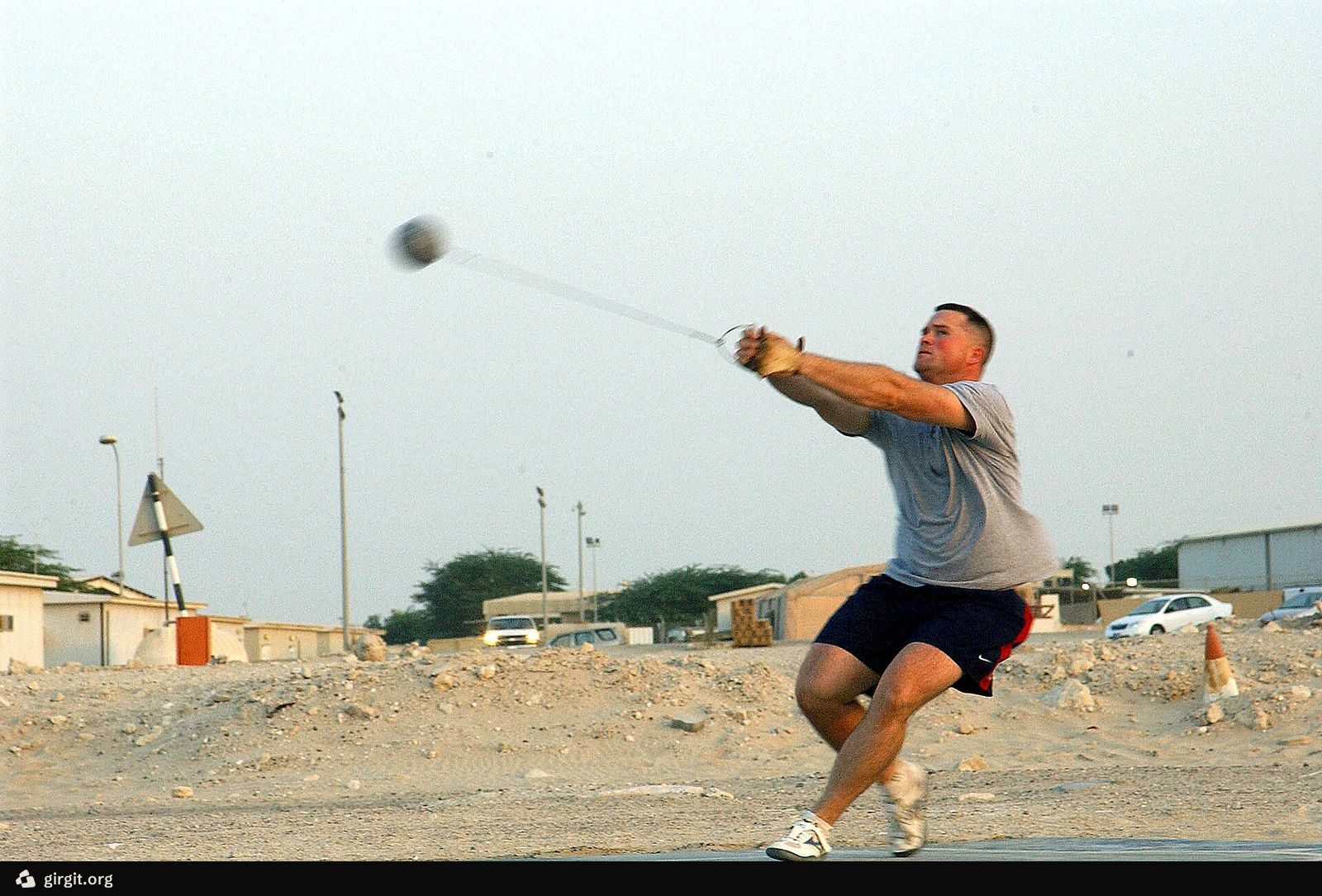 ball: moving along its circlewire: pulls in, towards the hands
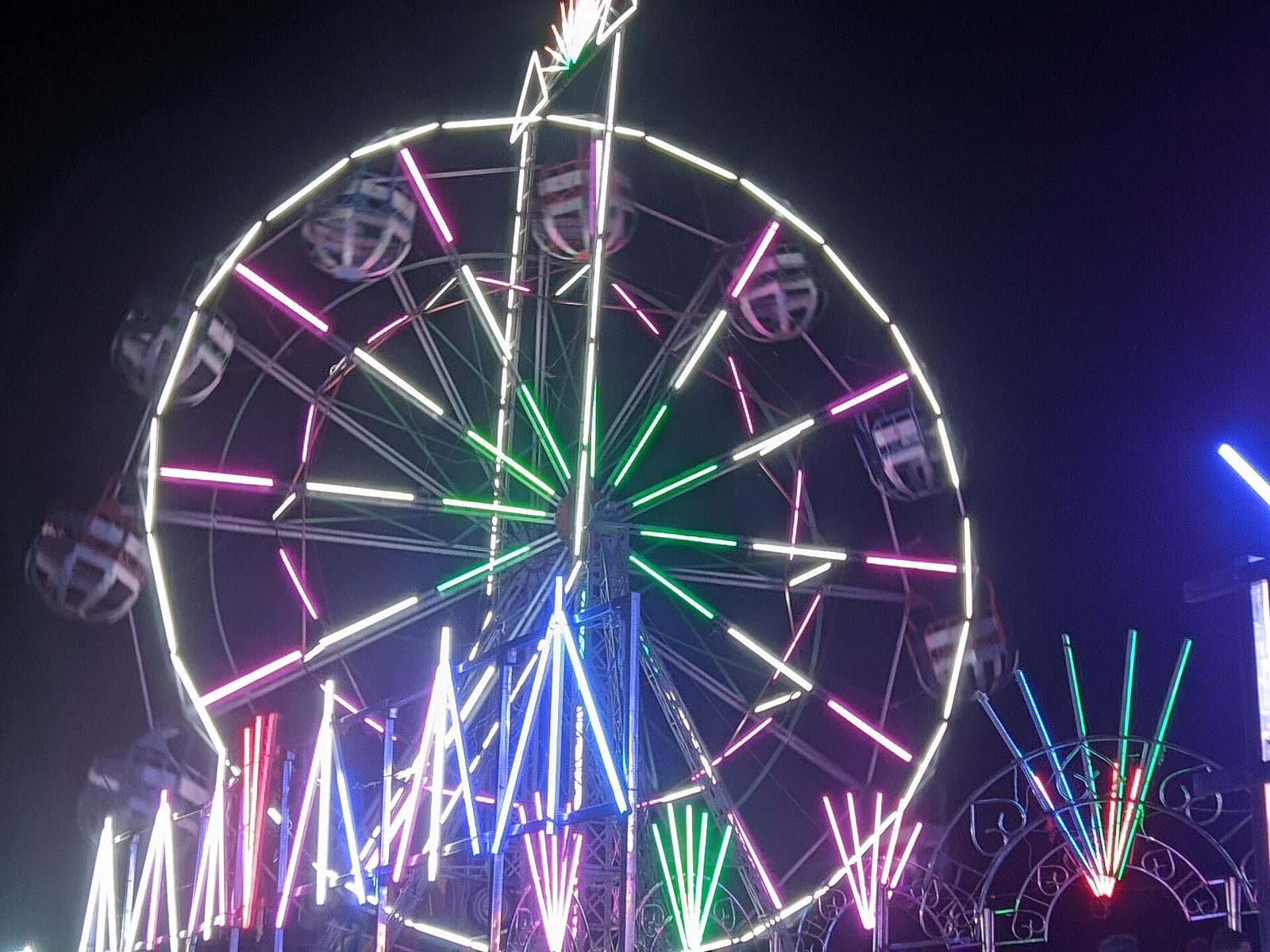 hub: every cabin accelerates towards itcabin: velocity along the rim
Worked example
A giant wheel at a village mela has radius 10 m and makes one turn every 20 s. Find the angular speed, the speed of a seat and its acceleration.
- \( \omega = 2\pi/T = 2\pi/20 \approx \) 0.31 rad s−1.
- \( v = R\omega = 10 \times 0.314 \approx \) 3.1 m s−1, along the tangent.
- \( a_c = v^2/R = 3.14^2/10 \approx \) 0.99 m s−2, towards the centre of the wheel. It is constant in size but turns as the seat goes round.
Worked example
A stone tied to a 0.5 m string is whirled in a horizontal circle at 2 rounds per second. Find its speed and acceleration.
- \( \nu = 2 \) s−1, so \( \omega = 2\pi\nu = 4\pi \approx 12.6 \) rad s−1.
- \( v = R\omega = 0.5 \times 12.6 \approx \) 6.3 m s−1.
- \( a_c = \omega^2 R = (12.6)^2 \times 0.5 \approx \) 79 m s−2, about eight times g.
When the speed also changes
Not in the current textbook, but NEET has asked it: if the speed along the circle is changing, there is an extra acceleration along the tangent, the tangential acceleration \( a_t = dv/dt \). The centripetal part \( a_c = v^2/R \) still points to the centre. The two are at right angles, so the total acceleration is
\[ a = \sqrt{a_c^2 + a_t^2} \]If the total acceleration \( a \) makes an angle φ with the radius, its part along the radius is the centripetal one: \( a_c = a\cos\varphi \), and \( a_t = a\sin\varphi \). For example, with \( a = 10 \) m s−2 at 60° to the radius on a circle of radius 2 m: \( a_c = 10\cos 60^\circ = 5 \) m s−2, so \( v = \sqrt{a_c R} = \sqrt{10} \approx 3.2 \) m s−1.
Try it
A car takes a circular turn of radius 50 m at a steady 36 km/h. What is its acceleration? What would it be at 72 km/h on the same turn?
Answer
Just remember
Names and symbols: nothing to derive here, just hooks.
- Centripetal = centre-seeking
- Newton's word, from Latin centrum (centre) and petere (to seek), as in "petition": the acceleration "asks" for the centre.
- ω (omega) in rad s−1; ν (nu) in s−1, also called hertz (Hz); T in s
- ω is the curly w of "whirl". ν is the Greek n of "number of rounds per second"; don't mix it up with v (vee) for speed. T is the Time for one turn, and \( \nu = 1/T \).
- \( v = R\omega \)
- "Farther out, faster": on a fan blade every point has the same ω, so the tip, with the biggest R, moves fastest.
- Uniform circular motion
- Moving round a circle at constant speed.
- Centripetal acceleration
- The centre-seeking acceleration v²/R of circular motion.
- Angular distance, Δθ
- The angle (in radians) the radius turns through.
- Angular speed, ω
- How fast that angle changes, in rad s⁻¹.
- Time period, T
- The time for one full round.
- Frequency, ν
- Rounds per second; ν = 1/T.
Words to know
For an object in uniform circular motion, which of these stays constant?
- Its speed
- Its velocity
- Its acceleration vector
A cyclist doubles her speed on the same circular track. Her centripetal acceleration becomes
- twice as large
- four times as large
- the same
Two points on a spinning ceiling fan blade, one near the hub and one at the tip. Which is true?
- Both have the same speed
- Both have the same angular speed, but the tip has the larger speed and acceleration
- The tip has the larger angular speed
Deep dive · optional
Why is steady circling accelerating? The Moon is falling
Why turning counts as accelerating, why it must point at the centre, where \( v^2/R \) comes from in one line, and how the same idea told Newton that the Moon is always falling. The exam doesn't need this; it makes the page stick.
The roots: turning is changing
- Why is something going round at a steady speed accelerating?Acceleration is how fast the velocity changes, and velocity is an arrow. Turning the arrow without stretching it is still a change of the arrow.
- Why must that change point at the centre?If the change had any part along the motion, the arrow would get longer or shorter: the speed would change. In uniform circular motion it doesn't, so the change is entirely sideways, at right angles to the velocity. On a circle, "at right angles to the motion, towards the inside of the bend" is exactly "towards the centre".
- Why \( v^2/R \), with the speed squared?Speed counts twice. A longer velocity arrow, turned through the same angle, changes by more: that is one \( v \). And a faster body goes round the bend sooner, so it turns through more angle each second, \( \omega = v/R \): that is the other. Together, \( a = v \times v/R \).
- What happens if the pull stops?Nothing turns the velocity any more, so it stays as it was: the body goes off along the tangent in a straight line, like the chakri's sparks. (Why a body keeps its velocity when nothing acts is Newton's first law, in the next chapter.)
- And the bedrock?A dropped stone falls about 4.9 m in its first second. Over 7.9 km of ground, the curved Earth drops away by about 4.9 m too (\( d^2/2R = 7.9^2/(2 \times 6371) \) km). Throw a stone sideways at 7.9 km/s, with no air, and it falls round the Earth for ever.
That last line is Newton's own thought experiment, and it joins this page to falling. For a circle, the drop below the straight tangent line in a short time \( t \) is \( \tfrac12 (v^2/R)\,t^2 \), exactly the \( \tfrac12 a t^2 \) of free fall with \( a = v^2/R \). So a body in uniform circular motion is falling towards the centre all the time; it just keeps missing.
Newton turned this on the Moon. It is about 60 times as far from the Earth's centre as we are (384,400 km against 6,371 km) and goes round once in 27.32 days. Its centripetal acceleration is
\[ a = \frac{4\pi^2 r}{T^2} = \frac{4\pi^2 \times 3.844 \times 10^{8}\ \text{m}}{(27.32 \times 86400\ \text{s})^2} \approx 0.00272\ \text{m s}^{-2} \]and \( g/60.3^2 = 9.8/3640 \approx 0.00270 \) m s−2. The pull that drops an apple, weakened as one over the distance squared, is just enough to keep the Moon on its circle. Each second the Moon falls about 1.4 mm below the straight line it would otherwise follow, while moving about 1 km along it.
The story
See it
Newton drew his cannon on a mountain in a small book published the year after his death. Here is his figure, then the same idea at the real size of the Earth.
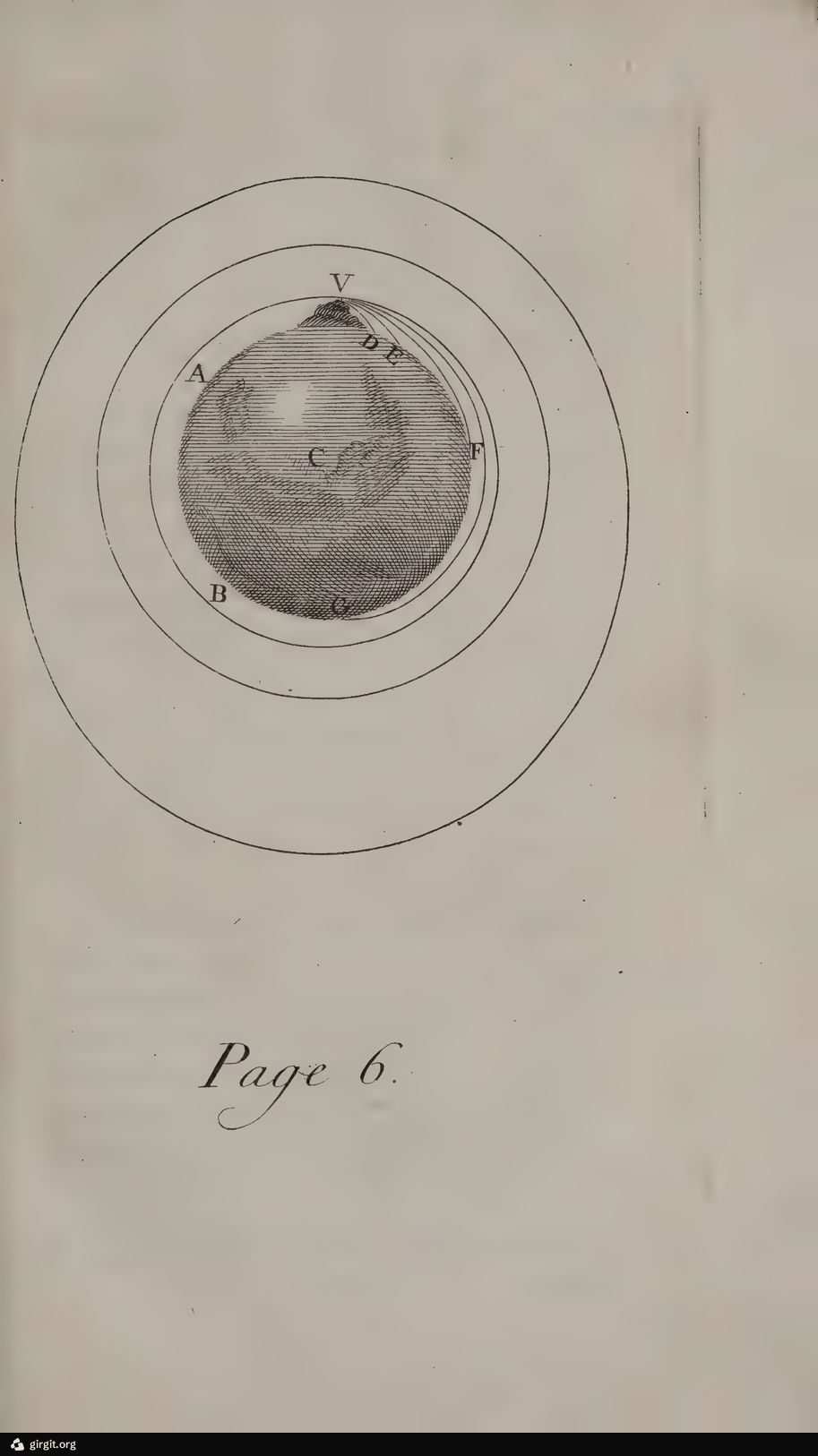 V: mountain topD, E, F: faster, lands fartherfast enough: it never lands
Guess first, then fire faster and faster, and watch the amber arrows: wherever the ball is, its acceleration points at the Earth's centre.
Solve it
Solve it
NASA says the space station goes round the Earth about 16 times a day, at about 400 km up. Check it: find the circular speed \( v = \sqrt{gR} \) using \( g \approx 8.7 \) m s−2 at that height and \( R = 6371 + 400 = 6771 \) km, then the time for one round.
Hint
Answer
Solve it
What if? How short would a day have to be for people on the equator to float, with the ground going round just fast enough that its centripetal acceleration equals \( g \)? How big is the centripetal acceleration of the equator today?
Answer
Solve it
A giant wheel has radius 10 m. How fast would its cabins have to move for the riders at the very top to need a centripetal acceleration equal to g, so that for an instant they are falling freely, like the space station? How long would one turn take? (g = 9.8 m s−2.)
Answer
Connect it
Connect it
- Velocity in a plane, this chapter. Velocity is along the tangent because the chord becomes the tangent: velocity and acceleration in a plane.
- Laws of motion, Chapter 4. What actually supplies the pull to the centre: a string, the friction of the road, a banked track: circular motion.
- Gravitation, Chapter 7. Newton's Moon test in full, and the speed of a satellite: from apples to planets and Earth satellites.
- Oscillations, Chapter 13. The shadow of a point going round a circle swings back and forth in simple harmonic motion: SHM and circular motion.
- ISRO's launch site. Sriharikota, at about 13.7° north, was chosen partly for being near the equator, which helps eastward launches: the ground there is already going round with the Earth's spin at about 0.45 km/s, a free start towards the 7.8 km/s or so an orbit needs.
Still confused?
If the space station is falling, why doesn't it hit the ground?
Because it is also moving sideways at about 7.7 km/s. In each second it falls about 4.3 m towards the Earth, and in that same second the curved surface below drops away by about the same amount. It falls all the time and never gets closer. Astronauts float inside because they and the station fall together.
When a bus turns, I am thrown outwards. Isn't that an outward force?
Seen from the road, nothing pushes you outwards. Your body simply tries to keep going in a straight line, along the old tangent, while the bus turns under you; the seat or the pole then has to push you inwards to make you turn too. Huygens described the outward tug you feel; Newton described the inward pull that is really acting. The next chapter makes this exact.
Sources
- Wikipedia, "Horologium Oscillatorium" and "Centripetal force": Huygens 1659, thirteen propositions without proofs (1673), De vi centrifuga (1703), Newton's word, centrum + petere.
- MacTutor, Isaac Newton: the plague years and the idea of 1666.
- "Newton's early thoughts on planetary motion: a fresh look", British Journal for the History of Science: the 1718 draft, "answer pretty nearly".
- Scientific American, "What's the real story with Newton and the apple?" and phys.org (2010): Stukeley's memoir and its digitisation.
- Newton, A Treatise of the System of the World (1728), Wellcome Collection copy: the mountain figure.
- NASA Moon fact sheet: distance 384,400 km, period 27.3217 days.
- NASA, space station facts and figures and NASA ISS reference: 16 orbits a day, 370 to 460 km up.
- Wikipedia, "Satish Dhawan Space Centre": latitude and the choice of site.
Picture and video credits
