Morphology of Flowering Plants
- 1. Roots: what holds a plant in the ground?
- 2. The stem: how is it different from a root?
- 3. The leaf: base, stalk and blade
- 4. How are leaves and flowers arranged?
- 5. What is a flower?
- 6. Sepals, petals and aestivation
- 7. Stamens, carpels and placentation
- 8. The fruit: what does an ovary become?
- 9. Inside a seed: gram and maize
- 10. How to read a floral formula
- 11. Three families: Solanaceae, Fabaceae, Liliaceae
- Review
10 of 11·NCERT §5.8·pp. 67–68·9 min
How to read a floral formula
The big ideaA floral formula squeezes a whole flower into one line of symbols, and a floral diagram draws the same flower as a map seen from above.
In simple words
Describing a flower in full sentences takes a long time. So botanists use a short code. One letter stands for each ring of the flower, a small number says how many parts it has, brackets mean the parts are stuck together, and a line shows whether the seed box sits high or low. Once you know the code, one short line tells you almost everything about a flower.
Describing a plant in a fixed order
A semi-technical description of a flowering plant is short, uses simple scientific words and always follows the same order, so that any two descriptions can be compared at a glance:
- Habit: herb, shrub or tree.
- Vegetative characters: root, stem, leaves.
- Floral characters: inflorescence, then the flower, then calyx, corolla, androecium and gynoecium.
- Fruit and seed.
- Finally a floral diagram and a floral formula.
The code, symbol by symbol
| Symbol | Means |
|---|---|
| Br | Bracteate (has a bract) |
| \( \oplus \) | Actinomorphic (radial symmetry) |
| % | Zygomorphic (bilateral symmetry); printed in some books like a slanted 0/0 |
| ⚥ | Bisexual flower |
| ♂ / ♀ | Male / female flower |
| K | Calyx |
| C | Corolla |
| P | Perianth (when calyx and corolla look alike) |
| A | Androecium |
| G | Gynoecium |
| \( \underline{\mathrm{G}} \) | Superior ovary (line under G: the other parts are below the ovary) |
| \( \overline{\mathrm{G}} \) | Inferior ovary (line over G: the other parts are above the ovary) |
| Small number after a letter | How many parts in that whorl, e.g. \( \mathrm{C}_4 \) = four petals |
| Number in brackets | Fusion (cohesion): parts of the same whorl joined, e.g. \( \mathrm{K}_{(5)} \) = five united sepals |
| + between numbers | Parts in separate rings or groups, e.g. \( \mathrm{A}_{2+4} \) |
| Line or arc drawn over two letters | Adhesion: parts of different whorls joined, e.g. stamens fixed to petals |
A memory hook for the ovary line: think of the line as the thalamus, the floor the other parts stand on. Line below G, the ovary stands on top: superior. Line above G, the ovary is buried underneath: inferior.
Try it: the formula below is live. Change any number or switch any symbol, and the floral diagram redraws itself. Start from mustard, then try the other three.
Worked example: the mustard flower
The mustard flower (family Brassicaceae) is written
\[ \oplus\ \text{⚥}\ \mathrm{K}_{2+2}\ \mathrm{C}_{4}\ \mathrm{A}_{2+4}\ \underline{\mathrm{G}}_{(2)} \]
Read it left to right:
- \( \oplus \): actinomorphic, radially symmetrical.
- ⚥: bisexual, with both stamens and carpels.
- \( \mathrm{K}_{2+2} \): four sepals in two rings of two; no brackets, so the sepals are free (polysepalous).
- \( \mathrm{C}_{4} \): four free petals (polypetalous). With parts in fours, the flower is tetramerous.
- \( \mathrm{A}_{2+4} \): six free stamens, two in an outer ring and four in an inner ring.
- \( \underline{\mathrm{G}}_{(2)} \): two carpels, fused (syncarpous, shown by the brackets); the line underneath says the ovary is superior, so the flower is hypogynous.
No "Br" at the start, so the flower has no bract (ebracteate).
Now check the code against real flowers. On the left, a stalk of mustard; on the right, a wallflower from the same family, taken apart and laid out flat on black card. Count each ring and you can read the formula straight off it: four sepals, four petals, two short stamens plus four long ones, and one pistil made of two carpels.
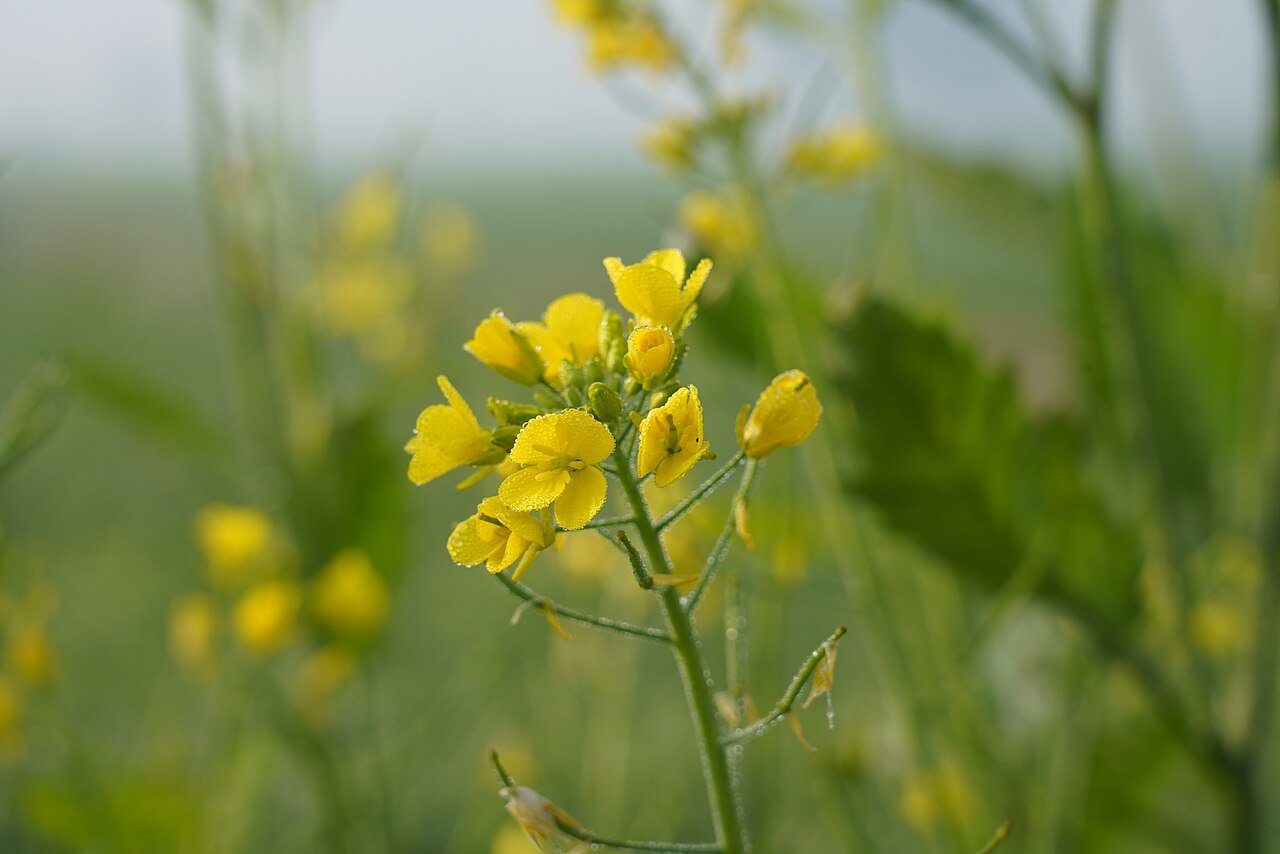 4 petals in a crossbuds at the tip
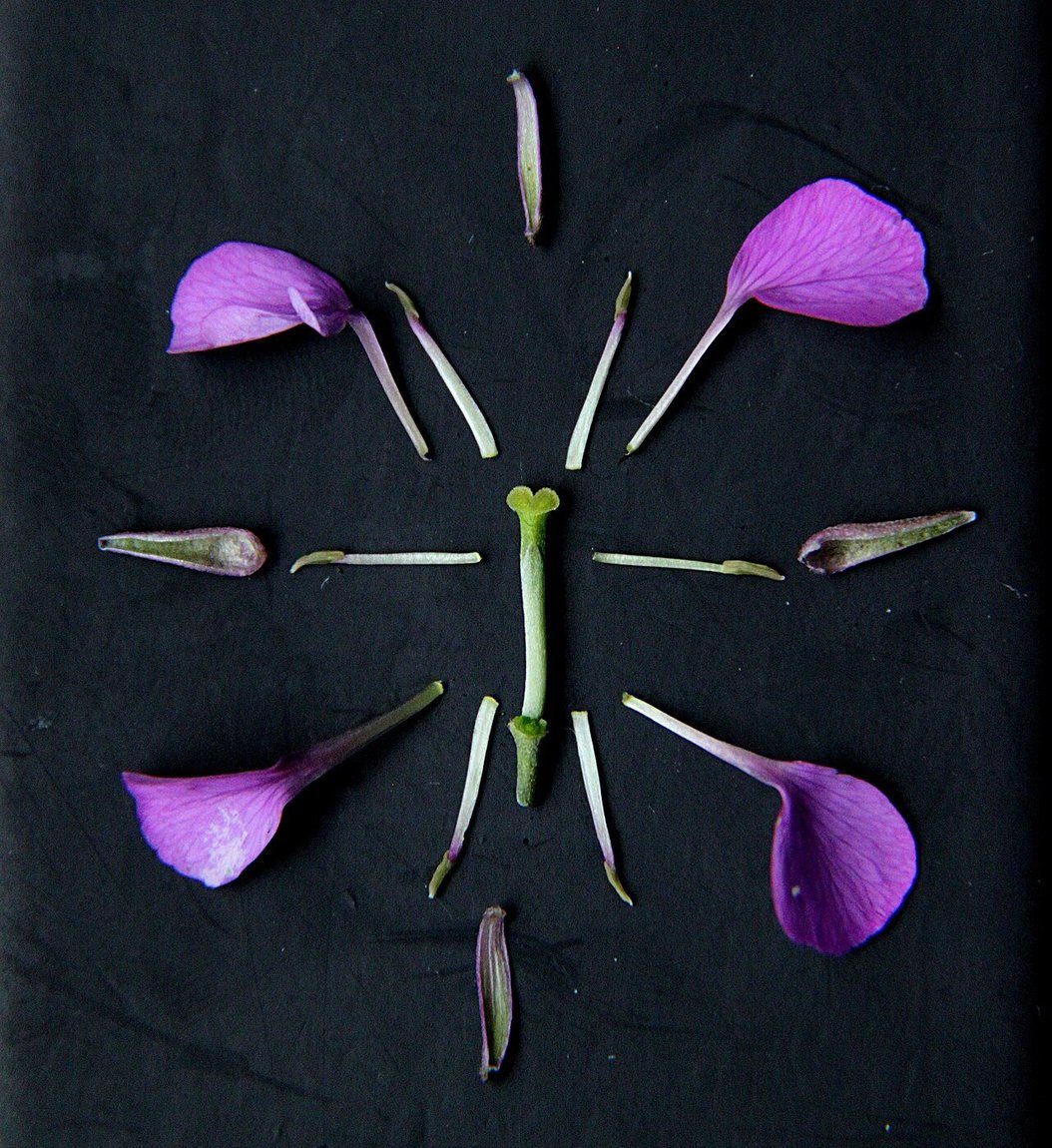 sepalpetallong stamenshort stamenpistil: 2 joined carpels
Worked example: brinjal and potato
Flowers of the potato family (Solanaceae), such as brinjal, are written
\[ \oplus\ \text{⚥}\ \mathrm{K}_{(5)}\ \overgroup{\mathrm{C}_{(5)}\ \mathrm{A}_{5}}\ \underline{\mathrm{G}}_{(2)} \]
- \( \oplus \) ⚥: actinomorphic and bisexual.
- \( \mathrm{K}_{(5)} \): five sepals, joined (gamosepalous).
- \( \mathrm{C}_{(5)} \): five petals, joined (gamopetalous).
- \( \mathrm{A}_{5} \): five stamens, not joined to each other.
- The arc over C and A: adhesion between corolla and androecium, so the stamens are fixed to the petals (epipetalous).
- \( \underline{\mathrm{G}}_{(2)} \): two fused carpels, superior ovary.
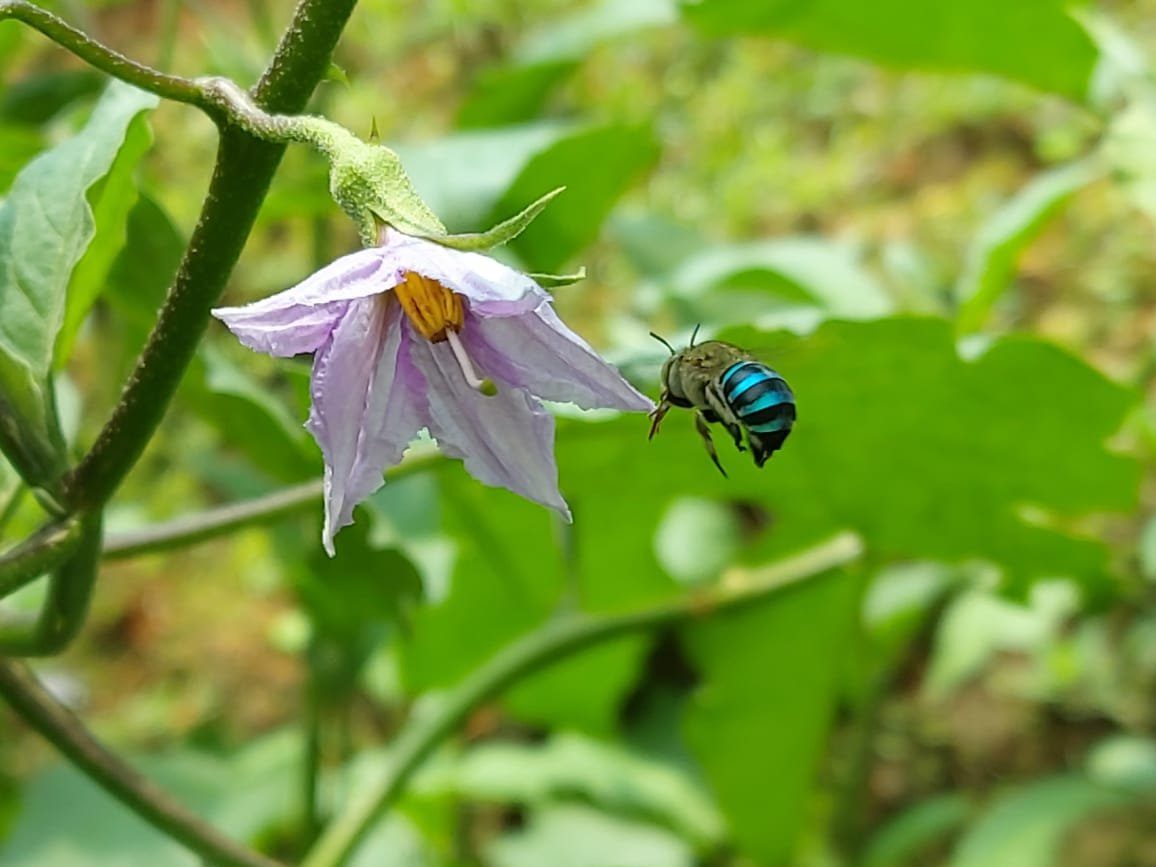 anthersblue-banded bee
Try it. A flower is zygomorphic and bisexual. It has five united sepals; five petals made of one standard, two free wings and two keel petals joined together; ten stamens, nine joined in a bundle and one free; and one carpel with a superior ovary. Write its formula.
Answer
\( \%\ \text{⚥}\ \mathrm{K}_{(5)}\ \mathrm{C}_{1+2+(2)}\ \mathrm{A}_{(9)+1}\ \underline{\mathrm{G}}_{1} \)
This is the pea flower (family Fabaceae): vexillary corolla, diadelphous stamens.
Try it. Decode \( \mathrm{Br}\ \oplus\ \text{⚥}\ \overgroup{\mathrm{P}_{(3+3)}\ \mathrm{A}_{3+3}}\ \underline{\mathrm{G}}_{(3)} \).
Answer
Bracteate, actinomorphic, bisexual. Six tepals in two rings of three, joined (no separate calyx and corolla). Six free stamens in two rings of three, attached to the perianth (epiphyllous, shown by the arc). Three fused carpels with a superior ovary. This is the lily family (Liliaceae), and with parts in threes the flower is trimerous.
The floral diagram
A floral diagram is a map of the flower as if you sliced it across and looked down from above. It shows how many parts there are in each whorl, how they are arranged, and how they relate to each other, including cohesion and adhesion.
- A dot at the top marks the position of the mother axis, the stem on which the flower is borne.
- The whorls are drawn as rings: calyx outermost, then corolla, then androecium, and the gynoecium in the centre.
The mustard diagram shows four sepals, four petals, six stamens (two outer, four inner) and, in the middle, an ovary of two fused carpels split into two chambers by a false septum.
Here is that diagram as the German botanist August Eichler engraved it in 1878, in the book that made floral diagrams standard. Match it with the wallflower laid out above: the same rings, in the same places.
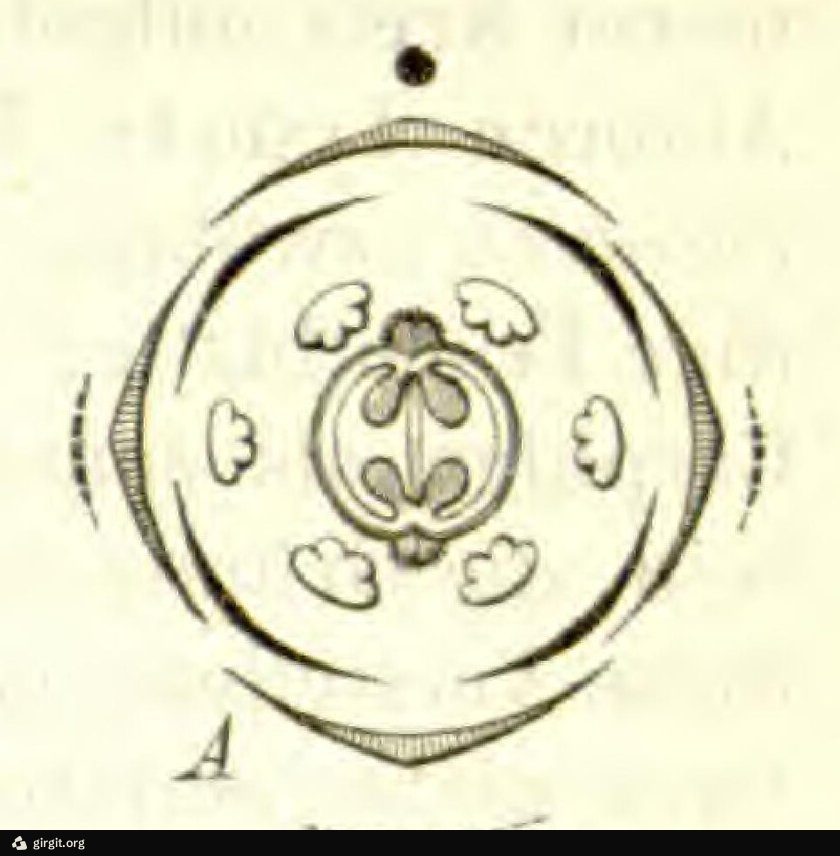 mother axissepalpetallong stamenshort stamenovary
Don't mix these up
- \( \oplus \) = actinomorphic; % = zygomorphic.
- Line under G = superior ovary; line over G = inferior ovary.
- Brackets = cohesion (same whorl joined). Line or arc over two letters = adhesion (different whorls joined).
Just remember
No deeper reason for these: they are agreed symbols, like the letters of a script. The hooks help them stick.
- \( \oplus \) actinomorphic, % zygomorphic
- \( \oplus \) is a wheel: cut it through the hub any way and the halves match. % has a single slash between two circles: one cut, two mirror halves.
- ⚥ bisexual, ♂ male, ♀ female
- ⚥ is simply ♂ and ♀ drawn on one ring: both in one flower.
- K calyx, C corolla, P perianth, A androecium, G gynoecium
- Outside to inside, in the order the bud makes them: "Keep Calm, And Grow". P replaces K and C when they look alike. Andros is Greek for man, gyne for woman.
- Line under G = superior; line over G = inferior
- The line is the floor of the flower. Ovary standing on the floor: superior. Ovary buried under the floor: inferior.
- ( ) cohesion, arc over two letters = adhesion
- Brackets hold one family together (same whorl). An arc is a bridge between two different whorls.
- Mustard: \( \oplus\ \text{⚥}\ \mathrm{K}_{2+2}\ \mathrm{C}_{4}\ \mathrm{A}_{2+4}\ \underline{\mathrm{G}}_{(2)} \)
- "Two-two, four, two-four, two": a cross of four petals (the old name Cruciferae means cross-bearing) around two short and four long stamens.
- Solanaceae: \( \oplus\ \text{⚥}\ \mathrm{K}_{(5)}\ \overgroup{\mathrm{C}_{(5)}\ \mathrm{A}_{5}}\ \underline{\mathrm{G}}_{(2)} \)
- "Five, five, five, two": a five-pointed star with the stamens holding the petals' hands (the arc).
- Semi-technical description
- A short, ordered description of a plant in simple scientific words.
- Floral formula
- A one-line code for a flower's symmetry, sex, whorls and ovary.
- Floral diagram
- A top-down map of the flower's whorls.
- Mother axis
- The stem bearing the flower; a dot at the top of the diagram.
- Cohesion
- Joining of parts within one whorl; brackets.
- Adhesion
- Joining of parts of different whorls; line or arc above.
Words to know
In a floral formula, what does K(5) tell you?
- Five free sepals
- Five united sepals
- Five united petals
A formula has a line drawn above the G. The flower is
- hypogynous, with a superior ovary
- epigynous, with an inferior ovary
- zygomorphic
In a floral diagram, what does the dot at the top stand for?
- The gynoecium
- The mother axis
- A bract
Deep dive · optional
Why can one line of symbols hold a whole flower?
Why a flower is orderly enough to fit in a code, why petals sit between the sepals, and the botanists who turned flowers into formulas and maps. The exam won't ask, but after this the code will read itself.
The roots: a flower is built in rings, from the outside in
- Why can a short code describe a flower at all?Because a flower is not a random heap of parts. The parts come in rings, each ring has a fixed number of parts, and the rings always come in the same order. So you only need to write down a few counts, which parts are joined, and where the ovary sits.
- Why do the rings always come in the same order?Because the bud makes them in that order. A flower is the tip of a shoot that has stopped growing longer. Around its edge it makes small bumps, one ring at a time: sepals first, then petals and stamens, and the carpels last, right in the centre. The order K, C, A, G in a formula is the order of birth.
- Why a fixed number in each ring?Each new bump forms in the biggest open space at the edge of the growing tip, as far as possible from the bumps already there. The botanist Wilhelm Hofmeister wrote this rule down in 1868. On a small round tip only a few bumps fit around the edge before the space runs out. Computer models of the rule mostly give four or five per ring, which is what most dicot flowers have; monocots usually have three.
- Then why do the petals sit between the sepals and not in front of them?Because the gaps between the sepals are the emptiest places. Each petal forms in a gap. Then the stamens form in the gaps between the petals, and so on inwards. Ring after ring alternates with the one outside it.
- Why does that make the code possible?Because a rule that places every part for you does not need to be written down. Tell someone "five, five, five, two" and the alternation rule tells them where every part goes. That is why a floral diagram looks woven, and why a one-line formula is enough.
The bedrock is two things you already know. A flower is a changed shoot, and its parts are changed leaves, so it grows like a shoot tip. And a new part needs room, the same reason the leaves on a stem spread out around it instead of stacking on top of each other.
A formula is also a kind of compression. It keeps what stays the same across a whole family (counts, joins, ovary position) and throws away what changes from plant to plant (colour, size, scent, the exact shape of a petal). Brinjal and potato flowers differ in colour and size but share one formula. That is exactly why the formula is useful for sorting plants into families, which is the next page.
Try the rule yourself. The bud below knows nothing about alternation: it just places each new ring at the least crowded spots. Guess first.
The stories
See it
A cranesbill (Geranium) flower taken apart and laid out in its rings. There are five sepals and five petals, and each petal sits in the gap between two sepals: alternation you can see with no microscope.
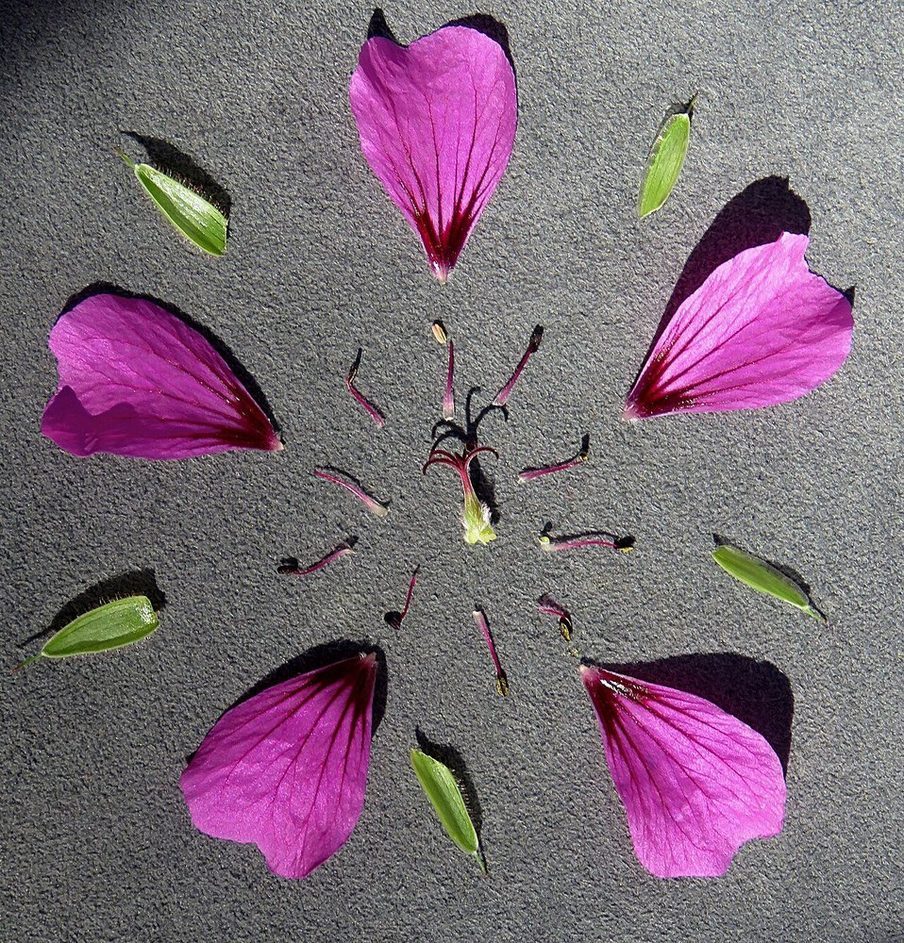 sepal, between 2 petalspetal10 stamens5 joined carpels
Solve it
Solve it
An Arabidopsis plant starts about 1.9 new flower buds a day, and each bud takes about 13 days to open. Roughly how many buds are developing on one flowering stalk at any moment? Look at a mustard stalk (the picture above): does that sound right?
Hint
Answer
Solve it
A student writes the potato flower as \( \oplus\ \text{⚥}\ \mathrm{K}_{5}\ \mathrm{C}_{5}\ \mathrm{A}_{5}\ \overline{\mathrm{G}}_{(2)} \). Find three mistakes, and say what each one would mean about the flower.
Answer
- No brackets on K and C: that would mean free sepals and free petals. Potato's sepals and petals are joined: \( \mathrm{K}_{(5)}\ \mathrm{C}_{(5)} \).
- No arc over C and A: that would mean the stamens stand free of the petals. In Solanaceae they are fixed to the petals (epipetalous), so an arc joins C and A.
- The line is over G: that would mean an inferior ovary, as in guava. Potato's ovary is superior, so the line goes under G.
Two flowers have exactly the same floral formula. What must be true?
- They are the same colour
- They have the same number of parts in each ring, joined the same way, with the ovary in the same position
- They are the same size
- They must be the same species
Connect it
Connect it
- Leaves on a stem, concept 4. The same "new part goes where there is most room" rule spaces the leaves in phyllotaxy. A flower is that rule squeezed onto a shoot that has stopped growing.
- A flower is a shoot, concept 5. What is a flower? explains the thalamus and why the ovary line moves.
- Cohesion and adhesion, concept 7. The brackets and arcs come from stamens and carpels: monadelphous, diadelphous, syncarpous.
- Families, concept 11. The formula is how Solanaceae, Fabaceae and Liliaceae are told apart.
- A chemical formula, Chemistry Class 11 Ch 1. \( \mathrm{C_6H_{12}O_6} \) gives the counts of atoms but not their arrangement, just as a floral formula gives counts but not shapes. See empirical and molecular formulas.
- The flower at work, Class 12 Ch 1. What the A and G actually do is the story of the flower and the anther.
Still confused?
My other book uses * and an arrow instead of \( \oplus \) and %. Which is right?
Both. The symbols are a convention and books differ: many international books use * for actinomorphic and an arrow for zygomorphic, and some mark an inferior ovary by a sign above G rather than a line. NCERT and most Indian books use \( \oplus \) and %. In the exam, use NCERT's symbols.
Why write \( \mathrm{A}_{2+4} \) and not just \( \mathrm{A}_{6} \)?
Because the + carries information: the six stamens are in two groups or rings, two outer and four inner. \( \mathrm{A}_{6} \) would hide that. In the same way \( \mathrm{A}_{(9)+1} \) in pea says nine stamens are joined and one is free.
Does the floral diagram show the same things as the formula?
More. The formula gives counts and joins. The diagram also shows where each part stands, which way the flower faces the stem (the dot), how the petals overlap in the bud (aestivation) and how the ovules sit (placentation). The formula is the summary; the diagram is the map.
Sources
- Wikipedia: Floral formula (history: Cassel, Martius, Grisebach 1854, Sachs 1873, Eichler; symbol conventions)
- Prenner, Bateman and Rudall (2010), Floral formulae updated for routine inclusion in formal taxonomic descriptions, Taxon 59: 241 to 250
- Wikipedia: Floral diagram and August W. Eichler
- Eichler, Blüthendiagramme vol. 2 (1878), p. 201, Fig. 83 (scan on Wikimedia Commons)
- Smyth, Bowman and Meyerowitz (1990), Early flower development in Arabidopsis, The Plant Cell 2: 755 to 767
- Kitazawa and Fujimoto (2015), A dynamical phyllotaxis model to determine floral organ number, PLoS Computational Biology (Hofmeister's 1868 rule)
Picture and video credits
Show 5 picture and video credits
- mustard-flowers-raceme-dew.jpg: Satdeep Gill, CC BY-SA 4.0
- erysimum-flower-dissected-diagram.jpg: Dwergenpaartje, CC BY-SA 4.0
- brinjal-flower-blue-banded-bee.jpg: Deoxyribose12, CC BY-SA 4.0
- geranium-flower-dissected-whorls.jpg: Dwergenpaartje, CC BY-SA 4.0
- portulaca-bud-opening.mp4: Ajith Samuel, CC BY 3.0


