Morphology of Flowering Plants
- 1. Roots: what holds a plant in the ground?
- 2. The stem: how is it different from a root?
- 3. The leaf: base, stalk and blade
- 4. How are leaves and flowers arranged?
- 5. What is a flower?
- 6. Sepals, petals and aestivation
- 7. Stamens, carpels and placentation
- 8. The fruit: what does an ovary become?
- 9. Inside a seed: gram and maize
- 10. How to read a floral formula
- 11. Three families: Solanaceae, Fabaceae, Liliaceae
- Review
4 of 11·NCERT §5.3.3 · §5.4·pp. 61–62·6 min
How are leaves and flowers arranged?
The big ideaLeaves are arranged on a stem in one of three patterns, and flowers are arranged on their stalk in one of two: racemose, where the tip keeps growing, or cymose, where the tip ends in a flower.
In simple words
Plants do not stick leaves on at random. Some put one leaf at each point on the stem, some put two facing each other, and some put a ring of many. This spreads the leaves out so each one gets sunlight. Flowers have patterns too. On some plants the stalk keeps growing taller and adds new flowers at the top. On others the tip of the stalk turns into a flower and stops, so new flowers must come from the sides below.
Phyllotaxy: how leaves sit on a stem
Phyllotaxy is the pattern in which leaves are arranged on a stem or branch ("phyllo" means leaf, "taxy" means arrangement). There are three usual types.
| Type | Leaves at each node | Examples |
|---|---|---|
| Alternate | One, on alternating sides as you go up | China rose, mustard, sunflower |
| Opposite | Two, facing each other across the node | Calotropis (aak), guava |
| Whorled | More than two, forming a ring (a whorl) | Alstonia (saptaparni, the "seven-leaf" tree) |
Look for the node first, then count the leaves that leave the stem there: one, two, or a ring.
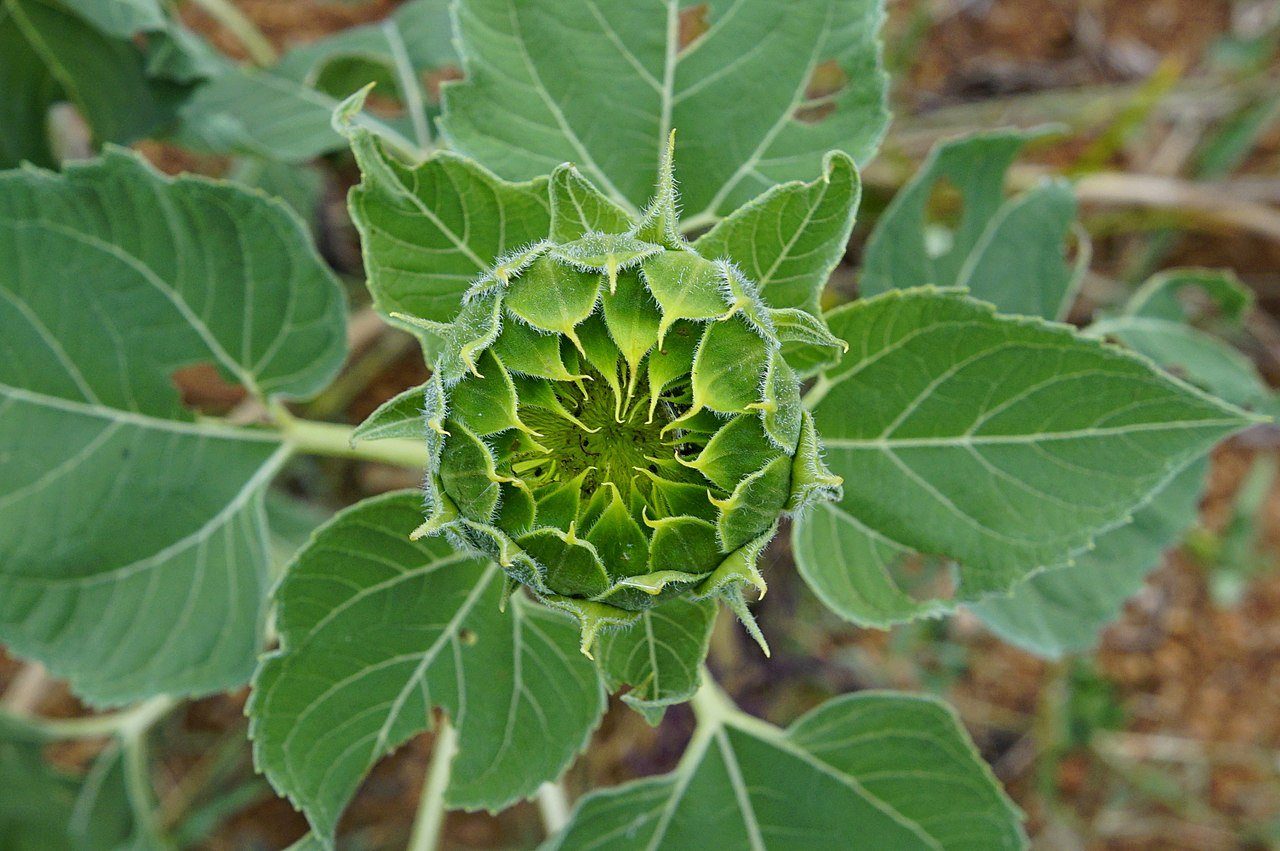 flower bud at the shoot tipone leaf per node
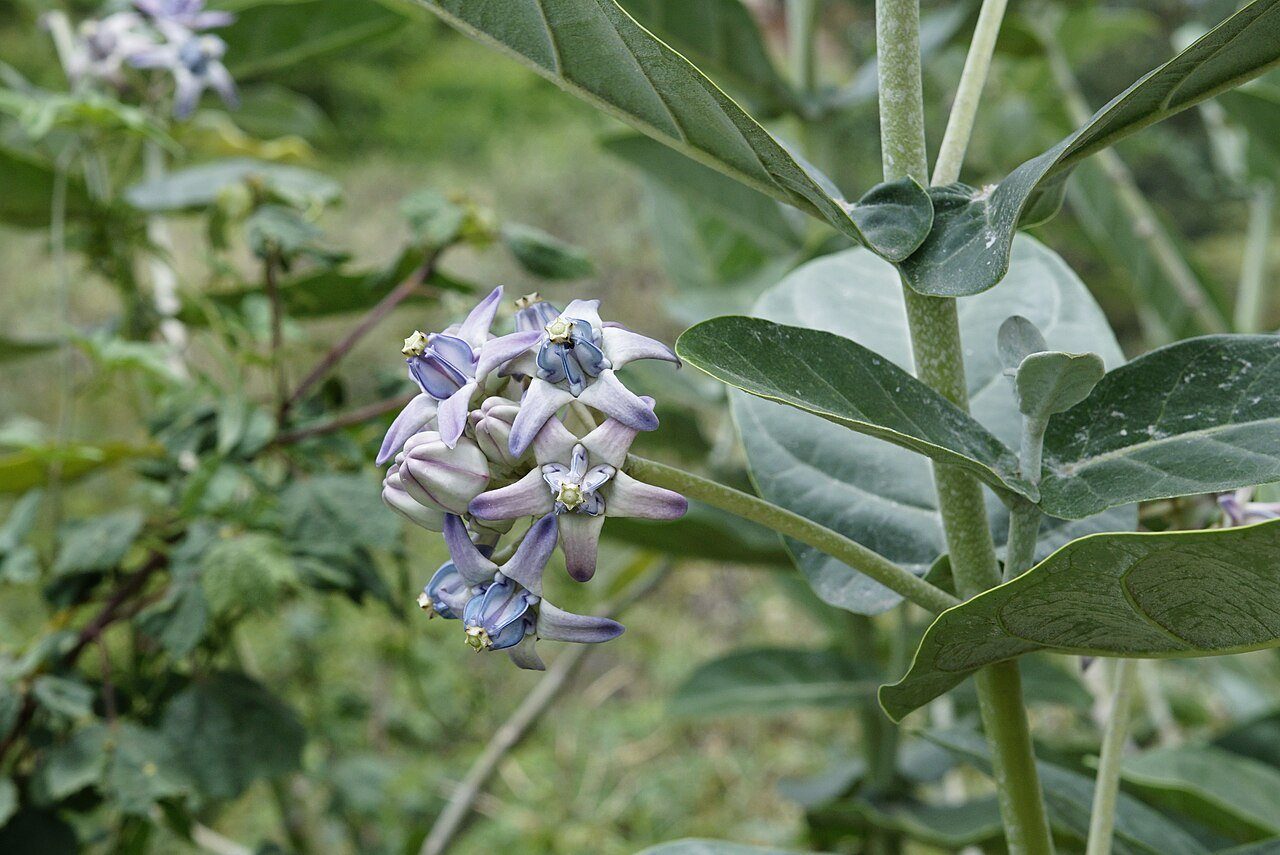 two leaves at one nodeflower cluster
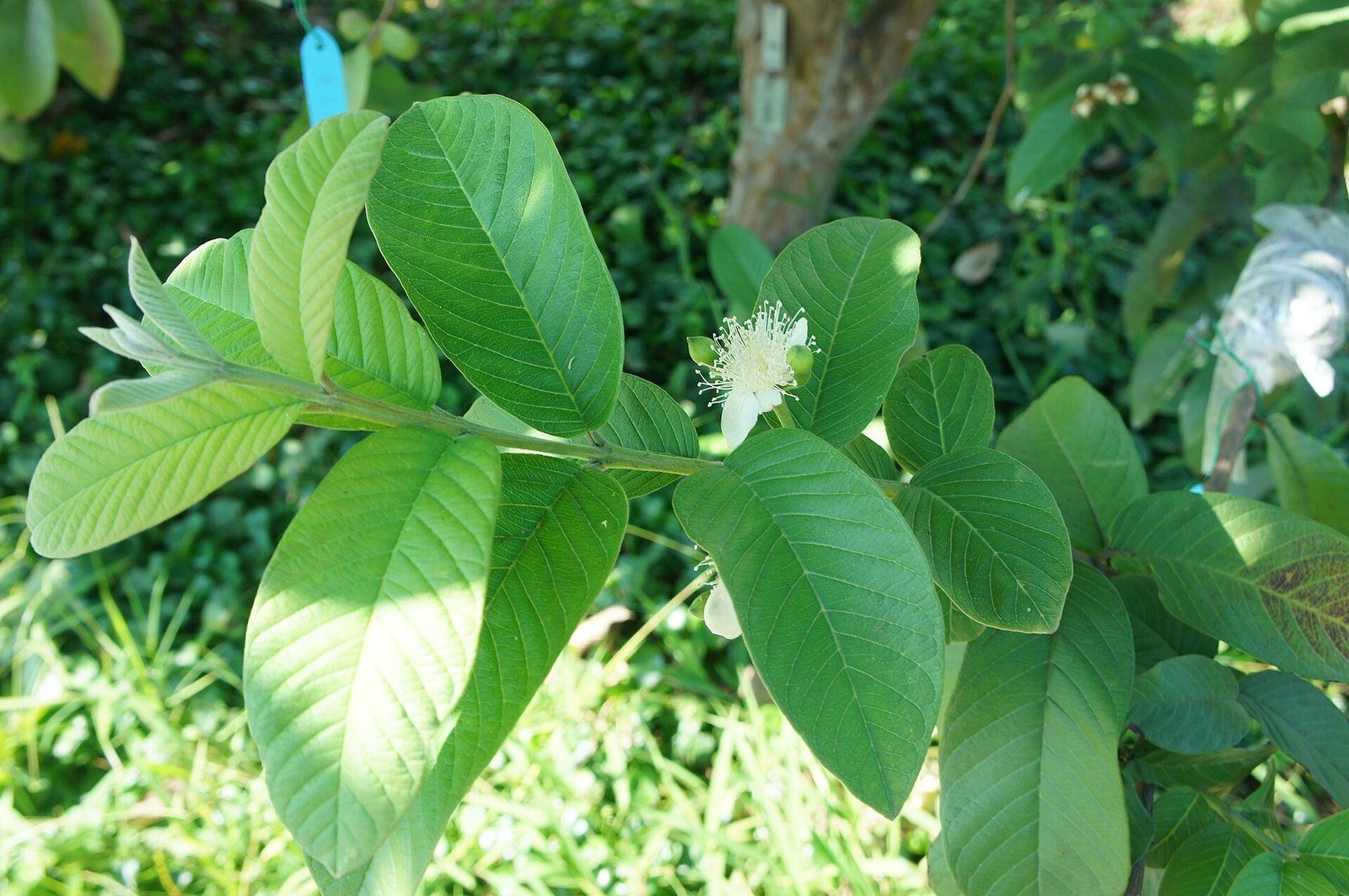 a pair of leaves at each node
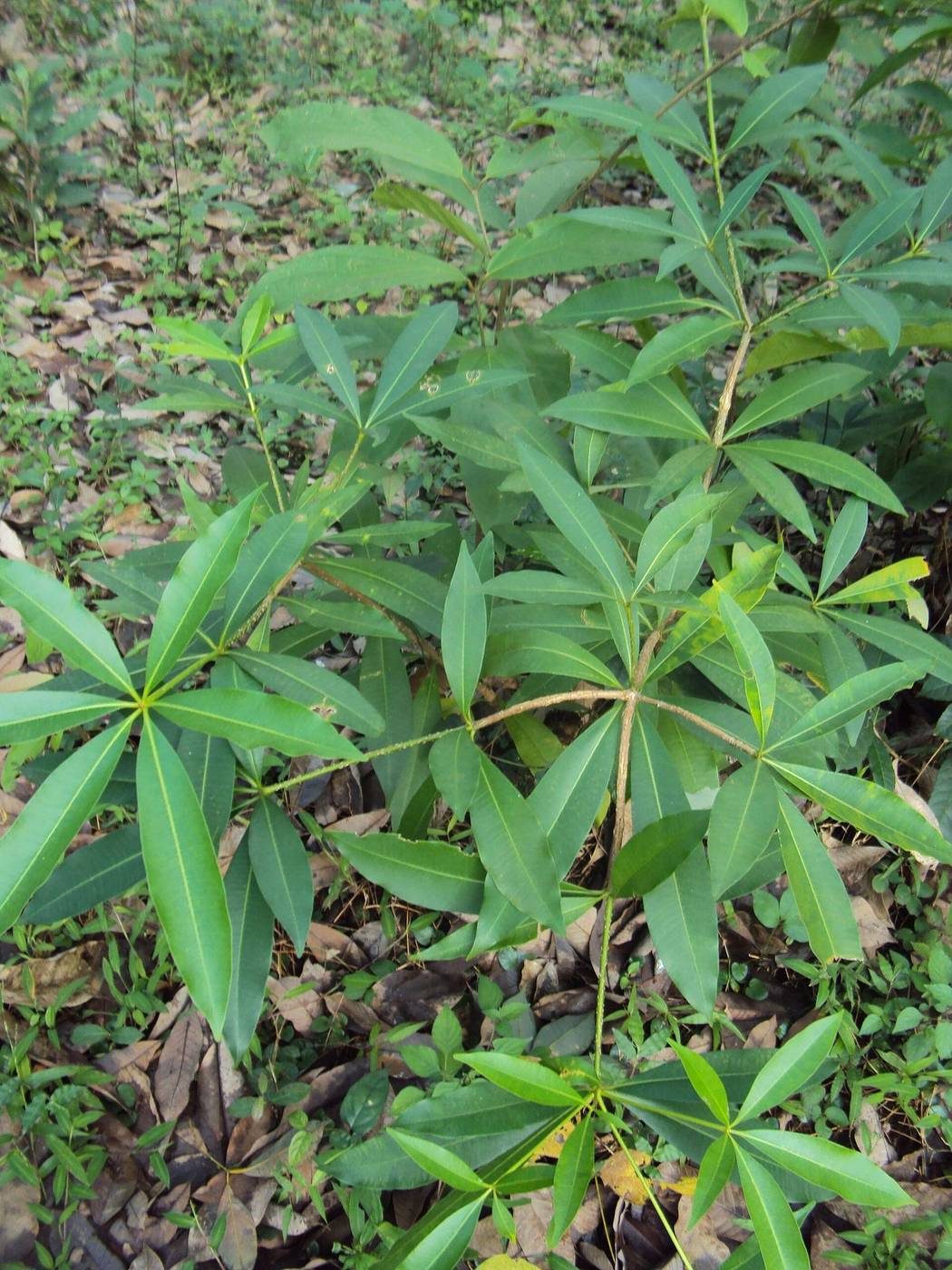 a ring of leaves at one nodeanother whorl
Whatever the pattern, the result is the same: leaves are spaced so they shade each other as little as possible.
Try it: change the number of leaves at each node and how far each node turns, and watch the shade on the lowest leaf.
A flower is a changed shoot
Before we arrange flowers, see where a flower comes from. A flower is a modified shoot. At its tip, the shoot apical meristem (the growing point) turns into a floral meristem. The internodes do not lengthen, so the axis stays short and squashed. At its closely packed nodes the apex makes floral parts (sepals, petals, stamens, carpels) instead of leaves. If the tip of a shoot itself turns into a flower in this way, the flower is always solitary (single).
Inflorescence: how flowers sit on a stalk
The way flowers are arranged on the flowering stalk (the floral axis) is called the inflorescence. The two main types depend on one question: does the tip of the main axis keep growing, or does it become a flower?
| Racemose | Cymose | |
|---|---|---|
| Tip of main axis | Keeps growing | Ends in a flower |
| Growth of axis | Unlimited | Limited |
| Where flowers form | On the sides of the axis | At the tip first, then from side branches below |
| Order of flowers | Acropetal: oldest at the base, youngest at the top | Basipetal: oldest at the top, younger ones lower down |
| Examples | Mustard, radish | Solanum (makoi), jasmine |
Try it: grow both kinds of stalk day by day and read the age of every flower.
Look at a mustard stalk in a field in winter. The bottom of the stalk already has pods, the middle has open yellow flowers, and the top still has tight buds. Oldest at the bottom, youngest at the top: racemose. Radish, mustard's cousin, does the same.
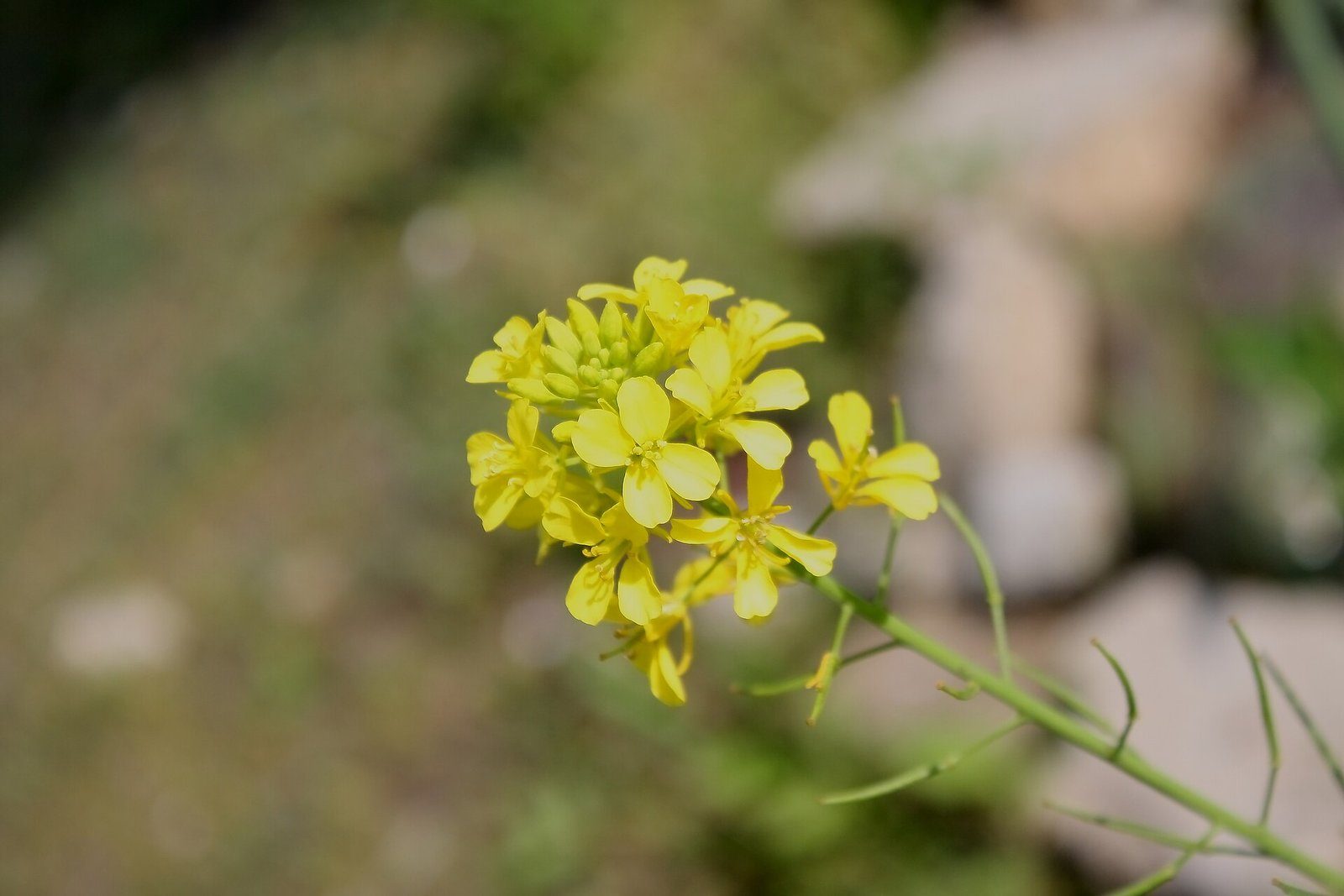 buds: youngest, at the tipopen flowersyoung pods: oldest, lowest
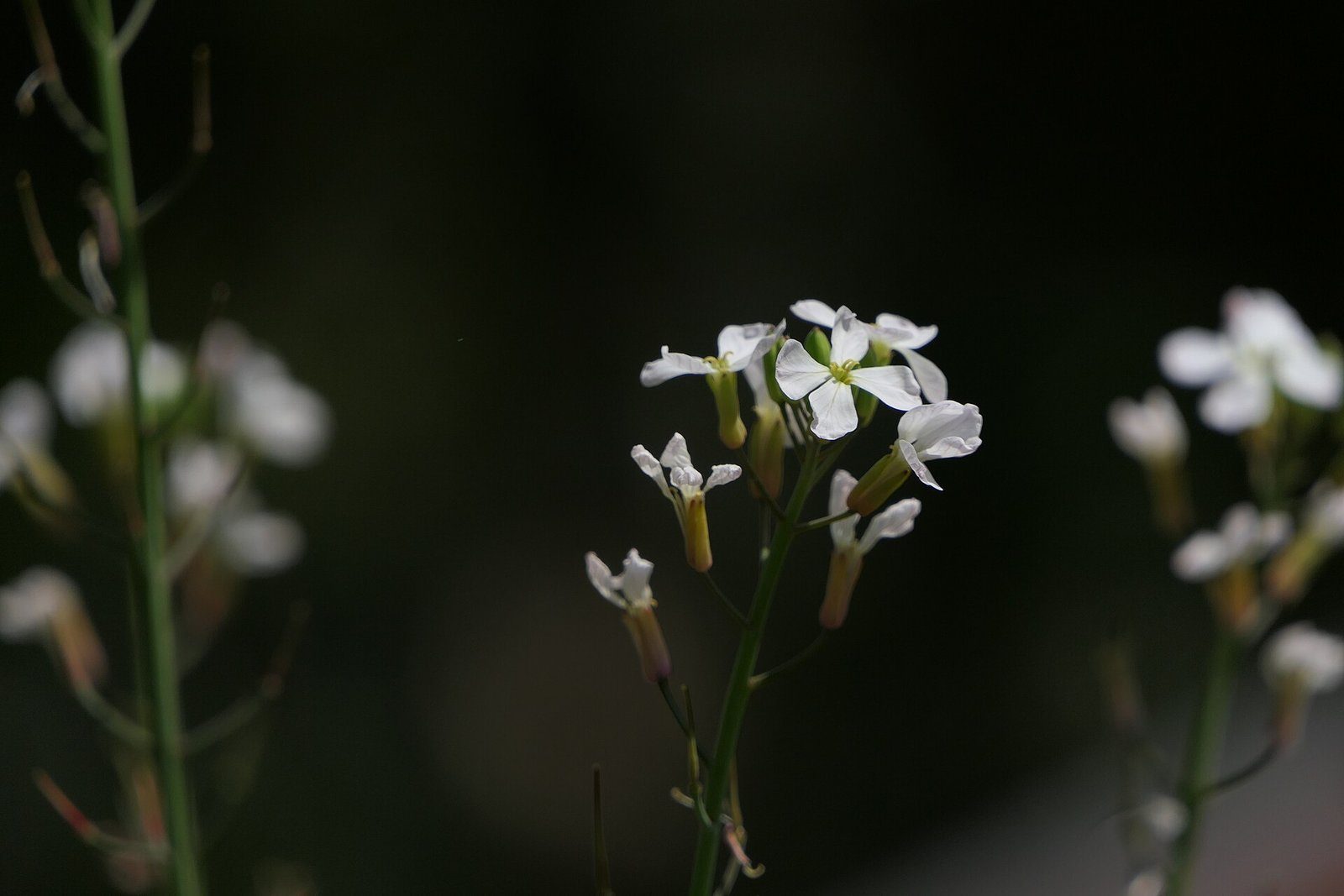 newest flowers near the tipolder flowers lower down
Now look at a makoi plant growing as a weed beside a wall. Its small white flowers hang in little bunches from the side of the stem. In each bunch the first flower to open sits where the stalk ends; the rest open after it from short side branches. That is a small cyme.
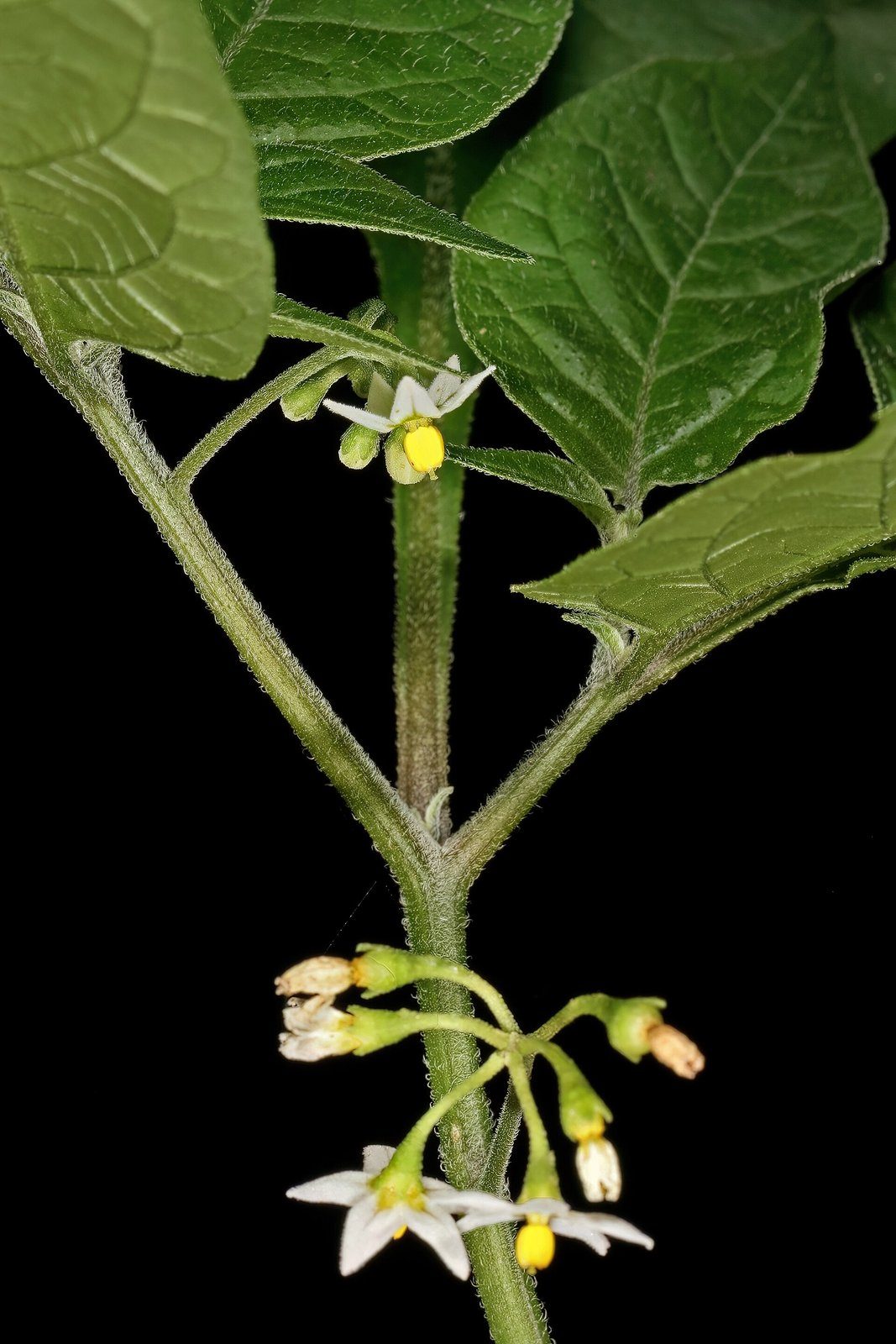 open flowersbuds still closeda second cluster
Don't mix these up
- Acropetal = towards the tip (young at top): racemose. Basipetal = towards the base (young at bottom): cymose.
- Phyllotaxy is about leaves. Inflorescence is about flowers.
Just remember
No deeper reason for these: they are the textbook's examples. Hooks help them stick.
- Alternate: sunflower, mustard, china rose
- Three S's for a Single leaf per node: Sunflower, Sarson (mustard) and Shoe-flower (another name for china rose).
- Opposite: Calotropis (aak) and guava (amrood)
- Two leaves face each other, like two A's facing each other: Aak and Amrood.
- Whorled: Alstonia (saptaparni)
- The name is the hook: sapta = seven, parni = leaves. A ring of about seven leaves at each node.
- Racemose: mustard, radish
- Mooli and Mustard: their stalks keep going up, like a queue that keeps growing at the front.
- Cymose: Solanum (makoi), jasmine
- Jasmine is chameli: the tip says "chup", stop, and turns into a flower. Makoi, a Solanum, stops the same way.
- Acropetal and basipetal
- The word roots do the work: acro = tip (as in acrobat, who walks on tiptoe), basi = base. Acropetal: the young ones are towards the tip.
- Phyllotaxy
- The arrangement of leaves on a stem.
- Whorled
- More than two leaves in a ring at one node.
- Floral meristem
- A growing tip that makes flower parts instead of leaves.
- Inflorescence
- The arrangement of flowers on the floral axis.
- Racemose
- Main axis keeps growing; flowers added acropetally.
- Cymose
- Main axis ends in a flower; flowers come basipetally.
Words to know
On a guava twig, two leaves arise at each node, facing each other. This phyllotaxy is
- alternate
- opposite
- whorled
On a flowering stalk, the topmost flower opened first and the lower ones opened later. The inflorescence is
- racemose, because flowers are acropetal
- cymose, because flowers are basipetal
- solitary
Why is a flower called a modified shoot?
- Its growing tip becomes a floral meristem and makes floral parts at condensed nodes instead of leaves
- It grows from a root
- It has no nodes at all
Deep dive · optional
Why do sunflowers count in Fibonacci numbers?
How a growing tip decides where the next leaf or floret goes, why the answer is a strange angle of 137.5°, and how a dish of magnetic drops and a few hundred sunflowers grown by the public tested the idea. The exam won't ask, but after this you will never look at a sunflower the same way.
The roots: each new bud goes into the biggest gap
- Why do the florets of a sunflower sit in spirals?Because they were made one at a time at the growing tip, each a fixed turn round from the one before. Make points that way, push the older ones outward, and spirals appear by themselves. Nobody draws them.
- Why a fixed turn, and why that one?Because a new bud starts where there is most room: in the biggest gap left by the buds already there. The German botanist Wilhelm Hofmeister wrote this rule down in 1868, from careful study of growing shoot tips.
- Why does a new bud need room?Because of a growth hormone, auxin. Every young bud pulls auxin towards itself out of the cells around it, using pump proteins in the surface of the tip. The ground near a bud is left starved. A new bud can only start where auxin piles up again, which is as far as possible from the old ones.
- Why does "as far as possible" give 137.5°?Try a simple fraction of a turn, say 2/5 (144°). Every fifth bud lands exactly behind an earlier one, the buds line up in five straight rows, and empty wedges open between the rows. Any fraction does this sooner or later. The only turn that never lines up is the one furthest from every fraction, and that is the golden angle, about 137.5°.
- And why Fibonacci numbers?The fractions that come closest to the golden angle are 1/2, 1/3, 2/5, 3/8, 5/13, 8/21…, all made of Fibonacci numbers (1, 1, 2, 3, 5, 8, 13, 21, 34, 55…, each the sum of the two before). So a bud's nearest neighbours were born a Fibonacci number of steps before or after it, and those neighbours line up into the spirals you count: 21 one way and 34 the other, or 34 and 55 in a big head. It is geometry, not counting.
The golden angle comes from the golden ratio \( \varphi = \frac{1 + \sqrt{5}}{2} \approx 1.618 \). Split a full turn so that the big part divided by the small part is \( \varphi \): the small part is \( 360^\circ / \varphi^2 \approx 137.5^\circ \). Ratios of neighbouring Fibonacci numbers (8/5, 13/8, 21/13…) close in on \( \varphi \), which is why the two ideas always appear together.
Check it below: change the angle by half a degree and gaps open; let the head grow and the spiral counts climb the Fibonacci ladder.
Try it: guess first, then drag the angle and run time.
The stories
See it
Look at a ripe sunflower head from close up. The open florets, with their pollen, are on the rim; the youngest, still closed, are packed in the middle in crossing spirals. Oldest outside, youngest inside: racemose, flattened.
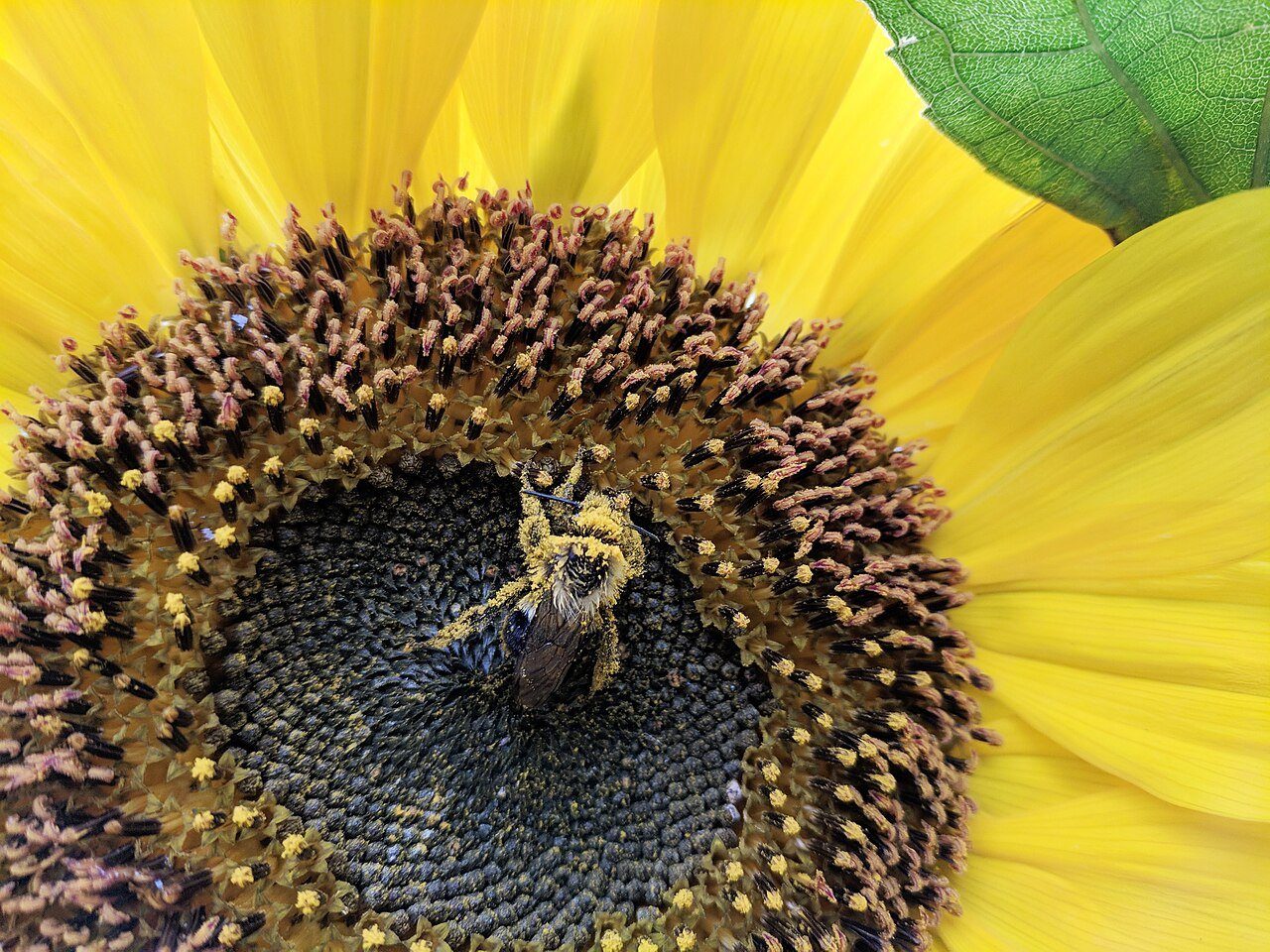 open florets on the rim: oldestclosed florets in spirals: youngestray florets
A computer model of a shoot tip seen from above, from a 2012 study. Each new bump appears in the gap at the centre and drifts outward, and the spiral builds itself.
Solve it
Solve it
In the widget, with the golden angle and 300 buds, each bud's nearest neighbours were born 21 and 34 buds away. Predict the two numbers for 400 buds, and for a giant head of 2,000 florets. Then check the 400 in the widget.
Hint
Answer
Which fraction of a full turn is closest to the golden angle (137.5°)?
- 2/5
- 3/8
- 5/13
- 8/21
Solve it
Spot the error: "A plant whose leaves are exactly 144° apart (2/5 of a turn) shades itself less than one at 137.5°, because 144° is a bigger angle."
Answer
Connect it
Connect it
- Racemose order, this page. A sunflower head opens from the rim inward, the same acropetal order as a mustard stalk, squeezed onto a flat disc.
- Auxin, Ch 13. The spacer in the shoot tip is the same hormone that bends shoots towards light: see auxins.
- Sequences, Maths Class 11 Ch 8. Fibonacci numbers are a sequence defined by a rule on earlier terms: see what is a sequence.
- Counting, Maths Class 11 Ch 6. The Sanskrit rhythm count is a counting problem: lines of n beats end in a short or a long syllable, so count(n) = count(n−1) + count(n−2). See counting without listing.
- In your kitchen. Count the spirals on a pineapple, a cauliflower or a pine cone from a hill station: you will usually get two neighbouring Fibonacci numbers, one for each direction.
Still confused?
Does every plant use the golden angle?
No. Plants with opposite or whorled leaves, like guava and Alstonia, put two or more leaves at each node, and the next node simply turns to fill the gaps. Grasses put their leaves in two rows, 180° apart. The golden angle belongs to plants that make one part at a time in a spiral, and even then, as the sunflower count showed, some heads break the rule.
How can a plant "know" an irrational number?
It doesn't. Each new bud just starts where auxin collects, which is the biggest gap. The golden angle is the result of that simple local rule, the way a queue forms without anyone planning it. The magnetic drops in Paris "knew" no more than the plant.
Sources
- Douady and Couder (1992), Phyllotaxis as a physical self-organized growth process, Physical Review Letters 68: 2098
- Reinhardt et al. (2003), Regulation of phyllotaxis by polar auxin transport, Nature 426: 255–260
- Swinton, Ochu and the MSI Turing's Sunflower Consortium (2016), Novel Fibonacci and non-Fibonacci structure in the sunflower, Royal Society Open Science 3: 160091
- University of Manchester: Turing's Sunflowers
- Phyllotaxis (Hofmeister's rule, history)
- Fibonacci sequence (Liber Abaci; Pingala, Virahanka, Gopala, Hemachandra)
- Vogel (1979), A better way to construct the sunflower head, Mathematical Biosciences 44: 179–189
- Mirabet et al. (2012), Noise and robustness in phyllotaxis, PLoS Computational Biology (source of the model video)
Picture and video credits
Show 10 picture and video credits
- sunflower-young-head-from-above.jpg: Vengolis, CC BY-SA 4.0
- calotropis-opposite-leaves.jpg: Vengolis, CC BY-SA 4.0
- guava-branch-opposite-leaves.jpg: Olaf8940, CC BY-SA 4.0
- alstonia-whorled-leaves.jpg: Vinayaraj, CC BY-SA 3.0
- mustard-raceme.jpg: Dalgial, CC BY-SA 3.0
- radish-raceme-thane.jpg: Dinesh Valke from Thane, India, CC BY-SA 2.0
- makoi-cyme.jpg: SAplants, CC BY-SA 4.0
- sunflower-disc-florets-bee.jpg: USFWS Midwest Region from United States, CC BY 2.0
- phyllotaxis-model-meristem.mp4: Mirabet V, Besnard F, Vernoux T, Boudaoud A (PLoS Computational Biology, 2012), CC BY 2.5
- sunflower-head-bee.mp4: ZDF/Terra X/Sabine Müller/Malik Alpoguz/Maximilian Mohr, CC BY 4.0


