Classification of Elements and Periodicity in PropertiesFull experience
- 1. Why sort the elements?
- 2. Mendeleev's periodic table
- 3. The modern periodic table
- 4. How do you name element 120?
- 5. Why the table has the shape it has
- 6. The s, p, d and f blocks
- 7. Metals, non-metals and metalloids
- 8. How big is an atom?
- 9. How hard is it to pull an electron off?
- 10. Which atoms want extra electrons?
- 11. Valence, and the odd ones at the top
- 12. Where are the most reactive elements?
- Review
8 of 12·NCERT §3.7 · §3.7.1·pp. 85–92·6 min
How big is an atom?
The big ideaAtoms get smaller from left to right across a period, because the nucleus pulls the same shell harder, and bigger down a group, because new shells are added further out.
In simple words
An atom is a tiny centre with a cloud of even tinier bits around it. Going along a row of the chart, the centre gets stronger but the cloud stays at the same level, so the centre pulls it in tighter and the atom shrinks. Going down a column, a whole new layer of cloud is added on the outside each time, so the atom grows, like adding another layer of clothes.
Periodic trends: what and why
Many properties change in a regular way across a period or down a group. For example, across a period reactivity is high in group 1, lower in the middle, and high again in group 17. Down a group of metals (alkali metals) reactivity rises; down a group of non-metals (halogens) it falls. To explain such patterns we look at two things: the number of electrons and the energy levels they sit in.
Many physical properties are periodic: melting and boiling points, heats of fusion and vaporisation, energy of atomisation. This chapter studies five: atomic radius, ionic radius, ionization enthalpy, electron gain enthalpy and electronegativity.
How do you measure an atom?
Measuring an atom is far harder than measuring a ball, for two reasons. It is tiny, about 1.2 Å (1.2 × 10⁻¹⁰ m) in radius. And its electron cloud has no sharp edge. So we cannot measure one atom on its own. Instead we measure the distance between the centres of two atoms that are joined, and take half.
- Covalent radius (for non-metals): half the distance between two atoms joined by a single covalent bond. In \(\ce{Cl2}\) the bond length is 198 pm, so chlorine's radius is 99 pm.
- Metallic radius (for metals): half the distance between neighbouring metal cores in the metal crystal. In solid copper the distance is 256 pm, so copper's radius is 128 pm.
"Atomic radius" in this book means whichever of these fits: covalent for non-metals, metallic for metals. These distances come from X-ray and other spectroscopy measurements. (1 pm, a picometre, is 10−12 m.)
Today an electron microscope can even show atoms directly. It still cannot show an edge, only fuzzy bright spots whose centres we can measure between:
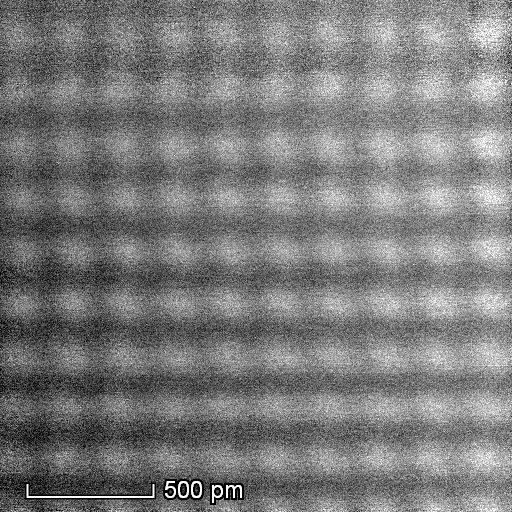 a column of Al atomsnext one, 0.2 nm away
The two trends
| Period 2 | Li | Be | B | C | N | O | F |
|---|---|---|---|---|---|---|---|
| Radius / pm | 152 | 111 | 88 | 77 | 74 | 66 | 64 |
| Period 3 | Na | Mg | Al | Si | P | S | Cl |
| Radius / pm | 186 | 160 | 143 | 117 | 110 | 104 | 99 |
| Group 1 | Li | Na | K | Rb | Cs |
|---|---|---|---|---|---|
| Radius / pm | 152 | 186 | 231 | 244 | 262 |
| Group 17 | F | Cl | Br | I | At |
| Radius / pm | 64 | 99 | 114 | 133 | 140 |
- Across a period, radius decreases. The outer electrons stay in the same shell, but the nuclear charge rises by one each step. The effective nuclear charge (the pull an outer electron actually feels) grows, so the electrons are drawn in closer.
- Down a group, radius increases. The principal quantum number n goes up, so the valence electrons are in a shell farther out. The filled inner shells also shield (screen) the outer electrons from the nucleus. Both make the atom larger.
Try it: drag across period 2 and watch each new proton pull the same shell in tighter.
Noble gases are left out of these tables. They do not bond, so we can only measure their non-bonded radii, which are much larger. Those should be compared with the van der Waals radii of other elements, not with covalent radii.
Ionic radius
An atom that loses an electron becomes a cation (positive ion); one that gains an electron becomes an anion (negative ion). We estimate ionic radii by measuring how far apart the cations and anions sit in an ionic crystal, such as common salt.
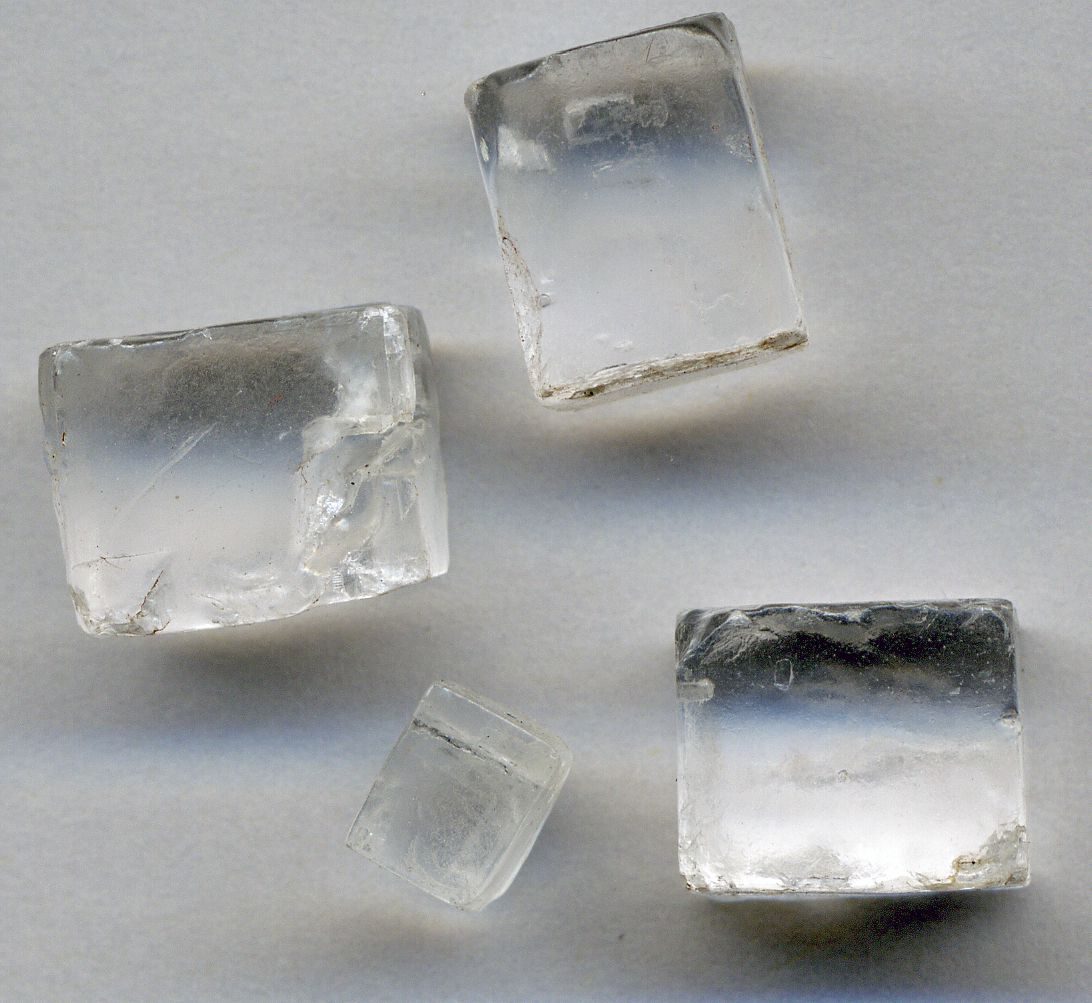 NaCl crystalfaces meet at right angles
Before the rules, a guess. Then switch between atoms and ions and watch every size at once.
Ionic radii follow the same trends as atomic radii, plus two rules:
- A cation is smaller than its atom. It has fewer electrons but the same nuclear charge, so the rest are pulled in tighter. Na is 186 pm; Na+ is 95 pm.
- An anion is larger than its atom. The extra electron adds repulsion among the electrons and lowers the effective nuclear charge each one feels, so the cloud swells. F is 64 pm; F− is 136 pm.
Try it: slide sodium's outer electron over to fluorine and watch both sizes change.
Isoelectronic species
Atoms and ions with the same number of electrons are called isoelectronic species. For example \(\ce{O^2-}\), \(\ce{F-}\), Ne, \(\ce{Na+}\) and \(\ce{Mg^2+}\) all have 10 electrons. They are not the same size, because their nuclei carry different charges:
- The more protons pulling on the same 10 electrons, the smaller the species. So the cation with the larger positive charge is smallest.
- The anion with the larger negative charge is largest: its electron repulsion outweighs the nuclear pull.
(8, 9, 11 and 12 protons; 10 electrons each.)
Textbook check · §3.7.1Two meanings of "isoelectronic"
- The textbook says
- In the text: isoelectronic species have the same number of electrons (O2−, F−, Na+, Mg2+). In its footnote: species with the same number of atoms, the same number of valence electrons and the same structure, whatever the elements.
- What we know now
- Both meanings are in use, but they are not the same. The footnote's meaning is meant for molecules: CO, NO+ and N2 are isoelectronic because each has two atoms and ten valence electrons. Taken literally for single atoms, it would make Na and K "isoelectronic" (one valence electron each), although they have 11 and 19 electrons. For comparing the sizes of atoms and ions, chemists use the stricter meaning: the same total number of electrons.Source: Isoelectronicity (Wikipedia), on the valence-only and total-electron definitions
- In the exam
- For ions and atoms, use the same total number of electrons (N3− to Al3+ all have 10). For molecules such as CO and N2, the two meanings agree anyway: both have 14 electrons in all.
Worked example: largest and smallest
Which of K, \(\ce{K+}\), Ca and \(\ce{Ca^2+}\) is largest, and which is smallest?
- K and Ca are in period 4; radius falls across a period, so K > Ca.
- Each cation is smaller than its atom: K > \(\ce{K+}\) and Ca > \(\ce{Ca^2+}\).
- \(\ce{K+}\) and \(\ce{Ca^2+}\) are isoelectronic (18 electrons). Ca has 20 protons, K 19, so \(\ce{Ca^2+}\) is smaller.
- Largest: K. Smallest: \(\ce{Ca^2+}\).
Try it. Arrange \(\ce{N^3-}\), \(\ce{Al^3+}\), \(\ce{F-}\), \(\ce{Mg^2+}\), \(\ce{O^2-}\), \(\ce{Na+}\) from largest to smallest.
Answer
Now check your order: drag along six ions that all hold ten electrons.
Remember
- Radius: decreases across a period, increases down a group.
- Cation < parent atom < anion.
- Isoelectronic: more protons, smaller species.
Just remember
These are conventions and textbook numbers, not things you can work out. Use the hooks.
- Which radius for which element: metals, metallic radius; non-metals, covalent radius; noble gases, van der Waals radius
- "Metals in a crowd, sharers in pairs, loners alone": metal atoms sit packed in a crystal, non-metals share bonds two by two, noble gases touch nobody. Never compare a noble gas's van der Waals radius with its neighbours' covalent radii.
- 1 Å = 100 pm = 10−10 m; 1 pm = 10−12 m
- One ångström is a hundred picometres, like one rupee is a hundred paise. A typical atom is 1 to 2 Å: "a rupee or two".
- Cl–Cl 198 pm, so Cl is 99 pm; Cu–Cu 256 pm, so Cu is 128 pm
- Always halve the distance between centres: 198 → 99, 256 → 128.
- Na 186 → Na+ 95 pm; F 64 → F− 136 pm
- "Sodium halves, fluorine doubles." And the ions swap places: the small atom makes the big ion.
- N3− 171 > O2− 140 > F− 136 > Na+ 95 > Mg2+ 65 > Al3+ 50 pm
- The order has a reason (more protons on the same 10 electrons), but the list is worth knowing by heart: "seven to thirteen protons, big to small", N (7) is the fattest, Al (13) the tightest.
- Covalent radius
- Half the single-bond length between two like atoms.
- Metallic radius
- Half the distance between neighbouring atoms in a metal crystal.
- Effective nuclear charge
- The pull an outer electron really feels, after inner electrons shield part of it.
- Shielding (screening)
- Inner electrons blocking some of the nucleus's pull on outer electrons.
- Isoelectronic species
- Atoms or ions with the same number of electrons.
- Van der Waals radius
- Half the distance between non-bonded neighbouring atoms; larger than the covalent radius.
Words to know
Why is a chloride ion, \(\ce{Cl-}\), larger than a chlorine atom?
- It has more protons
- The extra electron increases repulsion and lowers the effective pull on each electron
- The extra electron starts a new shell
Going from Li to F across period 2, the atomic radius falls from 152 pm to 64 pm. The main reason is that
- new shells are added
- effective nuclear charge increases while the shell stays the same
- shielding increases strongly
Deep dive · optional
Why does one more proton make an atom smaller?
Adding a proton and an electron sounds like adding stuff, yet fluorine is less than half as wide as lithium. Here is why, how anyone measured something with no edge, and the metal that hid for 50 years because it was exactly the same size as its neighbour. Not needed for the exam; it makes the trends obvious instead of memorised.
The roots: pull minus shield
- Why is fluorine (64 pm) so much smaller than lithium (152 pm), when both use the n = 2 shell?Because fluorine's outer electrons are pulled much harder. Lithium's outer electron feels a nuclear charge of only about +1.3; each of fluorine's outer electrons feels about +5.2.
- Why does the pull grow by so much across a period?Each step adds one proton (+1 of pull) and one electron to the same shell. But an electron in the same shell is a poor shield: on average it hides only about a third of a proton (0.35) from its shell-mates. So every step adds about +0.65 of net pull, eight steps in a row.
- Why is a same-shell electron such a poor shield?An electron hides the nucleus only when it is between the nucleus and the electron being shielded. Charge spread evenly over a sphere pulls on things outside it as if it sat at the centre, and pulls not at all on things inside it. Inner shells sit almost wholly inside the outer electrons, so each hides nearly a whole proton (0.85 to 1.00). Electrons in the same shell are inside only part of the time.
- Why does a stronger pull mean a smaller atom?An electron's cloud settles where the pull is balanced by the electron's wave-like spreading (the uncertainty principle again). For one electron round a charge Z, Bohr's sum gives a size \( r = a_0 n^2 / Z \), with \( a_0 = 52.9 \) pm. Swap Z for the charge the electron actually feels, Zeff, and the size goes as \( n^2/Z_{\text{eff}} \): more pull, smaller cloud.
- Then why does sodium suddenly jump to 186 pm?Its new electron must start shell n = 3, so \( n^2 \) jumps from 4 to 9. And neon's eight outer electrons, which shielded each other poorly, now all sit inside the new electron and shield it well (0.85 each). The pull drops from neon's +5.85 to sodium's +2.20. Bigger \( n \), weaker pull: a much bigger atom.
- The bedrockCoulomb's law (unlike charges attract, more charge pulls harder), the fact that charge inside a sphere acts as if at its centre while charge outside it has no net pull, and \( r \propto n^2/Z \) from the Bohr model.
The numbers above come from Slater's rules (John Slater, 1930): count each other electron in the same group as 0.35, each one in the shell just inside as 0.85, each deeper one as 1.00, and subtract the total from Z. They are a rule of thumb fitted to measurements, not an exact law; better calculations (Clementi and Raimondi, 1963) give somewhat different numbers but the very same pattern. Down a group, the same sum explains the growth: Zeff on the outer electron stays roughly the same (Li +1.3, Na +2.2, K +2.2), while n keeps rising, so \( n^2 \) wins.
One more twist explains a famous surprise. The 4f electrons of the 14 lanthanoids (cerium to lutetium) are especially poor shields: their clouds are spread out in awkward shapes and leave the nucleus badly hidden. Their missing shielding piles up, element after element, and pulls everything after them inwards. This lanthanoid contraction almost exactly cancels the growth you expect from adding a whole new shell. So hafnium (period 6) is not bigger than zirconium (period 5) above it: 159 pm against 160 pm.
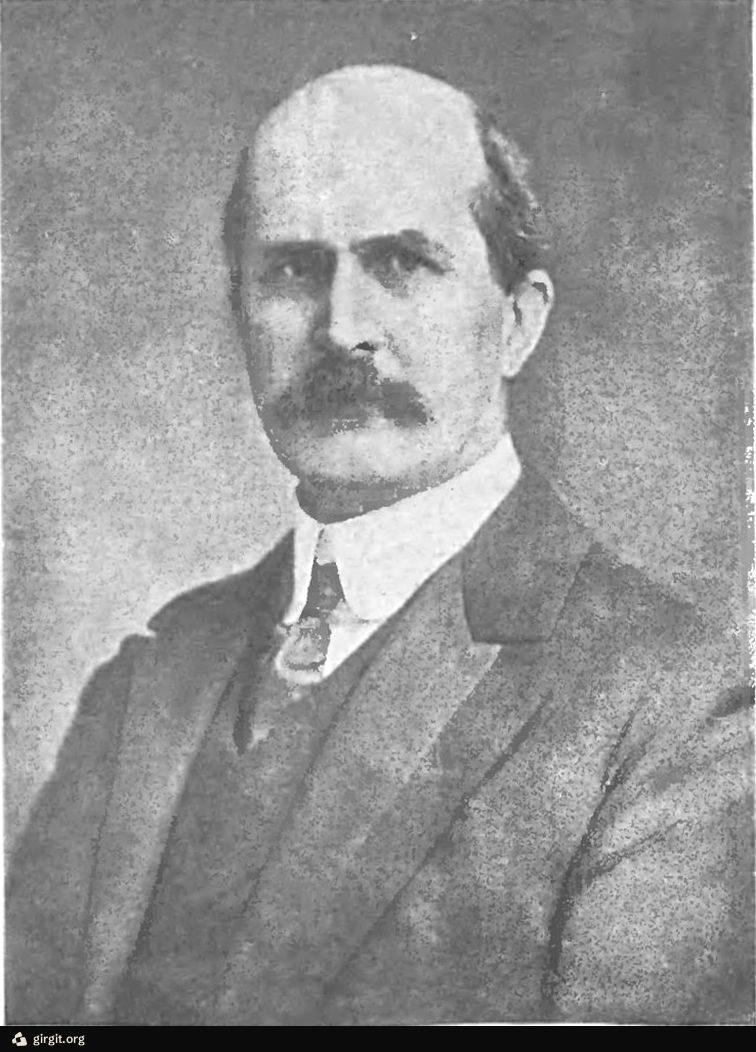
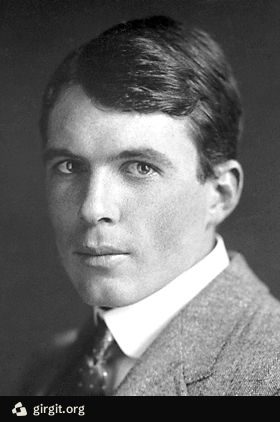
The story
 crystal on a turntableionisation chamberswinging arm
See it
Be Slater. Drag the number of protons and watch the outermost electron's pull: the nucleus bar, minus the three kinds of shield, leaves what the electron feels. Then change how well same-shell electrons shield (try 1.00, a perfect shield) and press Every element.
The lanthanoid contraction, in metal. Zirconium sits in period 5, hafnium in period 6 directly below it, with 32 more protons. They should differ in size by a whole shell. They do not:
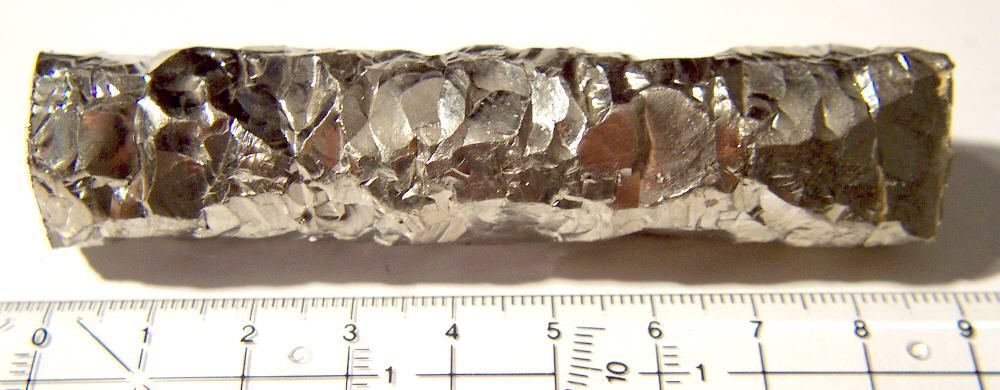 Zr: 160 pm
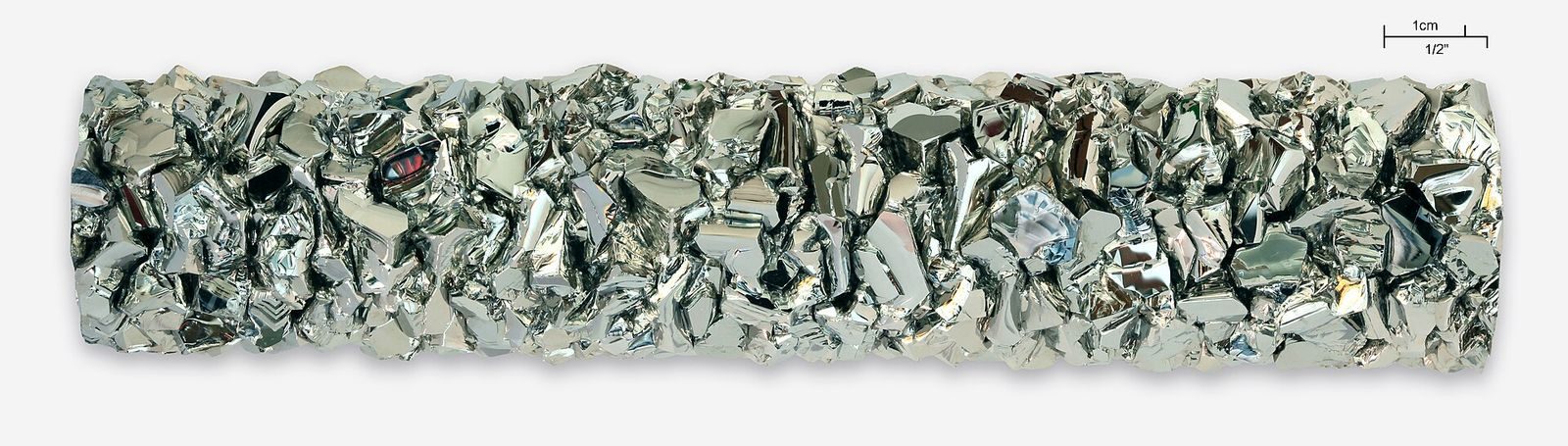 Hf: 159 pm
Solve it
Solve it
X-rays show that in rock salt the centres of neighbouring Na+ and Cl− ions are 282 pm apart. Taking Cl− as 181 pm, how big is Na+? Why can no measurement of salt alone tell you the answer without such an assumption?
Hint
Answer
Solve it: use Slater
Use Slater's rules to find Zeff for the outer electron of chlorine (2, 8, 7) and of potassium (2, 8, 8, 1). Then use size \( \propto n^{*2}/Z_{\text{eff}} \) with \( n^* = 3 \) for chlorine and 3.7 for potassium to predict how many times wider potassium is. Compare with the measured 231 pm and 99 pm.
Answer
Solve it: what would happen if…
Suppose electrons in the same shell were perfect shields, each hiding a whole proton. What would period 2 look like?
Answer
Solve it: estimate
A human hair is about 0.07 mm thick. Roughly how many copper atoms (radius 128 pm) would sit side by side across it?
Answer
Connect it
Connect it
- Bohr's radius, Chapter 2. The size rule \( r = a_0 n^2/Z \) is Bohr's, for one electron. Shielding just replaces Z with Zeff. See Bohr's model.
- Shielding and penetration, Chapter 2. Why 2s electrons shield 2p ones a little, and why s electrons dive closer to the nucleus than p: shapes and energies of orbitals, and the filling order on electronic configuration.
- Next pages. The same Zeff sets how hard an electron is to pull off (ionisation enthalpy) and how strongly an atom grabs one (electron gain enthalpy). Small atoms with a big pull do both.
- The d- and f-block, Class 12. The lanthanoid contraction returns in full in the lanthanoids and in the sizes of the transition metals.
- Lattice enthalpy, Chapter 4. How tightly an ionic crystal holds together depends on how close the ion centres can get, the sum of the radii: ionic bond and lattice enthalpy.
- X-rays and life. The Braggs' method grew into X-ray crystallography. In Madras in 1954, G.N. Ramachandran and Gopinath Kartha used X-ray diffraction to propose the triple helix of collagen, the protein in skin and bone; the same method helped reveal the shape of DNA (DNA structure).
Still confused?
More electrons means more stuff. Why doesn't fluorine end up bigger than lithium?
Electrons take up almost no room themselves; the size of an atom is the size of the space their clouds fill, and that is set by how tightly they are held. Fluorine adds electrons to the same shell and adds protons to the nucleus. The extra protons win (each new electron hides only 0.35 of a proton), so the whole shell is pulled in. Size is a tug-of-war result, not a count of parts.
Why does Na+ shrink so much more than Cl− grows?
Na+ loses its whole outer shell: the one 3s electron was the only thing in n = 3, so the ion is just sodium's n = 2 core, pulled by 11 protons. Cl− keeps the same shell and only adds one electron to it, which slightly weakens the pull on each. Losing a shell is a big change; adding one electron to a shell is a small one.
Is an atom's radius a real, fixed number?
No. The electron cloud fades smoothly with no surface, so "radius" means a measured half-distance, and it depends on the situation: chlorine is 99 pm bonded to another chlorine, 181 pm as a chloride ion, and about 175 pm as a non-bonded neighbour. Always compare radii of the same kind.
Sources
- J.C. Slater, "Atomic Shielding Constants", Physical Review 36, 57 (1930) and Slater's rules (Wikipedia): the 0.35, 0.85, 1.00 rules
- E. Clementi and D.L. Raimondi, "Atomic Screening Constants from SCF Functions", J. Chem. Phys. 38, 2686 (1963)
- Atomic radii of the elements (Wikipedia data page): metallic radii incl. Zr 160 pm, Hf 159 pm, and van der Waals radii
- WebElements (Mark Winter, University of Sheffield): Pauling ionic radii for each element
- Lawrence Bragg (Wikipedia): the 1912 insight, the 1915 Nobel Prize at 25, his brother's death at Gallipoli and The Nobel Prize in Physics 1915 (nobelprize.org)
- University of Leeds Special Collections: the X-ray spectrometer, built winter 1912 to 1913 and Science Museum Group: Bragg X-ray spectrometer
- W.L. Bragg, "The structure of some crystals as indicated by their diffraction of X-rays", Proc. R. Soc. A 89, 248 (1913)
- H.E. Armstrong, "Poor Common Salt!", Nature 120, 478 (1927)
- Ionic radius (Wikipedia): Landé 1920 (LiI), Pauling, Shannon 1976
- Hafnium (Wikipedia): Bury, Bohr, Coster and Hevesy 1923, separation from zirconium, neutron absorption, density and Lanthanide contraction (Wikipedia)
- Nuclear Fuel Complex, Hyderabad (Wikipedia): zirconium alloy cladding for India's power reactors
- Sodium chloride (Wikipedia): lattice constant 564.02 pm
- G.N. Ramachandran (Wikipedia): the collagen triple helix with Gopinath Kartha, 1954
Picture and video credits
Show 5 picture and video credits
- aluminium-atoms-electron-microscope.jpg: Matheustunes, CC BY-SA 4.0
- halite-rock-salt-cubes.jpg: James St. John, CC BY 2.0
- bragg-x-ray-spectrometer.jpg: Wellcome Collection (Wellcome Images), CC BY 4.0
- zirconium-crystal-bar.jpg: Alchemist-hp (www.pse-mendelejew.de), CC BY-SA 3.0 de
- hafnium-crystal-bar.jpg: Alchemist-hp (www.pse-mendelejew.de), CC BY-SA 3.0 de


