ReviewStructure of Atom25 min
Everything, once more
The atom runs back through its history in one scroll: from orbital to Dalton's ball, to Bohr's rings, to the 2p cloud.
Five models, twelve points, 57 cards, then the questions.
ReviewThe chapter in one line
A tiny nucleus. Quantised electrons. Orbitals.
Labelled by four quantum numbers, filled by the aufbau, Pauli and Hund rules.
Full text
The chapter in one lineAn atom is a tiny positive nucleus with electrons whose energies are quantised, described not by orbits but by orbitals labelled with four quantum numbers and filled by the aufbau, Pauli and Hund rules.
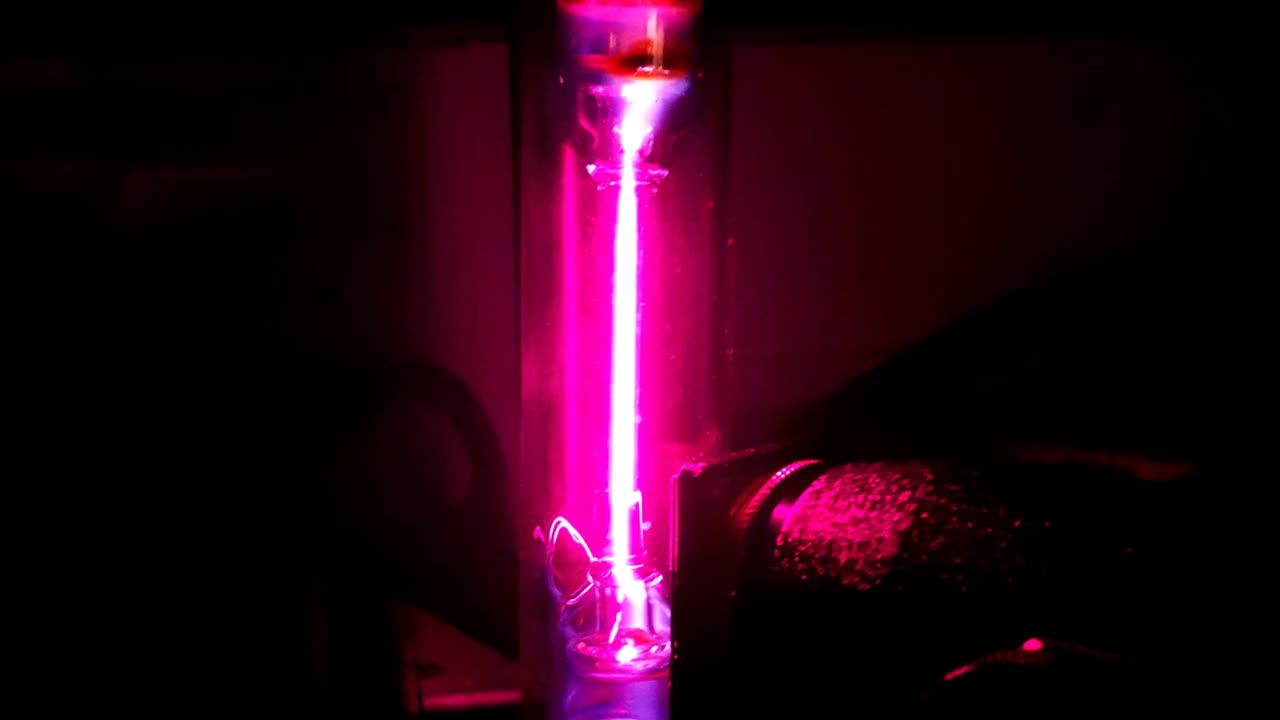
Hydrogen glowing in a discharge tube.
1 of 5Dalton · 1808
A solid ball that cannot be split.
Broken by cathode rays: every atom holds electrons.
- Charge of the electron
- 1.602 × 10⁻¹⁹ C
- Mass of the electron
- 9.109 × 10⁻³¹ kg
- Electrons to weigh one proton
- 1836
- Chadwick finds the neutron
- 1932
2 of 5Thomson · 1898
Positive pudding, electrons set in it like seeds.
Broken by gold foil, 1911.
- e/mₑ, C kg⁻¹ (Thomson)
- 1.758820 × 10¹¹
- Alphas that bounced back
- 1 in 20,000
- Penetration of α, β, γ
- 1 : 100 : 1000
3 of 5Rutherford · 1911
A tiny heavy nucleus, electrons circling far out.
Broken: a circling charge should radiate and spiral in.
- Nucleus in atom
- 10⁻¹⁵ m in 10⁻¹⁰ m
- Mass number
- A = Z + neutrons
- c = νλ, in a vacuum
- 3.0 × 10⁸ m s⁻¹
- Planck's h, in E = hν
- 6.626 × 10⁻³⁴ J s
4 of 5Bohr · 1913
Fixed orbits, fixed energies; light only on a jump.
Broken by many-electron atoms, by λ = h/mv and Δx·Δp ≥ h/4π.
- Radius of orbit n
- 52.9 n²/Z pm
- Energy of orbit n
- −2.18 × 10⁻¹⁸ Z²/n² J
- Rydberg constant, H
- 109,677 cm⁻¹
- Balmer lines, nm
- 656 · 486 · 434 · 410
5 of 5Schrödinger and Born · 1926
No paths: orbitals, clouds of chance, ψ².
Filled by aufbau, Pauli and Hund.
- Radial and angular nodes
- n − l − 1 and l
- Electrons in shell n
- 2n²
- Chromium
- 3d⁵ 4s¹
- Copper
- 3d¹⁰ 4s¹
The chapter's 3D atom changes through its five models as you scroll: Dalton's solid ball, Thomson's pudding, Rutherford's nucleus, Bohr's orbits and the quantum cloud of a 2p orbital, each shown with the numbers to remember from it.
Summary 1–3Inside the atom
The atom opens up
- 1808DaltonAtoms cannot be divided. Discharge tubes said otherwise.
- 1897Electrons, from cathode raysThe same for every gas and electrode. Thomson: e/me = 1.758820 × 10¹¹ C kg−1.
- 1898Plum puddingPositive charge and mass spread evenly.
- 1909Millikan's oil dropse = 1.602176 × 10⁻¹⁹ C, so me = 9.1094 × 10⁻³¹ kg.
- 1911Rutherford's gold foilMost α pass, a few bounce: a tiny dense positive nucleus, about 10−15 m, in a mostly empty atom, about 10−10 m.
- 1919ProtonsFrom canal rays.
- 1932NeutronsChadwick.
Full text
Summary
Read the summary · 12 points
- Dalton (1808) thought atoms could not be divided. Discharge-tube experiments showed they contain electrons (cathode rays, the same for every gas and electrode), protons (from canal rays, 1919) and neutrons (Chadwick, 1932).
- Thomson measured e/me = 1.758820 × 10¹¹ C kg−1; Millikan's oil drops gave e = 1.602176 × 10⁻¹⁹ C; together they give me = 9.1094 × 10⁻³¹ kg.
- Thomson's plum pudding model (1898) spread positive charge and mass evenly. Rutherford's α-scattering from gold foil (most pass, a few bounce back) showed a tiny, dense, positive nucleus (about 10−15 m) in a mostly empty atom (about 10−10 m).
- Atomic number Z = protons (= electrons in a neutral atom); mass number A = protons + neutrons. Isotopes share Z and react alike; isobars share A.
- Rutherford's model fails because an orbiting charge should radiate and spiral into the nucleus in about 10−8 s; it also says nothing about electron energies.
- Electromagnetic radiation is a wave of electric and magnetic fields that needs no medium: c = νλ, wavenumber ν̄ = 1/λ, and c = 3.0 × 10⁸ m s−1 in a vacuum.
- Planck (1900) explained black-body radiation with quanta of energy E = hν, h = 6.626 × 10⁻³⁴ J s. Einstein (1905) explained the photoelectric effect: hν = W0 + ½mev2, with a threshold frequency below which no electrons leave. Light shows dual behaviour.
- Atoms give line spectra, unique to each element. Hydrogen's lines obey ν̄ = 109,677 (1/n12 − 1/n22) cm−1: Lyman (UV), Balmer (visible), Paschen, Brackett and Pfund (IR).
- Bohr (1913): fixed orbits with angular momentum nh/2π; rn = 52.9 n2/Z pm and En = −2.18 × 10⁻¹⁸ Z2/n2 J for one-electron species; jumps give ΔE = hν. It fails for multi-electron atoms, fine structure, Zeeman and Stark effects, and bonding.
- de Broglie: every moving particle has λ = h/mv. Heisenberg: Δx·Δp ≥ h/4π, so electrons have no definite path, which rules out Bohr's orbits.
- Schrödinger's equation Ĥψ = Eψ gives quantised energies and orbitals; |ψ|2 is the probability density. Quantum numbers: n (shell, size, energy), l (sub-shell, shape, 0 to n − 1), ml (orientation, 2l + 1 values) and ms (spin, ±½). s orbitals are spherical, p have two lobes, d mostly four; radial nodes n − l − 1, angular nodes l.
- In hydrogen, energy depends on n only; in multi-electron atoms on n and l, by the (n + l) rule, because of shielding. Electrons fill by aufbau, Pauli (at most two per orbital, opposite spins) and Hund (singly before pairing); half-filled and full sub-shells are extra stable, so Cr is 3d5 4s1 and Cu is 3d10 4s1.
Summary 4–5Counting, and a crack
Two numbers, one flaw
Z and A
Z = protons; A = protons + neutrons
Atomic number and mass number. Z also counts electrons in a neutral atom. Isotopes share Z and react alike; isobars share A.
Why Rutherford fails
An orbiting charge should radiate
and spiral into the nucleus in about 10−8 s. It also says nothing about electron energies.
Summary 6–7Light
A wave that comes in packets
Electromagnetic radiation: electric and magnetic fields, no medium. Wavenumber ν̄ = 1/λ. Planck explained black-body radiation; h = 6.626 × 10⁻³⁴ J s. Light shows dual behaviour.
Practice 4Above the threshold
How much energy is left?
4
Light of frequency 1.2 × 10¹⁵ Hz falls on a metal with threshold frequency 8.0 × 10¹⁴ Hz. The maximum kinetic energy of the ejected electrons is about
- 8.0 × 10⁻¹⁹ J
- 2.65 × 10⁻¹⁹ J
- Zero
Summary 8–9Spectra, then Bohr
Lines, and fixed orbits
ν̄
Line spectra · unique to each element
- Hydrogen
- 109,677 (1/n₁² − 1/n₂²) cm⁻¹
- UV
- Lyman
- Visible
- Balmer
- IR
- Paschen, Brackett, Pfund
n
Bohr · 1913 · one electron
- Angular momentum
- nh/2π
- Radius
- rn = 52.9 n²/Z pm
- Energy
- En = −2.18 × 10⁻¹⁸ Z²/n² J
- A jump
- ΔE = hν
- Fails for
- Many electrons, fine structure, Zeeman, Stark, bonding
Practice 1He⁺ against H
Which orbit is bigger?
1
The ratio of the radius of the second Bohr orbit of He+ to that of the first Bohr orbit of hydrogen is
- 4 : 1
- 2 : 1
- 1 : 1
- 1 : 2
Summary 10Waves and uncertainty
Δx·Δp ≥ h/4π
- de Broglie:every moving particle has λ = h/mv.
- Heisenberg:position and momentum cannot both be sharp.
- So no definite path:Bohr's orbits are ruled out.
Practice 2An electron's wave
How long is it?
2
What is the de Broglie wavelength of an electron moving at 1.0 × 10⁶ m s−1? (h = 6.626 × 10⁻³⁴ J s, me = 9.11 × 10⁻³¹ kg)
- 7.3 × 10⁻¹⁰ m
- 7.3 × 10⁻⁷ m
- 1.4 × 10⁹ m
Summary 11Schrödinger: Ĥψ = Eψ · quantum numbers
Four numbers name an orbital
n
Shell
- Sets
- Size, energy
l
Sub-shell
- Sets
- Shape · 0 to n − 1
ml
Orientation
- Values
- 2l + 1
ms
Spin
- Values
- +½ or −½
Quantised energies; |ψ|² is the probability density. s spherical, p two lobes, d mostly four. Radial nodes n − l − 1, angular l.
Practice 3A 3d electron
Which set is valid?
3
Which set of quantum numbers describes a valid electron in a 3d orbital?
- n = 3, l = 3, ml = 0, ms = +½
- n = 3, l = 2, ml = −2, ms = −½
- n = 3, l = 1, ml = 0, ms = +½
- n = 3, l = 2, ml = +1, ms = 0
Summary 12Energies, then filling
Three rules, two exceptions
- Hydrogen: n only.Many electrons: n and l, the (n + l) rule, because of shielding.
- Aufbau, Pauli, Hund:lowest first; two per orbital, opposite spins; singly before pairing.
- Half-filled and full are extra stable:Cr 3d5 4s1, Cu 3d10 4s1.
Practice 5Iron, Z = 26
How many unpaired?
5
How many unpaired electrons does an iron atom (Z = 26) have in its ground state?
- 0
- 2
- 4
- 6
Remember it all57 cards
Say it, then tap
Every number, name, formula and exception, with the hooks. Missed cards come back.
Common questionsEight, answered
Still wondering?
What is the difference between an orbit and an orbital?
An orbit is Bohr's idea: a fixed circular path at a fixed distance from the nucleus. The uncertainty principle says no such exact path can exist or be observed. An orbital is a wave function ψ described by n, l and ml; it tells us the probability of finding the electron in different places, and it can hold at most two electrons.
Why is the energy of an electron in an atom negative?
Zero energy is set for a free electron at rest, infinitely far from the nucleus. A bound electron has less energy than that, because energy was given out when the nucleus captured it. So its energy is below zero. The more negative it is, the more tightly the electron is held; n = 1 is the most negative and most stable.
Why does brighter light not give faster photoelectrons?
Each electron is knocked out by one photon, and a photon's energy is hν, set only by the frequency. A brighter beam has more photons of the same energy, so it frees more electrons, each with the same kinetic energy hν − hν0. To get faster electrons you need higher-frequency light.
Which series of the hydrogen spectrum is visible?
Only the Balmer series, the lines that end on n = 2. Lyman lines (ending on n = 1) are ultraviolet; Paschen (n = 3), Brackett (n = 4) and Pfund (n = 5) are infrared.
How do I count radial and angular nodes?
Radial nodes = n − l − 1, angular nodes = l, total nodes = n − 1. For example 3p (n = 3, l = 1) has 1 radial and 1 angular node; 3d has 0 radial and 2 angular nodes; 4s has 3 radial nodes and none angular.
Why does 4s fill before 3d?
In multi-electron atoms the energy depends on n and l. By the (n + l) rule, 4s has 4 + 0 = 4 and 3d has 3 + 2 = 5, so 4s is lower and fills first. The reason underneath is shielding: a 4s electron gets close to the nucleus more often and feels a larger effective nuclear charge.
Why are chromium and copper exceptions?
Their 4s and 3d levels are very close in energy. Moving one electron from 4s to 3d gives a half-filled 3d5 (Cr) or a full 3d10 (Cu). These are extra stable because of their symmetry, smaller shielding and repulsion, and larger exchange energy. So Cr is [Ar] 3d5 4s1 and Cu is [Ar] 3d10 4s1.
Does the uncertainty principle matter for a cricket ball?
Not in practice. Δx·Δv ≥ h/4πm, and for a mass of grams or more this limit is unimaginably small (around 10−32 m for a cricket ball whose speed is known to 0.01 m s−1). It matters only for tiny masses such as electrons, where the uncertainty in velocity can be as big as the velocity itself.
NEETEvery past question, one card at a time
The real thing
Chapter puzzleBohr, Planck, Einstein, de Broglie, Heisenberg
One photon, three ideas
Chapter puzzle
In a hydrogen lamp, an electron falls from \( n = 4 \) to \( n = 2 \). (a) Which series is the light in, and what colour is it? (b) The photon lands on a potassium plate (work function 2.25 eV). Does an electron come out? If so, how fast is it moving? (c) What is that electron's de Broglie wavelength, and how does it compare with the size of a hydrogen atom? (d) If its speed is known to within 1%, how well can its position be known?
Hint
Answer
(a) \( \Delta E = 2.18 \times 10^{-18} \left( \frac{1}{4} - \frac{1}{16} \right) = 4.09 \times 10^{-19} \) J. \( \lambda = \dfrac{6.626 \times 10^{-34} \times 3.0 \times 10^{8}}{4.09 \times 10^{-19}} = 4.86 \times 10^{-7} \) m \( = 486 \) nm. It ends on \( n = 2 \), so it is a Balmer line, blue-green.
(b) In eV: \( 4.09 \times 10^{-19} / 1.602 \times 10^{-19} = 2.55 \) eV, which is more than 2.25 eV, so yes. Kinetic energy \( = 2.55 - 2.25 = 0.30 \) eV \( = 4.8 \times 10^{-20} \) J. Speed \( v = \sqrt{2 \times 4.8 \times 10^{-20} / 9.109 \times 10^{-31}} \approx 3.3 \times 10^{5} \) m s−1.
(c) \( \lambda = \dfrac{6.626 \times 10^{-34}}{9.109 \times 10^{-31} \times 3.3 \times 10^{5}} \approx 2.2 \times 10^{-9} \) m \( = 2.2 \) nm. A hydrogen atom is about 0.1 nm across (twice 52.9 pm), so this slow electron's wave is about twenty atoms wide.
(d) \( \Delta v = 0.01 \times 3.3 \times 10^{5} = 3.3 \times 10^{3} \) m s−1, so \( \Delta x \ge 5.79 \times 10^{-5} / 3.3 \times 10^{3} \approx 1.8 \times 10^{-8} \) m, about 18 nm: far bigger than an atom. A precise speed means a fuzzy place, which is why "orbits" inside an atom make no sense.
One photon used four pages: Bohr's energies, Planck's \( E = h\nu \), Einstein's photoelectric equation, and de Broglie with Heisenberg.