Act 06NCERT §2.3.3 · pp. 44–465 min
Why does each element glow in its own colours?
Scattered points of light gather back into an atom: every element gives out its own set of colours.
Heat a gas, or spark it, and it glows in its own few colours.
From the textbookpp. 44–46
NCERT Chemistry Part I, Class 11 · Reprint 2026-27
6.0The big idea
Each element glows in its own few colours.
Excited atoms give out light only at sharp wavelengths, unique to the element. So their energies must be fixed.
Full text
The big ideaExcited atoms give out light only at certain sharp wavelengths, a line spectrum unique to each element, which proves their energy levels are fixed.
In simple words
Pass sunlight through a glass prism and you get a smooth band of colours, like a rainbow. But heat one kind of gas until it glows and pass that light through the prism: you see only a few bright lines with darkness in between. Every element shows its own set of lines, like a fingerprint. Atoms can only give out a few exact colours because their electrons can only sit at a few exact energies.
6.1White light into a spectrum
Light you bend
- Light is refractedmoving from one material into another.
- Shorter wavelengths bend more.Violet most, red least.
- No gaps: a continuous spectrum, like a rainbow. Violet \( 7.50 \times 10^{14} \) Hz to red \( 4 \times 10^{14} \) Hz.
Full text
From white light to a spectrum
Light travels at different speeds in different materials, so it bends (is refracted) when it passes from one into another. In a prism, shorter wavelengths bend more. White light holds all visible wavelengths, so it spreads into coloured bands, a spectrum. Red, the longest wavelength, bends least; violet, the shortest, bends most. The visible range is from violet at \( 7.50 \times 10^{14} \) Hz to red at \( 4 \times 10^{14} \) Hz.
Here each colour merges smoothly into the next with no gaps, so it is a continuous spectrum. A rainbow is one.
Every colour, merging. (The fan is drawn wider than real glass spreads it.)
Only four lines: 656, 486, 434 and 410 nm. Darkness between.
Bright lines on black.
White light through hydrogen: dark lines, at the very same places.
6.2Atoms that absorb energy are excited
Bright lines, dark lines
An excited atom sits in a higher, unstable state. Returning to its stable state, it gives out radiation.
Emission spectrum
Given out after absorbing energy (heat, or light). Bright lines.
Absorption spectrum
Continuous light through a sample: some wavelengths go missing as dark lines. A photographic negative.
Full text
Emission and absorption spectra
Atoms and molecules can absorb energy and move to a higher, unstable energy state. They are then excited. When they return to their normal, more stable state they give out radiation.
- Emission spectrum: the radiation given out by a substance after it has absorbed energy (by heating or by shining radiation on it). It shows bright lines.
- Absorption spectrum: pass continuous radiation through a sample. The sample absorbs certain wavelengths, which go missing as dark lines in the bright spectrum. It is like a photographic negative of the emission spectrum: the dark lines sit exactly where the bright emission lines would be.
The study of these spectra is spectroscopy. Atoms in the gas phase do not give a continuous spread. They emit only at specific wavelengths, with dark gaps between. This is a line spectrum or atomic spectrum.
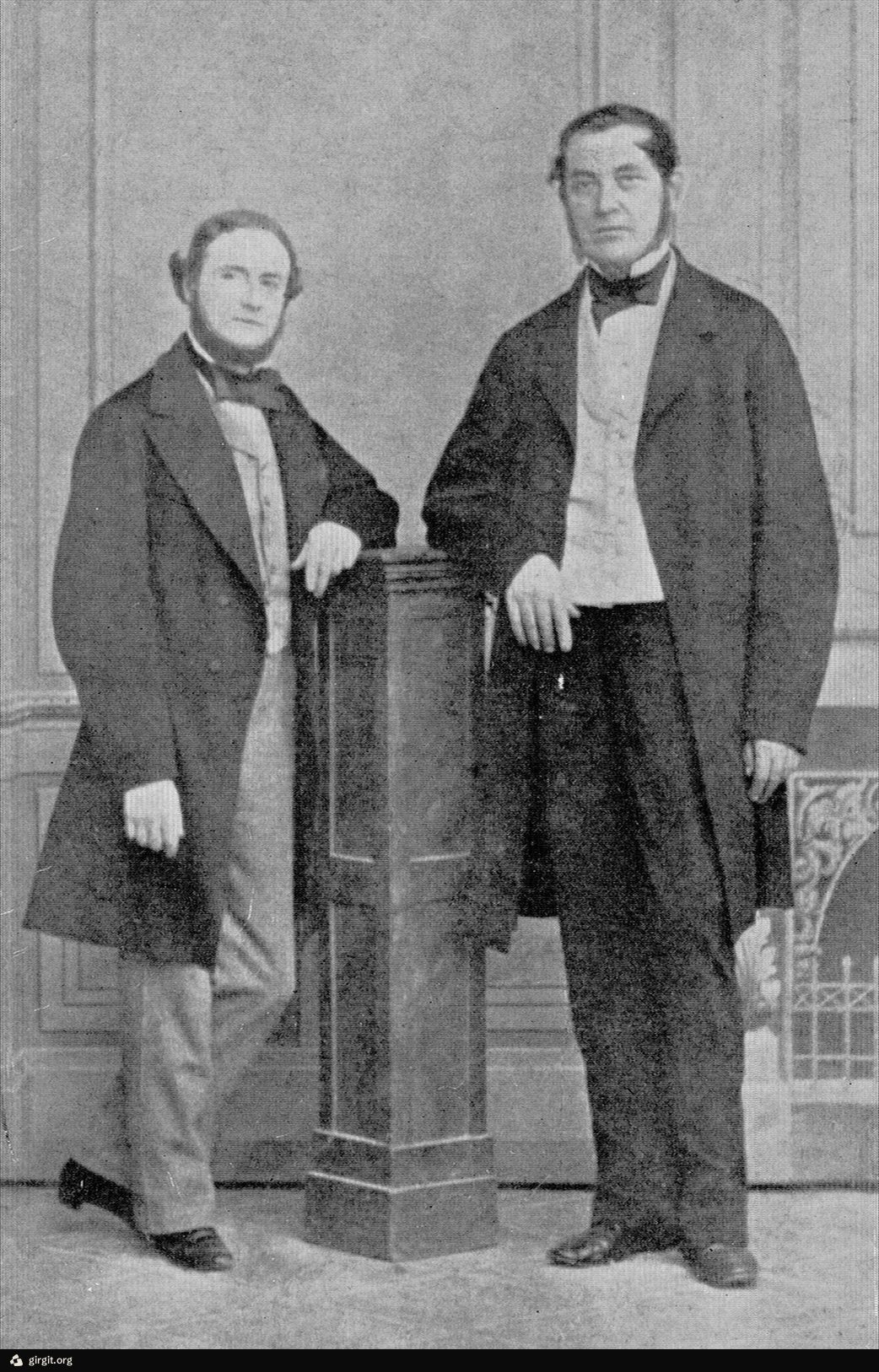
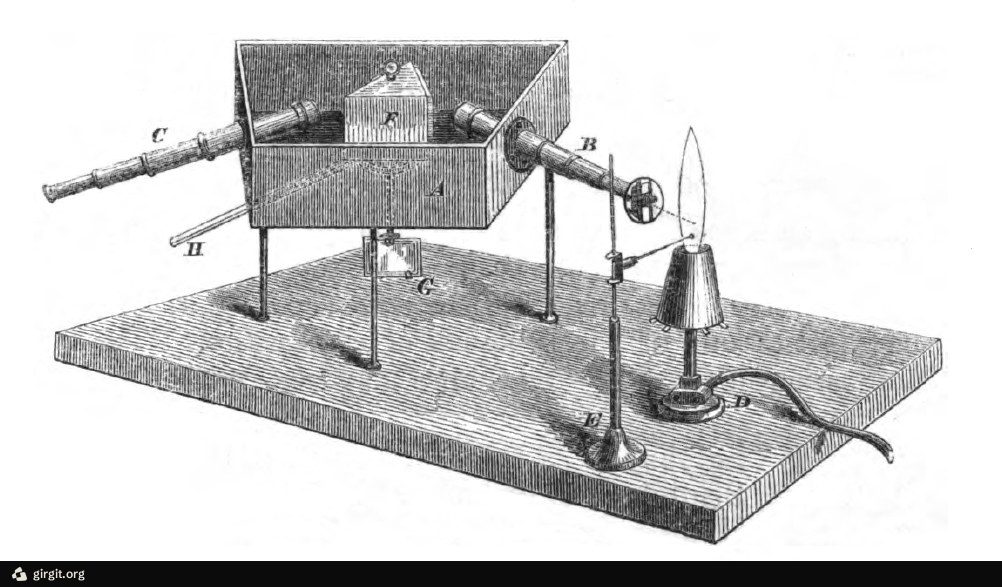
This makes line spectra useful in chemical analysis. Robert Bunsen was one of the first to identify elements this way. Rubidium (Rb), caesium (Cs), thallium (Tl), indium (In), gallium (Ga) and scandium (Sc) were discovered by spectroscopy, and helium was found in the sun from its spectrum before it was found on earth.
Any one atom is in just one excited state at a moment. A sample, though, has countless atoms spread over every possible excited state, so all the lines show up together.
CheckCool gas, white light
What do you see?
White light passes through cool hydrogen gas and then a prism. What do you see?
- A continuous spectrum with a few dark lines
- A few bright lines on a dark background
- A perfect, unbroken rainbow
A barcode per gas: only specific wavelengths, dark gaps between.
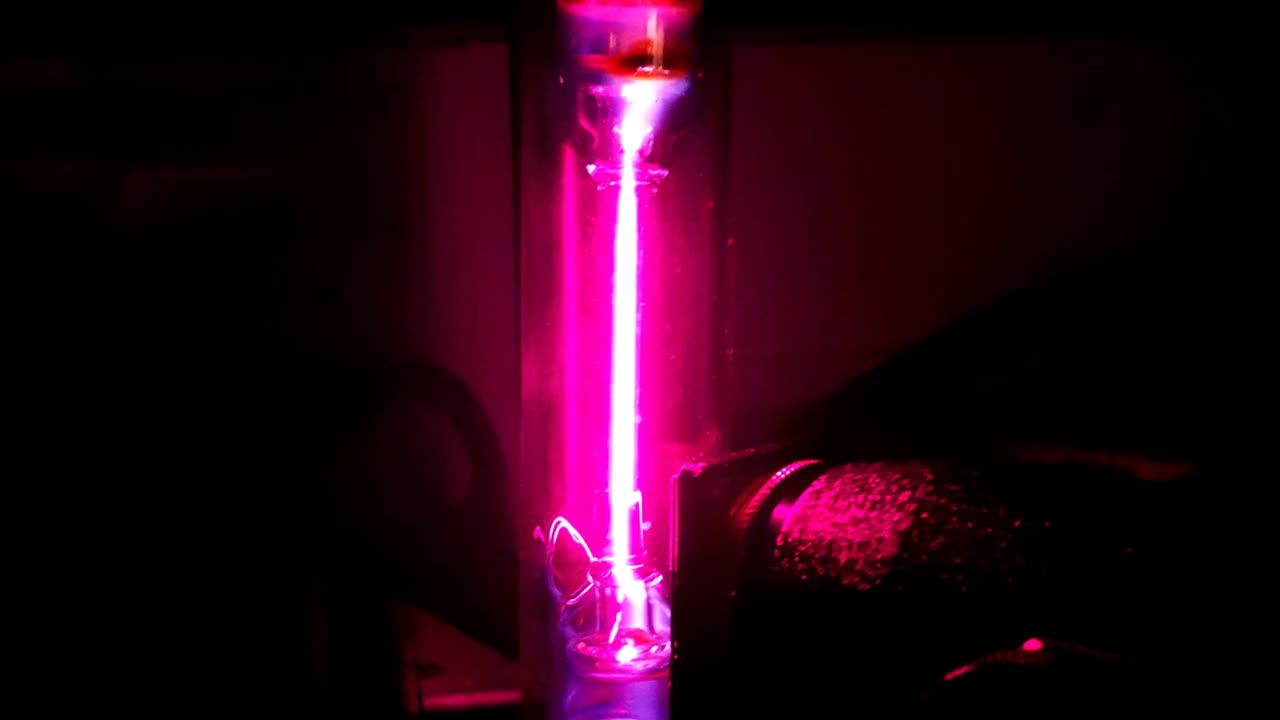
Hydrogen in a discharge tube glows pink-purple: mostly its red 656 nm line with some blue-violet. Neon glows orange-red, the colour of old neon shop signs.
A crowd of lines, nearly all orange and red.
The study of these spectra. The lines name the gas.
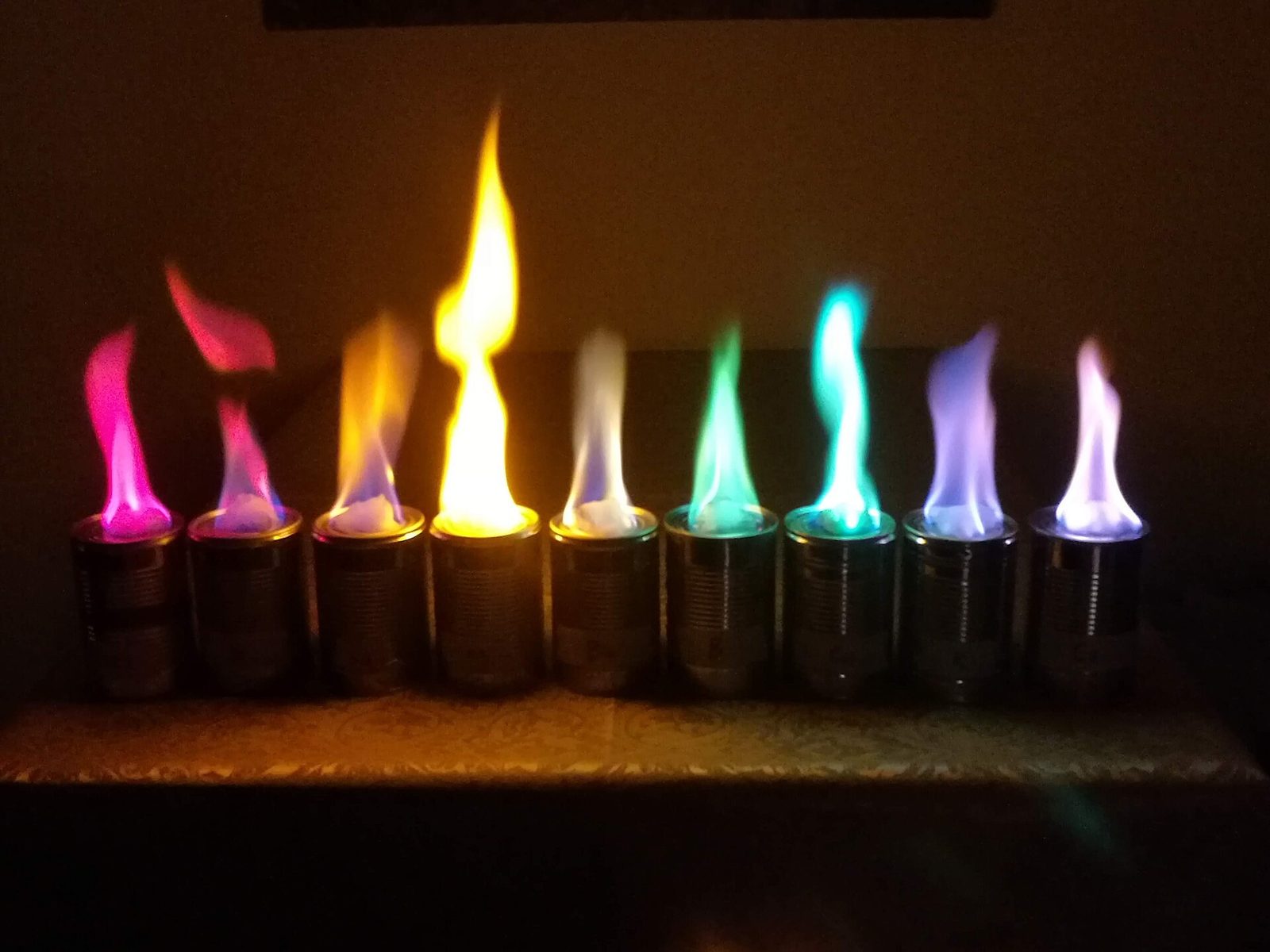 LiSrCaNaBaBCuCsK
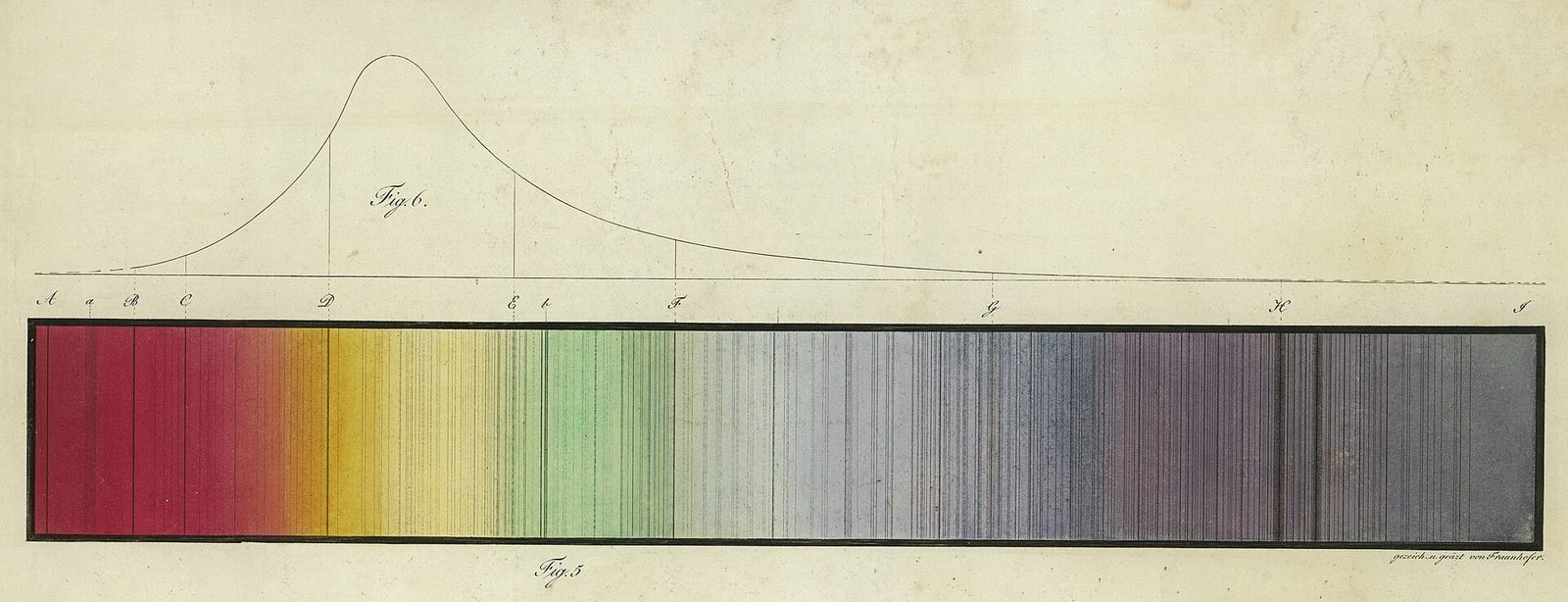 D: sodiumF: hydrogenH: calcium
6.4Robert Bunsen and chemical analysis
Found by their light
Rubidium (Rb), caesium (Cs), thallium (Tl), indium (In), gallium (Ga), scandium (Sc): discovered by spectroscopy. And helium was found in the sun before it was found on earth.
Try itRead the barcode
Name the gas
Compare emission and absorption, then identify a gas.
CheckFingerprints
Why a fingerprint?
Why can line spectra identify an element, like a fingerprint?
- All elements give the same lines
- Each element's set of lines is unique
- Every element gives a continuous spectrum
6.5Don't mix these up
One atom, one line
Myth
Each atom gives out every line at once
Fact
One atom is in one excited state at a moment
A sample has countless atoms in every possible state, so all the lines show together.
Don't mix these up
- Only the Balmer series is in the visible region. Lyman is ultraviolet; Paschen, Brackett and Pfund are infrared.
- Emission lines are bright on dark; absorption lines are dark on bright, at the same wavelengths.
- A rainbow is a continuous spectrum, not a line spectrum.
6.6Balmer · 1885 · discharge through hydrogen
Hydrogen's visible lines
Discharge splits H₂ into excited H atoms. These lines are the Balmer series: the only hydrogen lines in the visible.
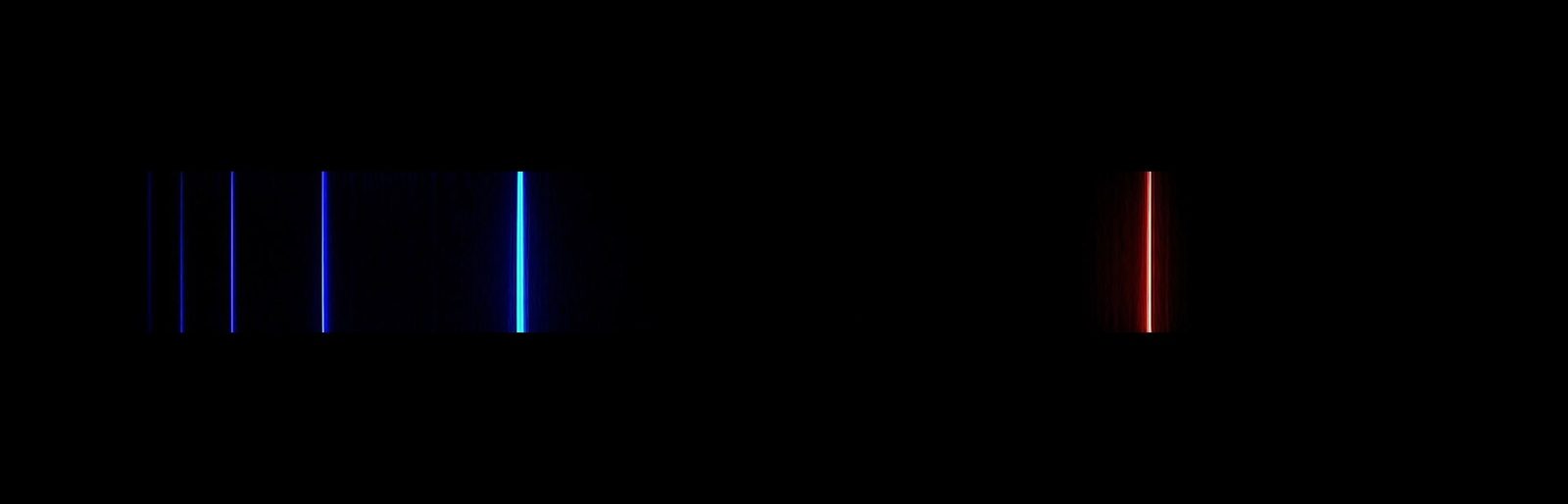 410 nm434 nm486 nm656 nm
Full text
The line spectrum of hydrogen
An electric discharge through hydrogen gas splits H2 molecules into excited H atoms, which give out light of fixed frequencies. In 1885 Balmer found that the visible lines fit a simple formula in wavenumbers:
\[ \bar{\nu} = 109{,}677 \left( \frac{1}{2^2} - \frac{1}{n^2} \right)\ \mathrm{cm^{-1}}, \qquad n = 3, 4, 5, \ldots \]These are the Balmer series, the only hydrogen lines in the visible region. The Swedish scientist Johannes Rydberg then found one formula for all of hydrogen's series:
\[ \bar{\nu} = 109{,}677 \left( \frac{1}{n_1^2} - \frac{1}{n_2^2} \right)\ \mathrm{cm^{-1}} \]with \( n_1 = 1, 2, 3 \ldots \) and \( n_2 = n_1 + 1, n_1 + 2 \ldots \). The number 109,677 cm−1 is the Rydberg constant for hydrogen.
| Series | n1 | n2 | Region |
|---|---|---|---|
| Lyman | 1 | 2, 3, … | Ultraviolet |
| Balmer | 2 | 3, 4, … | Visible |
| Paschen | 3 | 4, 5, … | Infrared |
| Brackett | 4 | 5, 6, … | Infrared |
| Pfund | 5 | 6, 7, … | Infrared |
The names and the order are in the "Just remember" box below.
Worked example: the first line of two series
- Balmer, first line (\( n_1 = 2, n_2 = 3 \)): \( \bar{\nu} = 109{,}677 \left( \tfrac{1}{4} - \tfrac{1}{9} \right) = 109{,}677 \times \tfrac{5}{36} = 15{,}233 \) cm−1. So \( \lambda = 1/\bar{\nu} = 6.565 \times 10^{-5} \) cm = 656.5 nm: red light.
- Lyman, first line (\( n_1 = 1, n_2 = 2 \)): \( \bar{\nu} = 109{,}677 \times \tfrac{3}{4} = 82{,}258 \) cm−1. So \( \lambda = 1.216 \times 10^{-5} \) cm = 121.6 nm: ultraviolet, invisible.
Smaller \( n_1 \) means bigger gaps, so higher wavenumber and shorter wavelength.
Answer
Hydrogen has the simplest line spectrum; heavier atoms give far more complex ones. But two features are common to all: each element's line spectrum is unique, and each shows regularity. Why? The answer lies in how electrons are arranged, which Bohr tackled next.
Don't mix these up
- Only the Balmer series is in the visible region. Lyman is ultraviolet; Paschen, Brackett and Pfund are infrared.
- Emission lines are bright on dark; absorption lines are dark on bright, at the same wavelengths.
- A rainbow is a continuous spectrum, not a line spectrum.
6.7The Swedish scientist Johannes Rydberg
One formula, every series
- n₁ 1LymanUltraviolet · n₂ = 2, 3 …
- n₁ 2BalmerVisible · n₂ = 3, 4 …
- n₁ 3PaschenInfrared · n₂ = 4, 5 …
- n₁ 4BrackettInfrared · n₂ = 5, 6 …
- n₁ 5PfundInfrared · n₂ = 6, 7 …
Try itFive series
Slide n₂, watch them bunch
6.8Worked: the first line of two series
Red, and invisible
Balmer · n₁ = 2, n₂ = 3
656.5nm
109,677 × 5/36 = 15,233 cm⁻¹, so λ = \( 6.565 \times 10^{-5} \) cm. Red light.
Lyman · n₁ = 1, n₂ = 2
121.6nm
109,677 × 3/4 = 82,258 cm⁻¹, so λ = \( 1.216 \times 10^{-5} \) cm. Ultraviolet, invisible.
Smaller n₁: bigger gaps, higher wavenumber, shorter wavelength.
Answer
CheckBigger bracket
Shortest wavelength?
Which line has the shortest wavelength?
- Balmer, n2 = 3
- Paschen, n2 = 4
- Lyman, n2 = 3
6.9Every element's line spectrum
Unique. Regular. Why?
Hydrogen's is the simplest; heavier atoms are far more complex. The answer lies in how electrons are arranged, which Bohr tackled next.
KeepJust remember
Names and a number
Series named after the people who found them; the constant is measured. Tap a card for its hook.
WordsTo know
Six words
- Continuous spectrum
- All wavelengths, merging with no gaps, as in a rainbow.
- Emission spectrum
- Light given out by excited atoms: bright lines.
- Absorption spectrum
- Dark lines where a sample has absorbed certain wavelengths.
- Line (atomic) spectrum
- Light at only a few sharp wavelengths.
- Spectroscopy
- The study of emission and absorption spectra.
- Rydberg constant
- 109,677 cm−1 for hydrogen.
NEETAsked in the exam
The real thing
RootsA line is a gap in a ladder
One drop, one colour
- Different ladders: charge and electrons differ.
- Same gaps both ways: re-emitted every way, so dark.
- Solids smear into a black-body glow.
Rydberg's formula hides a ladder, \( -R/n^2 \). A star 1,000 light years away gives up its elements.
Full text
The roots: a line is a gap in a ladder
- Why does hot sodium give out one yellow and not a whole rainbow?Because a sodium atom can give out light only by letting its electron drop from one allowed energy to a lower allowed energy, and the light carries away exactly the difference.
- Why exactly the difference?Energy is never made or lost, only moved. Light comes in packets, each with energy \( E = h\nu \) (see Planck's page). One drop gives one packet, so the drop fixes the frequency: \( \nu = \Delta E / h \). A few allowed drops give a few sharp frequencies: lines.
- Why does each element have a different set?The allowed energies are set by how hard the nucleus pulls and how the other electrons are arranged. Every element has a different nuclear charge and a different number of electrons, so a different ladder of energies, so a different set of gaps.
- Why are absorption lines in exactly the same places as emission lines?The same gaps work both ways. An atom can take in a packet of light only if its energy lifts the electron exactly to another allowed level. From white light it removes just those packets; it gives them out again a moment later, but in every direction, so fewer reach you along the beam and the line looks dark.
- Then why does a hot iron rod or a bulb filament give a continuous spectrum?In a solid the atoms are packed tight and push on each other's electrons. Their sharp ladders smear into broad bands, and the glow follows the black-body curve instead. A gas keeps its atoms far apart, so each keeps its own sharp ladder.
- The bedrockEnergy is conserved, and light energy comes in packets of \( h\nu \). A line spectrum is an atom's energy ladder, read from the outside.
This is why spectroscopy is so powerful. You never need to touch the sample. A few lines of light from a flame, a lamp or a star 1,000 light years away tell you which elements are there, because no two elements share a ladder. It also turned the hydrogen spectrum into a clue: if the lines fit \( \bar{\nu} = R\left( \frac{1}{n_1^2} - \frac{1}{n_2^2} \right) \), then every line is a difference of two numbers of the form \( R/n^2 \), and the ladder itself must be \( -R/n^2 \). That is the ladder Bohr explained on the next page.
StoryFrom a prism to the sun's chemistry
Reading the sun
- 1666Isaac NewtonSpreads sunlight with a prism; names the spectrum.
- 1814Joseph FraunhoferOver 570 dark lines in sunlight; letters A to K.
- 1859Bunsen and Gustav KirchhoffAbout 45 years on: the dark D line is sodium.
- 1860CaesiumTwo blue lines in Dürkheim water; Latin caesius. About 44,000 litres boiled down.
18 August 1868Guntur, Andhra Pradesh
587.49nm
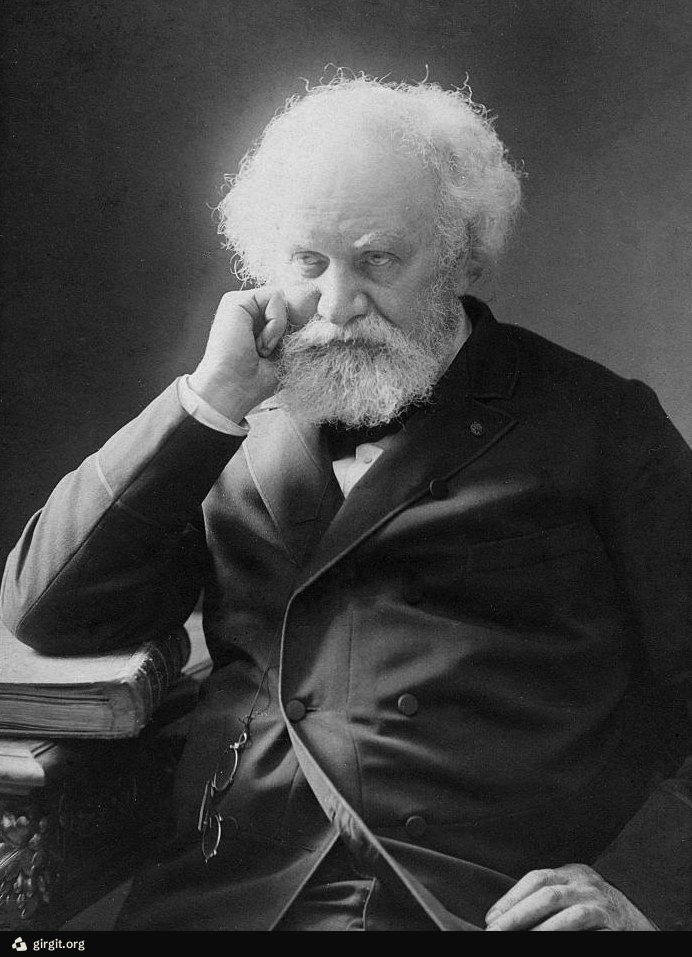
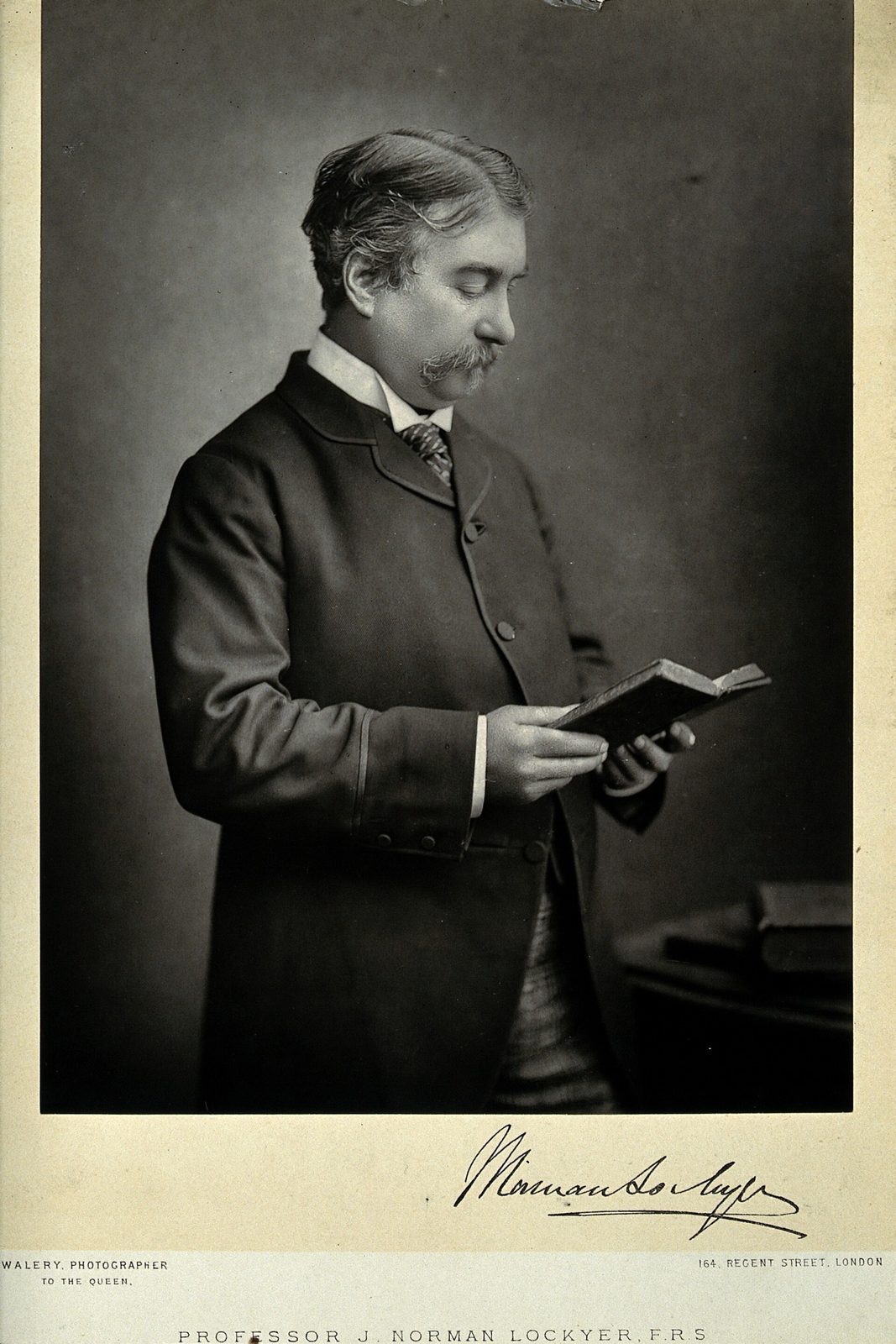
The French astronomer Jules Janssen's eclipse line, near sodium's D1 and D2. On 20 October, in England, Norman Lockyer called it D3: an element named from the Greek helios. Found from Indian soil, 27 years before William Ramsay held helium on earth (1895).
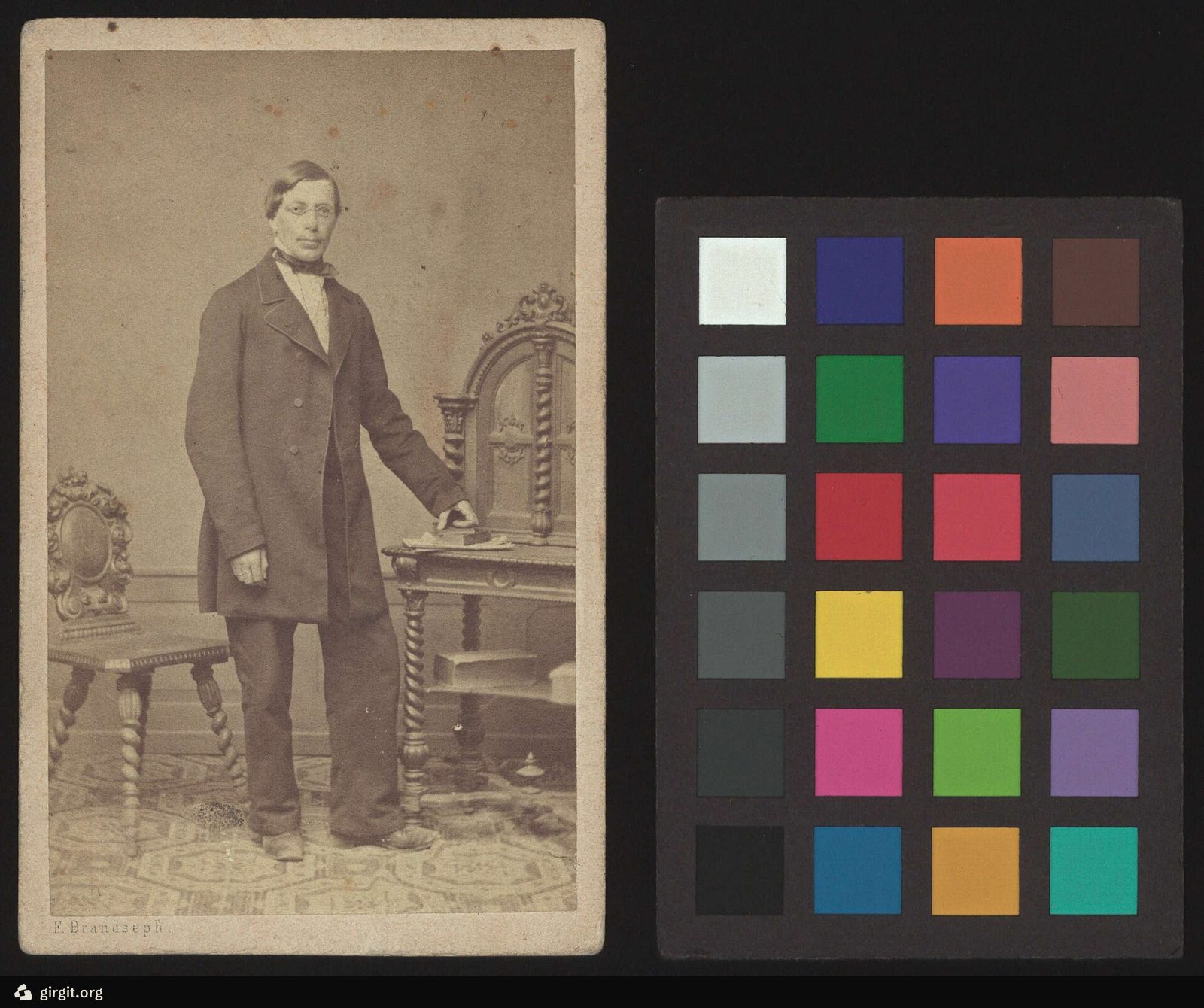
1885 · Basel, SwitzerlandJohann Jakob Balmer, at sixty
364.56nm × n²/(n² − 4)
Fitted Anders Ångström's four lines, n = 3, 4, 5, 6; predicted n = 7 at 397.0 nm. Hagenbach: Ångström had seen it. Bohr explained why 28 years later.
See itBe Balmer
Hit every line
Change the number B and the whole number k; then press Every B.
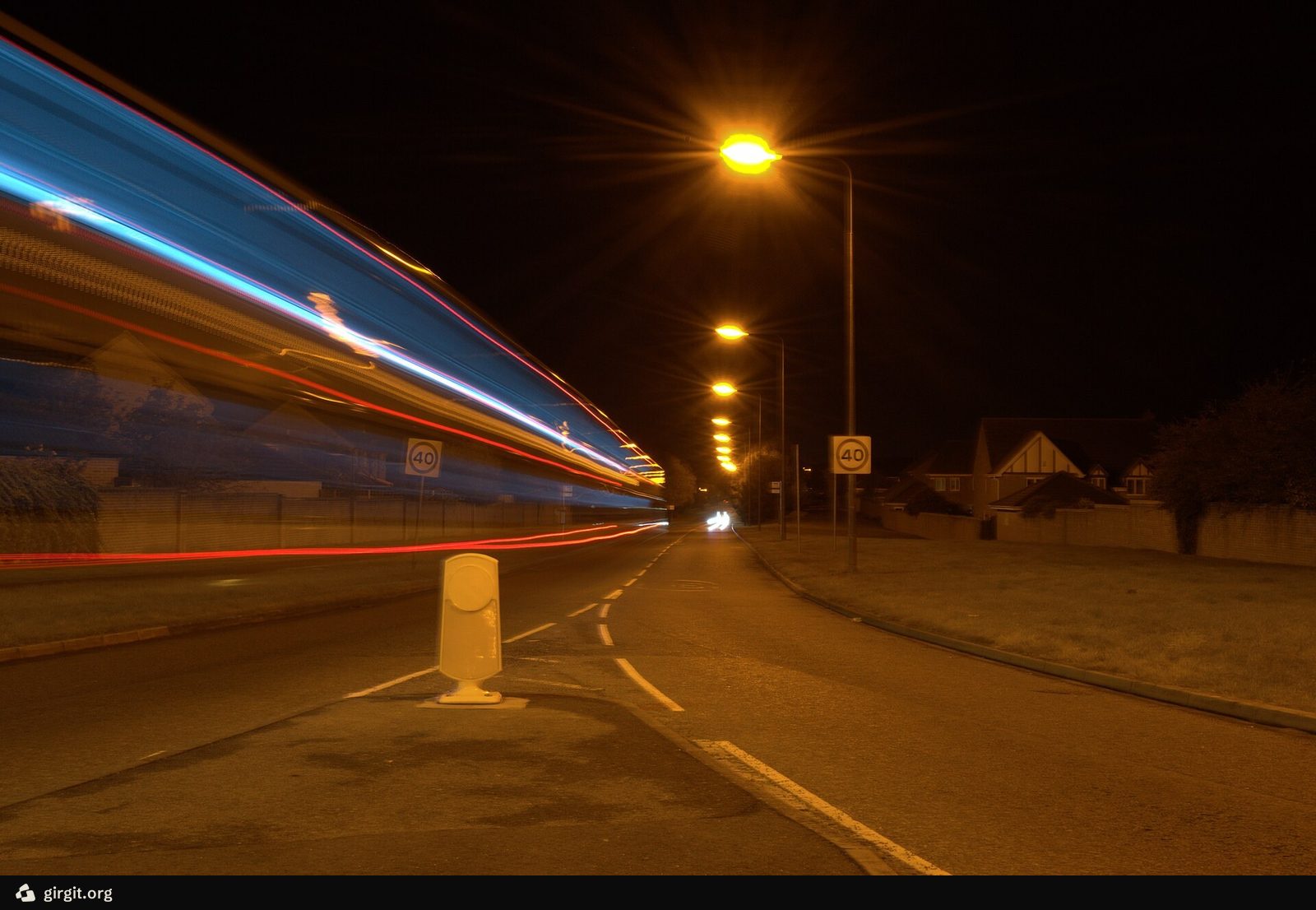 sodium lamproad: one colour
See itFlame tests you can watch
Fireworks and streetlights
Every firework colour is an element's lines. A sodium lamp is almost all one wavelength, 589 nm: every colour turns orange-yellow.
Solve itFour problems
Your turn
Solve it
Show that Balmer's number B = 364.56 nm and Rydberg's constant are really the same thing. Start from \( \lambda = B \dfrac{n^2}{n^2 - 4} \) and turn it into a wavenumber \( \bar{\nu} = 1/\lambda \).
Hint
Answer
Solve it
A sodium streetlight gives out light of wavelength 589 nm. Find the energy of one photon, and of one mole of photons. Compare it with the energy needed to break one mole of C–C bonds (about 350 kJ).
Answer
Solve it: what would happen if…
A red car is parked under a low-pressure sodium lamp, with no other light. What colour does it look, and why?
Answer
Solve it: think harder
The sun's spectrum has dark hydrogen lines at 656 and 486 nm (Fraunhofer's C and F). But white light through a jar of cold hydrogen atoms would show no dark lines there at all. Why not?
Hint
Answer
ConnectAnd still confused?
Where this goes next
Connect it
- Bohr, next page. The ladder \( -R/n^2 \) hiding in Rydberg's formula is exactly what Bohr's model gives. See Bohr's model and how Bohr explained the spectrum.
- Light in packets, two pages back. \( \nu = \Delta E/h \) is Planck's \( E = h\nu \) used in reverse. See Light comes in packets.
- Meghnad Saha. Around 1920 Saha wrote an equation for how much of each element in a star's outer layer is ionised at a given temperature. With it, astronomers could read a star's temperature from its spectrum. The pattern of lines is a thermometer as well as a fingerprint.
- C.V. Raman, a different kind of spectrum. On 28 February 1928 in Calcutta, Raman and K.S. Krishnan found that a little of the light scattered by molecules comes out with its colour shifted by the molecule's own vibrations. It won Raman the 1930 Nobel Prize in Physics, and India marks 28 February as National Science Day. Raman spectra fingerprint molecules the way line spectra fingerprint atoms.
- Physics, Class 12. The same hydrogen series appear in Atomic spectra and Hydrogen line spectra.
- Diwali. Red is strontium, green is barium, yellow is sodium, blue is copper. Blue is famously the hardest firework colour to make well, because copper compounds give it only within a narrow range of flame temperature.
Is a rainbow made the same way as a line spectrum?
No. A rainbow (or a prism) only sorts light that is already there: sunlight contains every colour, so you get a continuous band. A line spectrum is about which colours a gas makes. Put a sodium lamp's light through a prism and you get no rainbow, just one yellow line (in fact two lines very close together).
If the Lyman series is the strongest, why don't we see it?
Its lines are all ultraviolet, at 122 nm or shorter, far beyond what our eyes can see. Ordinary glass and even air absorb such short wavelengths, so they are studied with special instruments, often from space. The Balmer series became famous first only because it happens to fall in the visible band.
Why do the Balmer lines crowd together at the violet end?
Because the levels themselves crowd together near the top of the ladder: \( 1/n^2 \) changes a lot from n = 3 to 4, and hardly at all from n = 20 to 21. Jumps from high levels down to n = 2 all end up with almost the same energy, approaching the series limit at 364.6 nm.
Sources
- Fraunhofer lines (Wikipedia): Wollaston 1802, Fraunhofer 1814, over 570 lines, letters A to K, D = sodium, C and F = hydrogen, Kirchhoff and Bunsen's explanation
- Caesium (Wikipedia): discovery by Bunsen and Kirchhoff in 1860, Dürkheim water, 44,000 litres, the name
- Helium (Wikipedia): Janssen at Guntur, 18 August 1868, 587.49 nm; Lockyer, 20 October 1868, D3; Ramsay 1895
- Johann Jakob Balmer (Wikipedia): his teaching, the 1885 formula at sixty, B = 364.56 nm, the n = 7 prediction
- Balmer series (Wikipedia): measured wavelengths of Hα to Hδ in air
- Isaac Newton (Wikipedia): prism experiments of 1666
- Sodium-vapour lamp (Wikipedia): 589.0 and 589.6 nm, colours under low-pressure sodium light, orange sky glow
- Flame test (Wikipedia): flame colours of the elements and Pyrotechnic colorant (Wikipedia): firework colours, blue the hardest
- C.V. Raman (Wikipedia): the Raman effect, 28 February 1928, K.S. Krishnan, Nobel Prize 1930, National Science Day
- Meghnad Saha (Wikipedia): the Saha ionisation equation and star temperatures
- NIST Atomic Spectra Database: hydrogen and sodium line wavelengths