Act 10NCERT §2.6–2.6.1 · pp. 53–577 min
Orbitals and quantum numbers
The standing wave becomes a cloud: the 1s orbital, drawn from the real hydrogen wave function, densest at the nucleus.
No path at all: a cloud of chances.
From the textbookpp. 53–57
NCERT Chemistry Part I, Class 11 · Reprint 2026-27
10.0The big idea
Four numbers: one electron's address.
Its wave function ψ, the orbital, is labelled by n, l and ml; a fourth, ms, is its spin. A building, a floor plan, which way it faces, which of two people.
Full text
The big ideaIn the quantum mechanical model each electron has a wave function ψ, its orbital, labelled by three quantum numbers (n, l, ml), plus a fourth (ms) for its spin.
In simple words
We cannot say where an electron is, only where it is likely to be. A new kind of maths gives, for each allowed energy, a map of those likely places. Each map is called an orbital. Four numbers work like a full postal address: which floor (how big and how far out), which kind of room (its shape), which way the room faces, and which way the electron itself is turned.
10.1Big things, small things
Newton fails for electrons
Classical mechanics
A falling stone, a planet
Newton's laws. Ignores dual behaviour and the uncertainty principle, so fails for electrons, atoms, molecules.
Quantum mechanics
Tiny things that are waves and particles
Applied to big objects, it gives the same answers as Newton.
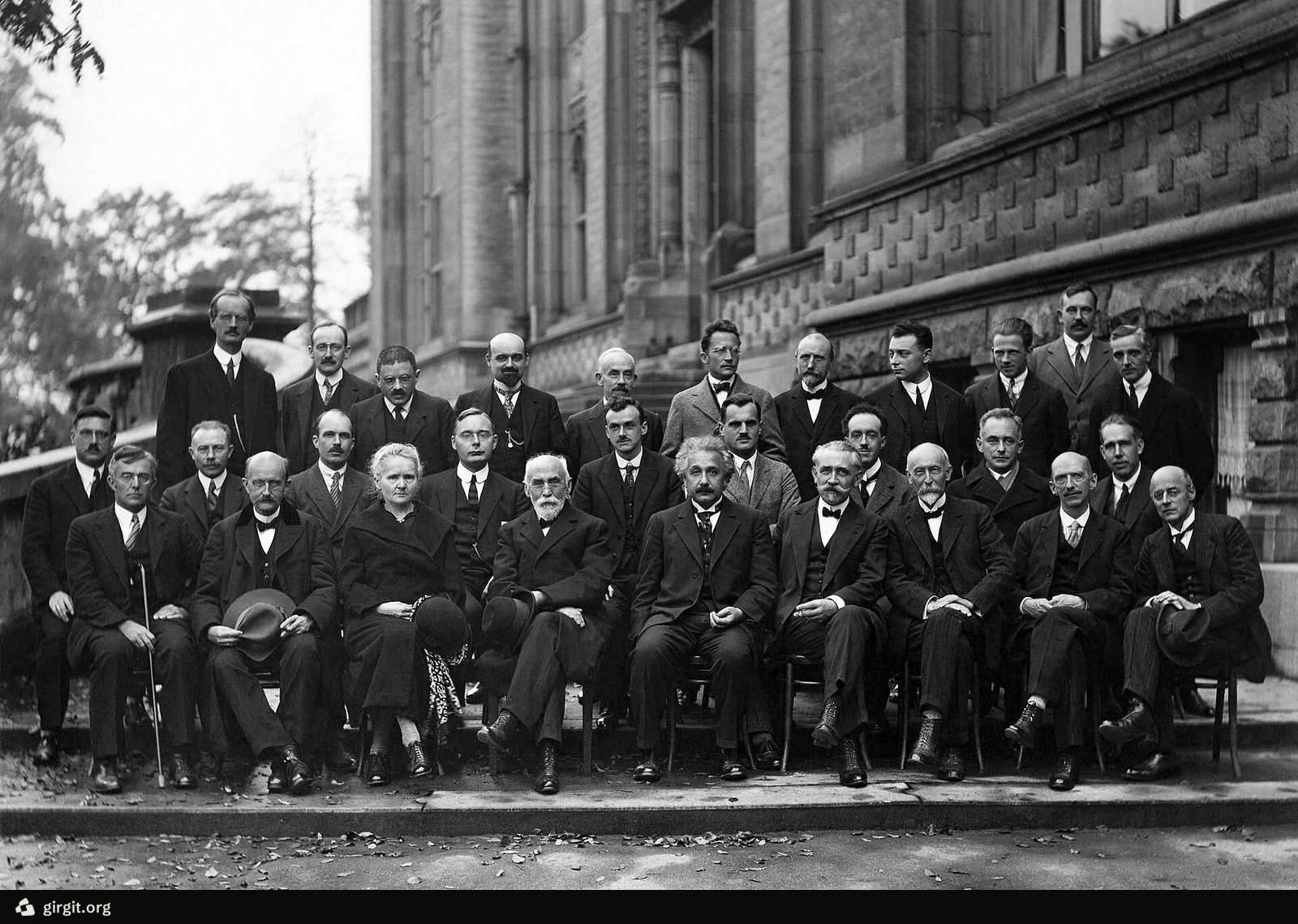 PlanckMarie CurieEinsteinde BroglieBohrSchrödingerHeisenberg
10.2Werner Heisenberg and Erwin Schrödinger
Built twice, separately, in 1926
We use Schrödinger's form: it treats the electron as a wave.
10.3For a constant total energy
One equation, every allowed energy
Ĥ holds the kinetic energy of all electrons and nuclei, their attraction, and the repulsion among electrons and among nuclei. Solving it needs higher maths: later classes.
Full text
Quantum mechanics
Classical mechanics, the physics of Newton's laws, works for big objects like a falling stone or a planet. It fails for electrons, atoms and molecules, because it ignores their dual behaviour and the uncertainty principle. Quantum mechanics is the science of how tiny objects move when they act as both waves and particles. Applied to big objects, it gives the same answers as classical mechanics.
Werner Heisenberg and Erwin Schrödinger each built it, separately, in 1926. We use Schrödinger's form, which treats the electron as a wave. For an atom or molecule with a constant total energy, his equation reads
\[ \hat{H}\psi = E\psi \]\( \hat{H} \) is the Hamiltonian, a mathematical operator that Schrödinger built from the system's total energy: the kinetic energy of all electrons and nuclei, the attraction between electrons and nuclei, and the repulsion among electrons and among nuclei. Solving it gives the allowed energies \( E \) and the wave functions \( \psi \) (psi). The solution needs higher maths; you will meet it in later classes.
10.4Solved for hydrogen
3numbers, from the maths
- n, l, ml come naturally.Bohr had to assume his.
- One electron's ψ: an atomic orbital. ψ alone has no physical meaning.
- All of hydrogen's spectrumexplained, even what Bohr could not.
- Many electrons: no exact solution.Orbitals like hydrogen's, a little contracted; energy by n and l.
Full text
What the equation says
For hydrogen, the solution gives the allowed energy levels and a wave function for each. Three quantum numbers, \( n \), \( l \) and \( m_l \), come out naturally from the maths; Bohr had to assume his. The wave function holds all the information about the electron, yet by itself \( \psi \) has no physical meaning. The wave function of a single electron in an atom is called an atomic orbital. The results explain every feature of hydrogen's spectrum, including some Bohr could not.
For atoms with many electrons the equation cannot be solved exactly, but computer approximations show their orbitals are much like hydrogen's, a little contracted by the larger nuclear charge. One key difference: in hydrogen an orbital's energy depends only on \( n \); in multi-electron atoms it depends on n and l.
Features of the quantum mechanical model
- Electron energy in atoms is quantised: only certain values are allowed.
- These levels arise from the wave nature of electrons, as allowed solutions of Schrödinger's equation.
- Exact position and velocity cannot both be known, so we speak only of the probability of finding the electron.
- An atomic orbital is a wave function ψ. An electron in a given orbital has a fixed energy, and no orbital takes more than two electrons. Electrons fill orbitals in order of rising energy.
- The probability of finding the electron at a point is proportional to \( |\psi|^2 \) there, the probability density. It is always positive, and it shows where the electron is most likely to be.
Don't mix these up
- An orbit (Bohr) is a fixed circular path; it can never be shown to exist, because of the uncertainty principle. An orbital is a wave function ψ described by n, l and ml.
- \( \psi \) has no physical meaning; \( |\psi|^2 \) does. \( |\psi|^2 \) is probability per unit volume; multiply it by a small volume to get the probability of finding the electron in that volume, and add up such pieces for a bigger region.
10.5The quantum mechanical model
Five rules of the new atom
|ψ|² is the probability density: always positive, largest where the electron is most likely.
Features of the quantum mechanical model
- Electron energy in atoms is quantised: only certain values are allowed.
- These levels arise from the wave nature of electrons, as allowed solutions of Schrödinger's equation.
- Exact position and velocity cannot both be known, so we speak only of the probability of finding the electron.
- An atomic orbital is a wave function ψ. An electron in a given orbital has a fixed energy, and no orbital takes more than two electrons. Electrons fill orbitals in order of rising energy.
- The probability of finding the electron at a point is proportional to \( |\psi|^2 \) there, the probability density. It is always positive, and it shows where the electron is most likely to be.
10.6Don't mix these up
An orbit is not an orbital
Bohr's orbit
A fixed circular path
Can never be shown to exist.
Orbital
A wave function ψ, labelled n, l, ml
|ψ|² × a small volume = the chance of finding it there.
Don't mix these up
- An orbit (Bohr) is a fixed circular path; it can never be shown to exist, because of the uncertainty principle. An orbital is a wave function ψ described by n, l and ml.
- \( \psi \) has no physical meaning; \( |\psi|^2 \) does. \( |\psi|^2 \) is probability per unit volume; multiply it by a small volume to get the probability of finding the electron in that volume, and add up such pieces for a bigger region.
CheckPsi squared
What does |ψ|² tell you?
What does |ψ|2 at a point tell us?
- The exact path of the electron
- How likely the electron is to be found there, per unit volume
- The energy of the electron at that point
10.7Four numbers, one electron
Narrow it down
n = 1, 2, 3, 4 are K, L, M, N. Take 3.
l = 0 to n − 1: 3s, 3p, 3d. No 3f.
ml = −l to +l: five for 3d. Take −1.
ms: two per orbital, opposite, +½ and −½.
9 orbitals = n². 18 electrons = 2n².
CheckCounting
Orbitals in shell 3?
How many orbitals are there in the n = 3 shell?
- 3
- 9
- 18
10.8Principal quantum number
n²orbitals in shell n
- n = 1, 2, 3 … sets size and energy.In hydrogen-like species, energy entirely.
- Names the shell: K, L, M, N for 1 to 4.
- Bigger n: farther out, higher energy.Pulling away from the nucleus costs energy.
Full text
Principal quantum number, n
\( n = 1, 2, 3 \ldots \) It fixes the size and, largely, the energy of the orbital (in hydrogen-like species, the energy entirely). It also names the shell: n = 1, 2, 3, 4 are the K, L, M, N shells. A shell with quantum number n has \( n^2 \) orbitals. Larger n means a bigger orbital, farther from the nucleus, and higher energy, since pulling the electron away from the nucleus costs energy.
10.9Azimuthal quantum number
l sets the 3-D shape
Also the subsidiary quantum number or orbital angular momentum quantum number. l = 0 … n − 1: n values, each a sub-shell.
n = 1: 1s · n = 2: 2s 2p · n = 3: 3s 3p 3d · n = 4: 4s 4p 4d 4f
Full text
Azimuthal quantum number, l
\( l \), which is also called the subsidiary quantum number or orbital angular momentum quantum number, sets the orbital's 3-D shape. For any n it takes n values: \( l = 0, 1, 2 \ldots (n-1) \). Each value is a sub-shell (sub-level), so shell n has n sub-shells.
| l | 0 | 1 | 2 | 3 | 4 | 5 |
|---|---|---|---|---|---|---|
| Sub-shell | s | p | d | f | g | h |
| Orbitals (2l + 1) | 1 | 3 | 5 | 7 | 9 | 11 |
So n = 1 has only 1s; n = 2 has 2s and 2p; n = 3 has 3s, 3p, 3d; n = 4 has 4s, 4p, 4d, 4f.
Try itClimb from K to N
Which orbitals exist?
Count them shell by shell. No 1p, no 2d, no 3f.
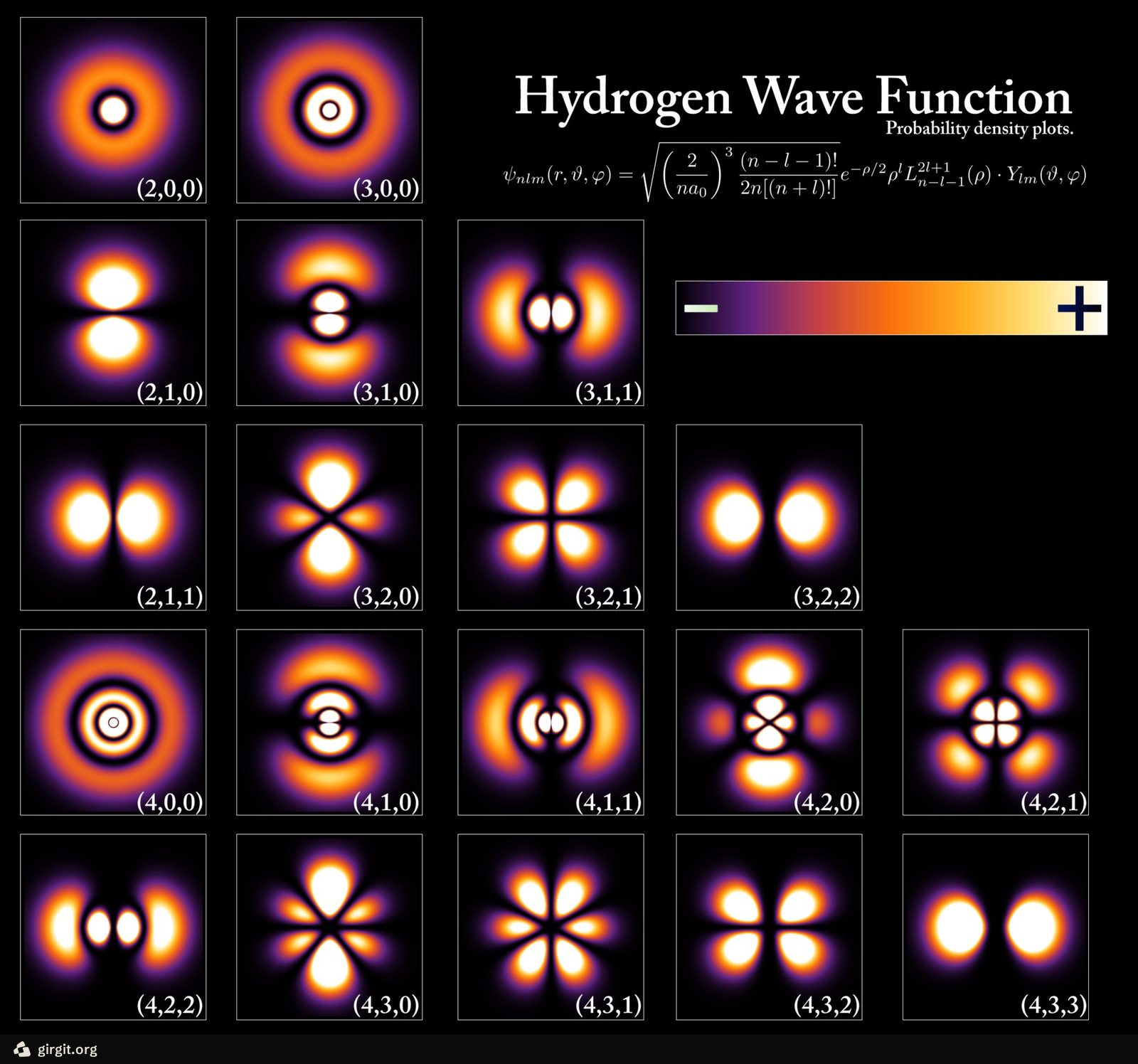 2s2p3d4f
10.10Magnetic quantum number
Which way it faces
- 2l + 1 values,−l … 0 … +l: the orientation.
- l = 1: −1, 0, +1, three p. l = 2: −2 to +2, five d.
- n → l → ml.n = 2, l = 1, ml = 0 is a 2p.
Full text
Magnetic quantum number, ml
\( m_l \) gives the orientation of the orbital in space, relative to a set of axes. For each l it has \( 2l + 1 \) values, \( m_l = -l, \ldots, 0, \ldots, +l \). For l = 1, ml = −1, 0, +1: three p orbitals. For l = 2, ml = −2 to +2: five d orbitals. So ml comes from l, and l comes from n; every orbital has its own set (n, l, ml). For example n = 2, l = 1, ml = 0 is one of the 2p orbitals.
And the five d orbitals, for m_l = −2 to +2.
Try itOrbital explorer
Tap an address, see its cloud
Real hydrogen wave functions. Dense where likely; two colours, two signs of ψ.
n = 1 · K
n = 2 · L
n = 3 · M · 7 of 9
n = 4 · N · 1 of 16
* x and y pictures mix the +ml and −ml pair; xy-plane ones are seen from above. All drawn the same size; really, bigger n is bigger.
Try itSame energy, different directions
Three dumbbells, five d
Turn one p orbital along x, y, z. Then step through the five 3d: dz² is the odd one out.
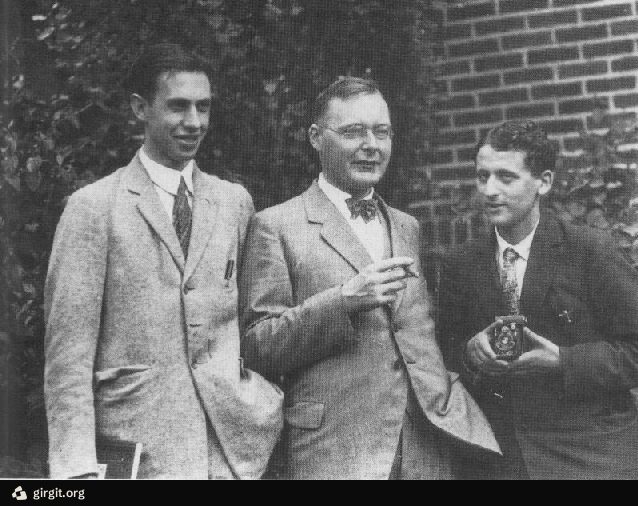 UhlenbeckKramersGoudsmit
10.11George Uhlenbeck and Samuel Goudsmit · 1925
A fourth number: spin
- Doublets and tripletsin many-electron spectra needed more levels.
- The electron spin quantum number, ms: built-in spin angular momentum, two ways: \( +\tfrac12 \) ↑ or \( -\tfrac12 \) ↓.
- At most two per orbital,with opposite spins.
Full text
Spin quantum number, ms
Three numbers could not explain why some lines in the spectra of multi-electron atoms come as doublets or triplets: there must be a few more energy levels. George Uhlenbeck and Samuel Goudsmit (1925) suggested a fourth quantum number, the electron spin quantum number, \( m_s \). The electron carries its own built-in spin angular momentum, often pictured as the electron spinning on its axis like the earth. It can point only two ways relative to a chosen axis: \( m_s = +\tfrac12 \) (spin up, ↑) or \( -\tfrac12 \) (spin down, ↓). Two electrons with different ms have opposite spins. One orbital holds at most two electrons, and they must have opposite spins.
Worked example 1: counting in a shell
How many orbitals and electrons can the n = 4 shell hold?
- l = 0, 1, 2, 3: the 4s, 4p, 4d and 4f sub-shells.
- Orbitals: 1 + 3 + 5 + 7 = 16, which is \( n^2 = 16 \).
- Electrons: two per orbital, 32, which is \( 2n^2 \).
Worked example 2: is this set allowed?
- n = 2, l = 2: not allowed. l can only go up to n − 1 = 1.
- n = 3, l = 1, ml = −2: not allowed. For l = 1, ml is only −1, 0 or +1.
- n = 4, l = 3, ml = −2, ms = +½: allowed. It is an electron in a 4f orbital.
Answer
Not in the current textbook, but NEET has asked it: the size of an electron's orbital angular momentum is \( \sqrt{l(l+1)}\,\dfrac{h}{2\pi} \). For an s electron, l = 0, so it is zero.
Textbook checkWhat to write in the exam
Does it really spin?
The textbook's picture
Spinning on its axis, like the earth
What we know now
A built-in property, like charge
Nothing turns. The spinning top is only a picture; in the exam, the picture is fine.
10.12Worked: count a shell, check a set
Shell 4, and three sets
Shell 4
16orbitals
n = 4, l = 0, 1, 2, 3: 4s 4p 4d 4f. 1 + 3 + 5 + 7 = 16 = n². Two each: 32 electrons = 2n².
Allowed?
- Non = 2, l = 2: l stops at n − 1 = 1.
- Non = 3, l = 1, ml = −2: only −1, 0, +1.
- Yesn = 4, l = 3, ml = −2, ms = +½: a 4f electron.
Answer
CheckSpot the impossible
Which set can't exist?
Which set of quantum numbers is not possible?
- n = 3, l = 2, ml = +2
- n = 1, l = 1, ml = 0
- n = 2, l = 0, ml = 0
- n = 4, l = 1, ml = −1
KeepJust remember
Letters and names need hooks
The counting rules follow from the ranges. Tap a card for its hook.
WordsTo know
Seven words
- Wave function, ψ
- The mathematical function that describes an electron; no direct meaning.
- Atomic orbital
- The wave function of one electron in an atom.
- Probability density, |ψ|²
- Probability of finding the electron per unit volume.
- Shell / sub-shell
- All orbitals with the same n / the same n and l.
- Azimuthal quantum number, l
- Fixes the shape: s, p, d, f.
- Magnetic quantum number, ml
- Fixes the orientation of an orbital.
- Spin quantum number, ms
- +½ or −½: the two spin states.
NEETAsked in the exam
The real thing
Not in the textbook, but asked: orbital angular momentum = √(l(l + 1)) h/2π. For s, l = 0, so zero.
RootsA wave trapped in three directions
Count the nodes
- One number per direction: an atom needs three.
- Whole numbers: one node or two, never one and a half.
- n − 1 nodes: l flat, n − l − 1 spheres. So l ≤ n − 1.
Full text
The roots: a wave trapped in three directions
- Why does an orbital need exactly three numbers?Because the electron in an atom behaves as a wave trapped in three-dimensional space, and a trapped wave needs one counting number for each direction it can vary in. A guitar string (one direction) needs one number: how many loops. A drum skin (two directions) needs two: how many rings and how many straight lines of stillness. An atom (three directions) needs three.
- Why must they be whole numbers?A trapped wave must join up smoothly with itself. It can have one node or two, never one and a half. Counting nodes is counting in whole numbers, and every allowed pattern has a fixed energy.
- Why can l never reach n?An orbital has n − 1 nodes in all. Of these, l are flat (planes or cones through the nucleus) and the rest, n − l − 1, are spheres. You cannot have a negative number of spheres, so l can be at most n − 1.
- Why are there exactly 2l + 1 values of ml?A pattern with l flat nodes can be turned to point many ways, but only 2l + 1 of them are independent: every other direction is a mixture of those. For l = 1 this is the familiar fact that any arrow in space is made of three parts, along x, y and z. So three p orbitals cover every direction a dumbbell could point.
- And why a fourth number?Schrödinger's equation does not give it at all. It was forced on chemists by experiments: sodium's yellow light is really two lines (589.0 and 589.6 nm), and a beam of silver atoms splits in two in a magnet. The electron carries its own built-in magnet that can point only two ways. In 1928 Paul Dirac wrote an equation that also obeys relativity, and spin came out of it naturally.
- The bedrockA wave held in a space can only take shapes with a whole number of nodes. You have seen this on a string fixed at both ends; an atom is the same idea in three directions.
This is why Bohr had to assume his n but Schrödinger did not: once the electron is treated as a wave, the numbers are simply the node counts of the patterns that fit. It also explains the counting rules on this page without memorising them. A shell n has n choices of l; each l has 2l + 1 orientations; add them up, 1 + 3 + 5 + … , and you get n² orbitals. Two spin directions per orbital give 2n² electrons.
RootsWhy so many directions
Three parts make any arrow
x, y, z
So three p orbitals cover every way a dumbbell could point.
- No spin in Schrödinger's equation.Experiments forced it.
- Sodium's yellow is two lines: 589.0 and 589.6 nm.
- 1928: Paul Dirac's equation obeys relativity; spin falls out of it.
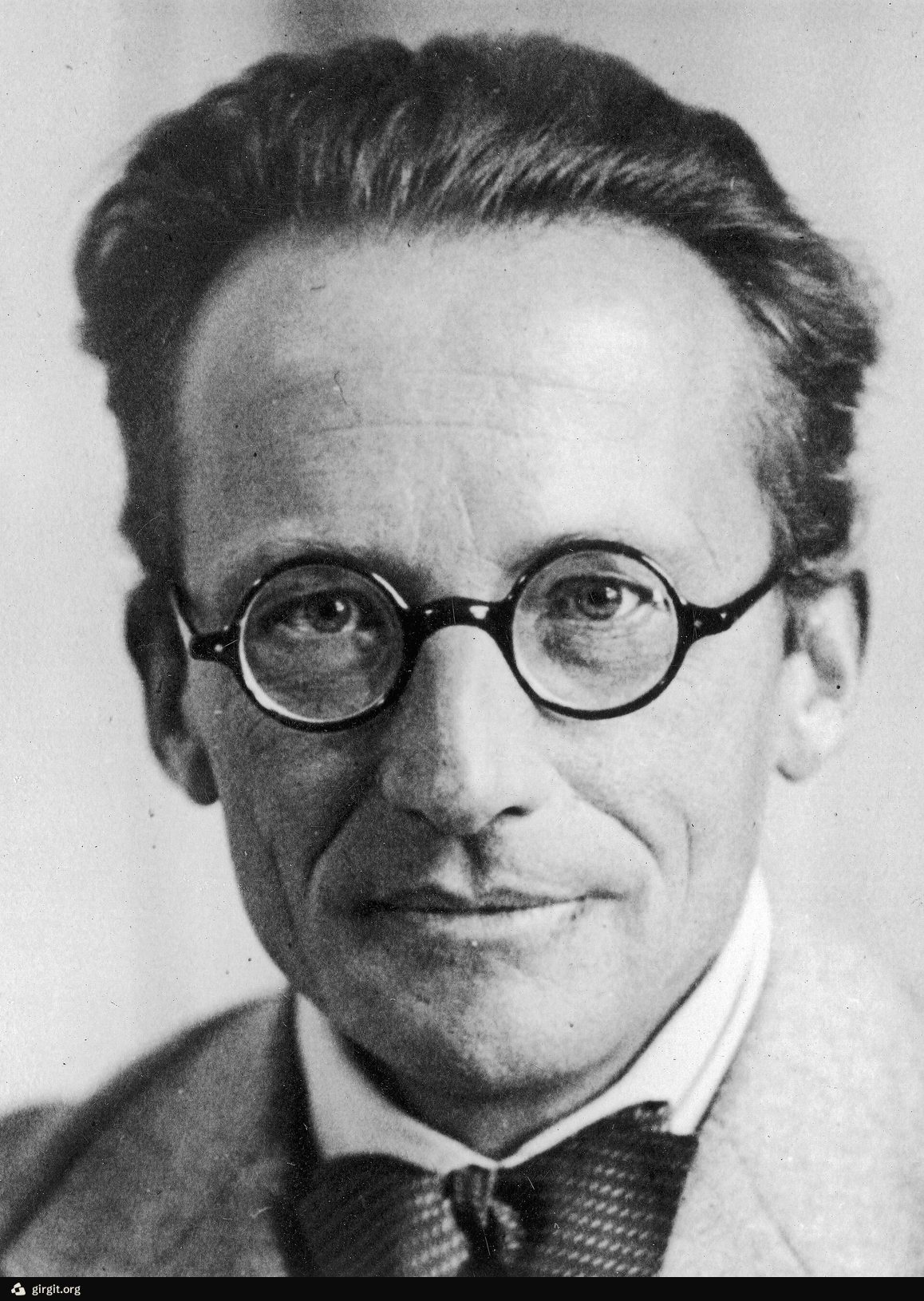
StoryChristmas 1925, Arosa, Switzerland
A holiday, an equation
A Zurich professor's letter to Wilhelm Wien, 27 December. "Quantisierung als Eigenwertproblem" reached Annalen der Physik on 27 January 1926, the first of four. Nobel 1933, shared with Paul Dirac. Swiss scientists put up a plaque in Arosa in January 2026.
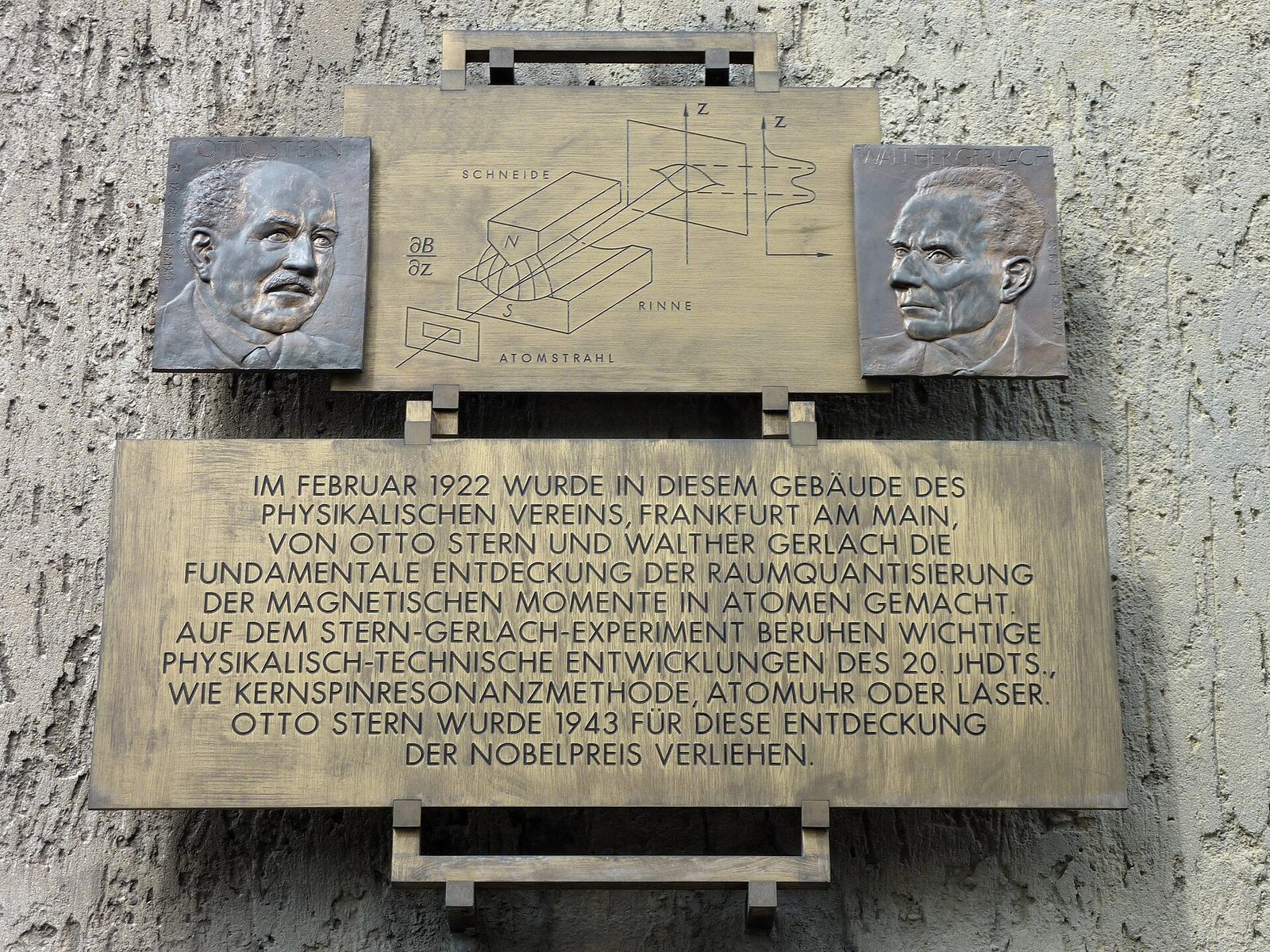 atom beamshaped magnetbeam split in two
Story7 February 1922, Frankfurt
Attached [is] the experimental proof of directional quantization.
Walther Gerlach's postcard to Niels Bohr. Silver atoms split in two, 0.2 mm apart, with Otto Stern.
StoryRight result, wrong reason
A cigar, a stupidity
- 1922Sulphur smokeStern's cheap cigars blackened the invisible silver into silver sulphide. Re-enacted in 2002: it works.
- 1925Leiden, OctoberFor George Uhlenbeck and Samuel Goudsmit, Paul Ehrenfest sent the note; Hendrik Lorentz objected. "Young enough to afford a stupidity!" Ralph Kronig, put off by Wolfgang Pauli, never published.
- 1927The penny dropsSilver's outer electron has l = 0: the split was spin. First tied together in print.
See itBe Stern and Gerlach
Count the lines
An orbital magnet with l sits 2l + 1 ways: 2l + 1 lines. Spin makes two, which would need "l = ½".
Solve itFour problems
Your turn
Solve it
How many electrons in one atom can have both n = 3 and ml = −1?
Hint
Answer
Solve it: what would happen if…
Suppose the electron's spin could point three ways, ms = −1, 0, +1, instead of two. How many electrons would the first and second shells hold? Which element would then be the first noble gas?
Answer
Solve it: numbers
In the Stern–Gerlach magnet the field changes by 10 T per cm (1000 T m−1). A silver atom (mass \( 1.79 \times 10^{-25} \) kg) carries a magnet of one Bohr magneton, \( 9.27 \times 10^{-24} \) J T−1, and crosses 3.5 cm of magnet at 550 m s−1. How far apart are the two lines?
Answer
Spot the error
A student writes the full address of an electron as n = 2, l = 1, ml = 0, ms = 0. What is wrong?
Answer
ConnectAnd still confused?
Where this goes next
Connect it
- Shapes and nodes, next page. The node counts n − l − 1 and l are the same idea seen from the other side. See What does an orbital look like?
- Pauli's rule and filling, page 12. Four numbers per electron, no two electrons alike: that is the Pauli exclusion principle. See How do electrons fill an atom?
- The periodic table, Chapter 3. The s, p, d and f blocks are 2, 6, 10 and 14 columns wide: 2 × (2l + 1). See The s, p, d and f blocks.
- Magnets from spin, Class 12. Unpaired electron spins are why iron, cobalt and many d-block ions are drawn into a magnetic field. See Magnetism and colour.
- In hospital. MRI scanners work with the spins of hydrogen nuclei in your body's water, flipped by magnets and radio waves. The Frankfurt plaque names nuclear spin resonance, atomic clocks and lasers as children of the Stern–Gerlach experiment.
- S.N. Bose. Particles whose spin is a whole number are called bosons, after Satyendra Nath Bose of Kolkata; electrons, with spin ½, are not, which is why only two fit in an orbital. Bose's story is told on Light comes in packets.
Is the electron really spinning like a top?
No. Spin is a built-in property, like charge, and it behaves like angular momentum, but nothing is turning. If the electron were a tiny ball spinning fast enough to make its measured magnet, its surface would have to move faster than light. The spinning top is a picture that helps you remember "two directions"; the exam uses the picture, and that is fine.
Is ml = +1 the px orbital?
Not exactly. The maths gives the ml = ±1 orbitals as rings round the z-axis. Chemists add and subtract that pair to make px and py, which are easier to draw and to use for bonds. Only ml = 0 is the same as pz. The next page shows both sets side by side.
If ψ has no meaning, why do we bother with it?
Because it is the thing that obeys the equation. Squaring it gives the probability density, which you can test against experiment. It is like a bank balance's history: the individual entries can be positive or negative, but what you care about is computed from them.
Sources
- Suslov, "Schrödinger's Wave Mechanics: Remarkable Dates and Place One Hundred Years Ago", arXiv:2601.05337 (2026)
- IMUS, University of Seville, "Bringing some order: Schrödinger's wave mechanics" (letter to Wien, 27 Dec 1925; paper received 27 Jan 1926)
- blue News, "The foundation for smartphones was laid in Arosa 100 years ago" (the 2026 plaque)
- The Nobel Prize in Physics 1933 (Schrödinger and Dirac)
- B. Friedrich and D. Herschbach, "Stern and Gerlach: How a Bad Cigar Helped Reorient Atomic Physics", Physics Today 56(12), 53 (2003)
- Instituut-Lorentz, Leiden University, "The discovery of electron spin"
- Solvay Conference (1927 attendees and Nobel laureates)
- Atomic orbital (origin of the letters s, p, d, f)
- NIST Atomic Spectra Database handbook: strong lines of sodium (589.0 and 589.6 nm)
- Encyclopaedia Britannica, "Boson"