Act 08NCERT §2.4.1–2.4.2 · pp. 48–495 min
How Bohr explained the hydrogen spectrum, and where he failed
Bohr's hydrogen atom, with its electron on the innermost orbit.
Each line is one fall between two orbits.
From the textbookpp. 48–49
NCERT Chemistry Part I, Class 11 · Reprint 2026-27
8.0The big idea
Every line is one jump.
The energy gap fixes its colour. But the model fails for anything with more than one electron.
Full text
The big ideaEach line in hydrogen's spectrum is one electron jump between two Bohr orbits, and the energy gap fixes its colour; but the model fails for anything with more than one electron.
In simple words
When the electron falls from a far track to a near one, it lets out one packet of light. The size of the fall decides the colour of the light. Bohr could work out every fall in hydrogen, and his numbers matched the lines people had measured. But his rules broke down for atoms with two or more electrons, and they could not say why atoms join together.
8.1Lines are jumps
Each fall, one photon
Collisions lift the electron; each fall sends one photon.
A gap of 3.03 × 10⁻¹⁹ J: red light, 656 nm.
486, 434, 410 nm. Every fall to n = 2 is a Balmer line.
n = 1 lies far below; the strip widens, ultraviolet to infrared.
Ultraviolet, 122 nm and shorter.
Infrared, 820 to 1875 nm.
8.2Bohr's second postulate, in numbers
The gap, in joules
- ÷ h, the frequency: ν = 3.29 × 10¹⁵ ( … ) Hz.
- ÷ c, the wavenumber: 1.09677 × 10⁷ m⁻¹ = 109,677 cm⁻¹.
- Rydberg's number, derived. Rydberg had only fitted the data.
Full text
Lines are jumps
By Bohr's second postulate, an electron absorbs energy when it moves from a smaller \( n \) to a larger \( n \), and emits energy when it falls from a larger \( n \) to a smaller one. The energy gap is
\[ \Delta E = E_f - E_i \]where \( i \) and \( f \) stand for the initial and final orbits. Putting in \( E_n = -R_H/n^2 \):
\[ \Delta E = R_H \left( \frac{1}{n_i^2} - \frac{1}{n_f^2} \right) = 2.18 \times 10^{-18} \left( \frac{1}{n_i^2} - \frac{1}{n_f^2} \right)\ \mathrm{J} \]Dividing by \( h \) gives the frequency, and dividing again by \( c \) gives the wavenumber:
\[ \nu = 3.29 \times 10^{15} \left( \frac{1}{n_i^2} - \frac{1}{n_f^2} \right)\ \mathrm{Hz} \qquad \bar{\nu} = 1.09677 \times 10^{7} \left( \frac{1}{n_i^2} - \frac{1}{n_f^2} \right)\ \mathrm{m^{-1}} \]- Absorption: \( n_f > n_i \), the bracket is positive, energy is taken in.
- Emission: \( n_i > n_f \), \( \Delta E \) is negative, energy is given out. We use its size for the photon.
The wavenumber constant, \( 1.09677 \times 10^{7} \) m−1 = 109,677 cm−1, is exactly Rydberg's number from the experiments. Bohr's theory derived what Rydberg had only found by fitting data. Each line, in emission or absorption, belongs to one particular jump. A sample has huge numbers of atoms making different jumps, so many lines appear together. A line is brighter when more photons of that wavelength are absorbed or emitted.
Worked example 1: a blue-green Balmer line
Find the energy, frequency and wavelength of the photon emitted when hydrogen's electron falls from n = 4 to n = 2.
- \( \Delta E = 2.18 \times 10^{-18} \left( \tfrac{1}{16} - \tfrac{1}{4} \right) = 2.18 \times 10^{-18} \times (-0.1875) = -4.09 \times 10^{-19} \) J. Negative: energy emitted.
- \( \nu = \dfrac{4.09 \times 10^{-19}}{6.626 \times 10^{-34}} = 6.17 \times 10^{14} \) Hz.
- \( \lambda = \dfrac{c}{\nu} = \dfrac{3.0 \times 10^{8}}{6.17 \times 10^{14}} = 4.86 \times 10^{-7} \) m = 486 nm, blue-green. It ends on n = 2, so it is a Balmer line.
Worked example 2: absorption from the ground state
What wavelength must hydrogen absorb to lift its electron from n = 1 to n = 3?
- \( \Delta E = 2.18 \times 10^{-18} \left( 1 - \tfrac{1}{9} \right) = 1.94 \times 10^{-18} \) J (positive: absorbed).
- \( \lambda = \dfrac{hc}{\Delta E} = \dfrac{1.988 \times 10^{-25}}{1.94 \times 10^{-18}} = 1.03 \times 10^{-7} \) m = 103 nm, in the ultraviolet (a Lyman line).
Guess first. Which jump gives out more energy: n = 2 → 1 or n = 6 → 2?
Answer
Answer
8.3One jump, either way
Up takes in, down gives out
Absorption
nf > ni: the bracket is positive, energy is taken in.
Emission
ni > nf: ΔE is negative, energy is given out. The photon carries its size.
A sample: countless atoms, different jumps, many lines at once. More photons of a wavelength, a brighter line.
Try itMake it jump
Which jump, which line?
Pick where the electron starts and ends; watch where its line lands.
CheckThree to two
Which series?
An electron in hydrogen falls from n = 3 to n = 2. The light emitted belongs to the
- Lyman series, ultraviolet
- Balmer series, visible
- Paschen series, infrared
Worked example 1: a blue-green Balmer line
Find the energy, frequency and wavelength of the photon emitted when hydrogen's electron falls from n = 4 to n = 2.
- \( \Delta E = 2.18 \times 10^{-18} \left( \tfrac{1}{16} - \tfrac{1}{4} \right) = 2.18 \times 10^{-18} \times (-0.1875) = -4.09 \times 10^{-19} \) J. Negative: energy emitted.
- \( \nu = \dfrac{4.09 \times 10^{-19}}{6.626 \times 10^{-34}} = 6.17 \times 10^{14} \) Hz.
- \( \lambda = \dfrac{c}{\nu} = \dfrac{3.0 \times 10^{8}}{6.17 \times 10^{14}} = 4.86 \times 10^{-7} \) m = 486 nm, blue-green. It ends on n = 2, so it is a Balmer line.
Worked example 2: absorption from the ground state
What wavelength must hydrogen absorb to lift its electron from n = 1 to n = 3?
- \( \Delta E = 2.18 \times 10^{-18} \left( 1 - \tfrac{1}{9} \right) = 1.94 \times 10^{-18} \) J (positive: absorbed).
- \( \lambda = \dfrac{hc}{\Delta E} = \dfrac{1.988 \times 10^{-25}}{1.94 \times 10^{-18}} = 1.03 \times 10^{-7} \) m = 103 nm, in the ultraviolet (a Lyman line).
8.4Worked: one out, one in
Blue-green out, ultraviolet in
486nm
Four to two gives out 486 nm, a Balmer line. One to three takes in 103 nm, a Lyman line.
Guess firstTwo falls
2 → 1, or 6 → 2?
Which gives out more energy?
Answer
8.5Start at n = 4, end at n = 1
Count every pair
6lines
Try it: a sample falls from n = 4 to n = 1, by any route. One arrow per pair of levels. (Levels drawn evenly here.)
Answer
CheckAbsorb
Highest frequency?
For hydrogen, which jump absorbs a photon of the highest frequency?
- n = 1 → 2
- n = 1 → 4
- n = 2 → 4
- n = 4 → 1
8.6Limitations of Bohr's model
4things it missed
Better than Rutherford's: stability, and the line spectra of H, He⁺, Li²⁺, Be³⁺ …
- Finer detail: doublets, two lines very close.
- Any other atom, even helium.
- Lines split in fields: the Zeeman effect (magnetic), the Stark effect (electric).
- Molecules: how chemical bonds form.
Full text
Limitations of Bohr's model
Bohr's model improved on Rutherford's: it explained the stability of the atom and the line spectra of hydrogen and hydrogen-like ions (He+, Li2+, Be3+…). But it was too simple:
- It cannot explain the finer details of hydrogen's spectrum: with better instruments some lines turn out to be doublets, two lines very close together.
- It cannot explain the spectrum of any atom other than hydrogen, not even helium, which has only two electrons.
- It cannot explain why lines split in a magnetic field (the Zeeman effect) or in an electric field (the Stark effect).
- It cannot explain how atoms form molecules through chemical bonds.
A better theory was needed. Concept 9 shows the two ideas that built it, and why they also show that Bohr's sharp orbits cannot be real.
Don't mix these up
- Zeeman effect: splitting in a magnetic field. Stark effect: splitting in an electric field.
- Emission: \( n_i > n_f \), \( \Delta E \) negative. Absorption: \( n_f > n_i \), \( \Delta E \) positive.
8.7One more electron
Helium breaks the pattern
Hydrogen: 1 electron
656 · 3→2486 · 4→2434 · 5→2410 · 6→2
Helium: 2 electrons
Ten visible lines, no neat pattern. Bohr's formula has nothing to say.
NIST wavelengths · drawn by girgit.org
CheckOne electron
Which could Bohr explain?
Bohr's model could correctly explain the line spectrum of
- the helium atom
- the He+ ion
- the H2 molecule

8.8Pieter Zeeman · 1896
A magnet splits a line
A light source between the poles of a strong magnet: its lines widen and split. Bohr's circles had no way to explain it.
8.9Turn the field up
One line becomes three
A cadmium lamp between the poles, through a fine spectroscope: one red line.
It splits in three; the outer two move apart.
About 0.02 nm apart. Bohr has no rule for it.
Think of it likeA school map
Perfect for one building. Useless for the campus.
Right for one electron, wrong the moment a second walks in. A better theory was needed: concept 9 shows the two ideas that built it.
8.10Don't mix these up
Magnet or spark?
Myth
Stark splitting needs a magnet
Fact
Stark: electric field. Zeeman: magnetic field.
Don't mix these up
- Zeeman effect: splitting in a magnetic field. Stark effect: splitting in an electric field.
- Emission: \( n_i > n_f \), \( \Delta E \) negative. Absorption: \( n_f > n_i \), \( \Delta E \) positive.
KeepJust remember
Two names, three numbers
Measured constants and named effects: tap a card for its hook.
WordsTo know
Five words
- Transition
- A jump of the electron from one orbit to another.
- ni, nf
- Initial and final orbits of a jump.
- Doublet
- Two spectral lines very close together.
- Zeeman effect
- Splitting of spectral lines in a magnetic field.
- Stark effect
- Splitting of spectral lines in an electric field.
NEETAsked in the exam
The real thing
RootsWhat a second electron spoils
One pull, or a pull and a push
H, He⁺, Li²⁺ · one electron
One steady pull to the centre
Clean closed orbits: −13.6 Z²/n² eV, right to better than one part in a thousand.
He · two electrons
A push that keeps moving
About 30 eV of repulsion against 54 eV of pull: a three-body problem, which even Newton's gravity cannot solve neatly.
The bedrock is Coulomb's law. Bohr kept only the attraction.
Full text
The roots: what a second electron spoils
- Why does Bohr's formula work so well for H, He+ and Li2+?Because each has one electron, and one electron feels only one thing: the steady pull of the nucleus towards the centre. A single central pull gives clean, closed orbits, and Bohr's rule picks out the allowed ones. Out come energies \( -13.6\,Z^2/n^2 \) eV that match experiment to better than one part in a thousand.
- Why does a second electron spoil it?Because now each electron is also pushed by the other one, and that push depends on where the other electron is at that instant. The energy of one electron is no longer fixed by its own orbit alone. There is no single "orbit with energy \( E_n \)" left to pick.
- Couldn't you just add a small correction?The push is not small. In helium the two electrons repel each other with an energy of roughly 30 eV, compared with about 54 eV of pull on each. Bohr's sum, which leaves the push out, says 108.8 eV to strip both electrons; the real figure is 79.0 eV.
- Why is there no neat formula even then?Two electrons and a nucleus is a three-body problem. Even in Newton's gravity, three bodies pulling on each other have no general neat solution; the motion has to be worked out step by step. Bohr's method needs one closed orbit to quantise, and three bodies give none.
- The bedrockCoulomb's law, the rule from the first page of this chapter: unlike charges attract, like charges repel. Bohr kept only the attraction. Any atom with two or more electrons has the repulsion too.
The modern theory does not track orbits at all. It describes each electron by a wave (page 9 and after), and handles the repulsion by careful approximation. The simplest idea is the one used later in this chapter: each electron partly shields the nucleus from the other, so each feels a smaller effective charge. For helium, treating each electron as seeing about +1.69 instead of +2 brings the estimate to 77.5 eV, within 2% of the truth.
The other failures have their own roots. The Zeeman effect happens because a circling electron is a tiny loop of current, so it behaves like a small magnet; in an outside magnetic field its energy depends on which way that small magnet points. Bohr's flat circles had no rule for which ways are allowed. Arnold Sommerfeld stretched Bohr's model in 1916 with tilted, elliptical orbits and Einstein's relativity, and explained part of the fine detail. The full answer needed the electron's spin and the new quantum mechanics, which you meet in quantum numbers.
RootsStrip both of helium's electrons
79.0eV, measured
Bohr's sum, leaving the push out, says 108.8 eV. Let each electron see +1.69, not +2 (shielding): 77.5 eV, within 2%.
Story1896 to 1916: hydrogen that wasn't
A theory corrects the experts
- 1896Edward Pickering, HarvardThe hot star ζ Puppis: extra lines between the Balmer lines. "A new hydrogen."
- 1912Alfred Fowler, LondonMakes them in a tube of hydrogen and helium; agrees.
- 1913Bohr: ionised helium, He⁺Z = 2, four times the energies. Falls to n = 4 from even levels land on Balmer's lines; odd ones between. Fowler argues back in Nature.
- 1915SettledWithin two years the series moves to helium.
- 1916Arnold SommerfeldTilted ellipses and Einstein's relativity: part of the fine detail.
Full text
The story
See itThe Sun
Hot enough to lose electrons
Saha's question was about gas like this: collisions keep knocking electrons right out of atoms.
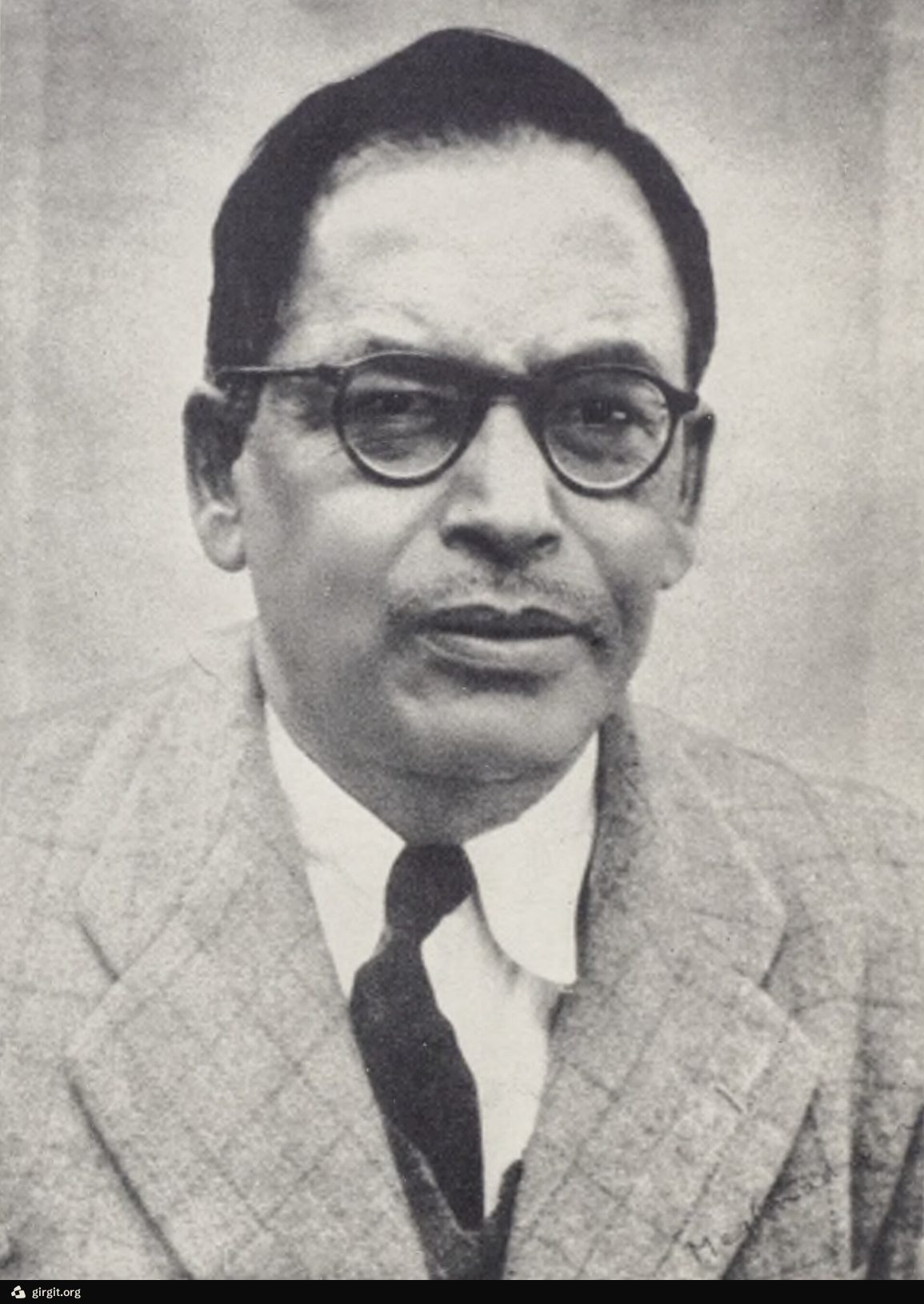
October 1920Calcutta and London
An Indian physicist reads the stars
Meghnad Saha: born 1893, Dacca district; S.N. Bose's classmate at Presidency College. Atom ⇌ ion + electron, as an equilibrium, in the Philosophical Magazine; rewritten in Fowler's lab at Imperial College. Stars differ mainly in temperature.
1925Harvard · Cecilia Payne
1 in 200million
hydrogen atoms sit in n = 2 in the Sun's atmosphere, about 5700 K. Weak Balmer lines hide a lot of hydrogen: stars are mostly hydrogen and helium. Henry Norris Russell objected; later work, Russell's own included, proved her right.
See itTest Bohr yourself
Every ion, one formula?
Change the nucleus and the number of electrons, then press Every ion.
Solve itFour problems
Your turn
Solve it: predict, then check
Using Bohr's energies, show that the He+ jump from n = 4 to n = 2 gives exactly the same photon as hydrogen's jump from n = 2 to n = 1. Then find which He+ jump matches hydrogen's red line, 3 → 2.
Hint
Answer
Solve it: spot the error
A student says: "Helium's first ionisation energy is \( 13.6 \times 2^2 = 54.4 \) eV." The table says 24.6 eV. What did the student calculate, and why is the real value so much smaller?
Answer
Solve it: one atom or many?
A single hydrogen atom has its electron in n = 5. What is the largest number of spectral lines it can give out on the way down to n = 1? And a flask of such atoms?
Answer
Solve it: harder (Saha's idea)
The fraction of hydrogen atoms sitting in n = 2 is roughly \( 4\,e^{-\Delta E/kT} \), where \( \Delta E \) is the gap from n = 1 to n = 2 and \( kT = 8.62 \times 10^{-5}\,T \) eV. Use Bohr's energies to find \( \Delta E \), then compare the fraction at 5700 K (the Sun) with 10,000 K (a hotter, white star).
Answer
ConnectAnd still confused?
Where this goes next
Connect it
- Shielding, this chapter. The fix that rescues helium is the effective nuclear charge you meet in shapes and energies of orbitals: inner electrons hide part of the nucleus.
- Ionisation enthalpy, Chapter 3. Helium's 24.6 eV (2372 kJ mol−1) tops the chart of first ionisation enthalpies; the reasons are on ionisation enthalpy.
- The same lines in Physics. Class 12 Physics derives the hydrogen series again in hydrogen line spectra and ends with the limits of Bohr's model.
- Waves next. Why orbits had to go entirely: dual nature and uncertainty.
- Stars over India. The Saha equation is still taught to every astrophysics student, and Kolkata's Saha Institute of Nuclear Physics carries his name. When you see a bluish-white star such as Sirius, its strong hydrogen lines are Saha's temperature effect at work.
If Bohr's model is wrong, why do we still learn it?
Because for one-electron atoms its energies are right, and they are exactly what quantum mechanics gives too: \( -13.6\,Z^2/n^2 \) eV. What is wrong is the picture of a definite circular path. Bohr's model is a correct answer reached with a wrong picture, and it is the quickest way to calculate hydrogen's lines.
Why is He+ fine but He not, if both have the same nucleus?
The nucleus is not the problem; the second electron is. He+ has one electron and only the pull of +2 to deal with. Neutral helium adds an electron that repels the first, and Bohr's rule has no place for that push.
Do doublets mean there are two electrons making the line?
No. Even hydrogen's single electron gives doublets when you look closely. The level it jumps from is itself split into two very slightly different energies (because of the electron's spin and relativity), so one "line" is really two lines very close together.
Sources
- Pickering series (Wikipedia), citing Pickering, Harvard College Observatory Circular 12 (1896), Fowler, MNRAS 73, 62 (1912), Bohr, Nature 92, 231 (1913)
- N. Bohr, "The Spectra of Helium and Hydrogen", Nature 92, 231 (1913)
- D.S. Kothari, "Meghnad Saha 1893–1956", Biographical Memoirs of Fellows of the Royal Society 5 (1960), reproduced by INSA
- APS News, "January 1925: Cecilia Payne-Gaposchkin and the day the universe changed"
- The Nobel Prize in Physics 1902 (Zeeman and Lorentz)
- NIST Atomic Spectra Database: ionisation energies (H, He, Li, Be, B, C and their ions)
- NIST Handbook of Basic Atomic Spectroscopic Data: strong lines of helium
- Bohr–Sommerfeld model (Wikipedia): Sommerfeld's 1916 elliptical, relativistic orbits
- Encyclopaedia Britannica, "Three-body problem"