Act 11NCERT §2.6.2–2.6.3 · pp. 57–616 min
What does an orbital look like, and which is lowest?
The 1s cloud becomes the 2s cloud with its one spherical node, then the dumbbell of a 2p orbital; warm and cool colours show the two signs of the wave function.
A ball, a bigger ball with a hollow, then two lobes.
From the textbookpp. 57–61
NCERT Chemistry Part I, Class 11 · Reprint 2026-27
11.0The big idea
A ball, two lobes, four leaves.
The shapes of s, p and d orbitals. In hydrogen only n sets the energy; in bigger atoms, n and l together.
Full text
The big ideas orbitals are spheres, p orbitals are pairs of lobes, d orbitals mostly four-leafed; in hydrogen only n sets the energy, but in bigger atoms n and l together do.
In simple words
If you marked a dot every time you caught the electron, the dots would make a cloud. For the simplest kind of orbital the cloud is a ball. For the next kind it is two balloons stuck end to end. Some places in the cloud never get a dot at all. In hydrogen, the ball and the balloons on the same floor cost the same energy. In bigger atoms, the other electrons get in the way, so the ball is cheaper than the balloons.
11.1ψ and ψ² · the German physicist Max Born
A wave, and its square
ψ · 2s
Can be negative
No physical meaning on its own.
ψ² · 2s
Never negative
The probability density.
1s: highest at the nucleus, falling steadily. 2s: falls to zero, rises to a small maximum, then fades.
Full text
Plots of ψ and ψ²
The wave function ψ has no physical meaning, but its graph against \( r \), the distance from the nucleus, is different for each orbital. The German physicist Max Born said that \( \psi^2 \) at a point is the probability density of the electron there.
- 1s: the probability density is highest at the nucleus and falls steadily as you move out.
- 2s: it falls sharply to zero, rises again to a small maximum, then fades towards zero far away.
A region where the probability density drops to zero is a nodal surface, or simply a node. An ns orbital has \( n - 1 \) nodes: one for 2s, two for 3s, and so on.
A charge cloud diagram shows this with dots: denser dots, more likely to find the electron.
11.1A charge cloud diagram, cut open
Where it is never found
ψ > 0ψ < 0denser dots, likelier
ψ² is highest at the nucleus, then fades.
ψ starts positive, and falls fast.
ψ crosses zero at 106 pm: there ψ² = 0.
Two nodes: 101 pm and 375 pm.
An ns orbital has n − 1 of them.
11.2Boundary surface diagram
90%inside
- One surface, one value of |ψ|²,drawn to enclose about 90%.
- Why not 100%?|ψ|² never reaches zero at any finite distance.
- Like a town map:90% of its people, not the cousin in Canada.
Full text
Boundary surface diagrams
A better picture of an orbital's shape is a boundary surface diagram: a surface on which \( |\psi|^2 \) has one constant value, chosen so that it encloses about 90% of the probability of finding the electron.
Why not 100%? Because \( |\psi|^2 \) is never exactly zero at any finite distance, however far out. No surface of fixed size can hold the electron with complete certainty.
11.3Shapes of s, p and d
Turn every orbital
Spheres; size grows: 4s > 3s > 2s > 1s.
Two lobes; zero on the plane between.
Four alike; dz² is the odd one.
Tap any orbital; drag to turn it.
1s
- Radialn − l − 1
- 0
- Angularl
- 0
- Totaln − 1
- 0
- n, l
- 1, 0
No nodes.
A 3D cloud of points for the chosen orbital, drawn from the real hydrogen wave function: the density of points is the probability, warm points where ψ is positive and cool points where it is negative. The panel gives the orbital's n, l and its radial, angular and total nodes.
11.3Three families
Sphere, dumbbell, cloverleaf
s
l = 0
- Orbitals
- 1 per shell
- Shape
- Spherical: alike in every direction
- Size
- 4s > 3s > 2s > 1s
p
l = 1 · ml = −1, 0, +1
- Orbitals
- 3: px, py, pz, at right angles
- Alike in
- Size, shape, energy
- ml → x, y, z
- No simple link
- Size
- 4p > 3p > 2p
d
l = 2 · ml = −2 to +2 · n ≥ 3
- Orbitals
- 5: dxy, dyz, dxz, dx²−y², dz²
- Shape
- Four alike; dz² different
- Energy
- All five 3d equal; 4d, 5d larger, higher
Full text
Shapes of s, p and d orbitals
s orbitals are spherical: at any fixed distance from the nucleus, the electron is equally likely in every direction. Their size grows with n: 4s > 3s > 2s > 1s.
p orbitals (l = 1) each have two lobes, one on each side of a plane through the nucleus. On that plane, where the lobes meet, the probability density is zero. The three p orbitals have the same size, shape and energy but point along three mutually perpendicular axes, so they are named \( p_x \), \( p_y \) and \( p_z \). There is no simple link between the ml values (−1, 0, +1) and the x, y, z labels; just remember three ml values means three p orbitals. Size and energy grow with n: 4p > 3p > 2p.
d orbitals (l = 2) need n of at least 3, since l cannot exceed n − 1. There are five, for ml = −2 to +2: \( d_{xy} \), \( d_{yz} \), \( d_{xz} \), \( d_{x^2-y^2} \) and \( d_{z^2} \). The first four have the same shape; \( d_{z^2} \) looks different. All five 3d orbitals have the same energy. The 4d and 5d orbitals have similar shapes but are larger and higher in energy.
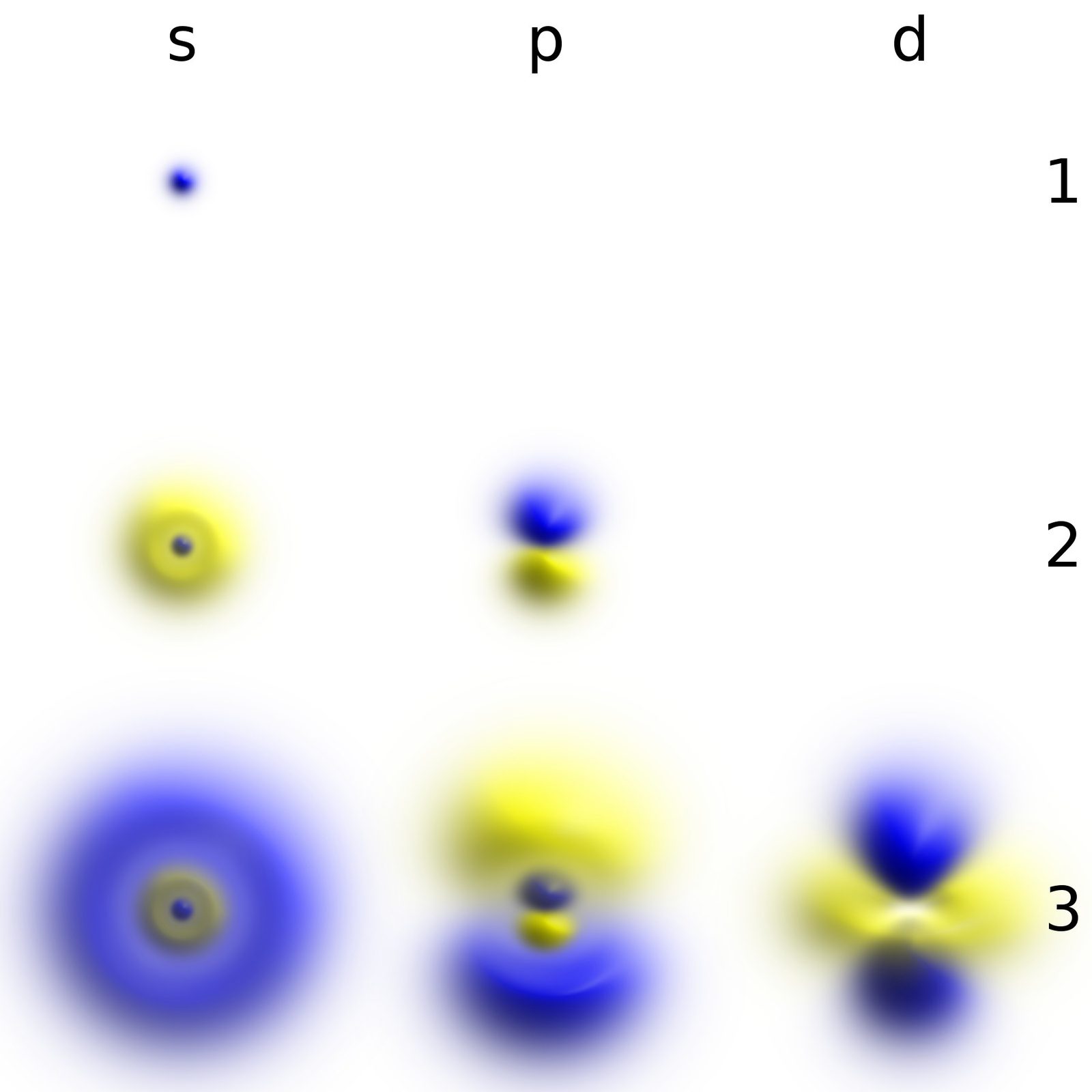 radial nodenodal planetwo radial nodesfour lobes
11.3To the same scale
Every new shell, a bigger cloud
Two colours, two signs of ψ. Where the colour flips, ψ passes through zero: a node.
11.4Counting nodes
Two kinds of nothing
- pz: the xy-plane is its nodal plane.
- dxy: two nodal planes through the nucleus.
- ns: all n − 1 nodes are radial.
Full text
Counting nodes
There are two kinds of node:
- Radial nodes: spheres at some distance where the probability density is zero. Number \( = n - l - 1 \).
- Angular nodes: flat planes (or cones) through the nucleus where it is zero. Number \( = l \). The \( p_z \) orbital has the xy-plane as its nodal plane; \( d_{xy} \) has two nodal planes through the nucleus.
- Total nodes \( = n - 1 \).
Worked example 1: nodes
| Orbital | n, l | Radial (n − l − 1) | Angular (l) | Total (n − 1) |
|---|---|---|---|---|
| 3p | 3, 1 | 1 | 1 | 2 |
| 4d | 4, 2 | 1 | 2 | 3 |
| 5s | 5, 0 | 4 | 0 | 4 |
| 2p | 2, 1 | 0 | 1 | 1 |
Worked example 1: nodes
| Orbital | n, l | Radial (n − l − 1) | Angular (l) | Total (n − 1) |
|---|---|---|---|---|
| 3p | 3, 1 | 1 | 1 | 2 |
| 4d | 4, 2 | 1 | 2 | 3 |
| 5s | 5, 0 | 4 | 0 | 4 |
| 2p | 2, 1 | 0 | 1 | 1 |
WorkedRead them off
Four orbitals, counted
Angular is just l. Radial is what is left of n − 1.
Try it1s, 2s, 3s, 2p, 3p, 3d
Cut each one open
Empty spheres are radial nodes; flat planes through the nucleus are angular.
CheckRadial nodes
How many in 3s?
How many radial nodes does a 3s orbital have?
- 1
- 2
- 3
11.5Energies of orbitals
One electron, or many
Hydrogen
n alone sets the energy
1s < 2s = 2p < 3s = 3p = 3d < 4s = 4p = 4d = 4f. Equal energies: degenerate.
Multi-electron atoms
n and l together
s < p < d < f in a shell. Neighbours overlap: 4s < 3d, 6s < 5d, 4f < 6p.
1s is the ground state. In 2s, 2p or higher, the electron is in an excited state.
Full text
Energies of orbitals
In hydrogen the energy depends only on n:
\[ 1s < 2s = 2p < 3s = 3p = 3d < 4s = 4p = 4d = 4f < \ldots \]Orbitals with the same energy are degenerate. The 1s orbital is the most stable, the ground state; an electron in 2s, 2p or higher is in an excited state.
In multi-electron atoms the energy depends on n and l. Within one shell, \( s < p < d < f \). At higher levels the sub-shells of neighbouring shells can overlap: 4s < 3d, 6s < 5d, 4f < 6p.
11.5The (n + l) rule
Climb the staircase
2s = 2p, 3s = 3p = 3d: one level each.
Each level splits: s, then p, d, f.
Lower n + l first; on a tie, smaller n.
4s is 4, 3d is 5; then 4p and 5s, also 5.
1s 2s 2p 3s 3p 4s 3d 4p 5s 4d 5p 6s 4f 5d 6p 7s
11.6Why: shielding
Inner electrons get in the way
- Every electron repels the others;total attraction still wins.
- The outer one feels less than Ze:the effective nuclear charge.
- s gets closest, then p, then d,so Zeff falls as l rises: s < p < d.
- Bigger Z, lower level:E2s(H) > E2s(Li) > E2s(Na) > E2s(K).
Full text
Why: shielding and effective nuclear charge
In hydrogen the only force is the nucleus pulling its one electron. In bigger atoms every electron is also repelled by all the others; the atom is stable because total attraction beats total repulsion.
- Inner electrons stand between the nucleus and an outer electron, so the outer one does not feel the full charge \( Ze \). This is shielding (screening), and the charge it feels is the effective nuclear charge, \( Z_{\mathrm{eff}}e \).
- s electrons shield better than p electrons, which shield better than d electrons, even in the same shell.
- Within a shell, a spherical s electron is found near the nucleus more often than a p electron, and a p electron more than a d electron. So \( Z_{\mathrm{eff}} \) falls as l rises: s is held most tightly, then p, then d. Hence s < p < d in energy, and one shell's level splits into sub-shells.
- As Z grows, \( Z_{\mathrm{eff}} \) grows, so the same orbital gets lower in energy: \( E_{2s}(\mathrm{H}) > E_{2s}(\mathrm{Li}) > E_{2s}(\mathrm{Na}) > E_{2s}(\mathrm{K}) \).
The (n + l) rule
- Lower \( n + l \) means lower energy.
- For a tie in \( n + l \), the orbital with the smaller n has the lower energy.
Worked example 2: which is lower?
- 4s (4 + 0 = 4) or 3d (3 + 2 = 5)? 4s is lower.
- 3d (3 + 2 = 5) or 4p (4 + 1 = 5)? A tie, so the lower n wins: 3d.
- Arrange 6s, 4f, 5p: 6s = 6, 4f = 7, 5p = 6. 5p and 6s tie; 5p has lower n. So 5p < 6s < 4f.
Guess first. In a hydrogen atom, which is lower in energy, 3s or 3d?
Answer
Don't mix these up
- Hydrogen (and He+, Li2+): energy depends on n only, so 2s = 2p. Multi-electron atoms: 2s < 2p.
- Radial nodes \( n - l - 1 \), angular nodes \( l \), total \( n - 1 \).
- All five d orbitals of one shell are equal in energy in a free atom, even though \( d_{z^2} \) has a different shape.
CheckLithium vs hydrogen
Why does 2s drop?
Why is 2s lower in energy than 2p in a lithium atom but not in a hydrogen atom?
- Lithium's 2s is in a lower shell
- Other electrons shield 2p more than 2s; hydrogen has no other electrons
- Because s and p orbitals have different shapes
The (n + l) rule
- Lower \( n + l \) means lower energy.
- For a tie in \( n + l \), the orbital with the smaller n has the lower energy.
Worked example 2: which is lower?
- 4s (4 + 0 = 4) or 3d (3 + 2 = 5)? 4s is lower.
- 3d (3 + 2 = 5) or 4p (4 + 1 = 5)? A tie, so the lower n wins: 3d.
- Arrange 6s, 4f, 5p: 6s = 6, 4f = 7, 5p = 6. 5p and 6s tie; 5p has lower n. So 5p < 6s < 4f.
WorkedThe (n + l) rule
Add, then compare
Shells mix only in atoms with more than one electron.
CheckWhich fills first?
5s or 4d?
Which orbital fills first, 5s or 4d?
- 5s
- 4d
- They have equal energy
Guess firstHydrogen only
3s or 3d: which is lower?
Answer
11.7Don't mix these up
2s = 2p, only alone
Myth
2s and 2p always cost the same
Fact
Only with one electron
H, He+, Li2+: 2s = 2p. With more electrons, 2s < 2p.
Don't mix these up
- Hydrogen (and He+, Li2+): energy depends on n only, so 2s = 2p. Multi-electron atoms: 2s < 2p.
- Radial nodes \( n - l - 1 \), angular nodes \( l \), total \( n - 1 \).
- All five d orbitals of one shell are equal in energy in a free atom, even though \( d_{z^2} \) has a different shape.
KeepJust remember
Four forms the exam asks
Tap a card for its hook.
WordsTo know
Six words
- Node
- A place where the probability of finding the electron is zero.
- Boundary surface diagram
- A surface enclosing about 90% of the electron probability.
- Lobe
- One of the two halves of a p orbital.
- Degenerate orbitals
- Orbitals with the same energy.
- Shielding
- Inner electrons screening outer ones from the nucleus.
- Effective nuclear charge, Zeff
- The net positive charge an electron actually feels.
NEETAsked in the exam
The real thing
RootsThe likeliest 1s distance
52.9pm
- ψ² is chance per unit volume.Chance at r = density × shell volume, 4πr²Δr.
- At the nucleus the shell has no volume; far out the density fades.
- The product peaks between, exactly at Bohr's radius.
Full text
The roots
- Why is a 1s electron most likely found 52.9 pm from the nucleus, when ψ² is largest at the nucleus itself?Because ψ² is a density: chance per unit volume. The chance of finding the electron at a distance r is the density times the volume of a thin shell at that distance, \( 4\pi r^2\,\Delta r \). At the nucleus the shell has no volume at all; far out the density has faded. The product peaks in between, at exactly Bohr's radius.
- Why does 2s have a node, and 3s two?Each is a standing wave, and higher energy means a wave that wiggles more. A guitar string's next note has one more point of stillness; 2s is 1s with one more sign change, 3s with two. Where ψ changes sign it must pass through zero: a node.
- Why is a p orbital two lobes with a flat node between?For l = 1 the wave is positive on one side of the nucleus and negative on the other. Going from + to − it must cross zero, and the set of crossing points is a plane through the nucleus. For l = 2 there are two such sign changes, so two planes (or cones), and four lobes.
- Then why does 4s fill before 3d, when 4s is bigger on average?Because energy depends on how strongly the electron is held, and that depends a lot on its close visits to the nucleus. A 4s electron has small inner humps that dip inside the inner electrons, where it feels nearly the full nuclear charge. A 3d electron almost never goes there: its chance near the nucleus grows only as \( r^6 \). In potassium and calcium those close visits win, and 4s ends up lower.
- The bedrockThe pull of a charge grows sharply as you get close (Coulomb's law, \( F \propto 1/r^2 \)), and inner electrons screen it only from the outside. Even brief trips inside the screen are worth a lot of energy.
The word for those close visits is penetration. Within one shell, s penetrates most, then p, then d, then f, and that single fact gives the splitting s < p < d < f and, between shells, 4s < 3d and 6s < 4f < 5d. The (n + l) rule is a handy summary of it, not a law of nature: it gets most atoms right and a few wrong (chromium and copper, next page).
One more surprise sits in the pictures you draw. The maths for hydrogen gives, for ml = ±1, orbitals shaped like doughnuts round the z-axis, not dumbbells. They have the same energy as the ml = 0 dumbbell, so any mixture of them is also a solution, and adding and subtracting the pair gives the familiar px and py. That is why the textbook says there is no simple link between ml and x, y, z: px and py are mixtures of ml = +1 and −1.
RootsNodes are sign changes
A wave that wiggles more
Radial
2s is 1s with one more sign change
A standing wave: higher energy, more wiggles, like a guitar string's next note. Where ψ changes sign it passes zero: 3s has two.
Angular
p: plus on one side, minus on the other
The crossing points make a plane through the nucleus. l = 2: two sign changes, two planes (or cones), four lobes.
4s3dchance at each distance, hydrogen-like
RootsPenetration
Close visits decide 4s vs 3d
- 4s dips inside the inner electrons: nearly the full charge.
- 3d rarely goes there: its chance near the nucleus grows as r⁶.
- Coulomb's law, F ∝ 1/r²: brief trips in pay.
- The (n + l) rule sums it up, and misses Cr and Cu.
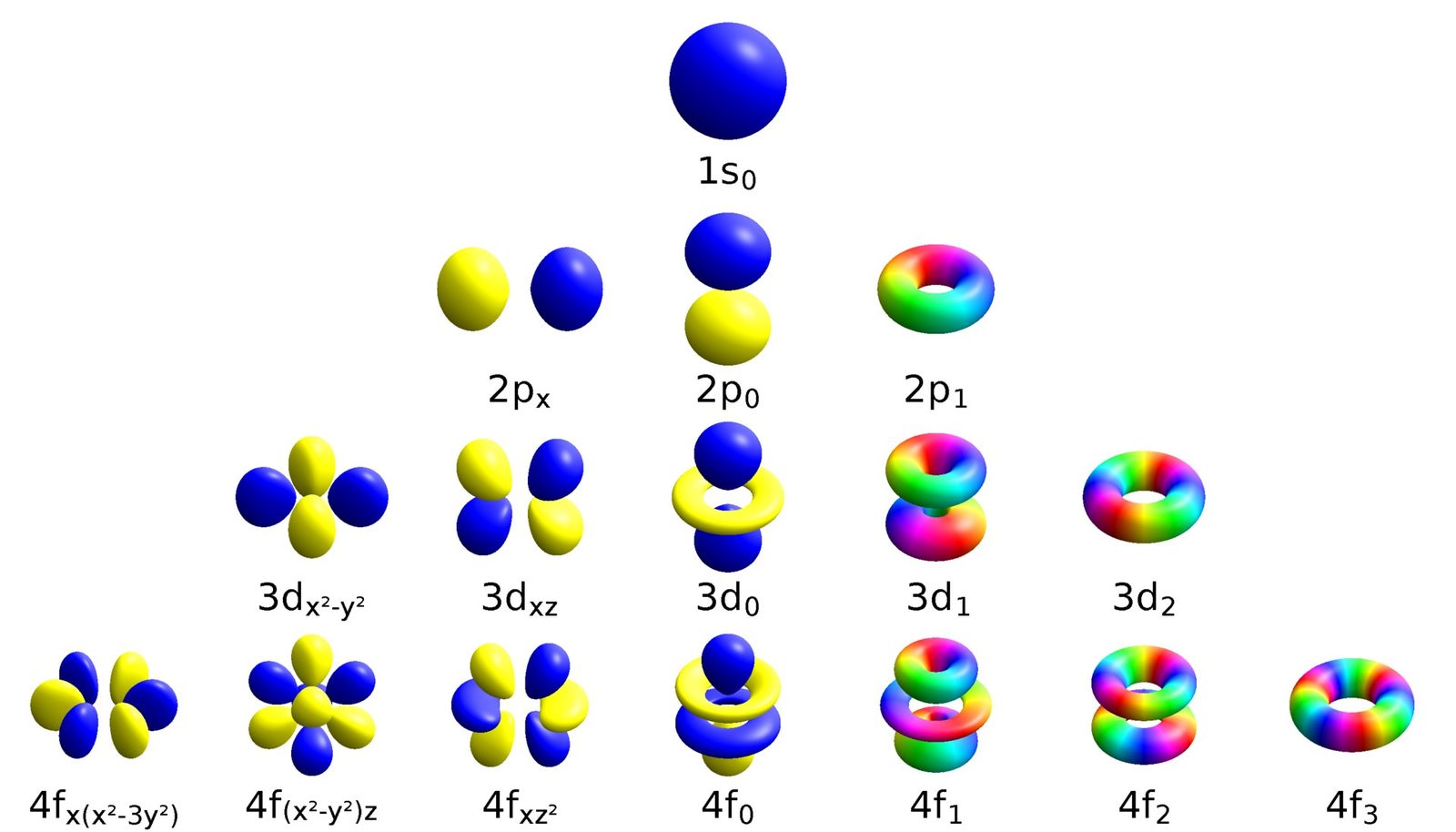
Rootsml = ±1
Doughnuts, mixed into dumbbells
For ml = ±1 the maths gives doughnuts round the z-axis, same energy as the ml = 0 dumbbell. Add and subtract the pair: px and py. Hence no simple link to x, y, z.
StoryFrom waves to chance to pictures
Who read the cloud
- 1926Göttingen: Max BornSchrödinger thought the wave was the smeared electron. Born: it gives only the probability.
- 1932Robert MullikenWith Friedrich Hund's molecules work, coins "orbital": a wave, not a path.
- 1954Born's Nobel Prize"For his statistical interpretation of the wavefunction". Mulliken's came in 1966, in Chemistry.
- 2013May, the Netherlands: AMOLFLasers, an electrostatic lens, rings on a detector: the nodes, seen. "Hydrogen Atoms under Magnification", Physical Review Letters.
See itHydrogen's real orbitals
Where is it most likely?
Guess for 1s first. Then drag the radius, switch orbitals, and press 4s vs 3d.
Solve itThree problems
Your turn
Solve it
An orbital has 2 radial nodes and 1 angular node. Name it. Then say how many nodes of each kind a 5f orbital has.
Answer
Solve it: predict, then check
Without the widget, predict: is the most likely distance for 2p bigger or smaller than for 2s? Then check with "Every orbital".
Hint
Answer
Solve it: estimate
The 1s density is \( \psi^2 = \dfrac{1}{\pi a_0^3} e^{-2r/a_0} \). Use it to find how much more likely you are to find the electron in a tiny cube at the nucleus than in a cube of the same size at r = a0, and then explain why the electron is still "most likely" at a0.
Answer
ConnectAnd still confused?
Where this goes next
Connect it
- Filling order, next page. Penetration is the real reason behind Aufbau and the 4s-before-3d order. See How do electrons fill an atom?
- The four numbers, previous page. The node counts are the quantum numbers seen in the picture. See Orbitals and quantum numbers.
- Bonds, Chapter 4. Lobes overlap to make bonds; the sign of ψ (blue and yellow in the pictures) decides whether they add up or cancel. See Valence bond theory and Molecular orbital theory.
- Atomic size, Chapter 3. Zeff and shielding explain why atoms shrink across a period and why ionisation enthalpy rises. See Atomic and ionic radius.
- d-block ions, Class 12. Iron loses its 4s electrons before 3d when it forms Fe2+. See Position and configuration.
4s fills before 3d, so why does iron lose its 4s electrons first?
Because the order changes once d electrons are present. In potassium and calcium the empty 3d is higher than 4s. From scandium on, the 3d electrons feel more of the growing nuclear charge and 3d drops below 4s. So the atom's last electrons went into 4s, but in the ion the 4s ones are the easiest to remove. The (n + l) rule describes filling in neutral atoms, not which electron leaves first.
Does the electron "jump" across a node? How can it be on both sides?
It does not travel across like a ball. The orbital is a standing wave, and the electron is described by the whole wave at once, both sides of the node together. A guitar string vibrates on both sides of its still point without anything crossing it.
Are the blue and yellow colours in orbital pictures positive and negative charge?
No. They are the sign of ψ, which has no direct meaning. ψ² is the same on both lobes. The signs matter only when orbitals combine, in bonds.
Sources
- A.S. Stodolna et al., "Hydrogen Atoms under Magnification: Direct Observation of the Nodal Structure of Stark States", Physical Review Letters 110, 213001 (2013)
- C.T.L. Smeenk, "A New Look at the Hydrogen Wave Function", Physics 6, 58 (2013)
- Atomic orbital (Mulliken's 1932 coinage of "orbital")
- Max Born (1926 probability interpretation; Nobel Prize 1954 and its citation)
- Robert S. Mulliken (work with Hund, Nobel Prize in Chemistry 1966)
- NIST, Bohr radius a0 = 52.9 pm
- Hydrogen radial functions and the radial distribution \( 4\pi r^2 R_{nl}^2 \): any physical chemistry text, e.g. P. Atkins and J. de Paula, Atkins' Physical Chemistry, chapter on atomic structure (the widget computes them directly).