- 1. What is a vector?
- 2. How do you add two arrows?
- 3. Breaking a vector into parts
- 4. Adding vectors with numbers
- 5. Velocity and acceleration in a plane
- 6. Motion in a plane with constant acceleration
- 7. How does a thrown ball move?
- 8. How high, how long, how far?
- 9. Why is steady circling still accelerating?
- Review
2 of 9·NCERT §3.3 · §3.4·pp. 29–31·6 min
How do you add two arrows?
The big ideaTo add vectors, put them head to tail: the sum is the single arrow from the first tail to the last head.
In simple words
Walk 3 steps one way, then 4 steps another way. Where did you end up? Draw the first walk as an arrow. Start the second arrow where the first one ends. The arrow from where you began to where you stopped is the answer. That is all adding arrows means.
Multiplying a vector by a number
Multiply a vector \( \mathbf{A} \) by a positive number \( \lambda \) (lambda) and you get a vector in the same direction, with magnitude \( \lambda A \). So \( 2\mathbf{A} \) points the same way as \( \mathbf{A} \) and is twice as long; \( 0.5\mathbf{A} \) is half as long.
Multiply by a negative number \( -\lambda \) and the direction flips, while the magnitude becomes \( \lambda A \). So \( -\mathbf{A} \) has the same length as \( \mathbf{A} \) but points the opposite way, and \( -1.5\mathbf{A} \) points the opposite way and is one and a half times as long.
\[ |\lambda \mathbf{A}| = |\lambda|\,A \]The number can carry its own unit. Then the new vector's dimension is the product of both. Multiply a constant velocity (m s−1, a vector) by a time (s, a scalar) and you get a displacement (m, a vector): a scooter at 10 m s−1 due north for 6 s is displaced 60 m due north.
Try it: slide the number and watch the arrow stretch, shrink and flip.
The triangle (head-to-tail) method
By definition, vectors add by the triangle law. Draw each vector as an arrow whose length is in proportion to its magnitude (for example 1 cm for every 1 m). To find \( \mathbf{A} + \mathbf{B} \):
- Draw \( \mathbf{A} \), starting at a point O.
- Slide \( \mathbf{B} \), without turning it, so that its tail sits on the head of \( \mathbf{A} \).
- Draw the arrow from the tail of \( \mathbf{A} \) (point O) to the head of \( \mathbf{B} \) (call it Q). This arrow \( \mathbf{OQ} = \mathbf{R} \) is the sum, called the resultant.
Because the arrows go head to tail, this is the head-to-tail method. The two vectors and their sum form the three sides of a triangle, so it is also the triangle method of vector addition.
Two rules come out of drawing it:
- Order does not matter (vector addition is commutative). Drawing \( \mathbf{B} \) first and then \( \mathbf{A} \) gives the same resultant: \( \mathbf{A} + \mathbf{B} = \mathbf{B} + \mathbf{A} \).
- Grouping does not matter (it is associative). With three vectors, \( (\mathbf{A} + \mathbf{B}) + \mathbf{C} = \mathbf{A} + (\mathbf{B} + \mathbf{C}) \). Place all three head to tail; the resultant runs from the first tail to the last head however you group them.
The zero vector
Add a vector and its opposite, \( \mathbf{A} + (-\mathbf{A}) \). The second arrow brings you straight back to the start, so the resultant has zero length. This is the null vector or zero vector, \( \mathbf{0} \), with \( |\mathbf{0}| = 0 \). A zero-length arrow points nowhere, so its direction cannot be given. Multiplying any vector by the number zero also gives \( \mathbf{0} \). Its main properties:
\[ \mathbf{A} + \mathbf{0} = \mathbf{A}, \qquad \lambda\,\mathbf{0} = \mathbf{0}, \qquad 0\,\mathbf{A} = \mathbf{0} \]Physically, a zero vector is the displacement of a round trip: go from P to P′ and come back to P, and your displacement is \( \mathbf{0} \).
Subtracting vectors
Subtraction is defined as adding the opposite:
\[ \mathbf{A} - \mathbf{B} = \mathbf{A} + (-\mathbf{B}) \]So flip \( \mathbf{B} \), then add it head to tail to \( \mathbf{A} \). A useful picture: put \( \mathbf{A} \) and \( \mathbf{B} \) tail to tail. Then \( \mathbf{A} - \mathbf{B} \) is the arrow from the head of \( \mathbf{B} \) to the head of \( \mathbf{A} \). Swap them and you get \( \mathbf{B} - \mathbf{A} \), the same length pointing the other way.
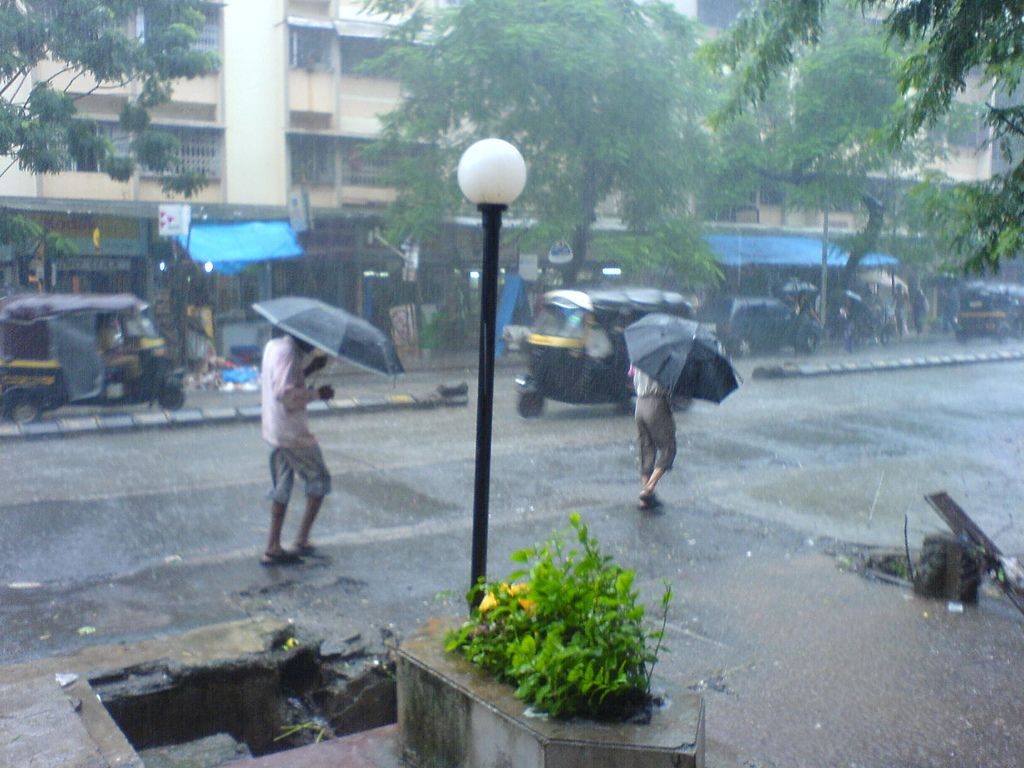
Subtraction is how a moving person sees the rain. Rain falls straight down, but a cyclist riding through it meets the rain at a slant: the rain's velocity relative to her is \( \mathbf{v}_{\text{rain}} - \mathbf{v}_{\text{cycle}} \). Try it: speed her up and watch her tilt the umbrella forward.
 tilted into the raintilted another way
The parallelogram method
There is a second way to draw the same sum. Put the tails of \( \mathbf{A} \) and \( \mathbf{B} \) together at a point O. From the head of \( \mathbf{A} \), draw a line parallel to \( \mathbf{B} \); from the head of \( \mathbf{B} \), draw a line parallel to \( \mathbf{A} \). They meet at a point S and complete a parallelogram. The diagonal from O to S is the resultant \( \mathbf{R} = \mathbf{A} + \mathbf{B} \).
This is the parallelogram method. It always gives the same answer as the triangle method, because the far side of the parallelogram is just \( \mathbf{B} \) slid up to the head of \( \mathbf{A} \). The other diagonal of the same parallelogram (between the two heads) is the difference \( \mathbf{A} - \mathbf{B} \) or \( \mathbf{B} - \mathbf{A} \).
Try it: turn the rider at the crossing and see both ways round the block meet at the same corner.
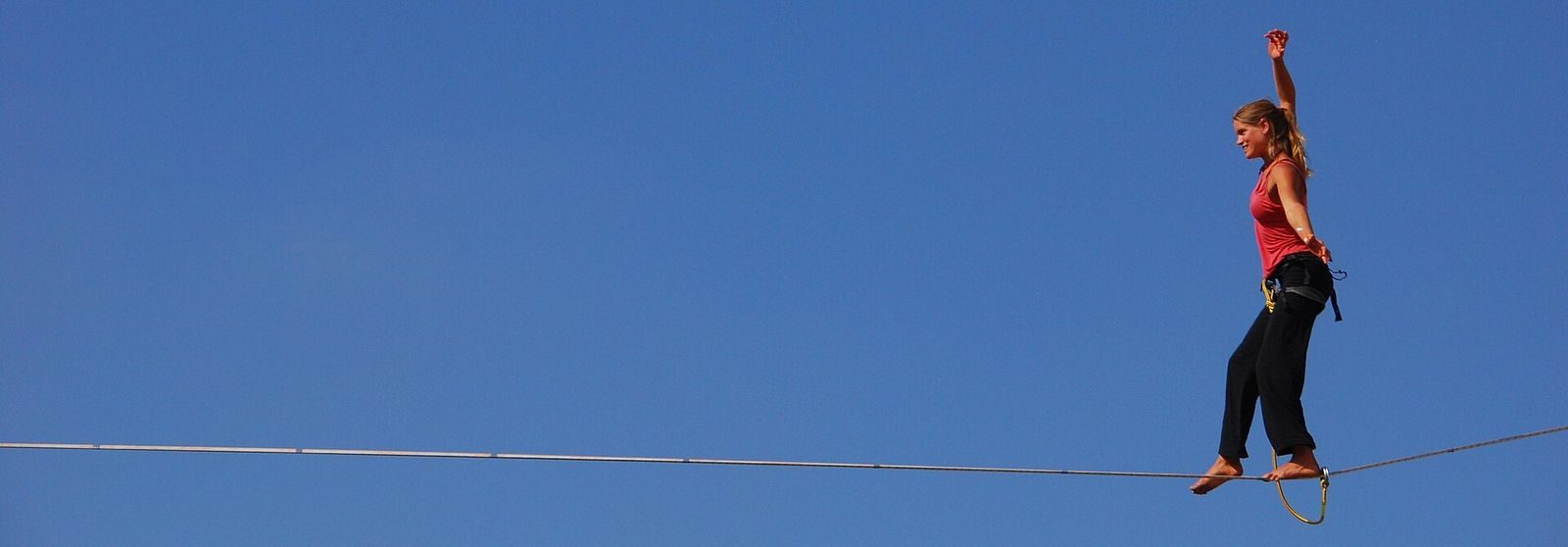
A slackline shows the same thing upside down. Where the walker stands, the line bends into a shallow V. Each half pulls on her feet along its own direction, a little up and mostly sideways. The sideways parts cancel; the small upward parts add, and their sum holds up her weight.
 pull of the left halfright halfweight held by the two together
Worked example
Rain falls straight down at 24 m s−1. Then a wind starts, blowing from west to east at 7 m s−1, and the drops are carried along with it. How fast do the drops now move, and how should a person at a bus stop tilt the umbrella?
- Draw the rain's velocity as an arrow pointing down, 24 units long. From its head, draw the wind's velocity pointing east, 7 units long. The two arrows meet at a right angle.
- The resultant is the long side of this right triangle: \( R = \sqrt{24^2 + 7^2} = \sqrt{625} = \) 25 m s−1.
- Angle with the vertical: \( \tan\theta = 7/24 \approx 0.29 \), so θ ≈ 16°.
- The drops slant down towards the east, so they come from the west. The umbrella should lean about 16° from the vertical, with its top tilted towards the west, into the rain.
Try it
\( \mathbf{A} \) is 3 m due east and \( \mathbf{B} \) is 4 m due north. Find the magnitudes of \( \mathbf{A} + \mathbf{B} \) and \( \mathbf{A} - \mathbf{B} \), and say which way \( \mathbf{A} - \mathbf{B} \) points.
Answer
Just remember
Names and one drawing rule. Nothing here to derive; use the hooks.
- Resultant = the single arrow that equals the sum
- It is what "results" when the arrows act together: one arrow that can replace them all.
- Commutative: \( \mathbf{A} + \mathbf{B} = \mathbf{B} + \mathbf{A} \)
- Commuters swap seats on the local train and the train still reaches Churchgate. Order can be swapped.
- Associative: \( (\mathbf{A} + \mathbf{B}) + \mathbf{C} = \mathbf{A} + (\mathbf{B} + \mathbf{C}) \)
- Who you associate with first, your group of friends, does not change the total trip. Grouping can be swapped.
- Tail to tail, \( \mathbf{A} - \mathbf{B} \) runs from the head of B to the head of A
- "Minus points at the first": the arrow of A − B ends on A. Check it: B plus this arrow lands on A's head.
- Resultant
- The single vector equal to the sum of two or more vectors.
- Triangle (head-to-tail) method
- Put the second arrow's tail on the first arrow's head; the sum joins first tail to last head.
- Parallelogram method
- Put both tails together, complete the parallelogram; the sum is the diagonal from the tails.
- Commutative
- Order does not matter: A + B = B + A.
- Associative
- Grouping does not matter: (A + B) + C = A + (B + C).
- Null (zero) vector
- A vector of zero length and no definite direction.
Words to know
What is \( -2\mathbf{A} \)?
- Twice as long as A, same direction
- Twice as long as A, opposite direction
- A vector with magnitude −2A
Put \( \mathbf{A} \) and \( \mathbf{B} \) tail to tail. Which arrow is \( \mathbf{A} - \mathbf{B} \)?
- From the head of A to the head of B
- From the head of B to the head of A
- The diagonal of the parallelogram starting at the common tail
A ball is hit from P, bounces around the field and is thrown back to exactly P. What is its total displacement?
- The total distance it travelled
- The zero vector
- A zero-length vector pointing back towards P
Deep dive · optional
Why do arrows add head to tail?
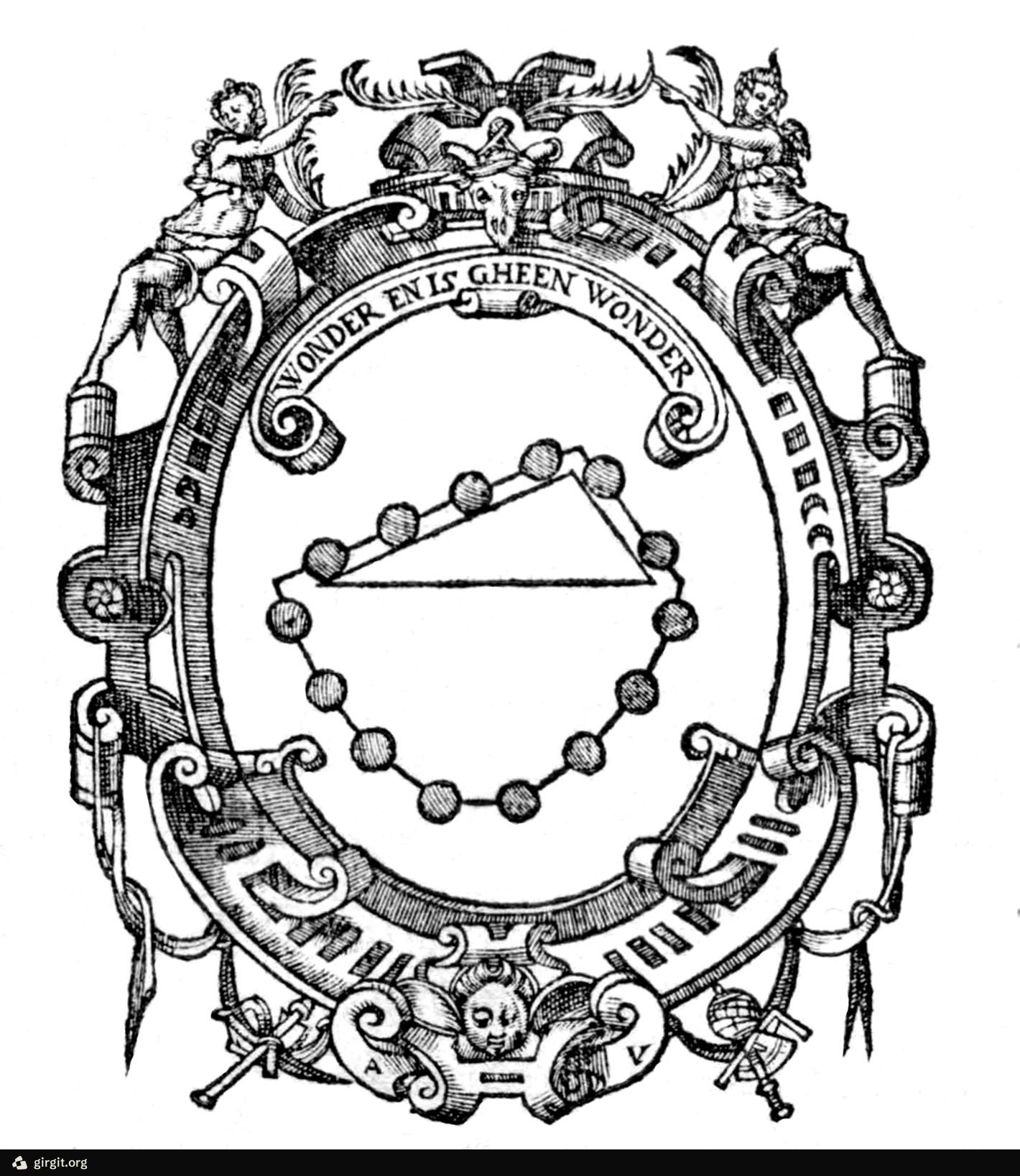
Head to tail looks like a rule someone invented. For displacements it is plain common sense; for forces it is a fact about nature, first seen clearly by a Flemish engineer with a loop of balls and later written down by Newton. The exam doesn't need this; it makes the page stick.
The roots: "and then", drawn
- Why do displacements add head to tail?Because doing one trip and then another is exactly that. The second trip starts where the first one ended, so its tail goes on the first one's head. Head to tail is just a drawing of the words "and then".
- Why does the order not matter?Walk 3 m east then 4 m north, or 4 m north then 3 m east. The two routes are the opposite sides of one parallelogram, and both end at its far corner. That is all "commutative" means.
- Why should velocities add the same way?A velocity is a displacement per second. A boat that moves across a river while the river carries it along makes two displacements in each second; add them head to tail and divide by the second. So velocities add head to tail too.
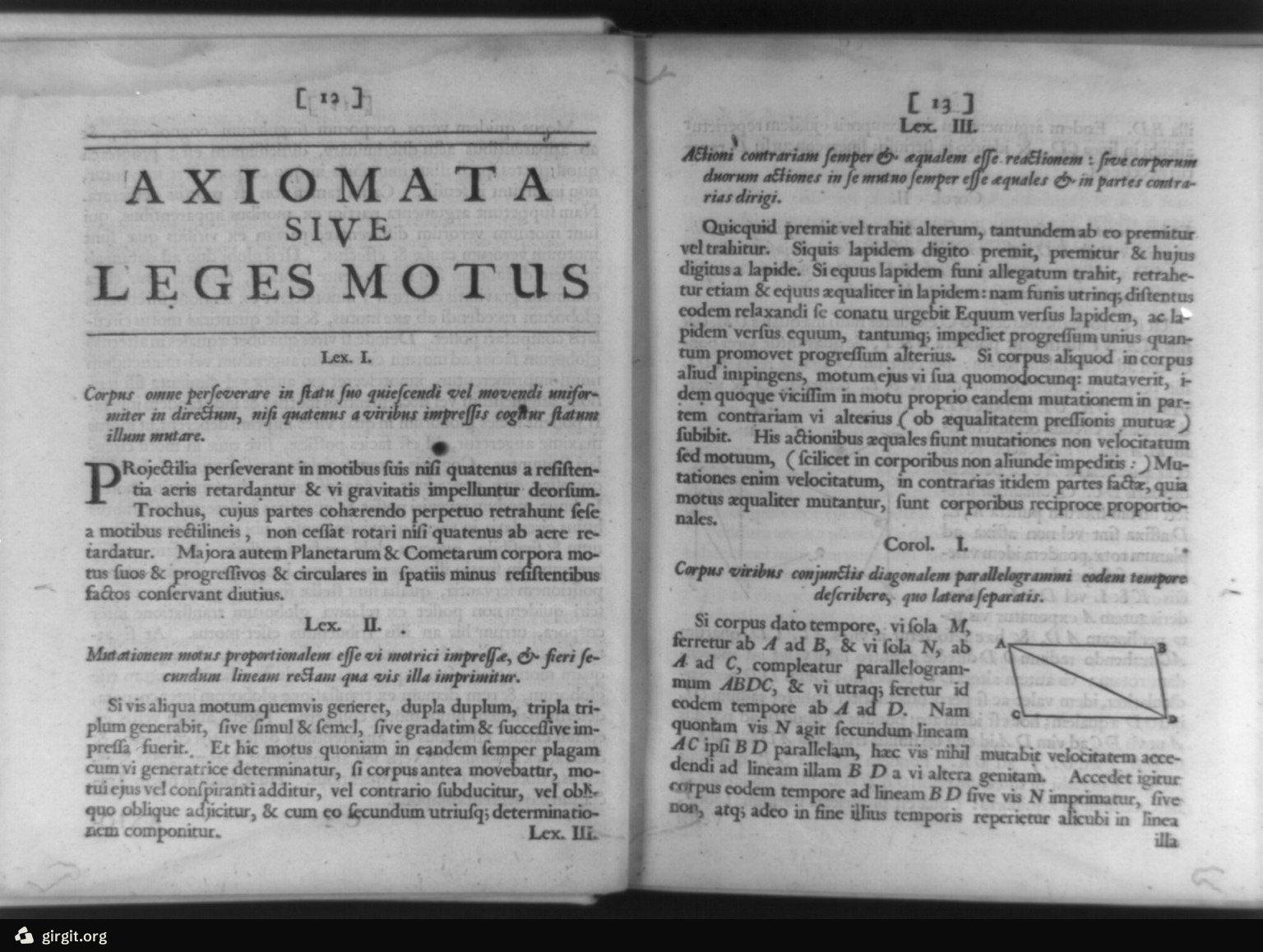
- And forces? A pull is not a trip.Here logic alone cannot decide. That two pulls on a ring are balanced by one pull equal to their head-to-tail sum is a fact found by experiment. Newton built it into his laws in 1687; later mathematicians argued over attempted "proofs" of it; today it is accepted as a fact of experience.
- And the bedrock?A quantity is a vector only if it passes this test. Electric current has a direction, but currents meeting at a junction add like plain numbers, so it fails and is a scalar.
What would break if forces added like plain numbers? Two ropes of 5 N each would always pull with 10 N, at any angle. A slackline would hold a person up with almost no tension at all. Neither is true. Because pulls add as arrows, two pulls that are nearly opposite mostly cancel, and only what is left over does useful work. A slackline that dips only 5° under a walker has to pull with almost six times her weight in each half (see Solve it). The two limits are worth keeping in your head: pulls along one line add fully (\( A + B \)), opposite pulls subtract (\( |A - B| \)), and every other angle gives something in between.
The story
See it
 long slope: more ballssteep: fewerloop hangs evenly
 Law IICorollary I
A force table in a physics lab tests the rule directly: strings over pulleys pull a small ring, and weights hanging on the strings set the pulls. Guess first, then make the ring sit still.
Solve it
Solve it
A slackliner weighs 600 N. Under her feet, each half of the line dips 5° below the horizontal. What is the tension in each half? Why can't the line ever be pulled perfectly straight with her on it? (sin 5° ≈ 0.087.)
Hint
Answer
Solve it
Check Stevin's balance with numbers. A block has a long slope 5 m long and a steep slope 3 m long, both rising to the same top, 2.4 m above the level base. The wreath's balls are spaced evenly, so the long slope carries 5 balls for every 3 on the steep one. A ball of weight W on a slope pulls along it with W × (height ÷ slope length). Do the two sides balance?
Answer
Solve it
Spot the error: "A boat is rowed north at 4 m s−1 across a river that flows east at 3 m s−1, so the boat moves at 7 m s−1."
Answer
Three people pull a tyre with equal 100 N forces, 120° apart. What is the resultant?
- 300 N
- 100 N
- Zero
Connect it
Connect it
- What is a vector? This chapter. Why passing the triangle-law test is part of the definition, and why current fails it: scalars and vectors.
- Adding with numbers, this chapter. The triangle drawn here becomes \( R^2 = A^2 + B^2 + 2AB\cos\theta \): adding vectors with components.
- Relative velocity, Chapter 2. The rain and the cyclist are a subtraction of velocities; on a line it was just a minus sign: relative velocity.
- Laws of Motion, Chapter 4. A ring at rest under three strings is a particle in equilibrium: the forces close a triangle: equilibrium of a particle.
- Maths, Class 12. The same rules, written for any vectors: adding vectors.
Still confused?
Are the triangle and parallelogram methods two different kinds of adding?
No. Slide B along the side of the parallelogram until its tail sits on A's head, and the parallelogram's diagonal becomes the third side of the triangle. Same arrow, two drawings. Use whichever is easier to draw.
When I draw a force, does it matter where on the page it starts?
For adding, no: in this chapter vectors are free, and you may slide them parallel to themselves. Where a force acts on a real body can matter for whether it turns the body (a push near a door's hinge), but that is a question for rotation, not for the sum.
Why is 3 + 4 sometimes 5?
Because the 3 and the 4 are lengths of arrows, not the arrows themselves. Arrows add head to tail, and the length of the result depends on the angle between them: 7 when they point the same way, 1 when opposite, 5 at right angles.
Sources
- MacTutor, "Simon Stevin": De Beghinselen der Weeghconst (1586) and the triangle of forces.
- Wikipedia, "Simon Stevin": the wreath (Epitaph of Stevinus), Dijksterhuis on perpetual motion, the Bruges statue (1847).
- Wikimedia Commons, the wreath with Stevin's motto, from Hypomnemata mathematica.
- Newton, Principia, Axioms or Laws of Motion, Corollary I (Motte's translation, Wikisource).
- Library of Congress scan via Wikimedia Commons, "Axiomata sive leges motus": the pages shown above.
- Wikipedia, "Parallelogram of force": Newton's argument, the later disputed proofs, its status as an experimental fact.


Picture and video credits
Show 2 picture and video credits
- mumbai-rain-umbrellas.jpg: Rakesh Krishna Kumar from Mumbai, India, CC BY-SA 2.0
- slackline-vienna.jpg: Wegmann, CC BY-SA 3.0

