- 1. What is a vector?
- 2. How do you add two arrows?
- 3. Breaking a vector into parts
- 4. Adding vectors with numbers
- 5. Velocity and acceleration in a plane
- 6. Motion in a plane with constant acceleration
- 7. How does a thrown ball move?
- 8. How high, how long, how far?
- 9. Why is steady circling still accelerating?
- Review
3 of 9·NCERT §3.5·pp. 31–33·6 min
Breaking a vector into parts
The big ideaAny vector in a plane can be split into two parts along chosen directions; along the x- and y-axes these parts are \( A\cos\theta \) and \( A\sin\theta \).
In simple words
A slanting walk across a field can also be done as two straight walks: some steps along the edge of the field, then some steps along the other edge. You end up in the same spot. Breaking one slanting arrow into a "sideways part" and an "up part" makes hard sums easy, because each part is just a number.
Splitting along any two directions
Take two vectors \( \mathbf{a} \) and \( \mathbf{b} \) in a plane that are not zero and do not point along the same line. Any third vector \( \mathbf{A} \) in that plane can be built from them:
\[ \mathbf{A} = \lambda\,\mathbf{a} + \mu\,\mathbf{b} \]where \( \lambda \) and \( \mu \) (mu) are real numbers. Here is how to see it. Let \( \mathbf{A} \) run from O to P. Through O draw a line along \( \mathbf{a} \); through P draw a line along \( \mathbf{b} \). They cross at a point Q. Then \( \mathbf{OP} = \mathbf{OQ} + \mathbf{QP} \), and since \( \mathbf{OQ} \) lies along \( \mathbf{a} \) and \( \mathbf{QP} \) along \( \mathbf{b} \), we can write \( \mathbf{OQ} = \lambda\mathbf{a} \) and \( \mathbf{QP} = \mu\mathbf{b} \).
Splitting a vector like this is called resolution of the vector, and \( \lambda\mathbf{a} \) and \( \mu\mathbf{b} \) are its component vectors along \( \mathbf{a} \) and \( \mathbf{b} \).
Unit vectors
The most useful directions are the axes of an ordinary graph. For them we use unit vectors: vectors of magnitude exactly 1 that only show a direction. A unit vector has no unit and no dimension; it is a pure pointer.
- \( \hat i \) points along the x-axis, \( \hat j \) along the y-axis, \( \hat k \) along the z-axis. The cap (^) marks a unit vector.
- \( |\hat i| = |\hat j| = |\hat k| = 1 \), and the three are perpendicular to each other.
Multiply a unit vector \( \hat n \) by a number \( \lambda \) and you get a vector \( \lambda\hat n \) of length \( |\lambda| \) along that line. In fact any vector is its magnitude times the unit vector along it:
\[ \mathbf{A} = |\mathbf{A}|\,\hat n, \qquad \hat n = \frac{\mathbf{A}}{|\mathbf{A}|} \]Components along x and y
Let \( \mathbf{A} \) lie in the x-y plane, starting at the origin and making an angle θ with the x-axis. From its head, drop one line straight down to the x-axis and one straight across to the y-axis. This gives two perpendicular vectors that add to \( \mathbf{A} \): one along the x-axis and one along the y-axis. Write them as \( A_x\hat i \) and \( A_y\hat j \):
\[ \mathbf{A} = A_x\,\hat i + A_y\,\hat j \]The numbers \( A_x \) and \( A_y \) are the x-component and y-component of \( \mathbf{A} \). Note: \( A_x \) itself is a number (it can be negative), while \( A_x\hat i \) is a vector.
The right triangle formed by \( \mathbf{A} \) and its two parts gives, by simple trigonometry,
\[ A_x = A\cos\theta, \qquad A_y = A\sin\theta \]A component can be positive, negative or zero, depending on θ. A vector pointing into the second quarter of the graph (up and to the left, θ between 90° and 180°) has \( A_x \) negative and \( A_y \) positive. A vector straight up (θ = 90°) has \( A_x = 0 \).
A real kite shows the same picture. Put the origin at the flyer's hand. The straight arrow to the kite (not the sagging string) is its position vector; its x-part is how far out the kite is, its y-part how high.
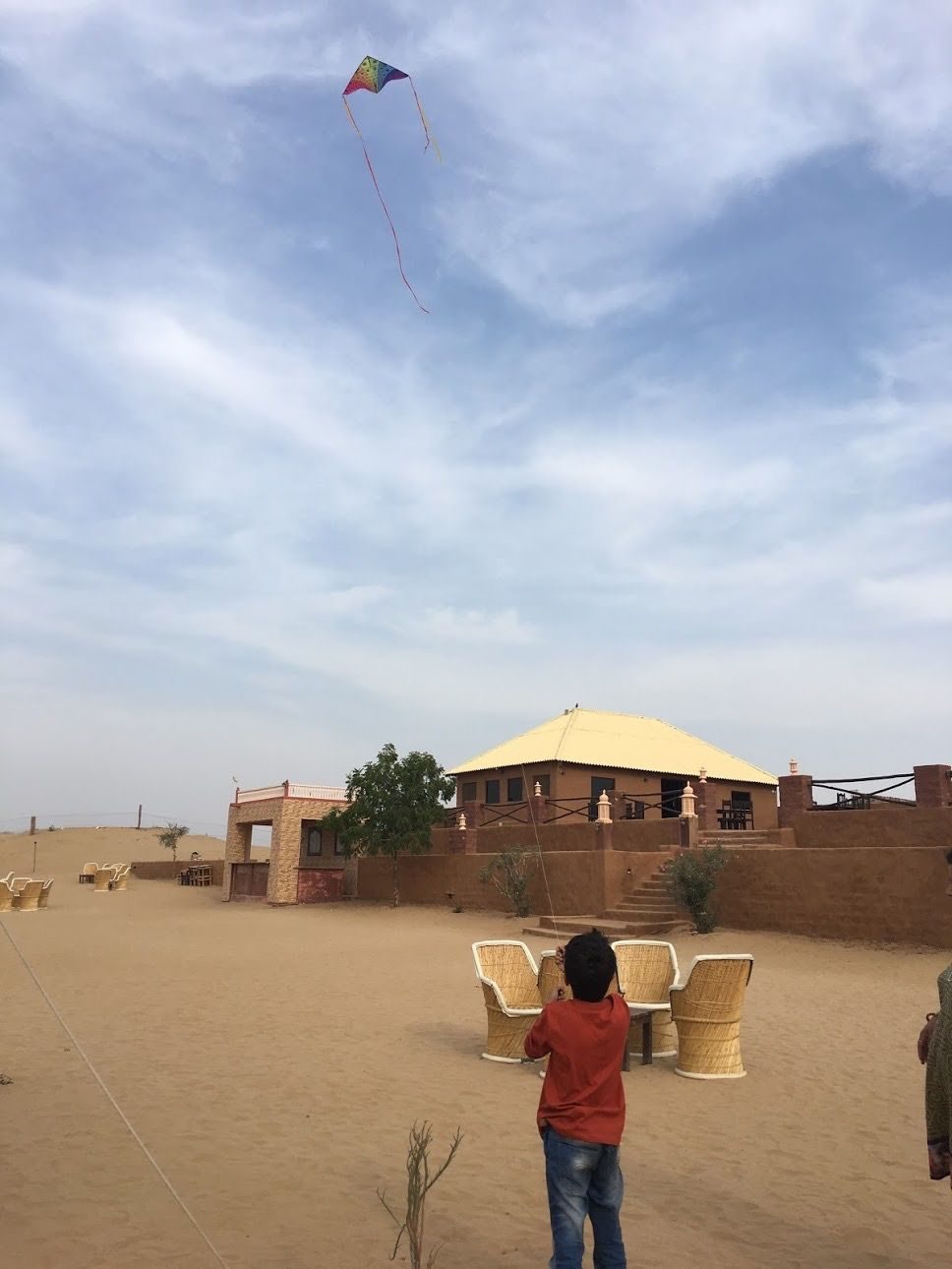 kite: head of the arrowthe flyer: tail (origin)
Try it: fly the kite all over the sky, even behind her, and watch the signs of x and y.
Two ways to give a vector
A vector in a plane can be given either by (i) its magnitude \( A \) and angle θ, or (ii) its components \( A_x \) and \( A_y \). To go from (ii) back to (i), use Pythagoras and the tangent:
\[ A = \sqrt{A_x^2 + A_y^2}, \qquad \tan\theta = \frac{A_y}{A_x} \]Look at the signs of \( A_x \) and \( A_y \) to see which quarter the vector points into; the tangent alone cannot tell \( (3, 4) \) from \( (-3, -4) \).
Try it: this is the trap a calculator sets. Guess first, then drag the arrow into each quarter.
Components in one box
- \( \mathbf{A} = A_x\hat i + A_y\hat j \), with \( A_x = A\cos\theta \), \( A_y = A\sin\theta \) (θ measured from the +x-axis).
- \( A = \sqrt{A_x^2 + A_y^2} \) and \( \tan\theta = A_y / A_x \).
- A component is never bigger than the vector: \( |A_x| \le A \).
In three dimensions
The same idea works in space. If \( \mathbf{A} \) makes angles α, β and γ with the x-, y- and z-axes,
\[ A_x = A\cos\alpha,\quad A_y = A\cos\beta,\quad A_z = A\cos\gamma \] \[ \mathbf{A} = A_x\hat i + A_y\hat j + A_z\hat k, \qquad A = \sqrt{A_x^2 + A_y^2 + A_z^2} \]Putting the first line into the last one gives \( \cos^2\alpha + \cos^2\beta + \cos^2\gamma = 1 \). A position vector in space is \( \mathbf{r} = x\hat i + y\hat j + z\hat k \), where \( x, y, z \) are simply the coordinates of the point.
Worked example
A porter at a railway station pulls a trolley with a force of 50 N along a handle that makes 60° with the platform. How much of the pull moves the trolley forward, and how much lifts it?
- Take x along the platform and y straight up. θ = 60°.
- Forward part: \( F_x = 50\cos 60^\circ = 50 \times 0.5 = \) 25 N.
- Lifting part: \( F_y = 50\sin 60^\circ = 50 \times 0.866 \approx \) 43.3 N.
- Check: \( \sqrt{25^2 + 43.3^2} = \sqrt{625 + 1875} = 50 \) N. Lowering the handle would make more of the pull go forward.
 hands: pull forward and liftshaft
Worked example
Find the magnitude and direction of \( \mathbf{A} = -3\hat i + 4\hat j \).
- \( A = \sqrt{(-3)^2 + 4^2} = \) 5.
- \( A_x \) is negative and \( A_y \) positive, so the vector points up and to the left.
- It makes \( \tan^{-1}(4/3) \approx 53^\circ \) with the negative x-axis, so θ ≈ 180° − 53° = 127° from the +x-axis.
Try it
A kite moves at 20 m s−1 at 37° above the horizontal. Find the horizontal and vertical parts of its velocity. (Use sin 37° = 0.6, cos 37° = 0.8.)
Answer
Just remember
These are agreed conventions, the same in every book. Nothing to derive; use the hooks.
- \( \hat i, \hat j, \hat k \) point along x, y, z, in that order
- Alphabetical order matches: i, j, k go with x, y, z.
- The cap (^) means "unit vector": length 1, no unit
- The cap is a little hat: a vector wearing a hat has been shrunk to size 1, just a pointer.
- θ is measured from the +x-axis, turning anticlockwise
- Start at "3 o'clock" and turn the way a clock does not.
- With θ from the x-axis: \( A_x = A\cos\theta \), \( A_y = A\sin\theta \)
- "Cos is close": the cos part lies along the side that touches the angle. If θ is measured from the y-axis instead, the two swap.
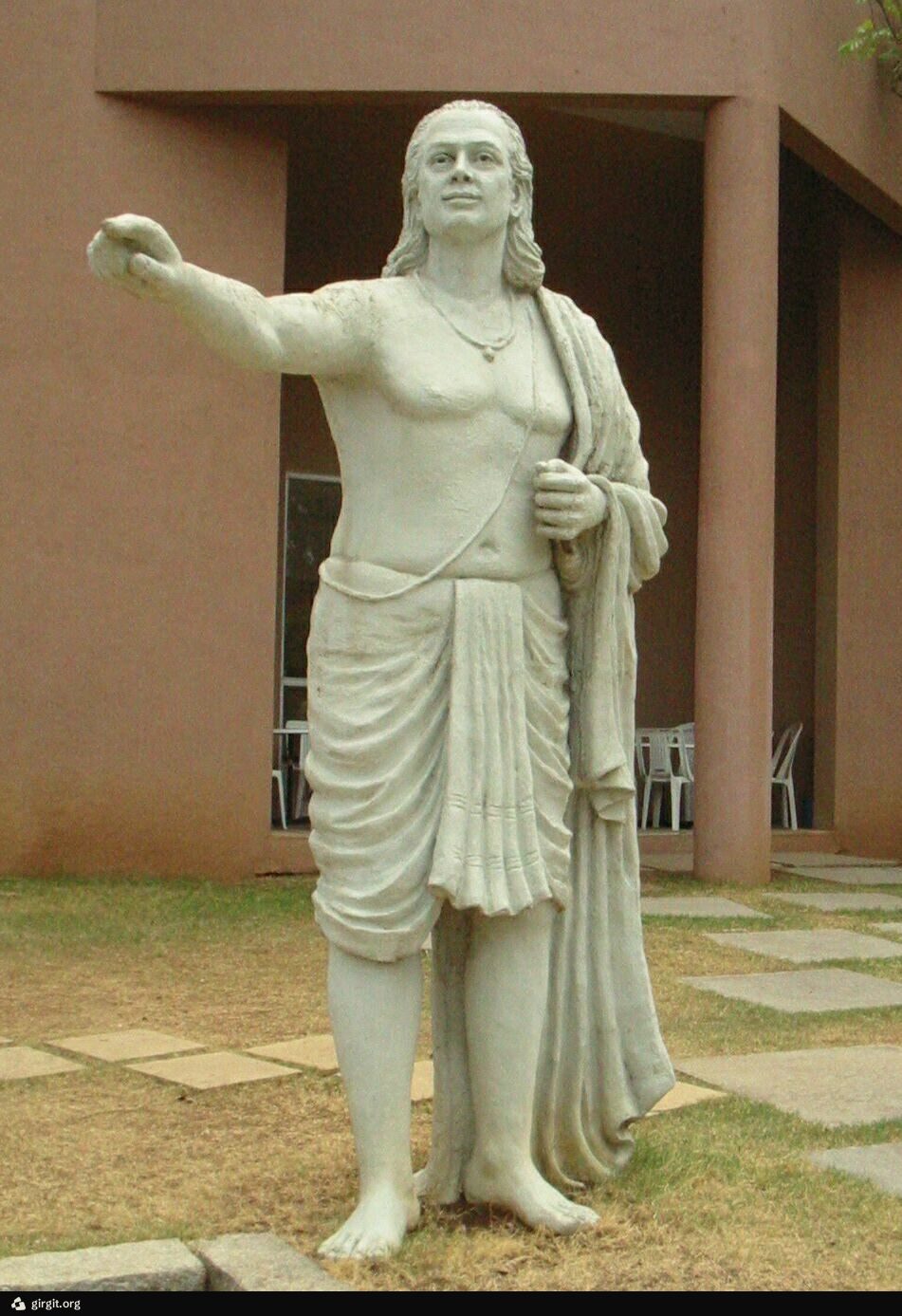
- sin comes from Sanskrit jya, "bowstring"
- The arc is the bow, the half-chord is the half-string. Aryabhata's jya became Arabic jiba, then Latin sinus: the deep dive tells the story.
- Resolution
- Splitting one vector into parts along chosen directions.
- Component vector
- One of the parts that add up to the original vector.
- Component (Ax, Ay)
- The signed number giving how much of a vector lies along an axis.
- Unit vector
- A vector of length 1, with no unit, that only shows a direction.
- î, ĵ, k̂
- Unit vectors along the x-, y- and z-axes.
Words to know
A vector of magnitude 10 makes 120° with the +x-axis. What is its x-component?
- +5
- −5
- +8.66
- −8.66
What is the unit of a unit vector?
- The metre
- The same unit as the vector it points along
- It has no unit at all
A vector points straight along the +y-axis. Which is true?
- Its x-component is zero and its y-component equals its magnitude
- Its two components are equal
- Its x-component cannot be defined
Deep dive · optional
Why cos and sin, and why axes at right angles?
Components are shadows. Here is why that works only when the axes are perpendicular, what goes wrong when they are not, and how a Sanskrit word for a bowstring became the "sin" on your calculator. The exam doesn't need this; it makes the page stick.
The roots: a component is a shadow
- Why is the x-component \( A\cos\theta \)?Shine a light straight down on the arrow. Its shadow on the x-axis is the side of a right triangle next to the angle θ, and "cos θ" is simply the name for that side divided by the slanting side. So the shadow is \( A\cos\theta \). The sine gives the other side, the shadow on the y-axis.
- Why may we use shadows as the parts that add up to A?The parts must add head to tail back to A, so they are the sides of a parallelogram with A as its diagonal. When the axes are perpendicular, that parallelogram is a rectangle, and the sides of a rectangle are exactly the two shadows.
- What changes if the axes are slanted?The parallelogram is no longer a rectangle, so its sides are no longer the shadows. Along axes an angle φ apart, the part along a is \( \lambda = A\sin(\varphi - \theta)/\sin\varphi \): it depends on where the other axis points too.
- And why does that matter?With perpendicular axes, each part depends on its own axis only, and Pythagoras gives the size back: \( A^2 = A_x^2 + A_y^2 \). With slanted axes the law of cosines brings in a cross term, \( A^2 = \lambda^2 + \mu^2 + 2\lambda\mu\cos\varphi \), and every sum gets tangled.
- And the bedrock?The meaning of cos and sin in a right triangle, and Pythagoras. The cross term \( 2\lambda\mu\cos\varphi \) vanishes only when \( \cos\varphi = 0 \), at 90°.
So resolving along slanted axes is allowed (any two non-parallel directions work, as the core page says), but it is clumsy. That is the whole reason for the perpendicular x, y, z axes: each component can be found and used on its own, and the three pieces of information never interfere. Physics later relies on this again and again: a horizontal push cannot change a vertical motion, because the two directions are perpendicular and share nothing.
Check the numbers in the guess below. With φ = 60°, θ = 30° and A = 10, the parts are \( \lambda = \mu = 10\sin 30^\circ/\sin 60^\circ \approx 5.77 \), but the shadows are \( 10\cos 30^\circ \approx 8.66 \). Pythagoras gives \( 5.77^2 + 5.77^2 \approx 66.7 \), not 100; the law of cosines adds \( 2 \times 5.77 \times 5.77 \times \cos 60^\circ \approx 33.3 \) and gets 100 exactly.
The story
See it
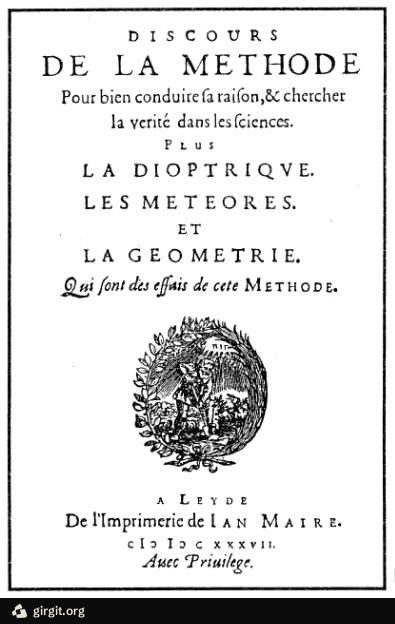 La Géométrie, the third essayLeiden, 1637
Now resolve a force along two axes that are not at right angles. Guess first, then turn axis b until the parts and the shadows agree.
Solve it
Solve it
A rickshaw puller pulls with 200 N along the shafts, which point 20° above the horizontal. How much of his pull moves the rickshaw forward, and how much helps hold the shafts up? If he raises the shafts to 35°, what happens to the forward part? (cos 20° ≈ 0.94, sin 20° ≈ 0.34, cos 35° ≈ 0.82.)
Answer
Solve it
Prove the formula for slanted axes. Axis a is the x-axis; axis b makes angle φ with it, so its unit vector is \( (\cos\varphi, \sin\varphi) \). A has size A at angle θ. Write \( \mathbf{A} = \lambda\,\hat a + \mu\,\hat b \), compare the y-components first, then the x-components, and find λ and μ.
Hint
Answer
A vector of size 10 makes 30° with axis a. Axis b is 60° from a. What is the shadow of the vector on axis b?
- 8.7
- 8.7 as well
- 5.8
Connect it
Connect it
- Where î, ĵ and k̂ came from, this chapter. The letters are borrowed from Hamilton's quaternions: what is a vector?
- The cross term, this chapter. \( 2AB\cos\theta \) is the same term, met again when adding two vectors at an angle: adding vectors with numbers.
- Projectiles, this chapter. Perpendicular axes let the sideways motion and the up-down motion be solved separately: projectile motion.
- Maths, Class 11. Sine and cosine on the unit circle, and why their signs change from quarter to quarter: sine and cosine on the unit circle.
- Work, Chapter 5. A shadow times a length is the scalar product, and the work a force does is exactly that: the scalar product.
Still confused?
Sometimes the x-component is A sin θ. Is the book wrong?
No, it measured the angle from the y-axis. The rule is about the side next to the angle: the component along the side that touches θ gets the cos. On an inclined plane, the weight's part along the slope is mg sin θ because θ there is the slope's angle, which sits at the other corner of the triangle.
Is a component a vector or a number?
\( A_x \) is a number, which can be negative. \( A_x\hat i \) is a vector: that number times the unit pointer along x. The sign of the number says which way along the axis the part points.
If any two directions work, why not always use the most convenient slanted pair?
You may, and engineers sometimes do. But then a part along one axis depends on the other axis too, and sizes need the law of cosines instead of Pythagoras. Perpendicular axes make every part independent; that saving is almost always worth it.
Sources
- MacTutor, "Aryabhata the Elder": the Aryabhatiya (499), his age, the table of sines at 3°45'.
- MacTutor, "The trigonometric functions": Hipparchus's chords; jya to jiba to jaib to sinus.
- Wikipedia, "Jyā, koti-jyā and utkrama-jyā": bow, bowstring and half-chord.
- Wikipedia, "Aryabhata": ardha-jya and the 12th-century Latin translation.
- Wikipedia, "Cartesian coordinate system" (citing Katz, A History of Mathematics, 2009, and Burton, 2011): Descartes and Fermat used one axis; the pair came after van Schooten's 1649 Latin edition.
- Wikimedia Commons, title page of the Discours de la méthode (Leiden, 1637).

Picture and video credits
Show 2 picture and video credits
- kite-flying-osiyan.jpg: Srishti Sethi, CC BY-SA 4.0
- rickshaw-puller-kolkata.jpg: Pradip paswan, CC BY-SA 4.0

