- 1. What is a vector?
- 2. How do you add two arrows?
- 3. Breaking a vector into parts
- 4. Adding vectors with numbers
- 5. Velocity and acceleration in a plane
- 6. Motion in a plane with constant acceleration
- 7. How does a thrown ball move?
- 8. How high, how long, how far?
- 9. Why is steady circling still accelerating?
- Review
4 of 9·NCERT §3.6·pp. 33–34·6 min
Adding vectors with numbers
The big ideaTo add vectors exactly, add their x-components together and their y-components together; for two vectors at an angle θ, the size of the sum is \( \sqrt{A^2 + B^2 + 2AB\cos\theta} \).
In simple words
Drawing arrows is good for seeing, but a ruler is never perfectly exact. A better way: write each arrow as "so much sideways, so much up". Then add all the sideways bits, and add all the up bits. Those two totals tell you the answer arrow, with no drawing at all.
Add the components
The graphical method helps you picture the answer, but it is slow and only as accurate as your drawing. The analytical method uses components instead. Take two vectors in the x-y plane:
\[ \mathbf{A} = A_x\hat i + A_y\hat j, \qquad \mathbf{B} = B_x\hat i + B_y\hat j \]Their sum is \( \mathbf{R} = (A_x\hat i + A_y\hat j) + (B_x\hat i + B_y\hat j) \). Because vector addition is commutative and associative, we may regroup the terms, putting the \( \hat i \) parts together and the \( \hat j \) parts together:
\[ \mathbf{R} = (A_x + B_x)\,\hat i + (A_y + B_y)\,\hat j \]So each component of the resultant is the sum of the matching components:
\[ R_x = A_x + B_x, \qquad R_y = A_y + B_y \]In three dimensions add a third line, \( R_z = A_z + B_z \). The method works for any number of vectors, and for subtraction too. For \( \mathbf{T} = \mathbf{a} + \mathbf{b} - \mathbf{c} \):
\[ \begin{gathered} T_x = a_x + b_x - c_x \\ T_y = a_y + b_y - c_y \\ T_z = a_z + b_z - c_z \end{gathered} \]Try it: drag the heads of A and B and watch the parts add, column by column.
Worked example
\( \mathbf{A} = 3\hat i + 4\hat j \) and \( \mathbf{B} = 5\hat i - 2\hat j \) (in metres). Find \( \mathbf{A} + \mathbf{B} \) and its magnitude.
- \( R_x = 3 + 5 = 8 \), \( R_y = 4 + (-2) = 2 \), so \( \mathbf{R} = 8\hat i + 2\hat j \).
- \( R = \sqrt{8^2 + 2^2} = \sqrt{68} \approx \) 8.25 m.
- Direction: \( \tan\theta = 2/8 = 0.25 \), so θ ≈ 14° above the +x-axis.
Two vectors at an angle: the law of cosines
Often you know only the sizes \( A \) and \( B \) and the angle θ between the two vectors. Here is how to get the resultant without components on a graph.
Draw \( \mathbf{A} \) from O to P. From P draw \( \mathbf{B} \), making angle θ with the direction of \( \mathbf{A} \) (that is, with the line OP carried on past P). The head of \( \mathbf{B} \) is at S, so \( \mathbf{OS} = \mathbf{R} \). From S drop a perpendicular onto the line OP extended; call its foot N. Now:
- PN, the part of \( \mathbf{B} \) along \( \mathbf{A} \), is \( B\cos\theta \); so ON = \( A + B\cos\theta \).
- SN, the part of \( \mathbf{B} \) across \( \mathbf{A} \), is \( B\sin\theta \).
- OSN is a right triangle, so \( OS^2 = ON^2 + SN^2 \).
This is the law of cosines. For the direction, let α be the angle between \( \mathbf{R} \) and \( \mathbf{A} \). In the same right triangle,
\[ \tan\alpha = \frac{SN}{ON} = \frac{B\sin\theta}{A + B\cos\theta} \]The triangle OPS also obeys the law of sines, where β is the angle between \( \mathbf{R} \) and \( \mathbf{B} \):
\[ \frac{R}{\sin\theta} = \frac{A}{\sin\beta} = \frac{B}{\sin\alpha}, \qquad \text{so } \sin\alpha = \frac{B}{R}\sin\theta \]Special angles to know
- θ = 0° (same direction): \( R = A + B \), the largest possible.
- θ = 90°: \( R = \sqrt{A^2 + B^2} \).
- θ = 180° (opposite): \( R = |A - B| \), the smallest possible.
- So always \( |A - B| \le R \le A + B \).
- Two equal vectors at 120° give a resultant of the same size; at 60° they give \( \sqrt3\,A \).
Worked example
Two ropes pull a bullock cart out of mud: 30 N along one rope and 40 N along the other, with 60° between the ropes. Find the resultant pull.
- \( R^2 = 30^2 + 40^2 + 2(30)(40)\cos 60^\circ = 900 + 1600 + 1200 = 3700 \), so \( R \approx \) 60.8 N.
- Direction from the 30 N rope: \( \tan\alpha = \dfrac{40\sin 60^\circ}{30 + 40\cos 60^\circ} = \dfrac{34.6}{50} \approx 0.69 \), so α ≈ 35°.
- Sense check: the pull lies between the ropes, closer to the stronger 40 N rope (35° from one, 25° from the other).
Crossing a river
Not in the current textbook, but NEET has asked it: a swimmer or boat in a river is a vector sum. The velocity seen from the bank is the boat's velocity relative to the water plus the water's velocity. Let the boat's speed in still water be \( u \), the river's speed \( v \), and the width \( d \).
- Shortest path (straight across). Head partly upstream, at angle θ from the straight-across line, so that the upstream part of your velocity cancels the current: \( u\sin\theta = v \), i.e. \( \sin\theta = v/u \). This needs \( u > v \). You then cross at speed \( \sqrt{u^2 - v^2} \), taking \( d/\sqrt{u^2 - v^2} \).
- Shortest time. Head straight across. All of \( u \) goes into crossing, so the time is \( d/u \), but the current carries you a distance \( v\,d/u \) downstream.
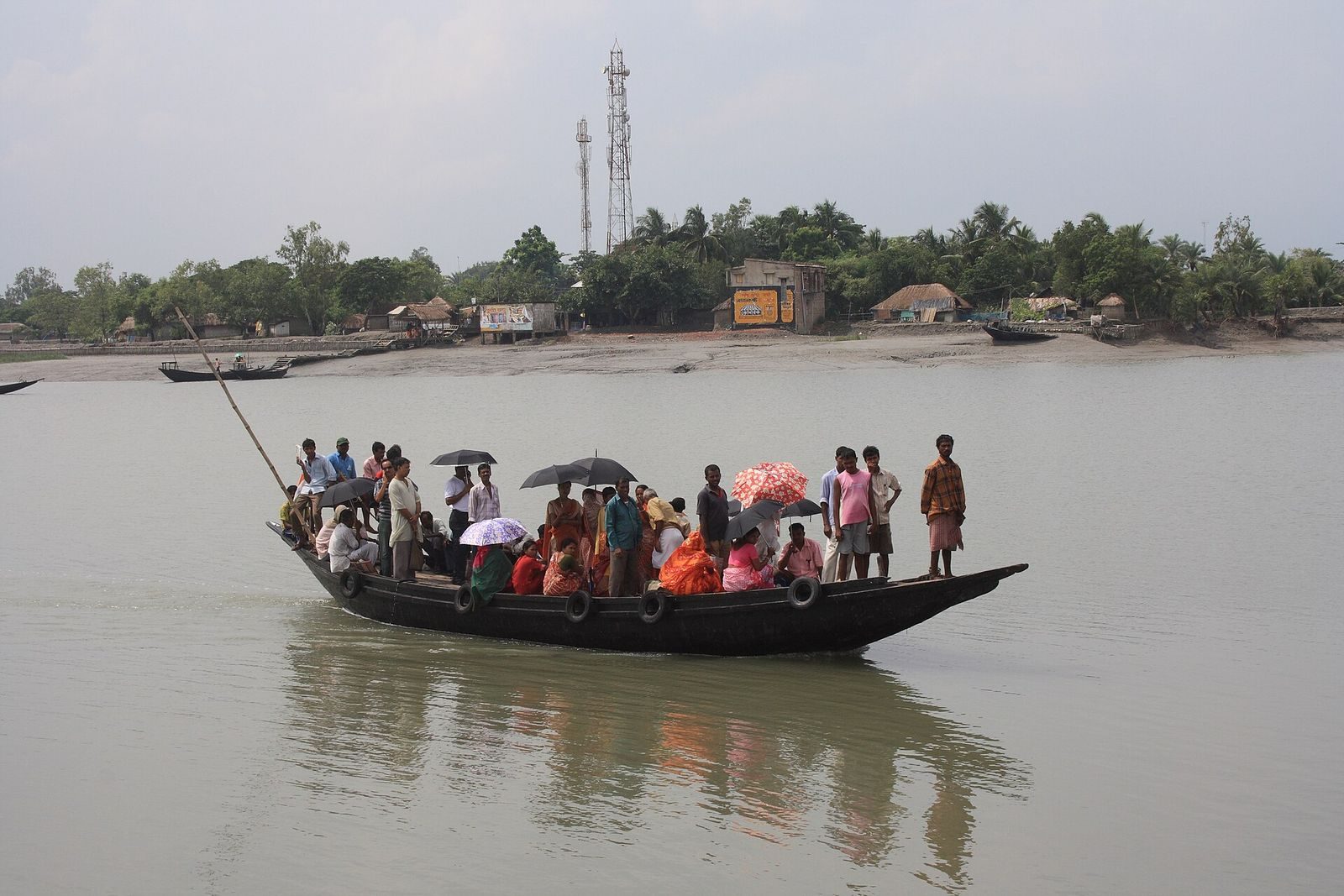 bow: where the boat pointsthe water itself moves toolanding ghat on the far bank
Air works the same way. An aircraft's velocity over the ground is its velocity through the air plus the wind's velocity. In a crosswind the pilot points the nose partly into the wind, so the plane flies along the runway while looking a little sideways: pilots call this crabbing. The direction the nose points is the heading; the direction it actually travels over the ground is the track.
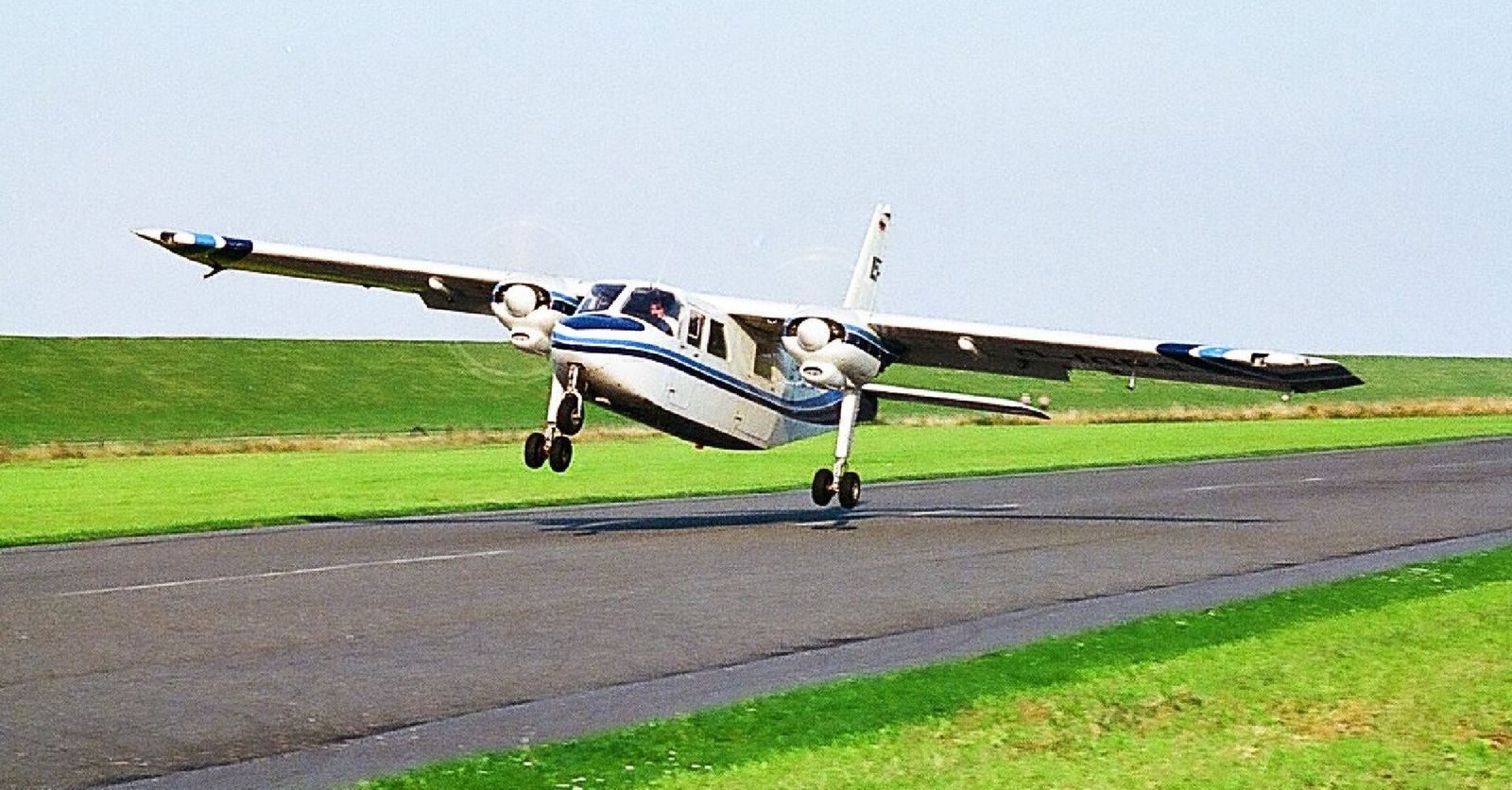 nose points partly into the wind (heading)runway: the path it must follow (track)
Try it: aim the swimmer and let go. Find the quickest crossing, and the heading that lands her straight opposite.
Worked example
A boatman on the Ganga rows at 5 m s−1 in still water. The river is 200 m wide and flows at 3 m s−1. How should he row to land exactly opposite, and how long does it take? How long is the quickest crossing?
- Straight across: \( \sin\theta = 3/5 \), so θ ≈ 37° upstream of the straight-across line. Crossing speed = \( \sqrt{25 - 9} = 4 \) m s−1; time = 200 ÷ 4 = 50 s.
- Quickest: point straight across. Time = 200 ÷ 5 = 40 s, landing 3 × 40 = 120 m downstream.
Try it
Forces of 5 N and 12 N act on a ring. What is the largest and smallest resultant possible, and what is it when they are at right angles?
Answer
Just remember
The formula itself has a reason (see the deep dive), but which angle goes into it is a convention, and the exam numbers are shortcuts. Use the hooks.
- In \( R^2 = A^2 + B^2 + 2AB\cos\theta \), θ is the angle between the tails
- "Tails together, plus sign." Inside a head-to-tail triangle the angle at the joint is 180° − θ, and the same law is written with a minus: \( A^2 + B^2 - 2AB\cos(180^\circ - \theta) \). Same answer, different angle.
- Two equal vectors F at angle θ: \( R = 2F\cos(\theta/2) \)
- The ladder: 0° gives 2F, 60° gives √3 F, 90° gives √2 F, 120° gives F, 180° gives 0. Hook: "one-twenty, nothing gained": three equal pulls at 120° to each other add to zero.
- Exam angles: sin 37° ≈ 0.6, cos 37° ≈ 0.8 (and the other way round for 53°)
- They come from the 3-4-5 right triangle, so the sums work out in whole numbers. Hook: "small angle, small side": in the 3-4-5 triangle the smaller angle, 37°, faces the 3, so sin 37° = 3/5; the 53° angle faces the 4.
- Analytical method
- Adding vectors by adding their components, without drawing.
- Law of cosines
- R² = A² + B² + 2AB cos θ, the size of the sum of two vectors at angle θ.
- Law of sines
- In the vector triangle, each side divided by the sine of the opposite angle is the same.
- Resultant
- The single vector that equals the sum.
- Drift
- How far a river carries a boat downstream while it crosses.
Words to know
Forces of 3 N and 4 N act together at some angle. Which of these can NOT be their resultant?
- 1 N
- 5 N
- 7 N
- 8 N
Two vectors each of size F add up to a vector also of size F. What angle is between them?
- 60°
- 90°
- 120°
- 0°
If \( \mathbf{A} = 2\hat i + 3\hat j \) and \( \mathbf{B} = \hat i - 5\hat j \), what is \( \mathbf{A} - \mathbf{B} \)?
- 3î − 2ĵ
- î + 8ĵ
- −î − 8ĵ
Deep dive · optional
Why does adding the parts give the right answer?
Why you are allowed to add x to x and y to y, where the 2AB cos θ comes from, a 2,300-year-old version of the same rule, and the slide rule pilots still carry to solve it in the air. The exam doesn't need this; it makes the page stick.
The roots: Pythagoras plus an overlap
- Why may we add the x-parts together and the y-parts together?Because every vector in the plane is written with the same two arrows, \( \hat i \) and \( \hat j \). Adding means placing arrows head to tail, and that lets us reorder and regroup them freely (addition is commutative and associative). So all the \( \hat i \) pieces can be put next to each other, and \( 3\hat i + 5\hat i \) is simply \( 8\hat i \), just as 3 steps east and then 5 steps east is 8 steps east.
- Why don't the x-parts and y-parts get mixed up?Because \( \hat i \) and \( \hat j \) point in different directions. No amount of walking east ever moves you north. So the sum of the east parts tells you only about east, and the sum of the north parts only about north.
- Then why is the size \( \sqrt{R_x^2 + R_y^2} \)?Because the two axes are at right angles, so \( R_x \), \( R_y \) and \( R \) make a right triangle. That is Pythagoras' theorem, nothing more.
- So where does the extra \( 2AB\cos\theta \) come from?Lay \( \mathbf A \) along the x-axis. Then \( \mathbf A = (A, 0) \) and \( \mathbf B = (B\cos\theta, B\sin\theta) \), so \( R_x = A + B\cos\theta \) and \( R_y = B\sin\theta \). Pythagoras gives \( R^2 = A^2 + 2AB\cos\theta + B^2(\cos^2\theta + \sin^2\theta) \), and the bracket is 1.
- And the bedrock?Pythagoras' theorem, and \( \cos^2\theta + \sin^2\theta = 1 \), which is Pythagoras again for a triangle of long side 1.
Look at the extra term as a picture. \( B\cos\theta \) is the shadow of \( \mathbf B \) on the line of \( \mathbf A \): the part of \( \mathbf B \) that pulls along with \( \mathbf A \) (or against it). Without it, the two vectors would be at right angles and Pythagoras alone would do. With it, the answer is "Pythagoras, corrected by twice A times B's shadow on A". If the shadow points along \( \mathbf A \) (θ less than 90°), the sum is longer than the right-angle case; if it points backwards (θ more than 90°), shorter.
The limits fall out at once. Since \( \cos\theta \) can only go from −1 to +1, \( R^2 \) lies between \( A^2 + B^2 - 2AB = (A - B)^2 \) and \( A^2 + B^2 + 2AB = (A + B)^2 \). So \( |A - B| \le R \le A + B \): the triangle inequality. In pictures, one side of a triangle is never longer than the other two put together, because a straight line is the shortest way between two points. A 3 N and a 4 N force can make anything from 1 N to 7 N, but never 8 N.
The story
See it
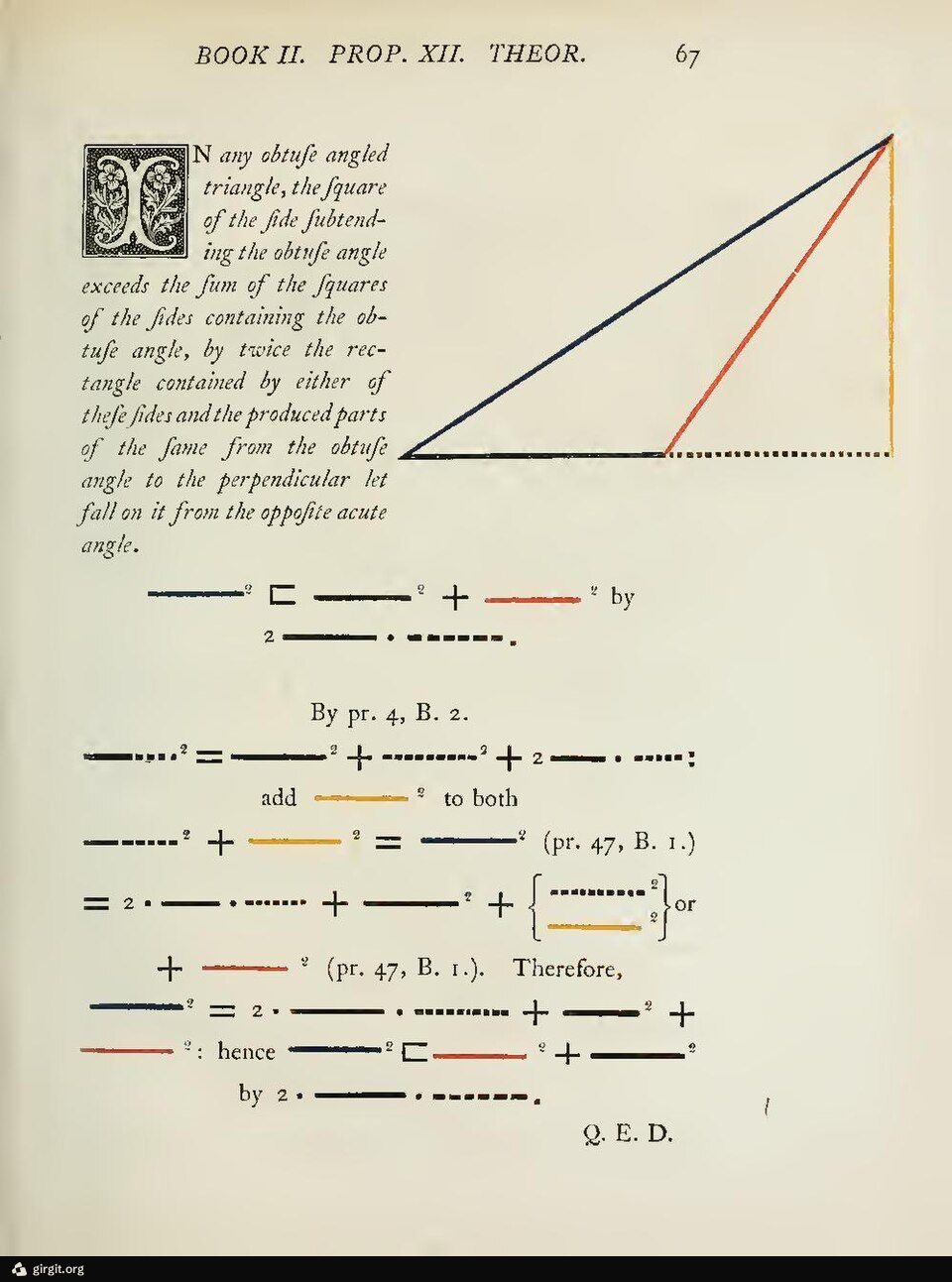 side opposite the obtuse angleobtuse angleperpendicularproof in coloured lines, not letters
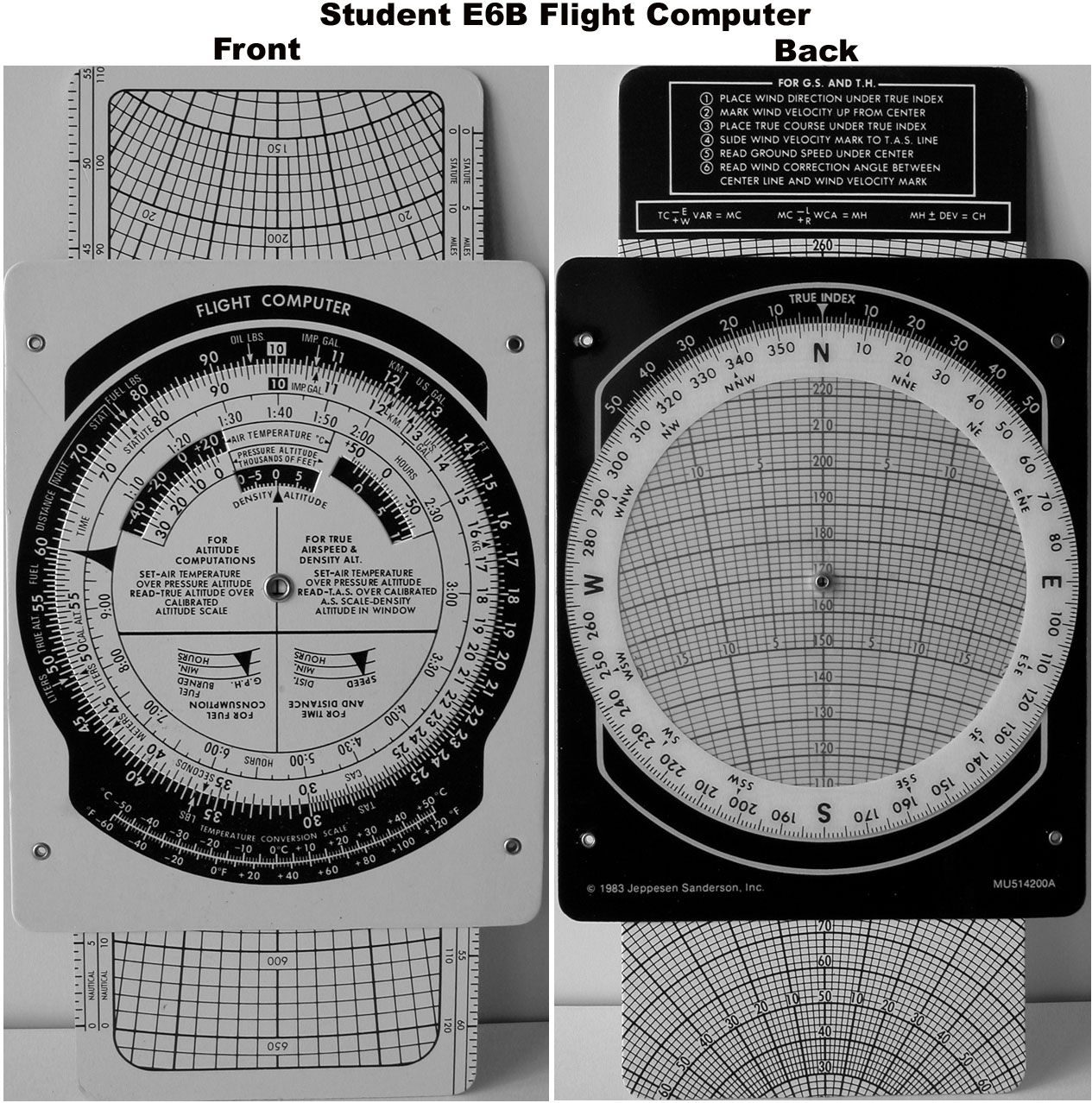 front: a circular slide ruleback: pencil the wind arrow herecompass rose
Now be the pilot. Guess first, then drag the nose and the wind and watch the triangle, the columns and the law of cosines agree.
Solve it
Solve it
A small plane flies at 200 km/h through the air. A 60 km/h wind blows towards the east. The pilot wants to reach a town 300 km due north. Which way should the nose point, what is the ground speed, and how much longer does the trip take than on a still day?
Hint
Answer
Solve it
Spot the error. "Two forces of 5 N act with 120° between them. \( R^2 = 25 + 25 - 2(5)(5)\cos 120^\circ = 50 + 25 = 75 \), so R ≈ 8.7 N." What went wrong, and what is the right answer?
Answer
Solve it
Five friends pull a tyre with ropes, each with the same force, at equal angles all round (72° apart). Without any trigonometry, show that the tyre does not move.
Hint
Answer
Solve it
JEE style: for two non-zero vectors, \( |\mathbf A + \mathbf B| = |\mathbf A - \mathbf B| \). What is the angle between them?
Answer
Connect it
Connect it
- Adding by drawing, this chapter. The component method is the head-to-tail rule done with numbers: how do you add two arrows?
- Resolution, this chapter. Components as shadows, and what happens along slanted axes: breaking a vector into parts.
- Relative velocity, Chapter 2. The river and the wind are relative velocity in two dimensions: relative velocity.
- Work and energy, Chapter 5. The term \( AB\cos\theta \) gets its own name, the scalar (dot) product \( \mathbf A\cdot\mathbf B \), so \( R^2 = A^2 + B^2 + 2\,\mathbf A\cdot\mathbf B \): the scalar product.
- Laws of motion, Chapter 4. A body at rest under several forces is a polygon of forces that closes: equilibrium of a particle.
- Daily life. Every airliner landing at a windy airport, and every ferry across the Hooghly or the Brahmaputra, is solving this page's sum.
Still confused?
Why can't I just add the sizes, 3 + 4 = 7?
Sizes add only when the vectors point the same way. A size forgets the direction, and directions can fight. Walk 3 km east and 4 km west and you are 1 km from home, not 7. The components keep the direction inside the sign, which is why adding components always works and adding sizes usually does not.
Do the axes have to be east and north?
No. Any two perpendicular directions work, as long as you use the same pair for every vector in the sum. Choose the axes that make the numbers easy, for example one axis along the river or along the runway. The resultant you get is the same arrow whichever axes you choose; only its components change.
In the law of sines, why is the angle opposite R the angle θ?
In the head-to-tail triangle OPS, the angle at P (between A and B placed head to tail) is 180° − θ, and \( \sin(180^\circ - \theta) = \sin\theta \). So the sine rule can use θ itself, though the cosine rule cannot without changing its sign.
Sources
- D. E. Joyce, Euclid's Elements, Book II, Proposition 12 (Clark University), and Proposition 13.
- Wikipedia, "Law of cosines": history, al-Kashi's Miftah al-hisab (1427), the French name, Viète.
- Oliver Byrne, The First Six Books of the Elements of Euclid (London: Pickering, 1847), scan on Wikimedia Commons.
- AOPA Pilot, "Wind triangle computers" (April 2000): Philip Dalton, the Model E-6 and E-6B, the wind triangle.
Picture and video credits
Show 3 picture and video credits
- ganga-ferry-lebukhali.jpg: Arne Hückelheim, CC BY-SA 3.0
- crosswind-landing-crabbed.jpg: Uli Elch, CC BY-SA 4.0
- e6b-flight-computer.jpg: Cosmicship (English Wikipedia), CC BY-SA 3.0


